
OECD Pillar Two 15% GloBE Minimum Tax Architecture: QDMTT, IIR, and UTPR Institutional Guide
Multinational enterprise groups exceeding EUR 750 million in consolidated revenue in two of four prior fiscal years face a 15.0% jurisdictional OECD Pillar Two sovereign tax floor enforced through interlocking QDMTT, IIR, and UTPR charging mechanisms.
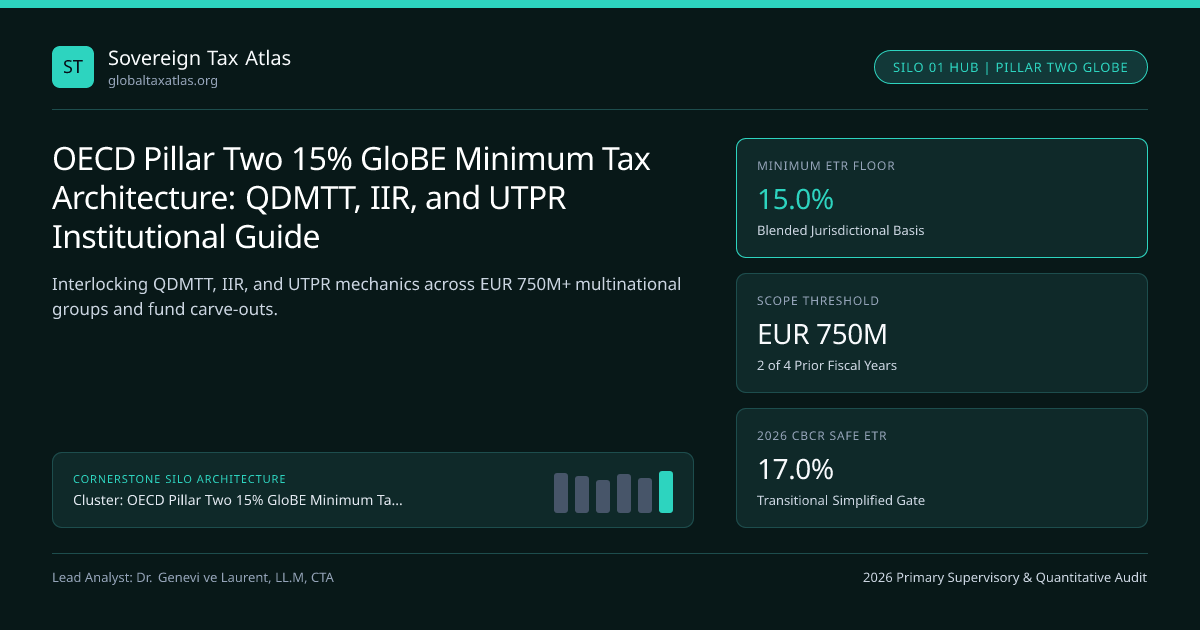
Multinational groups posting at least EUR 750 million in consolidated financial statement revenue during two of the four fiscal years preceding the tested fiscal year fall within the mandatory 15.0% OECD Global Anti-Base Erosion (GloBE) minimum tax regime across more than 140 Inclusive Framework jurisdictions. Rather than replacing domestic corporate income tax statutes, the OECD Pillar Two 15% Global Minimum Tax framework establishes a three-tier interlocking top-up tax waterfall—led first by source-jurisdiction Qualified Domestic Minimum Top-Up Taxes (QDMTT), second by parent-level Income Inclusion Rules (IIR), and third by backstop Undertaxed Profits Rules (UTPR)—calibrated against the 2026 GloBE Benchmark Standard and monitored within the OECD Pillar Two QDMTT & GloBE cluster.
Interlocking Three-Tier Rule Order: QDMTT Priority Over IIR and UTPR#
Rule priority determines which treasury collects the resulting revenue. When the low-taxed source jurisdiction enacts a peer-reviewed domestic minimum tax satisfying QDMTT Safe Harbor consistency and switch-off standards, that jurisdiction captures 100% of the top-up liability locally, neutralizing both IIR and UTPR exposure elsewhere. Absent a qualifying domestic minimum tax, taxing authority shifts upward under Article 2.1 Income Inclusion Rule top-down ordering to the Ultimate Parent Entity (UPE)—or down to an Intermediate Parent Entity (IPE) or Partially Owned Parent Entity (POPE) where split-ownership exceeds 20%. Only residual low-taxed profits uncaptured by either a QDMTT or an IIR fall into the Undertaxed Profits Rule substance allocation key, which denies deductions or imposes equivalent source adjustments across operating subsidiaries weighted 50% by employee headcount and 50% by tangible asset net book value.
Scope Perimeter, Constituent Entity Blending, and Excluded Vehicles#
Scoping precision begins at the consolidated financial statement boundary prepared under IFRS or an Acceptable Financial Accounting Standard such as US GAAP, Japanese GAAP, or Swiss FER. Corporate M&A transactions frequently distort historical revenue baselines; consequently, Article 6.1 consolidated revenue merger and demerger rules require combining pre-acquisition target revenues for four-year lookback testing while bifurcating post-spin-off demerged groups after their first standalone fiscal year.
Crucially, sovereign institutional investors, pension vehicles, and pooled fund structures enjoy statutory protection under Article 1.5 Excluded Entity classifications, extending to 95%-owned asset-holding SPVs and 85%-owned qualifying equity SPVs. Minority-held operating companies consolidated line-by-line inside an industrial conglomerate remain exposed—verified via our benchmark datasets and methodology.
Jurisdictional Effective Tax Rate Numerator and Denominator Mechanics#
Unlike US GILTI—which blends foreign tested income globally across high-tax and low-tax subsidiaries—GloBE operates on a strict country-by-country jurisdictional blending perimeter (with separate sub-buckets for Investment Entities, Minority-Owned Constituent Entities, and Stateless Flow-Through Entities). The denominator, analyzed in depth in Article 3.2 Financial Accounting Net Income adjustments, starts with each Constituent Entity's pre-consolidation net income before eliminating intra-group dividends (excluding short-term portfolio holdings under 10% held less than 12 months), excluded equity gains or losses, asymmetric foreign currency gains, policy-disallowed bribes or fines above EUR 50,000, and prior-period accounting errors.
The numerator—detailed in Adjusted Covered Taxes and five-year deferred tax recapture—combines current corporate tax expense accrued on income with a Total Deferred Tax Adjustment Amount recast at the lower of the applicable domestic rate or 15.0%. Deferred tax liabilities that fail to reverse and be paid within five fiscal years (excluding statutory exceptions such as tangible accelerated depreciation, R&D amortization, and insurance reserves) trigger retroactive ETR recalculation for the fifth preceding year. Moreover, government incentives diverge sharply under Qualified Refundable Tax Credits versus non-qualified credits: QRTCs refundable in cash within four years inflate the GloBE Income denominator, preserving ETR far more effectively than non-refundable tax credits that directly slash Covered Taxes in the numerator.
- Top-Up Tax % = max(0, 15.0% - Jurisdictional ETR)
- Excess Profit = max(0, Net GloBE Income - SBIEPayroll - SBIETangibles)
- Jurisdictional Top-Up Tax = (Top-Up Tax % * Excess Profit) + Additional Current Top-Up Tax - QDMTT
- Worked Institutional Example (FY 2026 Low-Tax Treasury & IP Hub):
- Net GloBE Income across 3 local Constituent Entities = EUR 120,000,000
- Adjusted Covered Taxes (after 15% deferred tax recast) = EUR 7,800,000
- Jurisdictional ETR = 7,800,000 / 120,000,000 = 6.50%
- Top-Up Tax % = 15.00% - 6.50% = 8.50%
- 2026 Transitional SBIE: Payroll (9.6% * EUR 15,000,000) + Tangibles (7.6% * EUR 25,000,000)
- = EUR 1,440,000 + EUR 1,900,000 = EUR 3,340,000
- Excess Profit = EUR 120,000,000 - EUR 3,340,000 = EUR 116,660,000
- Gross Top-Up Tax (pre-QDMTT) = 8.50% * EUR 116,660,000 = EUR 9,916,100
Substance-Based Income Exclusion and Transitional CbCR Safe Harbors#
Real physical operations receive formulaic shelter through the Substance-Based Income Exclusion payroll and tangible asset carve-out. During the 10-year transitional corridor (2023–2032), the exclusion step-downs move from 10.0% of eligible payroll costs and 8.0% of tangible asset carrying values in 2023 (9.6% payroll and 7.6% tangibles in FY 2026) down to a permanent 5.0% symmetrical rate from 2033 onward. Mobile employees and leased assets satisfying cross-border physical presence thresholds exceeding 50% qualify in full, whereas dual-location personnel below 50% receive proportional allocation under July 2023 OECD Administrative Guidance.
To prevent immediate compliance overload across non-material operating markets, tax departments rely heavily on the Transitional Country-by-Country Reporting Safe Harbor tests during fiscal years beginning on or before December 31, 2026 (ending before June 30, 2028). Provided the group prepares a Qualified CbC Report sourced from Qualified Financial Statements without hybrid arbitrage arrangements, top-up tax is deemed zero in any jurisdiction passing one of three gates: (1) De Minimis Revenue below EUR 10 million and Profit Before Tax below EUR 1 million; (2) Simplified ETR of at least 17.0% for FY 2026; or (3) Routine Profits where Profit Before Tax does not exceed the jurisdiction's SBIE amount.
Offshore, Mid-Shore, and European Legislative Responses Matrix#
Historically zero-tax and low-tax financial centers regulated by authorities such as the Bermuda Monetary Authority (BMA), Jersey Financial Services Commission (JFSC), Guernsey Financial Services Commission (GFSC), Cayman Islands Monetary Authority (CIMA), and Dubai International Financial Centre (DIFC) have diverged strategically in response to Pillar Two. While Cayman and BVI declined to enact a blanket QDMTT, Bermuda enacted a standalone 15% CIT (Bermuda 15% CIT parity), Crown Dependencies adopted 15% regimes (Jersey & Guernsey 15% rules), and Gulf/APAC/EU hubs refined top-up and credit rules across UAE 15% DMTT, Singapore DTT & RIC, and Ireland Part 4A QDTT. Counterparty screening on entities like 360 Capital pairs with GIR XML filing governance.
| Jurisdiction & Regulator | Legacy Statutory CIT | Pillar Two Enactment | QDMTT Safe Harbor Target | Key Structural Impact on In-Scope MNEs & FinDB Counterparties |
|---|---|---|---|---|
| Bermuda (BMA) | 0.0% | 15.0% Corporate Income Tax Act (eff. 2025) | Standalone CIT (not a QDMTT; credited as Covered Tax) | Economic Transition Adjustments cushion pre-2025 captive & reinsurer deferred assets |
| Jersey (JFSC) & Guernsey (GFSC) | 0.0% / 10.0% / 20.0% | 15.0% Multinational Corporate Income Tax & DMTT (2025) | Yes — Peer-reviewed QDMTT alignment | Investment funds remain exempt; corporate treasury & management SPVs taxed at 15% |
| Cayman Islands (CIMA) | 0.0% | No domestic QDMTT enacted as of 2026 | N/A — Defers to foreign UPE IIR / UTPR | Master-feeder funds exempt under Art. 1.5; MNE captive HoldCos suffer parent IIR |
| UAE Free Zones (DIFC / DMCC) | 0.0% QFZP / 9.0% Federal | 15.0% Domestic Minimum Top-Up Tax (eff. FY 2025) | Yes — Federal Decree-Law DMTT | Overrides 0% Qualifying Free Zone Person rate solely for EUR 750M+ MNE groups |
| Barbados (CBB) | 1.0% – 5.5% sliding | 9.0% headline CIT + 15.0% QDMTT (eff. 2024) | Conditional QDMTT (subject to reciprocity) | Captive insurance & treasury SPVs move from 2% legacy band to 15% effective floor |
GloBE Information Return Compliance and ERP Data Extraction#
Operationalizing Pillar Two maps 240+ data elements into the OECD GIR XML schema within 15 months post-year-end (18 months in Year 1), reconciling ERP consolidation packages, statutory tax returns, and CbCR Qualified Financial Statements.
Frequently asked questions
How does QDMTT priority prevent double taxation under the IIR and UTPR?
When a source jurisdiction enacts a Qualified Domestic Minimum Top-Up Tax that passes OECD Inclusive Framework peer review for QDMTT Safe Harbor status, parent jurisdictions automatically deem the group top-up tax for that country to be zero under both the IIR and UTPR, eliminating duplicate ETR calculations.
Are Cayman Islands or Luxembourg investment funds subject to the 15% Pillar Two tax?
Pooled Investment Funds and Real Estate Investment Vehicles that are Ultimate Parent Entities—along with their 95%-owned asset-holding SPVs—are Excluded Entities under GloBE Article 1.5, meaning neither their fund-level returns nor their revenues count toward the EUR 750 million threshold unless consolidated into an industrial parent.
What is the Simplified ETR threshold for the Transitional CbCR Safe Harbor in 2026?
Under OECD Transitional CbCR Safe Harbor rules, the Simplified ETR test steps up from 15.0% in 2023–2024 and 16.0% in 2025 to 17.0% for fiscal years beginning in 2026, computed by dividing income tax expense from Qualified Financial Statements by CbCR Profit Before Income Tax.
When must a multinational group file its first GloBE Information Return (GIR)?
An in-scope MNE group enjoys an extended 18-month filing deadline after the close of its inaugural Pillar Two transition fiscal year (for calendar-year 2024 taxpayers, June 30, 2026), after which the standard statutory filing deadline reverts permanently to 15 months post-fiscal year-end.
Publication record
- Published
- 14 November 2026
- Updated
- 14 November 2026
- Author
- Dr. Geneviève Laurent, LL.M, CTA
- Review
- Review not recorded
- Automated fact check
- Passed in the stored pipeline record
- Source URLs
- 4 recorded
AI assistance recorded: anthropic/claude-opus-4.6. This field does not establish human review or source verification.
Academic & Institutional Attribution
Cite This Research & Embed Live Data Card
Standard academic & institutional research paper citation format.
Dr. Geneviève Laurent, LL.M, CTA. (2026, November 14). OECD Pillar Two 15% GloBE Minimum Tax Architecture: QDMTT, IIR, and UTPR Institutional Guide. Sovereign Tax Atlas. https://globaltaxatlas.org/entries/oecd-pillar-two-15-globe-qdmtt-iir-utpr-architecture-guideRegulatory Directory Cross-Reference
Referenced Institutions & Regulatory Registries
Top Regulated Institutions in This Coverage Slice
Related Oecd Pillar Two Qdmtt Globe & Institutional Briefings
Explore Oecd Pillar Two Qdmtt Globe Hub (20) →Oecd Pillar Two Qdmtt Globe
GloBE Article 1.1 EUR 750M Consolidated Revenue Scope, M&A Merger, and Demerger RulesOecd Pillar Two Qdmtt Globe
Pillar Two Article 1.5 Excluded Entities: Sovereign Wealth, Pension, and Investment FundsOecd Pillar Two Qdmtt Globe
Jurisdictional ETR Mechanics: Adjusted Covered Taxes and Five-Year Deferred Tax RecaptureOecd Pillar Two Qdmtt Globe
Computing GloBE Income or Loss: Article 3.2 Permanent Adjustments to Financial Accounting Net IncomeOecd Pillar Two Qdmtt Globe
Substance-Based Income Exclusion (SBIE): Transitional Payroll to 5% Steady-State Carve-OutsOecd Pillar Two Qdmtt Globe
Qualified Domestic Minimum Top-Up Tax (QDMTT) Safe Harbor and Switch-Off Rule TriggersOecd Pillar Two Qdmtt Globe
Income Inclusion Rule (IIR) Top-Down Ordering and Partially Owned Parent Entity MechanicsOecd Pillar Two Qdmtt Globe
Undertaxed Profits Rule (UTPR) Allocation Key: Employee Headcount and Tangible Asset WeightsCrs 2 Carf Fatca Exchange Rules
OECD CRS 2.0, CARF Crypto Reporting, and US FATCA IGA Institutional Compliance AtlasDouble Tax Treaty Withholding Lob
Double Tax Treaty Withholding Rates, OECD MLI Principal Purpose Test, and US LOB ReferenceEconomic Substance Cfc Transfer Pricing
Offshore Economic Substance Statutes, CFC Attribution Regimes, and OECD Transfer Pricing DEMPE GuideCross Border Fund Spv Tax Neutrality
Cross-Border Fund Tax Neutrality Guide: Blocker SPVs, Check-the-Box Elections, and Treaty Platforms
Sovereign Tax Atlas Data, Benchmarks & Contributor Records
CC BY 4.0 Open Data
Open Institutional Datasets (CSV / JSON) →
Download desk-compiled quantitative series & schemas.
2026 Reference Matrix
2026 Institutional Benchmarks & Thresholds →
Statutory capital, clearing, margin & rate conventions.
Editorial Records
Authors & Review Records →
View named contributors where those records are available.
Complete Index
Master Research & Dossier Archive →
Browse all published briefings by topic pillar & date.