
Undertaxed Profits Rule (UTPR) Allocation Key: Employee Headcount and Tangible Asset Weights
OECD GloBE Articles 2.4 through 2.6 enforce the Undertaxed Profits Rule backstop by allocating uncaptured top-up tax across implementing jurisdictions weighted 50% by FTE headcount and 50% by tangible assets.
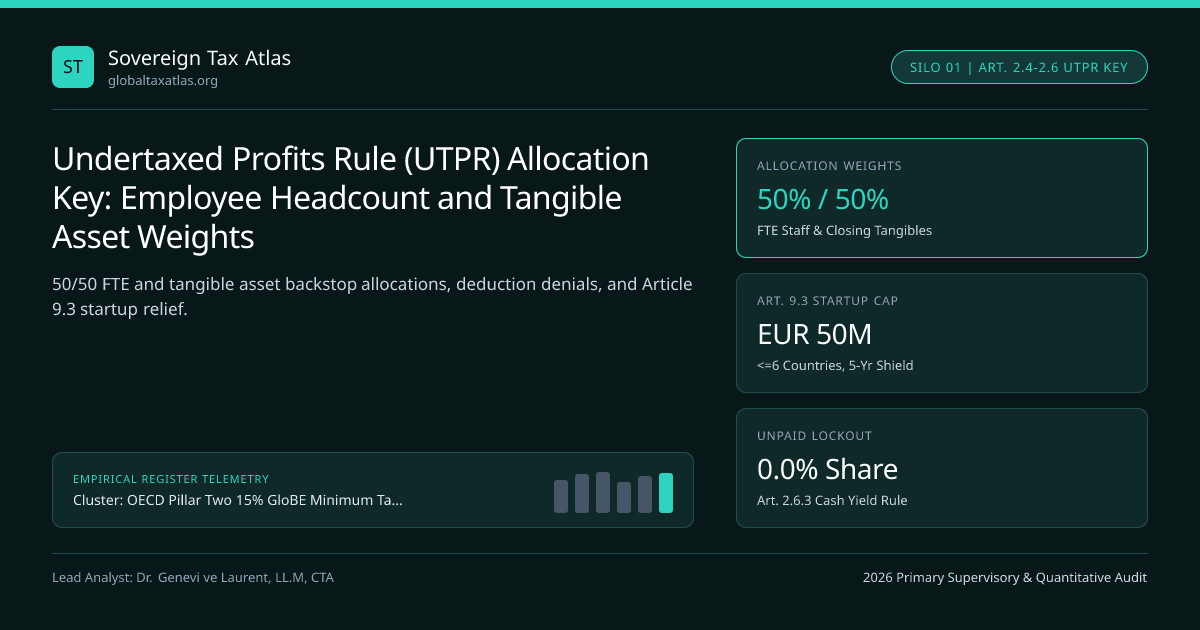
Enacted across the European Union, United Kingdom, Australia, South Korea, and Japan largely for fiscal years commencing on or after January 1, 2025 (following the expiration of the one-year Transitional UTPR Safe Harbor for 20%+ nominal-rate UPEs at year-end 2025), Articles 2.4 through 2.6 of the OECD GloBE Model Rules activate the Undertaxed Profits Rule (UTPR) whenever low-taxed group income escapes both a Qualified Domestic Minimum Top-Up Tax and a parent-level Income Inclusion Rule. As synthesized in our OECD Pillar Two 15% GloBE architecture hub, UTPR abandons equity ownership chains completely—authorizing lateral sister subsidiaries in high-tax operating markets to collect top-up tax on low-taxed UPEs or offshore affiliates via a 50% Employee / 50% Tangible Asset allocation formula across the OECD Pillar Two QDMTT & GloBE cluster.
Two Mechanisms of Domestic UTPR Collection: Deduction Denial vs Separate Charge#
Article 2.4.1 gives each UTPR-implementing jurisdiction legislative flexibility on how to collect its allocated UTPR Top-Up Tax Amount from local Constituent Entities:
- Denial of Intragroup or Third-Party Tax Deductions: Disallowing an amount of otherwise deductible operating expenses equal to the allocated UTPR tax divided by the domestic corporate income tax rate (for example, to collect EUR 3.0 million of UTPR tax in a 25.0% CIT country, local law denies EUR 12.0 million of interest, royalty, or cost-of-sales deductions).
- Equivalent Adjustment / Standalone UTPR Charge: Imposing a direct supplemental tax assessment equal to the allocated UTPR amount—adopted by the UK (Multinational Top-up Tax UTPR charge) and Germany/Netherlands alongside deduction limits so loss-making local subsidiaries with insufficient deductions can still settle the liability within the required window.
Crucially, under Article 2.4.2, if deduction denial in a UTPR jurisdiction fails to generate an immediate cash tax liability in the current fiscal year (because local Constituent Entities have net operating loss carryforwards!), the shortfall carries forward, and under Article 2.6.3, that jurisdiction's UTPR Percentage drops to 0% in subsequent years until all prior-year allocated UTPR taxes have actually generated cash tax!
Mathematical Anatomy of the Article 2.6.1 50/50 Substance Key#
Unlike the Article 5.3 SBIE carve-out—which measures payroll expense and excludes third-party leased investment property—the Article 2.6.1 UTPR Percentage uses Full-Time Equivalent (FTE) headcount (matching Country-by-Country Reporting Table 1 definitions, including independent contractors working in ordinary operations) and Net Book Value of Tangible Assets aggregated strictly across Constituent Entities located in Qualified UTPR Jurisdictions (excluding Investment Entities and Flow-Through Entities!).
- + 0.50 * (TangibleNBVj / Sum{k in UTPRStates}(TangibleNBVk))
- DeductionDisallowancej = (TotalUTPRTopUpTax * UTPR%Countryj) / StatutoryCITRate_j
- Worked Post-2025 US UPE Residual Exposure Example (FY 2026):
- US UPE holds Cayman Treasury Co (0% QDMTT, Net Top-Up Tax = EUR 18,000,000; no intermediate IPE)
- Qualified UTPR Footprint (3 Implementing Operating Jurisdictions):
- UK: 1,200 FTEs | EUR 90M Tangibles
- Germany: 2,000 FTEs | EUR 210M Tangibles
- Australia: 800 FTEs | EUR 100M Tangibles
- Totals across UTPR States: 4,000 FTEs | EUR 400M Tangibles
- Allocation Shares:
- UK UTPR % = 0.50(1,200/4,000) + 0.50(90M/400M) = 15.00% + 11.25% = 26.25% -> EUR 4,725,000
- Germany UTPR % = 0.50(2,000/4,000) + 0.50(210M/400M) = 25.00% + 26.25% = 51.25% -> EUR 9,225,000
- Australia UTPR % = 0.50(800/4,000) + 0.50(100M/400M) = 10.00% + 12.50% = 22.50% -> EUR 4,050,000
- Equivalent Deduction Disallowance in UK (25% CIT): EUR 4,725,000 / 0.25 = EUR 18,900,000 denied!
Look closely at the leverage effect in that formula: even if a group has only one 15-person sales office in a single UTPR-implementing country (say, the UK) and zero other UTPR jurisdictions exist in the group, 15 / 15 = 100%—meaning that tiny UK sales subsidiary can legally be assessed 100% of the group's EUR 18 million global UTPR liability via direct charge!
Expiration of the Transitional UTPR Safe Harbor vs Ongoing Side-by-Side Negotiations#
During fiscal years beginning on or before December 31, 2025 (and ending before December 31, 2026), the July 2023 Transitional UTPR Safe Harbor deemed UTPR Top-Up Tax for the UPE Jurisdiction itself to be zero if the UPE country had a nominal corporate income tax rate of at least 20.0% (primarily shielding US domestic R&D credit and FDII-reduced profits below 15% ETR, while never shielding low-taxed Cayman CIMA or BVI BVIFSC sister subsidiaries!). With that transitional window sunsetting for calendar-year 2026 taxpayers alongside intensive G7/OECD administrative guidance discussions on US GILTI coexistence, non-IIR-headquartered groups face acute UTPR exposure on any jurisdiction failing the Transitional CbCR Safe Harbor.
Article 9.3 Five-Year Initial Phase Exclusion for Expanding Groups#
Newly internationalizing mid-cap groups crossing EUR 750 million receive targeted UTPR relief (and EU domestic IIR relief) for five years under Article 9.3 provided they meet two strict tests:
- Constituent Entities are located in no more than six jurisdictions globally; and
- The sum of Net Book Values of Tangible Assets across all Constituent Entities located outside the Reference Jurisdiction (the single jurisdiction with the highest tangible assets) does not exceed EUR 50 million.
Groups operating offshore brokerage or treasury desks in Vanuatu (Reserve Bank of Vanuatu), Mauritius (Bank of Mauritius), or Dubai (DMCC)—such as FinDB-tracked Bancwesttrade and Ac Markets—must audit country counts carefully because adding a seventh nominal branch immediately terminates Article 9.3 protection!
UTPR Substance Factor & Startup Relief Audit Matrix#
| UTPR Structural Element | GloBE Rule Reference | Quantitative / Operational Metric | Difference From Article 5.3 SBIE | Compliance Risk & Audit Remedy |
|---|---|---|---|---|
| Labor Factor | Art. 2.6.1(a) & Art. 2.6.2(a) | Full-Time Equivalent (FTE) headcount | Uses FTE count (CbCR style), NOT payroll EUR cost | Reconcile contractor FTEs consistently with CbCR Table 1 |
| Tangible Asset Factor | Art. 2.6.1(b) & Art. 2.6.2(b) | Closing NBV in financial accounts | Uses closing NBV (incl. investment property!), NOT avg NBV | Do not strip investment real estate from UTPR asset key |
| Investment Entities | Art. 2.6.2(c) | 0% FTE & 0% Asset attribution; cannot be charged UTPR | Protects pooled funds (ESMA) from paying sister MNE UTPR | Tag all Art. 7.4 Investment Entities in ERP master data |
| Loss-Making UTPR State | Art. 2.4.2 & Art. 2.6.3 | Carryforward denied deduction; 0% next-year share | Unique self-correcting reallocation to cash-paying states | Direct-charge states (UK/DE) avoid Art. 2.6.3 lockout |
| Expanding MNE Carve-Out | Art. 9.3 | <=6 jurisdictions AND <=EUR 50M non-Ref tangibles | Applies for max 5 years from inaugural UTPR scope | Liquidate dormant branches pushing group to 7 countries |
Frequently asked questions
Can bilateral double tax treaties block a host country from enforcing UTPR on a sister company?
OECD Inclusive Framework analysis maintains that UTPR operates either by denying domestic expense deductions under internal law or imposing a domestic tax on a resident subsidiary—neither of which violates Article 7 (Business Profits) or Article 9 (Associated Enterprises) of OECD-patterned treaties, though Belgian and US commentators have debated constitutional challenges.
How does the UTPR tangible asset definition differ from the Article 5.3 SBIE tangible asset definition?
Unlike Article 5.3 SBIE—which averages opening and closing carrying values and excludes passive investment real estate or property held for sale—Article 2.6.2 UTPR measures closing Net Book Value and includes land and investment real estate owned by regular Constituent Entities.
Are regulated Investment Entities forced to pay UTPR top-up taxes for industrial affiliates?
No. Articles 2.4.1 and 2.6.2(c) explicitly exclude Investment Entities from both bearing a UTPR charge and contributing FTEs or tangible assets to a jurisdiction UTPR allocation percentage, protecting third-party fund investors.
What happens if every UTPR jurisdiction in the group has net operating losses blocking immediate cash tax?
Under the Article 2.6.4 exception, if applying Article 2.6.3 would reduce every UTPR jurisdiction percentage to zero in a fiscal year, Article 2.6.3 is suspended for that year and the Top-Up Tax is allocated across all UTPR jurisdictions using the normal 50/50 formula.
Publication record
- Published
- 14 November 2026
- Updated
- 14 November 2026
- Author
- Dr. Geneviève Laurent, LL.M, CTA
- Review
- Review not recorded
- Automated fact check
- Passed in the stored pipeline record
- Source URLs
- 3 recorded
AI assistance recorded: anthropic/claude-opus-4.6. This field does not establish human review or source verification.
Academic & Institutional Attribution
Cite This Research & Embed Live Data Card
Standard academic & institutional research paper citation format.
Dr. Geneviève Laurent, LL.M, CTA. (2026, November 14). Undertaxed Profits Rule (UTPR) Allocation Key: Employee Headcount and Tangible Asset Weights. Sovereign Tax Atlas. https://globaltaxatlas.org/entries/undertaxed-profits-rule-utpr-substance-allocation-denial-deductionRegulatory Directory Cross-Reference
Referenced Institutions & Regulatory Registries
Top Regulated Institutions in This Coverage Slice
Referenced Supervisory Authorities
Related Oecd Pillar Two Qdmtt Globe & Institutional Briefings
Explore Oecd Pillar Two Qdmtt Globe Hub (20) →Oecd Pillar Two Qdmtt Globe
OECD Pillar Two 15% GloBE Minimum Tax Architecture: QDMTT, IIR, and UTPR Institutional GuideOecd Pillar Two Qdmtt Globe
Transitional CbCR Safe Harbor: De Minimis, Simplified ETR, and Routine Profits TestsOecd Pillar Two Qdmtt Globe
Qualified Refundable Tax Credits (QRTCs) vs Marketable Transferable Tax Credits Under GloBEOecd Pillar Two Qdmtt Globe
Bermuda 15% Corporate Income Tax Act vs GloBE QDMTT Parity for Insurers and HoldCosOecd Pillar Two Qdmtt Globe
Crown Dependencies Pillar Two Response: Jersey and Guernsey 15% Multinational Tax RegimesOecd Pillar Two Qdmtt Globe
Caribbean Pillar Two Enactments: Bahamas 15% DMTT and Barbados 9% to 15% Tiered Tax ReformOecd Pillar Two Qdmtt Globe
UAE 9% Corporate Tax and 15% Supplemental DMTT Across DIFC and DMCC Qualifying Free ZonesOecd Pillar Two Qdmtt Globe
Singapore Domestic Top-Up Tax (DTT), Multinational Enterprise Minimum Tax, and RIC IncentivesCrs 2 Carf Fatca Exchange Rules
CRS Controlling Persons Look-Through: 25% AML Thresholds and Discretionary Trust ProtectorsCrs 2 Carf Fatca Exchange Rules
Cayman Islands DITC Portal Governance: CRS Compliance Forms, CIMA Fund Audits, and PenaltiesCrs 2 Carf Fatca Exchange Rules
BVI ITA and BVIFars Portal Compliance: FATCA/CRS Deadlines, Nil Filings, and ITA AuditsCrs 2 Carf Fatca Exchange Rules
IRS Form 1099-DA Digital Asset Broker Reporting vs OECD CARF: Cost Basis and Non-US Exemptions
Sovereign Tax Atlas Data, Benchmarks & Contributor Records
CC BY 4.0 Open Data
Open Institutional Datasets (CSV / JSON) →
Download desk-compiled quantitative series & schemas.
2026 Reference Matrix
2026 Institutional Benchmarks & Thresholds →
Statutory capital, clearing, margin & rate conventions.
Editorial Records
Authors & Review Records →
View named contributors where those records are available.
Complete Index
Master Research & Dossier Archive →
Browse all published briefings by topic pillar & date.