
Crs 2 Carf Fatca Exchange Rules
OECD CRS 2.0, CARF Crypto Reporting, and US FATCA IGA Institutional Compliance Atlas
Beginning January 1, 2026 across 60+ early-adopter jurisdictions, OECD CRS 2.0 and the Crypto-Asset Reporting Framework (CARF) converge with US FATCA Model 1 and Model 2 IGAs to govern cross-border financial and digital-asset tax transparency.
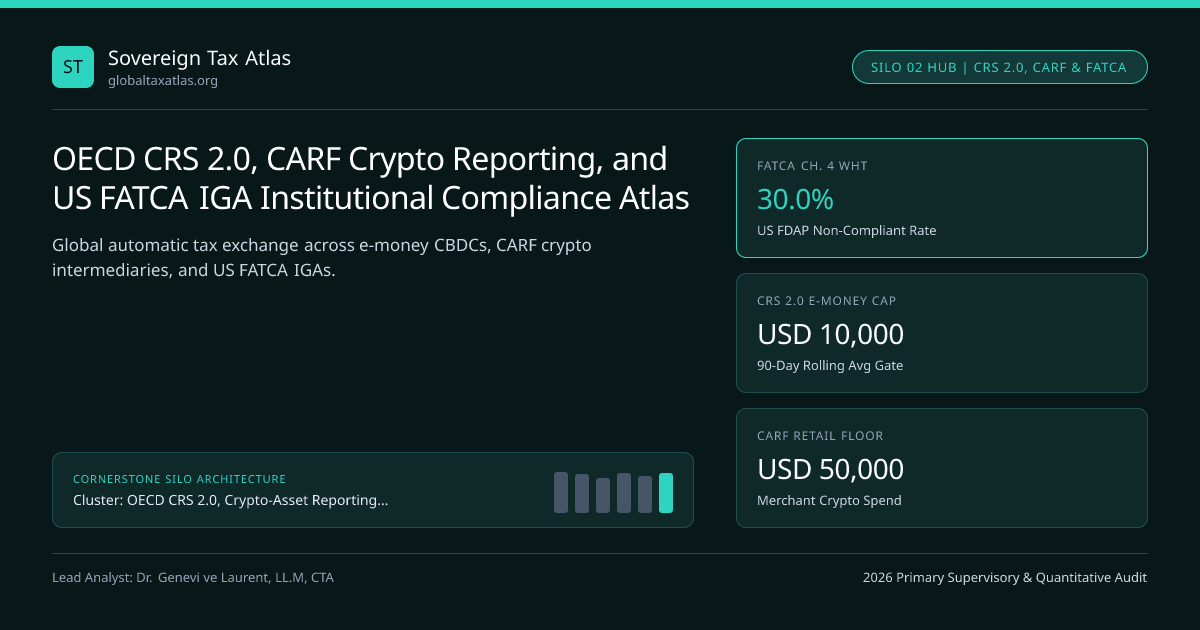
Simultaneous implementation of the amended OECD Common Reporting Standard (CRS 2.0) and the Crypto-Asset Reporting Framework (CARF) on January 1, 2026—paired with over 113 bilateral US Foreign Account Tax Compliance Act (FATCA) Intergovernmental Agreements enforcing a statutory 30.0% Chapter 4 punitive withholding tax—closes the final perimeter gaps around e-money wallets, Central Bank Digital Currencies (CBDCs), tokenized funds, and cross-chain crypto intermediaries. Monitored against the OECD CRS 2.0, CARF & FATCA Model 1 IGA framework and the 2026 CRS/CARF/FATCA Benchmark Standard, institutional custodians, alternative funds, and digital-asset exchanges rely on this cornerstone guide to navigate the CRS 2.0, CARF & FATCA Exchange Rules cluster.
Three Interlocking Transparency Regimes: FATCA, CRS 2.0, and CARF#
Although FATCA, CRS, and CARF all automate cross-border taxpayer data exchange, their triggering nexus, balance-versus-transaction reporting philosophy, and enforcement sanctions diverge sharply:
- US FATCA (IRC Sections 1471–1474): Targets US Persons (determined by citizenship as well as residency) via Model 1 reciprocal/non-reciprocal vs Model 2 direct-reporting IGAs. Non-Participating Foreign Financial Institutions (NPFFIs) and recalcitrant entities failing IRS GIIN portal registration and Responsible Officer certifications suffer 30.0% gross withholding on US-source FDAP income unless properly documented on Form W-8BEN-E Chapter 4 statuses or Form W-8IMY intermediary withholding statements.
- OECD CRS 2.0 (Amended 2023, Live 2026+): Targets tax residency across 120+ participating jurisdictions, reporting year-end account balances and gross dividends/interest/redemptions. Its 2026 overhaul sweeps Specified Electronic Money Products and CBDCs into Depository Account scope (above a USD 10,000 90-day rolling average exemption), mandates granular reporting of 25% AML Controlling Persons and trust roles, and adds TIN verification flags.
- OECD CARF & EU DAC8: Because decentralized wallets hold no year-end "custodial balance" with a single bank, CARF shifts from account-balance reporting to annual aggregate transaction-flow reporting by Reporting Crypto-Asset Service Providers (RCASPs), covering fiat-to-crypto trades, crypto-to-crypto swaps, and unhosted wallet transfers under the CARF XML schema and USD 50,000 retail payment rule alongside extraterritorial EU DAC8 operator registration.
Closing the Digital Asset & E-Money Perimeter Without Double Reporting#
Prior to 2026, fintech neo-banks issuing stored-value e-money wallets and crypto exchanges custodying spot Bitcoin or DeFi liquidity tokens escaped legacy CRS definitions limited to traditional commercial banks and securities custodians. CRS 2.0 and CARF seal both gaps while introducing an explicit anti-duplication hierarchy analyzed in CRS 2.0 vs CARF duplication relief on tokenized securities:
- CBDCs and Fiat-Pegged Specified E-Money Products (SEMPs): Reported strictly as Depository Accounts under CRS 2.0 (exempting CARF!).
- Relevant Crypto-Assets (Spot BTC/ETH, Utility/Governance Tokens, Non-SEMP Stablecoins): Reported strictly on a transactional basis under CARF, while CRS 2.0 expands its Investment Entity gross-income test to capture funds investing in Relevant Crypto-Assets!
- US Domestic Digital-Asset Divergence: Because the United States opted to expand domestic broker reporting via IRS Form 1099-DA digital asset regulations alongside bilateral CARF negotiations rather than joining multilateral CRS, dual-platform exchanges serving both US and European/APAC clients must maintain parallel tax engines.
- PassiveNFEStatusTest: (PassiveGrossIncome / TotalGrossIncome >= 50.0%) OR (PassiveAssets / Total_Assets >= 50.0%)
- FATCAPunitiveLeakage = 30.0% * GrossUSSource_FDAP [if NPFFI or undocumented Passive NFFE]
- Worked Multi-Regime Fund & Crypto Custodian Audit (FY 2026):
- Cayman Master-Feeder Hedge Fund (CIMA): USD 420M AuM (65% US equities, 35% spot ETH/SOL)
- FATCA Status: Reporting Model 1 FFI (Cayman GIIN issued) -> 0% Ch. 4 WHT; files US LPs via Cayman DITC.
- CRS 2.0 Status: Investment Entity RFI (now includes 35% Relevant Crypto-Assets in 50% test!) -> Reports LP year-end NAV.
- CARF Status: Fund units are Equity Interests reported under CRS 2.0 -> Exempt from duplicate CARF unit reporting; spot crypto execution broker (1inch Wallet / 0xchange screen) evaluated under RCASP nexus!
Offshore Portal Enforcement, Family Offices, and High-Risk Golden Visas#
Tax authorities have shifted from passive XML intake to automated cross-validation audits backed by stiff administrative fines and license revocations. In the Caribbean, Cayman DITC CRS Compliance Form audits cross-check CIMA fund registries against reported account populations, while BVI ITA BVIFars nil-return governance polices BVIFSC trustees and holding companies. Across wealth hubs, private banks apply Private Trust Company 50% Investment Entity tests, Singapore VCC umbrella sub-fund filings, Switzerland Model 1 FATCA switchover workflows, and OECD High-Risk CBI/RBI Golden Visa screening alongside public license verification tools and methodology standards.
Cross-Jurisdiction Automatic Exchange Comparison Matrix#
Institutional onboarding desks screening digital-asset protocols and offshore brokerages—such as FinDB-listed 1inch Wallet, Band Protocol, and Arbitrage Prime Limited—must map exact portal deadlines and statutory frameworks across primary fund domiciles:
| Exchange Regime | Governing Authority / Standard | Scope & Asset Perimeter | Primary Reporting Metric | Non-Compliance Sanction |
|---|---|---|---|---|
| US FATCA (Model 1/2 IGA) | IRS / IRC Sec. 1471 Standard | US Citizens, Green Card & US-Owned Passive NFFEs | Year-end balance + gross FDAP | 30.0% US FDAP WHT & GIIN revocation |
| OECD CRS 2.0 (2026+) | OECD / CIMA / JFSC / GFSC | Depository (incl. SEMP/CBDC), Custodial & Inv. Entities | Year-end balance/NAV + gross yield | Up to KYD 50k–100k+ fines & fund strike-off |
| OECD CARF (2026+) | OECD / ~60+ Early-Adopter Tax Portals | RCASPs executing Relevant Crypto-Asset trades/transfers | Aggregate buys, sells, swaps & unhosted wallet sums | Domestic RCASP licensing & penalty sanctions |
| EU DAC8 (Dir. 2023/2226) | EU Member States / ESMA MiCA Link | EU & non-EU crypto operators serving EU tax residents | Full CARF XML + mandatory EU TIN verification | Minimum EUR 50,000–150,000+ statutory fines & IP block |
| US Form 1099-DA | US Treasury / IRS Sec. 6045 | Custodial digital-asset brokers serving US taxpayers | Gross proceeds (2025+) & adjusted cost basis (2026+) | 24.0% US backup withholding & per-form IRS fines |
Data Governance, Self-Certification Remediation, and XML Schema Version Control#
Upgrading legacy CRS v2.0 engines to CRS XML v3.0 and CARF XML v1.0 requires capturing new mandatory self-certification fields—including whether a valid self-certification was obtained, the specific Controlling Person role (settlor, trustee, protector, beneficiary, or ≥25% shareholder), joint-account holder headcount, and equity versus debt interest flags—while resolving dual tax residency tie-breakers and preexisting account electronic indicia ahead of 2027 XML exchanges.
Frequently asked questions
Why did the OECD create a separate CARF framework instead of just adding crypto exchanges to CRS?
CRS relies on reporting a single year-end custodial account balance—which fails whenever a user buys crypto on an exchange and immediately withdraws it to a self-custodied Ledger or MetaMask wallet before December 31. CARF solves this by reporting full-year transaction flows and external wallet transfer totals.
When are the first CRS 2.0 and CARF XML filings due for early-adopter jurisdictions?
Across the 50+ first-wave jurisdictions (including EU Member States via DAC8, the UK, Cayman Islands, BVI, Jersey, and Guernsey), data collection commenced on January 1, 2026, with inaugural CRS 2.0 and CARF XML transmissions due in mid-2027 (second-wave hubs like Singapore and UAE follow in 2027/2028).
Does holding a UAE or Caribbean Golden Visa exempt an account holder from home-country CRS reporting?
No. Under OECD High-Risk CBI/RBI guidance and CRS 2.0 self-certification rules, financial institutions must challenge single-residency claims backed by low-presence Residency-by-Investment schemes and report ALL jurisdictions where the individual remains tax-resident.
How does US Form 1099-DA interact with OECD CARF for international crypto exchanges?
Custodial exchanges with US nexus report US non-exempt customers on IRS Form 1099-DA (subject to 24% backup withholding if Form W-9 is missing), while verifying non-US customers via Form W-8BEN or CARF tax-residency self-certifications for international CARF/DAC8 XML exchange.
Publication record
- Published
- 14 November 2026
- Updated
- 14 November 2026
- Author
- Dr. Geneviève Laurent, LL.M, CTA
- Review
- Review not recorded
- Automated fact check
- Passed in the stored pipeline record
- Source URLs
- 4 recorded
AI assistance recorded: anthropic/claude-opus-4.6. This field does not establish human review or source verification.
Academic & Institutional Attribution
Cite This Research & Embed Live Data Card
Standard academic & institutional research paper citation format.
Dr. Geneviève Laurent, LL.M, CTA. (2026, November 14). OECD CRS 2.0, CARF Crypto Reporting, and US FATCA IGA Institutional Compliance Atlas. Sovereign Tax Atlas. https://globaltaxatlas.org/entries/oecd-crs-2-carf-fatca-automatic-tax-information-exchange-guideRegulatory Directory Cross-Reference
Referenced Institutions & Regulatory Registries
Top Regulated Institutions in This Coverage Slice
Related Crs 2 Carf Fatca Exchange Rules & Institutional Briefings
Explore Crs 2 Carf Fatca Exchange Rules Hub (20) →Crs 2 Carf Fatca Exchange Rules
OECD CRS 2.0 Expansion to Specified Electronic Money Products and Central Bank Digital CurrenciesCrs 2 Carf Fatca Exchange Rules
CARF Reporting Crypto-Asset Service Provider (RCASP) Nexus Hierarchy and DeFi Control TestsCrs 2 Carf Fatca Exchange Rules
CARF XML Schema Valuations: Crypto-to-Crypto Swaps, Wallet Transfers, and USD 50,000 Retail ThresholdCrs 2 Carf Fatca Exchange Rules
EU DAC8 Directive vs OECD CARF: Extraterritorial Single Member State Registration and PenaltiesCrs 2 Carf Fatca Exchange Rules
US FATCA Model 1 vs Model 2 Intergovernmental Agreements and IRC Section 1471 30% WithholdingCrs 2 Carf Fatca Exchange Rules
IRS FATCA Registration Portal: GIIN Issuance, Sponsored FFI Hierarchies, and RO CertificationsCrs 2 Carf Fatca Exchange Rules
IRS Form W-8BEN-E Chapter 4 Classification: Active NFFE, Passive NFFE, and Investment EntitiesCrs 2 Carf Fatca Exchange Rules
IRS Form W-8IMY Documentation: Qualified Intermediaries, Withholding Partnerships, and Rate PoolsDouble Tax Treaty Withholding Lob
Double Tax Treaty Withholding Rates, OECD MLI Principal Purpose Test, and US LOB ReferenceEconomic Substance Cfc Transfer Pricing
Offshore Economic Substance Statutes, CFC Attribution Regimes, and OECD Transfer Pricing DEMPE GuideCross Border Fund Spv Tax Neutrality
Cross-Border Fund Tax Neutrality Guide: Blocker SPVs, Check-the-Box Elections, and Treaty PlatformsOecd Pillar Two Qdmtt Globe
GloBE Article 1.1 EUR 750M Consolidated Revenue Scope, M&A Merger, and Demerger Rules
Sovereign Tax Atlas Data, Benchmarks & Contributor Records
CC BY 4.0 Open Data
Open Institutional Datasets (CSV / JSON) →
Download desk-compiled quantitative series & schemas.
2026 Reference Matrix
2026 Institutional Benchmarks & Thresholds →
Statutory capital, clearing, margin & rate conventions.
Editorial Records
Authors & Review Records →
View named contributors where those records are available.
Complete Index
Master Research & Dossier Archive →
Browse all published briefings by topic pillar & date.