
GloBE Article 1.1 EUR 750M Consolidated Revenue Scope, M&A Merger, and Demerger Rules
Determining whether a multinational corporate group crosses the EUR 750 million OECD Pillar Two sovereign tax threshold requires adjusting short fiscal periods, currency conversions, and Article 6.1 merger and demerger lookback histories.
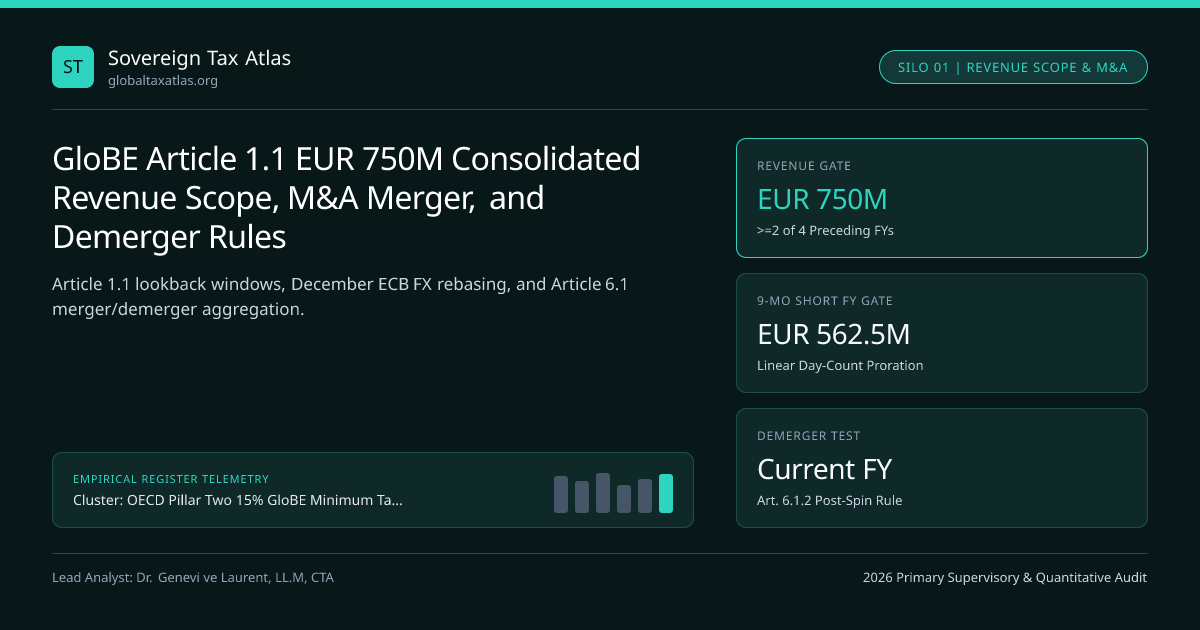
Crossing EUR 750 million in consolidated revenue in at least two of the four fiscal years immediately preceding the tested fiscal year brings an entire multinational group inside OECD GloBE Article 1.1—yet corporate mergers, mid-year spin-offs, non-euro reporting currencies, and short accounting periods routinely alter that four-year lookback math. As mapped in our OECD Pillar Two 15% GloBE architecture hub, miscalculating consolidated revenue inclusion—particularly around financial services gross investment returns or deemed consolidation under Article 1.2—exposes treasury teams to unbudgeted QDMTT and IIR assessments across the OECD Pillar Two QDMTT & GloBE cluster.
Defining Consolidated Revenue Under Acceptable Accounting Standards#
Article 1.1.1 anchors the EUR 750 million threshold to the Consolidated Financial Statements of the Ultimate Parent Entity (UPE), prepared under an Acceptable Financial Accounting Standard (IFRS, US GAAP, UK GAAP, J-GAAP, and twelve other listed GAAPs) or an Authorised Financial Accounting Standard adjusted for Material Competitive Distortions exceeding EUR 75 million group-wide. Under December 2023 OECD Administrative Guidance, consolidated revenue encompasses net inflows from ordinary operating activities before cost of sales—including net realized and unrealized investment gains reported in the profit-and-loss statement by banks, broker-dealers, and insurers—while excluding third-party pass-through excise taxes and VAT collected as agent.
Where a UPE lacks prepared consolidated accounts solely because it is privately held in a non-filing offshore jurisdiction overseen by the British Virgin Islands Financial Services Commission (BVIFSC) or the Cayman Islands Monetary Authority (CIMA), the Deemed Consolidation Test under Article 1.2.2(d) forces hypothetical line-by-line consolidation of all controlled entities to verify whether aggregate revenues hit EUR 750 million. Short or extended fiscal periods require strict daily or monthly linear pro-ration: a nine-month transitional fiscal year reduces the EUR 750 million hurdle proportionally to EUR 562.5 million.
Foreign Exchange Translation Drifts for Non-Euro Reporting Groups#
Groups reporting in USD, GBP, CHF, SGD, or JPY do not use the fiscal-year average exchange rate to test the EUR 750 million threshold. Instead, OECD Administrative Guidance mandates rebasing EUR 750 million annually using the arithmetic average of daily European Central Bank (ECB) foreign exchange reference rates across the calendar month of December immediately preceding the start of the tested fiscal year. For example, if the December average EUR/USD rate is 1.0840, a US-parented calendar-year group tests each of its four lookback years against USD 813.0 million, shielding border-line mid-cap groups when the euro weakens while pulling groups into scope unexpectedly during euro rallies.
Article 6.1.1 Mergers: Pre-Acquisition Revenue Aggregation#
Acquisitive private-equity-backed strategic buyers and financial brokerages frequently stumble over Article 6.1.1, which defines a "Merger" broadly to include any arrangement where two or more separate groups—or a standalone entity and an existing group—come under common UPE control. For any fiscal year prior to the merger, the combined group must sum the historical revenues shown on each constituent group's or target entity's separate financial statements for fiscal periods ending within that lookback year, without retrospectively eliminating pre-merger commercial sales between the previously unrelated parties.
- Merged Lookback Revenue (Year t) = RevenueAcquirer(t) + RevenueTarget(t) [no pre-merger interco elim]
- Worked M&A Scope Example (FY 2026 Tested Year; Acquirer + Target Closed Oct 2025):
- FY 2022 Combined: EUR 460M (Acquirer) + EUR 250M (Target) = EUR 710M (< EUR 750M -> Miss)
- FY 2023 Combined: EUR 510M (Acquirer) + EUR 275M (Target) = EUR 785M (>= EUR 750M -> Hit #1)
- FY 2024 Combined: EUR 535M (Acquirer) + EUR 290M (Target) = EUR 825M (>= EUR 750M -> Hit #2)
- FY 2025 Actual Consolidated (Target included Q4 only): EUR 620M (< EUR 750M -> Miss)
- Result: 2 of 4 prior years (FY 2023 & FY 2024) >= EUR 750M -> Group IN SCOPE for FY 2026!
Notice the counterintuitive result in the formula above: even though neither company ever exceeded EUR 535 million standalone and FY 2025 post-close consolidated revenue was only EUR 620 million, combining FY 2023 and FY 2024 standalone numbers creates two qualifying hits, triggering immediate FY 2026 Pillar Two compliance across all subsidiaries—unless entities qualify under Article 1.5 Excluded Entity rules for investment funds or pass Transitional CbCR Safe Harbor thresholds.
Article 6.1.2 Demergers and Post-Spin-Off Testing Mechanics#
When an in-scope multinational spins off or carves out a division into one or more independent groups (a "Demerger"), Article 6.1.2 replaces the standard four-year lookback with a two-stage post-separation test so divested mid-market businesses are not permanently tainted by their former parent's scale:
- First Tested Fiscal Year Ending After Demerger: A demerged group remains in scope if and only if its standalone consolidated revenue in that first post-demerger fiscal year equals or exceeds EUR 750 million (prorated if shorter than 12 months).
- Second Through Fourth Tested Fiscal Years After Demerger: A demerged group falls in scope if its standalone consolidated revenue reaches EUR 750 million in at least two of the fiscal years following the demerger (inclusive of that tested year itself!). Note that unlike the normal Article 1.1 rule—which looks solely at prior years—Article 6.1.2(b) counts the current tested year among the post-spin-off years evaluated.
Private Equity Silo Isolation vs Industrial Conglomerate Consolidation#
Private equity sponsors and multi-entity financial houses such as FinDB-tracked 360 Capital, April Investors, and Atm Capital rely heavily on IFRS 10 / ASC 946 investment entity accounting exceptions. Because a qualifying investment fund measures controlled portfolio companies at fair value through profit or loss rather than consolidating line-by-line, two EUR 500 million portfolio groups owned by the same buyout fund are not aggregated into a EUR 1.0 billion MNE group under OECD GloBE scoping standards. Conversely, family-owned holding companies domiciled in Labuan (Labuan FSA) or Jersey (JFSC) that prepare consolidated GAAP accounts across disparate industrial holdings inadvertently weld unrelated subsidiaries into a single EUR 750 million perimeter.
| Transaction / Group Archetype | Governing GloBE Clause | Revenue Aggregation Perimeter | First In-Scope Year Trigger | Key Structuring Risk & Verification Control |
|---|---|---|---|---|
| Organic Crossing MNE | Art. 1.1.1 & Art. 1.1.2 | Actual UPE Consolidated Financial Statements | Year 5 after 2nd EUR 750M+ lookback FY | December ECB FX shifts pulling USD/GBP border-line groups in |
| Strategic M&A Bolt-On | Art. 6.1.1(a)–(b) | Acquirer + Target historical uneliminated revenues | Immediate FY following closing year | Target lacks GAAP-compliant 4-year historical revenue ledger |
| Carve-Out / Spin-Off | Art. 6.1.2(a)–(b) | Demerged standalone group post-separation | Immediate FY1 if FY1 >= EUR 750M | Current-year revenue surprises triggering retroactive FY2–FY4 scope |
| Private Family Conglomerate | Art. 1.2.2(d) Deemed Test | Hypothetical consolidation under BVI (BVIFSC) / Cayman HoldCo | Once deemed group hits 2 of 4 FYs | Failure to qualify top HoldCo as IFRS 10 Investment Entity |
| Broker-Dealer / Insurer Group | Dec 2023 Admin Guidance | Operating fees + net P&L investment gains | Standard 2-of-4 lookback including financial gains | Omitting unrealized fair-value P&L gains from revenue tally |
Frequently asked questions
Does current-year revenue exceeding EUR 750 million trigger Pillar Two in that same year?
For an organic standalone group under Article 1.1, current-year revenue is irrelevant; only the four preceding fiscal years are tested. However, following a corporate demerger under Article 6.1.2, current-year revenue directly determines scope in post-demerger Years 1 through 4.
Which foreign exchange rate converts EUR 750 million for US-dollar reporting groups?
OECD Administrative Guidance requires translating EUR 750 million into the UPE presentation currency using the average daily ECB reference exchange rate during December immediately preceding the start of the tested fiscal year, applying that single threshold across all four lookback years.
Can a private group avoid Pillar Two simply by not preparing consolidated financial statements?
No. Under the Article 1.2.2(d) Deemed Consolidation Test, if a parent entity would have been required to consolidate controlled subsidiaries line-by-line under an Authorised Financial Accounting Standard had its equity been publicly traded, hypothetical consolidated revenue applies.
Are unrealized fair-value gains included in the EUR 750 million revenue test for financial groups?
Yes, if those net realized and unrealized investment gains or losses are presented within revenue or net financial income in the ordinary operating section of the consolidated profit-and-loss statement under the UPE accounting standard.
Publication record
- Published
- 14 November 2026
- Updated
- 14 November 2026
- Author
- Dr. Geneviève Laurent, LL.M, CTA
- Review
- Review not recorded
- Automated fact check
- Passed in the stored pipeline record
- Source URLs
- 3 recorded
AI assistance recorded: anthropic/claude-opus-4.6. This field does not establish human review or source verification.
Academic & Institutional Attribution
Cite This Research & Embed Live Data Card
Standard academic & institutional research paper citation format.
Dr. Geneviève Laurent, LL.M, CTA. (2026, November 14). GloBE Article 1.1 EUR 750M Consolidated Revenue Scope, M&A Merger, and Demerger Rules. Sovereign Tax Atlas. https://globaltaxatlas.org/entries/globe-eur-750m-consolidated-revenue-scope-merger-demerger-testsRegulatory Directory Cross-Reference
Referenced Institutions & Regulatory Registries
Top Regulated Institutions in This Coverage Slice
Referenced Supervisory Authorities
Related Oecd Pillar Two Qdmtt Globe & Institutional Briefings
Explore Oecd Pillar Two Qdmtt Globe Hub (20) →Oecd Pillar Two Qdmtt Globe
OECD Pillar Two 15% GloBE Minimum Tax Architecture: QDMTT, IIR, and UTPR Institutional GuideOecd Pillar Two Qdmtt Globe
Pillar Two Article 1.5 Excluded Entities: Sovereign Wealth, Pension, and Investment FundsOecd Pillar Two Qdmtt Globe
Jurisdictional ETR Mechanics: Adjusted Covered Taxes and Five-Year Deferred Tax RecaptureOecd Pillar Two Qdmtt Globe
Computing GloBE Income or Loss: Article 3.2 Permanent Adjustments to Financial Accounting Net IncomeOecd Pillar Two Qdmtt Globe
Substance-Based Income Exclusion (SBIE): Transitional Payroll to 5% Steady-State Carve-OutsOecd Pillar Two Qdmtt Globe
Qualified Domestic Minimum Top-Up Tax (QDMTT) Safe Harbor and Switch-Off Rule TriggersOecd Pillar Two Qdmtt Globe
Income Inclusion Rule (IIR) Top-Down Ordering and Partially Owned Parent Entity MechanicsOecd Pillar Two Qdmtt Globe
Undertaxed Profits Rule (UTPR) Allocation Key: Employee Headcount and Tangible Asset WeightsCrs 2 Carf Fatca Exchange Rules
CARF Reporting Crypto-Asset Service Provider (RCASP) Nexus Hierarchy and DeFi Control TestsCrs 2 Carf Fatca Exchange Rules
CARF XML Schema Valuations: Crypto-to-Crypto Swaps, Wallet Transfers, and USD 50,000 Retail ThresholdCrs 2 Carf Fatca Exchange Rules
EU DAC8 Directive vs OECD CARF: Extraterritorial Single Member State Registration and PenaltiesCrs 2 Carf Fatca Exchange Rules
US FATCA Model 1 vs Model 2 Intergovernmental Agreements and IRC Section 1471 30% Withholding
Sovereign Tax Atlas Data, Benchmarks & Contributor Records
CC BY 4.0 Open Data
Open Institutional Datasets (CSV / JSON) →
Download desk-compiled quantitative series & schemas.
2026 Reference Matrix
2026 Institutional Benchmarks & Thresholds →
Statutory capital, clearing, margin & rate conventions.
Editorial Records
Authors & Review Records →
View named contributors where those records are available.
Complete Index
Master Research & Dossier Archive →
Browse all published briefings by topic pillar & date.