
Pillar Two Article 1.5 Excluded Entities: Sovereign Wealth, Pension, and Investment Funds
OECD GloBE Article 1.5 shields Sovereign Wealth Funds, Pension Funds, UPE Investment Funds, and qualifying 95% and 85% asset-holding SPVs from 15% top-up taxation while preserving tax neutrality.
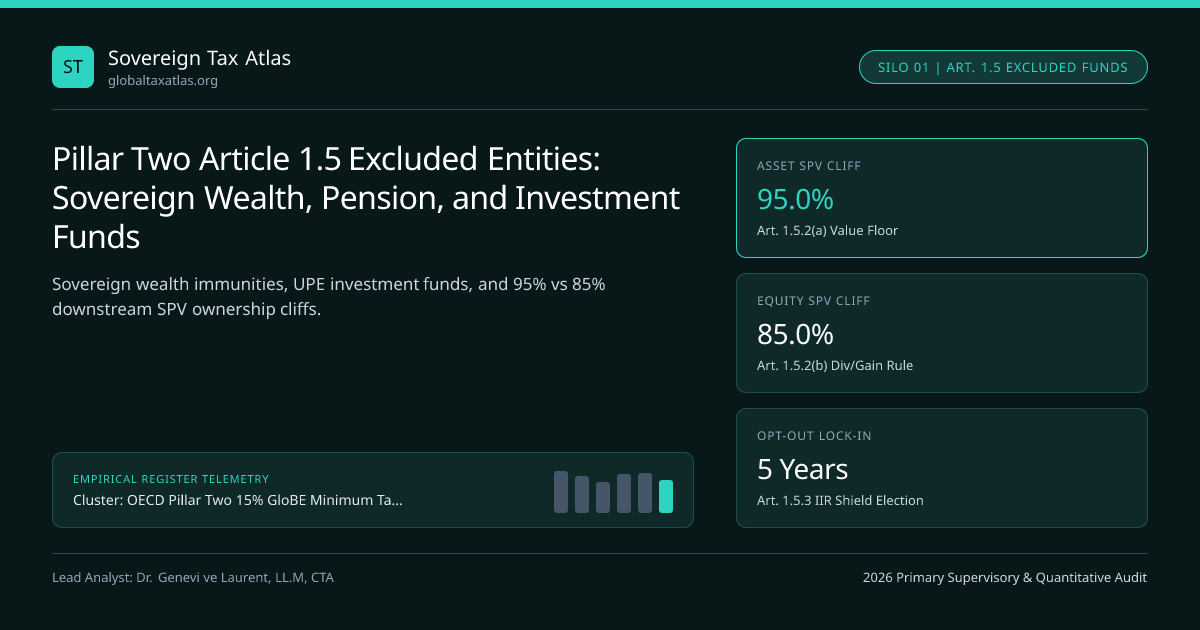
Article 1.5 of the OECD GloBE Model Rules exempts six institutional categories—Governmental Entities (including Sovereign Wealth Funds), International Organisations, Non-Profit Organisations, Pension Funds, Investment Funds that are Ultimate Parent Entities, and Real Estate Investment Vehicles (REIVs) that are Ultimate Parent Entities—from Constituent Entity obligations and the 15.0% top-up tax. Preserving single-layer investor taxation is foundational to our OECD Pillar Two 15% GloBE architecture guide, yet strict ownership-percentage cliffs under Article 1.5.2 and consolidation traps analyzed in Article 1.1 EUR 750M revenue scoping frequently catch downstream holding SPVs across the OECD Pillar Two QDMTT & GloBE cluster.
Six Primary Excluded Entity Categories Under Article 1.5.1#
Unlike corporate operating subsidiaries, institutional capital pools exist to deliver tax-neutral pass-through returns so investors pay tax once in their residence jurisdiction. Article 1.5.1 codifies six primary Excluded Entity definitions:
- Governmental Entities: Wholly owned public bodies and Sovereign Wealth Funds (aligned conceptually with US IRC Section 892 sovereign wealth exemptions) whose principal purpose is managing or investing sovereign assets without carrying on commercial trade or business—explicitly protected from consolidating unrelated sovereign portfolio holdings under February 2023 Administrative Guidance.
- Pension Funds & Pension Services Entities: Regulated retirement vehicles paying lifelong or retirement benefits, plus dedicated SPVs investing exclusively for those plans.
- Investment Funds (as UPE): Pooled vehicles designed to pool financial or non-financial assets from multiple unconnected investors, managed under a defined investment policy, subject to investor or fund-manager regulatory oversight (such as Luxembourg RAIF regimes or CIMA registered funds), where investors bear return rights proportional to contributions.
- Real Estate Investment Vehicles (as UPE): Widely held property vehicles taxed at a single level either in the vehicle's hands or upon distribution within one year.
Downstream Holding SPVs: The 95% vs 85% Value Ownership Cliffs#
Institutional funds and sovereign wealth investors rarely hold private equity, infrastructure, or credit assets directly at the master-fund tier; instead, they deploy Cayman (CIMA), Jersey (JFSC), BVI (BVIFSC), or Luxembourg SPVs. Article 1.5.2 extends Excluded Entity protection to subsidiary SPVs under two distinct quantitative prongs—excluding Pension Services Entities—measured by value of ownership interests (including tracking shares and carried-interest economic dilution!):
- Article 1.5.2(a) — The 95% Asset-Holding Prong: At least 95% of the entity's value is owned directly or through chains of Excluded Entities (other than Pension Services Entities), and the SPV operates exclusively or almost exclusively to hold assets or invest funds for their benefit, or only carries out ancillary activities.
- Article 1.5.2(b) — The 85% Excluded Equity Prong: At least 85% of the entity's value is owned by such Excluded Entities, provided substantially all (generally 90%+) of its GloBE income consists of Excluded Dividends or Excluded Equity Gains or Losses (i.e., ≥10% ownership stakes or stakes held ≥12 months).
Management rollover equity or GP carried-interest entitlements exceeding 5% in a debt-investing credit SPV (which earns taxable interest rather than Excluded Dividends/Gains!) breaches both the 95% asset-holding cliff and the 85% equity-income test, converting that SPV into a Constituent Entity if consolidated!
- Worked Carry Dilution Cliff Test (Credit HoldCo SPV):
- Total LP Commitments from Excluded Pension & UPE Funds = USD 960,000,000
- Non-Excluded GP Co-Investment (2.0%) = USD 20,000,000
- Vested In-the-Money GP Carried Interest Share Value at Year-End = USD 65,000,000
- Total SPV Equity Value = 960M + 20M + 65M = USD 1,045,000,000
- Excluded Entity Value % = 960,000,000 / 1,045,000,000 = 91.87% (< 95.0% Art. 1.5.2(a) cliff!)
- Income Composition: 100% direct-lending interest income (0% Excluded Dividends/Gains -> fails Art. 1.5.2(b) 85% prong!)
- Result: Credit SPV loses Art. 1.5.2 Excluded Entity status once carry vests above 5% total value!
Captive Insurance Subsidiaries Holding Seeded Investment Funds#
A critical trap emerges when a life insurer or banking group consolidates a seeded UCITS, ICAV, or RAIF sub-fund under IFRS 10 because the insurer holds 60% of seed units. Because the sub-fund is no longer the Ultimate Parent Entity, it fails Article 1.5.1(e) Excluded Entity status! Instead, it becomes a Minority-Owned or controlled Investment Entity governed by Articles 7.4 through 7.6—meaning its ETR is calculated separately from the insurer's operating entities in that country (compare Jurisdictional ETR and Adjusted Covered Taxes), unless the group makes an Article 7.5 Tax Transparency Election or an Article 7.6 Taxable Distribution Method election.
Strategic Five-Year Opt-Out Election Under Article 1.5.3#
Why would a tax director ever voluntarily waive Excluded Entity status for an 85%- or 95%-owned holding SPV? Under Article 1.5.3, the Filing Constituent Entity may elect for five-year binding periods not to treat an Article 1.5.2 SPV as an Excluded Entity. Consider a Sovereign Wealth Fund investing through a UK or Luxembourg top HoldCo into a consolidated EUR 900 million industrial sub-group with low-taxed subsidiaries in DIFC (DIFC). If the top HoldCo remains an Excluded Entity, it cannot apply an Income Inclusion Rule (IIR) top-down charge, forcing dozens of operating countries worldwide to attack the industrial sub-group via chaotic UTPR deduction denials. Electing into Constituent Entity status at the top HoldCo centralizes clean, single-point IIR collection—a critical governance check when onboarding institutional co-investors such as Arbitrage Prime Limited or April Investors.
Excluded Entity & Downstream SPV Classification Matrix#
| Vehicle Archetype | GloBE Classification | Revenue Counted in EUR 750M? | Downstream Portfolio Impact | Primary Structuring Safeguard |
|---|---|---|---|---|
| Sovereign Wealth Fund (IRC Sec. 892 Peer) | Art. 1.5.1(a) Governmental Entity | Excluded (never UPE of MNE Group) | Controlled industrial sub-group tested at its own top HoldCo | Segregate sovereign reserve management from commercial activities |
| Cayman / Lux Master Fund (CIMA) | Art. 1.5.1(e) UPE Investment Fund | Excluded when IFRS 10 fair-valued | Portfolio groups >= EUR 750M tested independently | Maintain regulatory oversight & multi-investor pooling docs |
| 95%-Owned Credit Blocker SPV | Art. 1.5.2(a) Excluded HoldCo | Excluded from Constituent scope | Protects loan interest from 15% top-up tax | Cap non-excluded GP co-invest + carry economic value below 5.0% |
| 85%-Owned Deal DealCo | Art. 1.5.2(b) Equity HoldCo | Excluded from Constituent scope | Permits up to 15% management rollover equity | Restrict SPV income strictly to >=10% / >=12m equity stakes |
| Life Insurer Seeded ICAV/RAIF | Art. 7.4 Investment Entity (not Excluded) | Included in Insurer UPE EUR 750M | Separate Investment Entity ETR bucket unless Art. 7.5/7.6 elected | File Art. 7.6 Taxable Distribution election within 4-yr window |
Frequently asked questions
Do Excluded Entity revenues still count toward an MNE group EUR 750 million test?
Warning: if an Excluded Entity (such as a non-profit foundation or pension entity) is consolidated line-by-line within a broader corporate group financial statement, OECD Administrative Guidance clarifies its consolidated revenues ARE included in the EUR 750 million group test even though the Excluded Entity itself pays no top-up tax.
Why does a Sovereign Wealth Fund never weld two portfolio companies into one Pillar Two group?
February 2023 OECD Administrative Guidance confirms a Sovereign Wealth Fund meeting Article 1.5.1(a) Governmental Entity criteria is never treated as an Ultimate Parent Entity of an MNE Group, so separate industrial groups it controls are tested strictly on their own standalone consolidated revenues.
How does carried interest affect the 95% Excluded Entity SPV threshold?
Article 1.5.2 tests ownership by total economic value rather than voting shares. Once fund performance crosses the hurdle rate and the GP carried interest partnership holds more than 5% of total SPV net asset value, a debt-holding SPV drops below 95% and loses Article 1.5.2(a) protection.
What happens to an investment fund consolidated by an insurance company?
Because the fund is consolidated by a corporate parent, it is not an Ultimate Parent Entity and cannot be an Article 1.5 Excluded Entity. Instead, it falls under Articles 7.4–7.6 special Investment Entity rules, requiring either a standalone Investment Entity ETR or an Article 7.5/7.6 transparency or distribution election.
Publication record
- Published
- 14 November 2026
- Updated
- 14 November 2026
- Author
- Dr. Geneviève Laurent, LL.M, CTA
- Review
- Review not recorded
- Automated fact check
- Passed in the stored pipeline record
- Source URLs
- 3 recorded
AI assistance recorded: anthropic/claude-opus-4.6. This field does not establish human review or source verification.
Academic & Institutional Attribution
Cite This Research & Embed Live Data Card
Standard academic & institutional research paper citation format.
Dr. Geneviève Laurent, LL.M, CTA. (2026, November 14). Pillar Two Article 1.5 Excluded Entities: Sovereign Wealth, Pension, and Investment Funds. Sovereign Tax Atlas. https://globaltaxatlas.org/entries/excluded-entities-pillar-two-pension-investment-sovereign-fundsRegulatory Directory Cross-Reference
Referenced Institutions & Regulatory Registries
Top Regulated Institutions in This Coverage Slice
Related Oecd Pillar Two Qdmtt Globe & Institutional Briefings
Explore Oecd Pillar Two Qdmtt Globe Hub (20) →Oecd Pillar Two Qdmtt Globe
OECD Pillar Two 15% GloBE Minimum Tax Architecture: QDMTT, IIR, and UTPR Institutional GuideOecd Pillar Two Qdmtt Globe
Jurisdictional ETR Mechanics: Adjusted Covered Taxes and Five-Year Deferred Tax RecaptureOecd Pillar Two Qdmtt Globe
Computing GloBE Income or Loss: Article 3.2 Permanent Adjustments to Financial Accounting Net IncomeOecd Pillar Two Qdmtt Globe
Substance-Based Income Exclusion (SBIE): Transitional Payroll to 5% Steady-State Carve-OutsOecd Pillar Two Qdmtt Globe
Qualified Domestic Minimum Top-Up Tax (QDMTT) Safe Harbor and Switch-Off Rule TriggersOecd Pillar Two Qdmtt Globe
Income Inclusion Rule (IIR) Top-Down Ordering and Partially Owned Parent Entity MechanicsOecd Pillar Two Qdmtt Globe
Undertaxed Profits Rule (UTPR) Allocation Key: Employee Headcount and Tangible Asset WeightsOecd Pillar Two Qdmtt Globe
Transitional CbCR Safe Harbor: De Minimis, Simplified ETR, and Routine Profits TestsCrs 2 Carf Fatca Exchange Rules
CARF XML Schema Valuations: Crypto-to-Crypto Swaps, Wallet Transfers, and USD 50,000 Retail ThresholdCrs 2 Carf Fatca Exchange Rules
EU DAC8 Directive vs OECD CARF: Extraterritorial Single Member State Registration and PenaltiesCrs 2 Carf Fatca Exchange Rules
US FATCA Model 1 vs Model 2 Intergovernmental Agreements and IRC Section 1471 30% WithholdingCrs 2 Carf Fatca Exchange Rules
IRS FATCA Registration Portal: GIIN Issuance, Sponsored FFI Hierarchies, and RO Certifications
Sovereign Tax Atlas Data, Benchmarks & Contributor Records
CC BY 4.0 Open Data
Open Institutional Datasets (CSV / JSON) →
Download desk-compiled quantitative series & schemas.
2026 Reference Matrix
2026 Institutional Benchmarks & Thresholds →
Statutory capital, clearing, margin & rate conventions.
Editorial Records
Authors & Review Records →
View named contributors where those records are available.
Complete Index
Master Research & Dossier Archive →
Browse all published briefings by topic pillar & date.