
Ireland Part 4A Pillar Two Implementation: 12.5% Trading Rate, 15% QDMTT, and 30% R&D Credit
Enacted in Part 4A of the Taxes Consolidation Act 1997, Ireland preserves its 12.5% trading tax below EUR 750M while pairing a Safe-Harbor 15.0% QDTT with an enhanced 30.0% Qualified Refundable R&D Tax Credit.
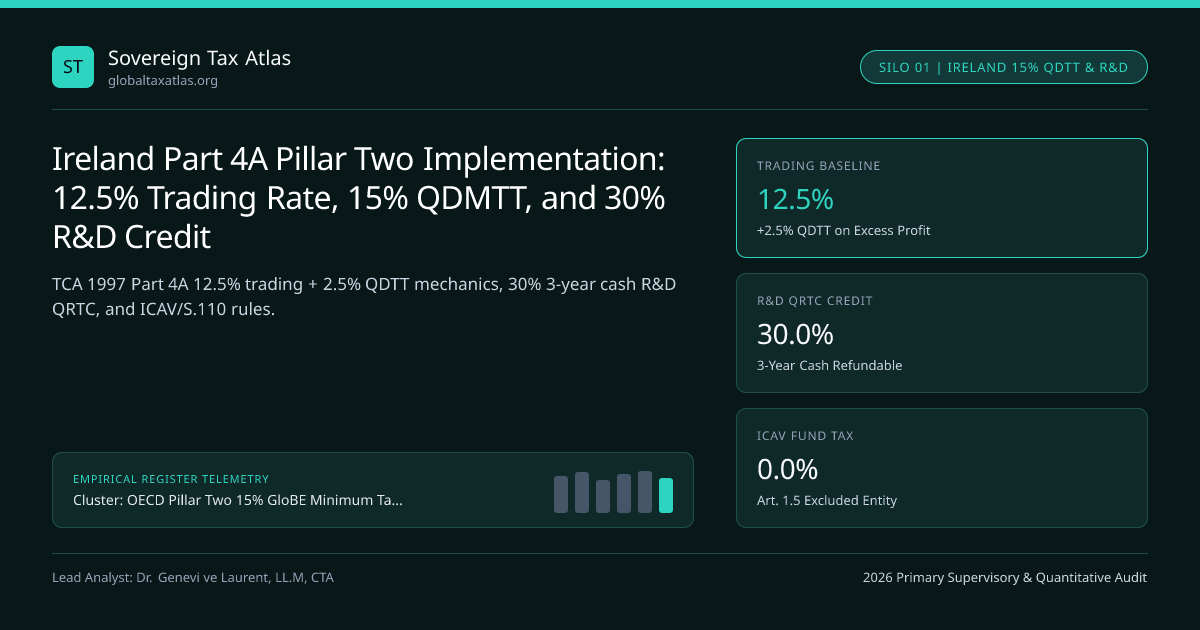
By inserting Part 4A (Sections 111A–111AAAE) into the Taxes Consolidation Act 1997 (TCA 1997) pursuant to EU Council Directive 2022/2523, Ireland executed one of Europe's sharpest fiscal balancing acts: retaining its iconic 12.5% Case I/II trading rate for more than 99% of domestic businesses (<EUR 750M group revenue), enacting a 15.0% Qualified Domestic Top-Up Tax (QDTT), IIR (from FY 2024), and UTPR (from FY 2025) for in-scope multinationals, and hiking its R&D Tax Credit to 30.0% (structured strictly as a three-year cash-refundable QRTC!). Situated inside our OECD Pillar Two 15% GloBE architecture guide, analyzing Irish QDTT mechanics—alongside Irish Collective Asset-management Vehicle (ICAV) fund exclusions and Section 110 securitisation SPVs—is essential across the OECD Pillar Two QDMTT & GloBE cluster.
Dual-Rate Persistence: 12.5% Trading + 25% Passive Blending + 2.5% QDTT#
Why didn't Dublin simply raise its statutory trading rate from 12.5% to 15.0% across the board? Two concrete arithmetic advantages favor keeping 12.5% Case I/II plus a 2.5% QDTT top-up:
- SME & Mid-Market Shield: Over 160,000 Irish companies outside EUR 750M groups keep the 12.5% rate untouched.
- SBIE & Case III/IV 25% Blending for Large MNEs: Even for a US tech or pharma giant exceeding EUR 750 million, paying 12.5% Case I tax plus 2.5% QDTT is cheaper than a flat 15% statutory CIT because:
- The 2.5% QDTT applies solely to Excess Profit after deducting Article 5.3 SBIE (9.6% Irish payroll + 7.6% Irish biopharma/fab tangibles in 2026), saving 2.5% × SBIE every year; and
- 25.0% Case III/IV non-trading income (interest, royalties outside a trade, rental income) and 33.0% chargeable capital gains on non-exempt assets blend directly with 12.5% Case I trading profits, frequently lifting blended Irish ETR to 13.8%–15.2% before QDTT!
Upgrading the Irish R&D Tax Credit From 25% to 30% QRTC#
Notice the exact fiscal precision of Finance (No. 2) Act 2023: when an R&D-intensive multinational's marginal Irish tax rate stepped up by 2.5 percentage points (from 12.5% to 15.0%), Dublin simultaneously increased the Section 766C/766D R&D Tax Credit by 5.0 percentage points—from 25.0% to 30.0%—and redesigned its payout into three mandatory unconditional annual installments (Year 1: max of EUR 50,000/EUR 75,000 or 50% of credit; Year 2: 60% of balance; Year 3: 100% remainder—payable in cash regardless of tax liability within 3 years ≤ 4-year GloBE limit!).
Because the 30% Irish R&D credit qualifies 100% as a Qualified Refundable Tax Credit, it enters the GloBE Income denominator rather than cutting the 12.5% Covered Tax numerator!
- / (CaseIProfit + CaseIIIInterest + RD30%QRTC_Recognized)
- NetCashTaxAfterRD = (0.125 * CaseIProfit + 0.25 * CaseIIIInterest) + IrishQDTT - CashRD30%Credit
- Worked Cork Biopharma Manufacturing & R&D Campus (FY 2026):
- Case I Trading Profit (pre-R&D credit) = EUR 400,000,000 | Baseline 12.5% Tax = EUR 50,000,000
- Qualifying Irish R&D Expenditure = EUR 100,000,000 -> 30.0% R&D QRTC = EUR 30,000,000!
- GloBE Income (incl. EUR 30M QRTC) = EUR 430,000,000 | Covered Tax = EUR 50,000,000
- Irish GloBE ETR = 50,000,000 / 430,000,000 = 11.63% -> Top-Up Tax % = 15.00% - 11.63% = 3.37%
- Campus 2026 SBIE (EUR 180M Payroll * 9.6% + EUR 600M Biologics Plant * 7.6%) = 17.28M + 45.60M = EUR 62,880,000!
- Excess Profit = 430,000,000 - 62,880,000 = EUR 367,120,000
- Irish QDTT = 3.3721% * 367,120,000 = EUR 12,379,600
- Gross Cash Tax (50.0M + 12.38M = EUR 62.38M) MINUS EUR 30.0M Cash R&D Credit = Net Outlay EUR 32,379,600 (8.09% of pre-credit profit!)
Section 291A Onshored IP Capital Allowances Under GloBE Article 9.1#
Between 2015 and 2020, scores of US technology and pharmaceutical multinationals migrated Cayman (CIMA) and Bermuda (BMA) intellectual property onshore into Ireland under Section 291A TCA 1997 (allowing capital allowances up to 80% of IP trading income, producing a 2.5% cash tax rate pre-2024). Under GloBE Article 9.1.1, deferred tax assets recorded on pre-November 30, 2021 intragroup IP step-ups—or legitimate third-party M&A IP acquisitions—reverse at up to 12.5% as Section 291A allowances are utilized, bringing Covered Taxes straight up to 12.5% so only the 2.5% QDTT gap applies! (Intragroup IP transfers occurring between December 1, 2021 and Pillar Two transition face strict Article 9.1.3 carrying-value caps unless foreign exit tax/CFC tax covered 15%.)
Irish ICAVs vs Section 110 Securitisation SPVs (Finance Act 2024 Update)#
Regulated within ESMA UCITS/AIFMD perimeters, Irish Collective Asset-management Vehicles (ICAVs)—celebrated under the Ireland ICAV 2026 Benchmark Standard for accessing 15% US-Ireland dividend withholding—are Article 1.5 Excluded Entities untouched by Part 4A. By contrast, Section 110 TCA 1997 Securitisation DACs posed a thorny trap if consolidated into a ≥EUR 750M bank or credit manager: imposing QDTT directly inside a bankruptcy-remote CLO/RMBS SPV would wreck credit-rating agency cash-flow waterfalls! Implementing June 2024 OECD Administrative Guidance via Finance Act 2024, Ireland excluded qualifying Securitisation Entities from bearing direct QDTT liability (or shifted any residual charge onto non-securitisation group members so the QDMTT Safe Harbor Switch-Off Rule stays contained), safeguarding structured-credit counterparties alongside European venues and FinDB-tracked firms like April Investors and Abstradex.
Ireland Part 4A Trading, R&D, and Fund Vehicle Matrix#
| Irish Tax Vehicle / Stream | Statutory TCA 1997 Rate | Part 4A Pillar Two Treatment | QDMTT Safe Harbor Status | Primary Planning Takeaway |
|---|---|---|---|---|
| Case I Trading (<EUR 750M) | 12.5% | Out of Scope | N/A | 12.5% rate preserved permanently |
| Case I Trading (>=EUR 750M) | 12.5% + up to 2.5% QDTT | 15.0% on Excess Profit | Full Safe Harbor (Local FRS 101/102/IFRS) | SBIE saves 2.5% * (Payroll/Plant carve-out) |
| Section 766C/D 30% R&D Credit | 30.0% Credit (3-Yr Cash) | QRTC -> Added to GloBE Income | Preserves Safe Harbor | Offsets both 12.5% Case I and 2.5% QDTT cash |
| Section 291A Onshored IP | 2.5% Cash + 10.0% DTA | Pre-Nov 2021 DTA counts in ETR | Safe Harbor intact | Verify Art. 9.1.3 cap on post-Nov 2021 intragroup IP |
| ICAV Funds / Orphan S.110 | 0.0% / Tax-Neutral PPN | Art. 1.5 Excluded / Unconsolidated | Securitisation SPV carve-out (FA 2024) | Confirm IFRS 10 non-consolidation on CLO equity retention |
Frequently asked questions
What happened to Ireland 6.25% Knowledge Development Box (KDB) rate after Pillar Two?
Because the KDB relief equals a 50% deduction linked to qualifying R&D nexus, Finance Act 2022/2023 adjusted the KDB deduction from 50% to 20%, raising the effective KDB rate from 6.25% to 10.0% (which is still topped up to 15.0% on Excess Profit for >=EUR 750M MNEs).
Can Irish subsidiaries calculate Irish QDTT using local FRS 101 or FRS 102 GAAP instead of US GAAP?
Yes, under Section 111AAD TCA 1997, if all Irish Constituent Entities of the MNE Group prepare financial accounts under local Irish GAAP (FRS 101, FRS 102, or EU-adopted IFRS) matching the UPE fiscal year, QDTT uses local accounts while retaining QDMTT Safe Harbor protection.
Do pre-2021 Section 291A IP capital allowances still protect Irish ETR up to 12.5%?
Yes. Deferred tax assets recognized on pre-November 30, 2021 Section 291A IP step-ups transition into GloBE under Article 9.1.1 at their 12.5% statutory rate, bringing Covered Taxes to 12.5% as allowances amortize so only the 2.5% QDTT gap remains.
Why did Finance Act 2024 amend Irish QDTT rules for Section 110 securitisation companies?
Rating agencies require CLO and RMBS Section 110 SPVs to remain tax-neutral without unpredictable group-level joint-and-several tax liabilities. Finance Act 2024 implemented June 2024 OECD guidance removing consolidated Securitisation Entities from direct QDTT liability and shifting any top-up to non-securitisation affiliates.
Publication record
- Published
- 14 November 2026
- Updated
- 14 November 2026
- Author
- Dr. Geneviève Laurent, LL.M, CTA
- Review
- Review not recorded
- Automated fact check
- Passed in the stored pipeline record
- Source URLs
- 3 recorded
AI assistance recorded: anthropic/claude-opus-4.6. This field does not establish human review or source verification.
Academic & Institutional Attribution
Cite This Research & Embed Live Data Card
Standard academic & institutional research paper citation format.
Dr. Geneviève Laurent, LL.M, CTA. (2026, November 14). Ireland Part 4A Pillar Two Implementation: 12.5% Trading Rate, 15% QDMTT, and 30% R&D Credit. Sovereign Tax Atlas. https://globaltaxatlas.org/entries/ireland-15-qdmtt-12-5-trading-rate-rd-tax-credit-alignmentRegulatory Directory Cross-Reference
Referenced Institutions & Regulatory Registries
Top Regulated Institutions in This Coverage Slice
Related Oecd Pillar Two Qdmtt Globe & Institutional Briefings
Explore Oecd Pillar Two Qdmtt Globe Hub (20) →Oecd Pillar Two Qdmtt Globe
OECD Pillar Two 15% GloBE Minimum Tax Architecture: QDMTT, IIR, and UTPR Institutional GuideOecd Pillar Two Qdmtt Globe
Luxembourg Pillar Two Law: Investment Undertaking Exemptions and Securitisation SPV RisksOecd Pillar Two Qdmtt Globe
GloBE Information Return (GIR) XML Schema, Centralized Filing, and Transitional PenaltiesOecd Pillar Two Qdmtt Globe
GloBE Article 1.1 EUR 750M Consolidated Revenue Scope, M&A Merger, and Demerger RulesOecd Pillar Two Qdmtt Globe
Pillar Two Article 1.5 Excluded Entities: Sovereign Wealth, Pension, and Investment FundsOecd Pillar Two Qdmtt Globe
Jurisdictional ETR Mechanics: Adjusted Covered Taxes and Five-Year Deferred Tax RecaptureOecd Pillar Two Qdmtt Globe
Computing GloBE Income or Loss: Article 3.2 Permanent Adjustments to Financial Accounting Net IncomeOecd Pillar Two Qdmtt Globe
Substance-Based Income Exclusion (SBIE): Transitional Payroll to 5% Steady-State Carve-OutsCrs 2 Carf Fatca Exchange Rules
OECD High-Risk CBI and RBI Golden Visa Blacklist: Enhanced CRS Due Diligence QuestionsCrs 2 Carf Fatca Exchange Rules
CRS 2.0 and CARF Duplication Switch-Off Rules: Tokenized Funds, RWA Securities, and StablecoinsDouble Tax Treaty Withholding Lob
OECD Model Article 10 Dividend Withholding: 5% Direct Participation, 365-Day Hold, and 15% PortfolioDouble Tax Treaty Withholding Lob
OECD Model Article 11 Interest Withholding: Bank Carve-Outs, Gross-Ups, and Arm’s-Length Caps
Sovereign Tax Atlas Data, Benchmarks & Contributor Records
CC BY 4.0 Open Data
Open Institutional Datasets (CSV / JSON) →
Download desk-compiled quantitative series & schemas.
2026 Reference Matrix
2026 Institutional Benchmarks & Thresholds →
Statutory capital, clearing, margin & rate conventions.
Editorial Records
Authors & Review Records →
View named contributors where those records are available.
Complete Index
Master Research & Dossier Archive →
Browse all published briefings by topic pillar & date.