
UAE 9% Corporate Tax and 15% Supplemental DMTT Across DIFC and DMCC Qualifying Free Zones
Effective for fiscal years starting January 1, 2025, the UAE imposed a 15.0% Domestic Minimum Top-Up Tax on EUR 750M+ MNEs—overriding both the 9% mainland corporate tax and the 0% DIFC and DMCC Qualifying Free Zone rate.
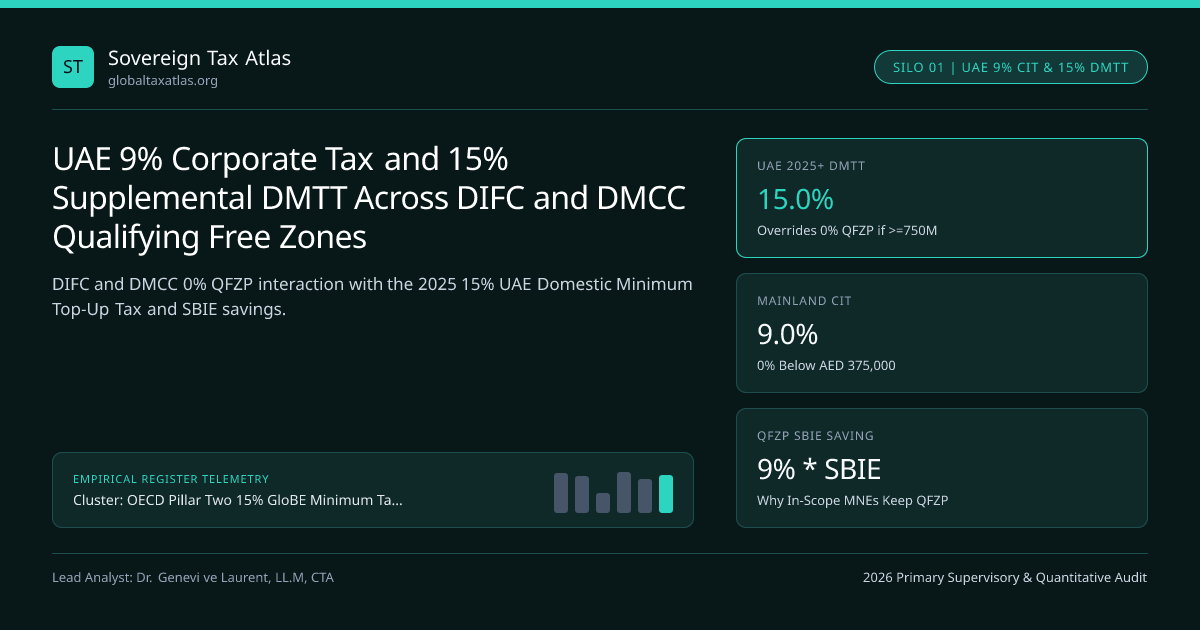
Within 24 months, the United Arab Emirates executed a two-stage fiscal transformation: first introducing a 9.0% federal Corporate Tax above AED 375,000 (preserving 0.0% on Qualifying Income of a Qualifying Free Zone Person [QFZP]) under Federal Decree-Law No. 47 of 2022, and second—via Federal Decree-Law No. 60 of 2023 and Ministry of Finance Cabinet Decision updates—enacting a 15.0% Domestic Minimum Top-Up Tax (DMTT) for fiscal years beginning on or after January 1, 2025. Framed within our OECD Pillar Two 15% GloBE architecture guide, understanding how the 15% UAE DMTT overrides Free Zone 0% incentives in the Dubai International Financial Centre (DIFC), Dubai Multi Commodities Centre (DMCC), and Dubai mainland (DET) is vital for regional headquarters and commodities desks across the OECD Pillar Two QDMTT & GloBE cluster.
Two-Tier UAE Corporate Tax Baseline vs 15% DMTT Override#
Every corporate group operating in Dubai or Abu Dhabi now navigates two concentric rings based solely on consolidated global revenue:
- Ring 1 — Groups Below EUR 750 Million Consolidated Revenue: Governed purely by Federal Decree-Law No. 47 of 2022. Mainland LLCs pay 0% on the first AED 375,000 (~USD 102,100) and 9.0% thereafter. Entities incorporated in Designated/Free Zones (DIFC, ADGM, DMCC, JAFZA) meeting QFZP criteria—adequate UAE economic substance, audited financial statements, arm's-length transfer pricing, and Non-Qualifying Revenue below the min(5% of total revenue, AED 5,000,000) de minimis ceiling—pay 0.0% UAE Corporate Tax on Qualifying Income (including fund/wealth management, headquarters services to related parties, treasury/financing to related parties, aircraft leasing, and physical commodity trading!).
- Ring 2 — In-Scope MNE Groups (≥EUR 750 Million in 2 of 4 Prior FYs): Effective January 1, 2025, the 15.0% UAE DMTT layers directly atop both mainland 9% entities (adding a ~6% top-up on Excess Profit) and 0% Free Zone QFZPs (adding a full 15.0% top-up on Excess Profit)!
Should an In-Scope MNE Subsidiary in DIFC Still Maintain QFZP Compliance?#
Here is a critical quantitative question CFOs in DIFC and DMCC frequently get wrong: "If our EUR 2 billion global commodities group has to pay 15% UAE DMTT starting in 2025 anyway, why bother maintaining strict QFZP de minimis and audited substance compliance to keep the 0% Free Zone rate instead of just forfeiting QFZP and paying 9% baseline CIT?"
Run the math on Article 5.3 Substance-Based Income Exclusion (SBIE)! Because SBIE reduces Excess Profit only for the top-up tax, a lower baseline statutory tax rate (0% QFZP vs 9% Mainland/Forfeited QFZP) directly saves 9.0% × SBIE in hard cash every single year!
- TotalUAETax (Maintained QFZP -> 0% CIT) = 0.00 + (0.15 - 0.00) * max(0, GloBEIncome - UAESBIE)
- AnnualCashSavingofKeepingQFZP = 0.09 * min(GloBEIncome, UAE_SBIE)
- Worked DMCC / DIFC Commodities & Regional HQ Hub (FY 2026; Global Group Revenue EUR 3.4B):
- Dubai Hub Net GloBE & Qualifying Income = USD 50,000,000
- Local Dubai Trader Payroll (USD 25M * 9.6%) + Bullion Vault / Office Tangibles (USD 40M * 7.6%):
- > FY 2026 UAE SBIE = USD 2,400,000 + USD 3,040,000 = USD 5,440,000
- > Excess Profit = USD 50,000,000 - USD 5,440,000 = USD 44,560,000
- Path A (Retains 0% QFZP Status):
- Law 47 CIT = USD 0 | UAE 15% DMTT = 15.0% * 44,560,000 = USD 6,684,000 (Effective Rate = 13.37%!)
- Path B (Drops QFZP Status -> Pays 9% CIT):
- Law 47 CIT = 9.0% * 50,000,000 = USD 4,500,000 | UAE 6% DMTT = 6.0% * 44,560,000 = USD 2,673,600
- Combined Tax = USD 7,173,600 (Effective Rate = 14.35% -> Losing QFZP costs USD 489,600/yr = 9% * USD 5.44M SBIE!)
Look at that result: retaining 0% QFZP status saves USD 489,600 every year (9.0% of the USD 5.44 million SBIE carve-out)—and moreover, forfeiting QFZP status triggers a mandatory five-year lock-out under UAE Ministerial Decision No. 265 of 2023, which would trap the hub at 9% even if a future corporate demerger (Article 6.1.2 spin-off rules) took the business below EUR 750 million!
UAE omitted IIR and UTPR in Initial 2025 Phase: Outbound HQ Implications#
Crucially, the UAE's 2025 Pillar Two rollout enacted the 15.0% DMTT (designed to secure QDMTT Safe Harbor status) and proposed R&D and High-Value Employment Refundable Tax Credits, while deferring enactment of an outbound Income Inclusion Rule (IIR) and Undertaxed Profits Rule (UTPR)! For UAE-headquartered sovereign conglomerates and holding groups:
- Domestic UAE profits and Free Zone profits are fully protected from foreign UTPR raids because the 15% UAE DMTT captures local top-up tax at home in Abu Dhabi/Dubai.
- However, if a UAE-headquartered UPE holds a 0%-taxed subsidiary in Cayman (CIMA) or BVI (BVIFSC) without an intermediate European/UK IPE, the absence of a UAE IIR leaves that Cayman/BVI subsidiary exposed to lateral UTPR assessments in any EU, UK, or Australian operating market where the UAE group employs staff!
Qualifying Investment Funds and Sovereign Wealth Entities#
Both UAE Law 47 (Articles 4 and 10) and GloBE Article 1.5 Excluded Entities protect Abu Dhabi/Dubai Sovereign Wealth Funds and Qualifying Investment Funds (QIFs) regulated in DIFC (DFSA) or ADGM (FSRA) at 0.0% tax—whereas proprietary FX and derivatives trading firms such as FinDB-listed Alamiya Markets and Agra Markets must verify whether principal-book trading qualifies under Free Zone commodity/treasury definitions.
UAE Mainland vs DIFC/DMCC Free Zone Pillar Two Matrix#
| UAE Entity Archetype | Global Group < EUR 750M | Global Group >= EUR 750M (2025+) | Foreign IIR / UTPR Exposure | Priority Governance Action |
|---|---|---|---|---|
| DIFC / ADGM Regulated Fund (QIF) | 0.0% (Law 47 Art. 10 Exempt) | 0.0% (GloBE Art. 1.5 Excluded) | None | File annual FTA QIF exemption declaration |
| DMCC Physical Commodity QFZP | 0.0% on Qualifying Commodity Trade | 15.0% UAE DMTT on Excess Profit | Zero (UAE QDMTT Safe Harbor) | Keep QFZP status to save 9% * SBIE annually! |
| Dubai Mainland Operating Sub (DET) | 9.0% (>AED 375,000) | 9.0% CIT + 6.0% UAE DMTT | Zero (UAE QDMTT Safe Harbor) | Group mainland subs for Law 47 Tax Group relief |
| DIFC Treasury & Regional HQ QFZP | 0.0% on Related-Party Services | 15.0% UAE DMTT on Excess Profit | Zero | Substantiate local trader/HQ FTEs for 9.6% SBIE |
| UAE UPE Owning 0% BVI Sub (BVIFSC) | 0.0% Participation Exemption | UAE has no IIR -> BVI Sub at 0% | High! EU/UK sister subs hit by UTPR | Insert UK/Lux/SG IIR sub-holding or onshore BVI IP |
Frequently asked questions
Does the 15% UAE DMTT eliminate the 0% DIFC and DMCC Free Zone tax regime for mid-sized businesses?
Not at all. Groups whose global consolidated revenue stays below EUR 750 million (roughly AED 3.0 billion) are completely outside the UAE 15% DMTT and continue to pay 0.0% on Qualifying Income if they satisfy QFZP criteria.
What is the penalty if a DMCC or DIFC entity breaches the 5% / AED 5 million Non-Qualifying Revenue de minimis cap?
Under Ministerial Decision No. 265 of 2023, breaching the de minimis threshold forfeits Qualifying Free Zone Person status for that entire tax period AND the subsequent four tax periods (a 5-year lock-out at the 9.0% standard corporate tax rate).
Did the UAE introduce dividend or interest withholding tax alongside the 9% CIT and 15% DMTT?
No. The UAE statutory withholding tax rate on cross-border dividends, interest, royalties, and service fees remains fixed at 0.0%, preserving frictionless treasury cash pooling and regional holding structures.
How do proposed UAE R&D and High-Value Employment credits interact with the 15% DMTT?
Announced alongside the 2025 DMTT framework for 2026 rollout, UAE 30%–50% R&D tax credits and high-value employment credits are structured as four-year Qualified Refundable Tax Credits (QRTCs) treated as GloBE Income rather than Covered Tax reductions.
Publication record
- Published
- 14 November 2026
- Updated
- 15 November 2026
- Author
- Dr. Geneviève Laurent, LL.M, CTA
- Review
- Review not recorded
- Automated fact check
- Passed in the stored pipeline record
- Source URLs
- 4 recorded
AI assistance recorded: anthropic/claude-opus-4.6. This field does not establish human review or source verification.
Academic & Institutional Attribution
Cite This Research & Embed Live Data Card
Standard academic & institutional research paper citation format.
Dr. Geneviève Laurent, LL.M, CTA. (2026, November 15). UAE 9% Corporate Tax and 15% Supplemental DMTT Across DIFC and DMCC Qualifying Free Zones. Sovereign Tax Atlas. https://globaltaxatlas.org/entries/uae-difc-dmcc-9-corporate-tax-15-supplemental-dmtt-free-zonesRegulatory Directory Cross-Reference
Referenced Institutions & Regulatory Registries
Top Regulated Institutions in This Coverage Slice
Related Oecd Pillar Two Qdmtt Globe & Institutional Briefings
Explore Oecd Pillar Two Qdmtt Globe Hub (20) →Oecd Pillar Two Qdmtt Globe
OECD Pillar Two 15% GloBE Minimum Tax Architecture: QDMTT, IIR, and UTPR Institutional GuideOecd Pillar Two Qdmtt Globe
Singapore Domestic Top-Up Tax (DTT), Multinational Enterprise Minimum Tax, and RIC IncentivesOecd Pillar Two Qdmtt Globe
Hong Kong Minimum Top-Up Tax (HKMTT) Interaction With Territorial Source and FSIE RulesOecd Pillar Two Qdmtt Globe
Ireland Part 4A Pillar Two Implementation: 12.5% Trading Rate, 15% QDMTT, and 30% R&D CreditOecd Pillar Two Qdmtt Globe
Luxembourg Pillar Two Law: Investment Undertaking Exemptions and Securitisation SPV RisksOecd Pillar Two Qdmtt Globe
GloBE Information Return (GIR) XML Schema, Centralized Filing, and Transitional PenaltiesOecd Pillar Two Qdmtt Globe
GloBE Article 1.1 EUR 750M Consolidated Revenue Scope, M&A Merger, and Demerger RulesOecd Pillar Two Qdmtt Globe
Pillar Two Article 1.5 Excluded Entities: Sovereign Wealth, Pension, and Investment FundsCrs 2 Carf Fatca Exchange Rules
Private Trust Companies (PTCs) and Single-Family Offices: CRS Investment Entity ClassificationCrs 2 Carf Fatca Exchange Rules
Switzerland AEOI Act Overhaul: US FATCA Model 1 IGA Switch, CRS 2.0, and CARF ImplementationCrs 2 Carf Fatca Exchange Rules
Singapore IRAS CRS, CARF, and FATCA Governance: Variable Capital Companies (VCC) and 13O/13U FundsCrs 2 Carf Fatca Exchange Rules
OECD High-Risk CBI and RBI Golden Visa Blacklist: Enhanced CRS Due Diligence Questions
Sovereign Tax Atlas Data, Benchmarks & Contributor Records
CC BY 4.0 Open Data
Open Institutional Datasets (CSV / JSON) →
Download desk-compiled quantitative series & schemas.
2026 Reference Matrix
2026 Institutional Benchmarks & Thresholds →
Statutory capital, clearing, margin & rate conventions.
Editorial Records
Authors & Review Records →
View named contributors where those records are available.
Complete Index
Master Research & Dossier Archive →
Browse all published briefings by topic pillar & date.