
Bermuda 15% Corporate Income Tax Act vs GloBE QDMTT Parity for Insurers and HoldCos
Effective January 1, 2025, Bermuda replaced zero-rate tax assurance certificates for EUR 750M+ MNE groups with a standalone 15.0% Corporate Income Tax featuring Economic Transition Adjustments.
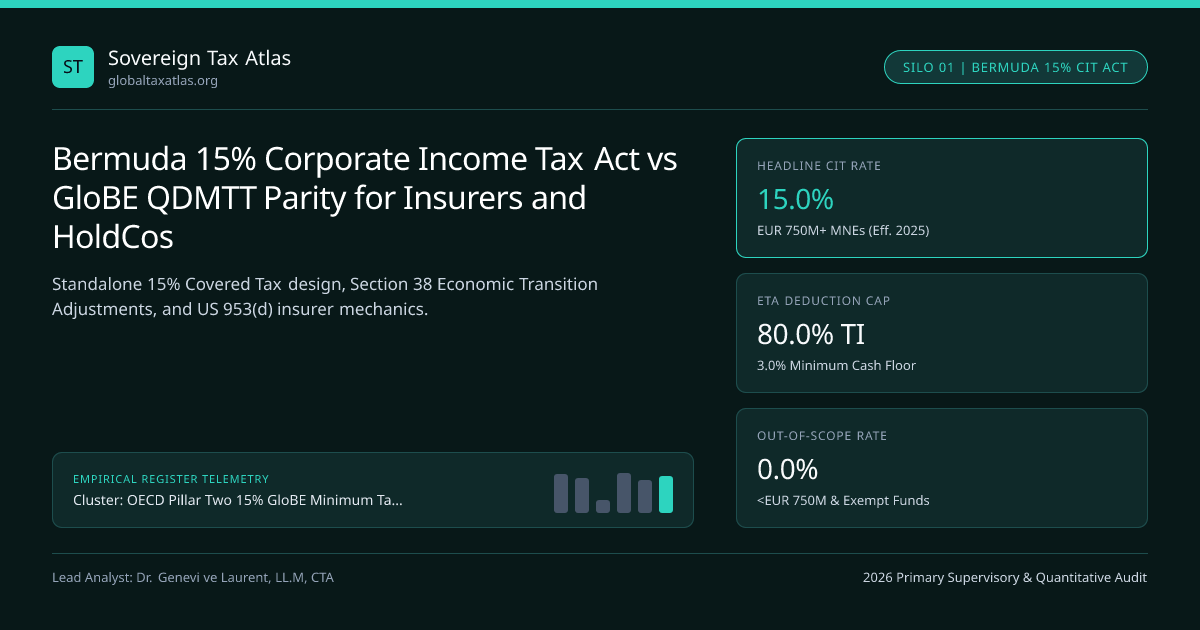
Rather than enacting a Qualified Domestic Minimum Top-Up Tax, Bermuda enacted the Corporate Income Tax Act 2023—imposing a 15.0% standalone statutory corporate income tax effective for fiscal years beginning on or after January 1, 2025 exclusively on Bermuda Constituent Entities of In-Scope MNE Groups (≥EUR 750 million consolidated revenue), overriding legacy Exempted Undertakings Tax Protection Act 1966 tax-assurance certificates. Within our OECD Pillar Two 15% GloBE architecture guide, choosing a regular Chapter 4 Covered Tax over a QDMTT Safe Harbor statute creates profound strategic advantages for US-parented property-catastrophe and life reinsurers supervised by the Bermuda Monetary Authority (BMA) across the OECD Pillar Two QDMTT & GloBE cluster.
Why Bermuda Enacted a Standalone 15% CIT Instead of a QDMTT#
Two structural imperatives drove Bermuda's Ministry of Finance and BMA-regulated reinsurance industry toward a regular corporate income tax:
- US Foreign Tax Credit (FTC) Creditability & GILTI Pushdown: Under US Treasury regulations and IRS Notice 2023-80, a standalone foreign corporate income tax applies before US Subpart F and GILTI, generating creditable foreign income taxes in the general/passive baskets—and conversely, if Bermuda tax is temporarily reduced by transition DTAs, parent CFC/GILTI taxes can push down into Bermuda's GloBE Covered Taxes (whereas CFC pushdown is strictly banned inside a QDMTT!).
- Preserving 0% Neutrality Below EUR 750 Million: Standalone captive insurers, catastrophe bond Special Purpose Insurers (SPIs), investment funds (Article 1.5 Excluded Entities), and mid-market Bermuda groups below EUR 750 million remain at 0.0% Bermuda corporate tax, preserving traditional offshore neutrality outside Pillar Two's perimeter.
Note also the Limited International Presence 5-Year Exemption: mirroring GloBE Article 9.3 startup UTPR relief, a Bermuda MNE group with Constituent Entities in no more than six jurisdictions and ≤EUR 50 million of tangible assets outside its reference jurisdiction is exempt from Bermuda CIT for five years (until 2030).
Economic Transition Adjustments (ETA) vs GloBE Article 9.1.1 Restrictions#
To soften the cliff transition from 0% to 15% for long-established insurers holding decades of seasoned insurance liabilities and intangible broker relationships, Section 38 of the Bermuda CIT Act introduced the Economic Transition Adjustment (ETA): an elective fair-value minus carrying-value step-up (as of September 30, 2023) on all assets and liabilities (excluding goodwill), amortized straight-line at 10% per year over 10 years starting in 2025, alongside opening tax loss carryforwards incurred after September 30, 2021—collectively capped at offsetting 80.0% of Bermuda Taxable Income in any single year (guaranteeing a minimum 3.0% cash tax floor when fully utilized!).
Critical GloBE Article 9.1.2 Warning: Does Bermuda's unilateral September 30, 2023 fair-value ETA DTA count in the parent group's GloBE Chapter 4 Adjusted Covered Taxes? NO! Under GloBE Article 9.1.2 and OECD Administrative Guidance on pre-GloBE deferred tax assets, deferred tax benefits created by retroactive tax-basis revaluations enacted after November 30, 2021 without an actual taxable gain event are disallowed in GloBE ETR! Unless the group relies on existing pre-November 30, 2021 accounting DTAs or US Subpart F/GILTI CFC pushdown, utilizing the Bermuda ETA to cut Bermuda cash tax from 15% down to 3% depresses the parent's GloBE ETR to 3%—triggering a 12% foreign IIR or UTPR top-up!
- ParentGloBEETRonBermuda = (BermudaCashCIT + AllowedArt91DTAReversal + CappedParentCFCPushdown) / BermudaNetGloBE_Income
- Worked Bermuda Reinsurer Scenario (FY 2026; Non-US UK-Parented Insurer vs US-Parented Insurer):
- Bermuda Net GloBE & Taxable Income = USD 200,000,000
- Elected Bermuda ETA Annual Deduction = USD 160,000,000 (hits 80% Taxable Income cap!)
- Bermuda Cash CIT Paid = 15.0% * (200M - 160M) = 15.0% * USD 40,000,000 = USD 6,000,000 (3.00% Cash Rate)
- Case A (UK Parent with Qualified IIR, Zero CFC Tax):
- ETA DTA disallowed under GloBE Art. 9.1.2 -> Bermuda GloBE ETR = 6M / 200M = 3.00%!
- UK Parent pays 12.00% IIR Top-Up Tax = USD 24,000,000 -> Electing Bermuda ETA saved USD 0 group-wide; Opt OUT of ETA so Bermuda collects the full USD 30M locally!
- Case B (US Parent Taxed on Bermuda Sub under IRC Sec. 953(d) / Subpart F at 21%):
- US Subpart F tax pushes down up to (15.0% - 3.0%) = 12.0% under Art. 4.3.3 -> Bermuda GloBE ETR = 15.00% -> Foreign UTPR = USD 0!
Fiscal Credits, Substance QRTCs, and IRC Section 953(d) Elections#
Bermuda's Tax Reform Commission has followed up the 2023 Act with substance-linked Qualified Refundable Tax Credits (modeled on Article 3.2.4 QRTC standards) rewarding local employment, housing infrastructure, and fintech innovation in Hamilton. Note, however, a crucial nuance for IRC Section 953(d) electing Bermuda insurers: because a 953(d) company is taxed by the US as if it were a domestic US corporation, Bermuda CIT Act rules allow separating 953(d) entities into standalone Bermuda tax groups and adjusting FTC ordering so US and Bermuda credits do not become circular—a vital diligence point alongside Crown Dependencies 15% multinational tax regimes and counterparty reviews of offshore entities like Island Prime 54 Limited 7584 and Agile Global Limited.
Compliance Administration, Installments, and CbCR Safe Harbor Overlap#
Because Bermuda CIT is a regular Covered Tax rather than a QDMTT Safe Harbor, every parent MNE Group must still report Bermuda inside its GloBE Information Return XML filing. However, for FY 2025 and FY 2026, paying 15% Bermuda CIT—or combining Bermuda current and deferred tax expense on Qualified Financial Statements where ETR hits 16% (2025) or 17% (2026)—can interact directly with Transitional CbCR Safe Harbor gates, while local Bermuda CIT quarterly installments and electronic returns introduce full tax-provision governance across BMA registrants.
Bermuda CIT Act vs Parent GloBE Outcome Matrix#
| Bermuda Entity / Group Profile | Bermuda CIT Act Rate | Claim Sec. 38 ETA Step-Up? | Parent GloBE Top-Up Outcome | Key Statutory / Structuring Control |
|---|---|---|---|---|
| MNE Group < EUR 750M Revenue | 0.0% (Out of Scope) | N/A | 0.0% (Out of Pillar Two) | Monitor Art. 6.1 M&A merger revenue spikes |
| Expanding Group (<=6 States, <=EUR 50M) | 0.0% (5-Yr Exemption) | Defer to 2030 | 0.0% UTPR (IIR applies if UPE in IIR state!) | Beware: UK/EU UPE IIR still taxes 0% Bermuda sub! |
| UK / EU / JP Reinsurer Sub | 15.0% | Waive ETA (Elect Out) | 15.0% Bermuda Covered Tax -> 0% Parent IIR | Avoid paying 3% BM + 12% IIR dual compliance |
| US Subpart F / GILTI Captive | 15.0% (3.0% w/ Max ETA) | Claim ETA (80% Cap) | 3% BM + up to 12% US CFC Pushdown = 15% ETR | Model post-2025 Blended CFC allocation expiry |
| Orphan Cat-Bond SPI (BMA) | 0.0% (Unconsolidated) | N/A | Excluded from Sponsor MNE Consolidation | Verify IFRS 10 variable-interest non-consolidation |
Frequently asked questions
Did Bermuda Exempted Undertakings Tax Assurance Certificates extending to 2035 block the 2025 15% CIT?
No. The Bermuda Corporate Income Tax Act 2023 explicitly amended and overrode the Exempted Undertakings Tax Protection Act 1966 solely with respect to Bermuda Constituent Entities belonging to in-scope EUR 750M+ MNE Groups, leaving assurance certificates intact for out-of-scope companies.
Why does the 5-year Limited International Presence exemption in Bermuda have a trap for UK-parented groups?
Bermuda 5-year exemption mirrors the GloBE Article 9.3 UTPR exemption (<=6 jurisdictions and <=EUR 50M foreign tangibles), dropping Bermuda CIT to 0%. However, a foreign UPE in the UK or EU still applies its IIR during those five years—so a UK-parented group should voluntarily opt out of the Bermuda exemption!
Are Bermuda catastrophe bond Special Purpose Insurers (SPIs) taxed at 15%?
Almost never. Catastrophe bond SPIs licensed by the BMA are typically structured as orphan charitable-trust vehicles not consolidated line-by-line into the ceding sponsor MNE Group Consolidated Financial Statements, keeping them outside Constituent Entity scope.
Can pre-2025 operating losses offset 100% of a Bermuda subsidiary 2025 taxable profit?
No. Opening tax loss carryforwards incurred between October 1, 2021 and December 31, 2024 (combined with Economic Transition Adjustments) are subject to an 80.0% annual taxable income deduction ceiling, leaving at least 20% of taxable income subject to the 15% rate (a 3.0% minimum cash floor).
Publication record
- Published
- 14 November 2026
- Updated
- 14 November 2026
- Author
- Dr. Geneviève Laurent, LL.M, CTA
- Review
- Review not recorded
- Automated fact check
- Passed in the stored pipeline record
- Source URLs
- 3 recorded
AI assistance recorded: anthropic/claude-opus-4.6. This field does not establish human review or source verification.
Academic & Institutional Attribution
Cite This Research & Embed Live Data Card
Standard academic & institutional research paper citation format.
Dr. Geneviève Laurent, LL.M, CTA. (2026, November 14). Bermuda 15% Corporate Income Tax Act vs GloBE QDMTT Parity for Insurers and HoldCos. Sovereign Tax Atlas. https://globaltaxatlas.org/entries/bermuda-15-corporate-income-tax-act-economic-transition-globeRegulatory Directory Cross-Reference
Referenced Institutions & Regulatory Registries
Mentioned Regulated Institutions
Referenced Supervisory Authorities
Related Oecd Pillar Two Qdmtt Globe & Institutional Briefings
Explore Oecd Pillar Two Qdmtt Globe Hub (20) →Oecd Pillar Two Qdmtt Globe
OECD Pillar Two 15% GloBE Minimum Tax Architecture: QDMTT, IIR, and UTPR Institutional GuideOecd Pillar Two Qdmtt Globe
Crown Dependencies Pillar Two Response: Jersey and Guernsey 15% Multinational Tax RegimesOecd Pillar Two Qdmtt Globe
Caribbean Pillar Two Enactments: Bahamas 15% DMTT and Barbados 9% to 15% Tiered Tax ReformOecd Pillar Two Qdmtt Globe
UAE 9% Corporate Tax and 15% Supplemental DMTT Across DIFC and DMCC Qualifying Free ZonesOecd Pillar Two Qdmtt Globe
Singapore Domestic Top-Up Tax (DTT), Multinational Enterprise Minimum Tax, and RIC IncentivesOecd Pillar Two Qdmtt Globe
Hong Kong Minimum Top-Up Tax (HKMTT) Interaction With Territorial Source and FSIE RulesOecd Pillar Two Qdmtt Globe
Ireland Part 4A Pillar Two Implementation: 12.5% Trading Rate, 15% QDMTT, and 30% R&D CreditOecd Pillar Two Qdmtt Globe
Luxembourg Pillar Two Law: Investment Undertaking Exemptions and Securitisation SPV RisksCrs 2 Carf Fatca Exchange Rules
IRS Form 1099-DA Digital Asset Broker Reporting vs OECD CARF: Cost Basis and Non-US ExemptionsCrs 2 Carf Fatca Exchange Rules
Dual Tax Residency Under CRS 2.0 and CARF: Elimination of Treaty Tie-Breaker Self-CertsCrs 2 Carf Fatca Exchange Rules
CRS Preexisting vs New Account Due Diligence: USD 1M High-Value Paper Searches and Curing IndiciaCrs 2 Carf Fatca Exchange Rules
Private Trust Companies (PTCs) and Single-Family Offices: CRS Investment Entity Classification
Sovereign Tax Atlas Data, Benchmarks & Contributor Records
CC BY 4.0 Open Data
Open Institutional Datasets (CSV / JSON) →
Download desk-compiled quantitative series & schemas.
2026 Reference Matrix
2026 Institutional Benchmarks & Thresholds →
Statutory capital, clearing, margin & rate conventions.
Editorial Records
Authors & Review Records →
View named contributors where those records are available.
Complete Index
Master Research & Dossier Archive →
Browse all published briefings by topic pillar & date.