
Economic Substance Cfc Transfer Pricing
Offshore Economic Substance Statutes, CFC Attribution Regimes, and OECD Transfer Pricing DEMPE Guide
Modern international corporate structuring enforces a three-sided vise: offshore CIGA Economic Substance statutes, parent-level Controlled Foreign Company (CFC) look-through taxes, and OECD Transfer Pricing DEMPE profit allocation.
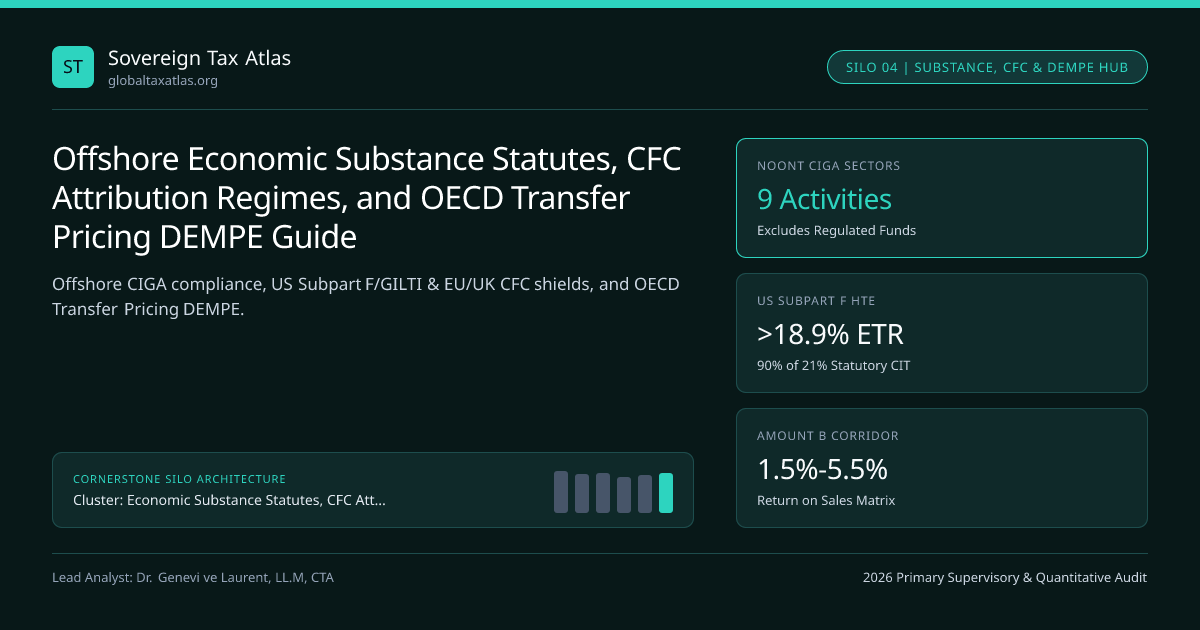
Placing intellectual property, treasury lending, captive insurance, or regional procurement inside a zero- or low-tax subsidiary now confronts three interlocking enforcement perimeters simultaneously: local Offshore Economic Substance Statutes (policed by the OECD Forum on Harmful Tax Practices and EU Code of Conduct Group), parent-country Controlled Foreign Company (CFC) Current-Inclusion Regimes, and OECD Transfer Pricing Guidelines (2022/2025 Consolidated Edition) DEMPE & Risk-Control Allocation. Benchmarked alongside OECD Pillar Two 15% GloBE Minimum Tax and Treaty PPT/LOB Substance Standards, this hub orchestrates all twenty technical guides across the Economic Substance Statutes, CFC Attribution & Transfer Pricing DEMPE cluster.
Three Simultaneous Perimeters Auditing Every Cross-Border Subsidiary#
Why does satisfying one tax authority frequently fail the other two? Because each perimeter tests a completely different statutory metric:
- Perimeter 1 — Local Offshore Economic Substance (CIGA, FTEs & Opex): Enacted across "No or Only Nominal Tax" (NOONT) and preferential-regime hubs—including Cayman Islands CIGA rules, BVI ITA Rulebook & foreign residency claims, Jersey, Guernsey & Bermuda physical board quorums, Labuan IBFC FTE/MYR gates, and UAE 0% QFZP substance integration—with draconian rebuttable presumptions of non-compliance and spontaneous tax exchange on High-Risk Offshore IP!
- Perimeter 2 — Parent-Jurisdiction Controlled Foreign Company (CFC) Attribution: Even if an offshore subsidiary leases an office and hires three local staff, its parent shareholder's tax authority pierces the corporate veil and taxes passive or mobile profits currently under US Subpart F & the 18.9% High-Tax Exception, US GILTI / NCTII (IRC Sec. 951A), EU ATAD Article 7–8 Model A vs Model B CFC rules, or UK TIOPA Part 9A CFC gateways!
- Perimeter 3 — OECD Transfer Pricing Value Creation (DEMPE, Amount B & Ch. X): Operating subsidiaries and headquarters challenge deductions and reallocate residual profits to where human executives actually control Development, Enhancement, Maintenance, Protection, and Exploitation under OECD Chapter VI DEMPE, Hard-to-Value Intangibles (HTVI) 20% corridors, Pillar One Amount B wholesale distribution margins, Chapter X financial transactions, and Chapter IX exit-tax restructurings.
Crucial Ordering Rule: How CFC Taxes Interact With 15% Pillar Two QDMTT!#
Corporate tax directors often ask: "Now that OECD Pillar Two 15% Minimum Tax is live, did countries repeal their CFC laws?" No—not a single major economy repealed its CFC statutes! Instead, GloBE Article 4.3.2(c) created a precise ordering cascade:
- Local QDMTT Runs BEFORE Parent CFC Tax (if the local QDMTT is designed to disallow credit for foreign CFC taxes, which virtually every EU/UK/UAE/SG/HK QDMTT does!). Thus, a 15% local QDMTT collects the minimum tax locally first—and frequently raises the subsidiary's foreign effective tax rate high enough to help clear UK CFC 75% lower-level tax exemptions or US GILTI/Subpart F foreign tax credit shields!
- Where a jurisdiction has no QDMTT (such as Cayman CIMA or BVI BVIFSC), Parent Subpart F / ATAD CFC taxes push down into the subsidiary's Pillar Two Covered Taxes (subject to the 15% Blended CFC Regimes allocation formula for US GILTI!).
Quantitative Profit-Allocation & CFC Inclusion Cascade Example#
- [Condition: HubCoShare == 0.0% (Risk-Free Financing Return ONLY!) if HubCo lacks OwnEmployeesControllingDEMPE_Risks!]
- Worked USD 100M Global MedTech Operating Profit Split Across US Parent, Irish R&D Hub, Cayman Cash-Box IP Co, and EU Distributors:
- Total System EBIT = USD 100,000,000 | EU Distributors (USD 400M Sales * 3.5% Amount B Return on Sales) = USD 14,000,000.
- Contract R&D Support (Cost USD 30M + 8% Markup) = USD 2,400,000 -> Residual Entrepreneurial IP Profit = USD 83,600,000!
- If Cayman Cash-Box IP Co holds legal patent title with 0 DEMPE scientists:
- 1. Transfer Pricing Ch. VI Audit: Allocates USD 0 residual IP profit to Cayman (only ~4.8% risk-free return on cash funded)!
- 2. Cayman ES Act: High-Risk IP Rebuttable Presumption triggered -> Spontaneous EOI sent to IRS & EU states + KYD 100k fine!
- 3. US Subpart F / GILTI: Any residual passive royalty swept immediately into US Parent taxable income!
Defensive Documentation: CCAs, Master/Local Files, LVAS, and Bilateral APAs#
To prevent double taxation when two high-tax countries both claim the exact same DEMPE or financing profit, institutional groups anchor intercompany pricing inside Cost Contribution Arrangements (CCAs), BEPS Action 13 Master File & Local File penalty shields, 5% Low Value-Adding Services (LVAS) safe harbors, and binding Bilateral APAs & Article 25 MAP Mandatory Arbitration.
Master Substance, CFC & Transfer Pricing Coordination Matrix#
Multinational tax leaders, fiduciary directors across CIMA, BVIFSC, JFSC, and Labuan IBFC, and global execution houses like 360 Capital and Agile Global Limited align all three perimeters using this coordination matrix:
| Offshore / Hub Function | Local Economic Substance Gate | Parent CFC Risk | OECD Transfer Pricing Rule | Best Institutional Structure |
|---|---|---|---|---|
| Pure Equity Holding Co | Reduced Substance (Cayman/BVI) | Dividend participation exempt (EU/UK/US 245A) | Minimal TP (Cost admin only) | Keep 100% pure equity (zero loans!) |
| Intragroup Treasury / Loans | Full CIGA (Board + FTEs + Opex) | High! (Subpart F FPHCI / UK Ch. 9 Finance) | OECD Ch. X Credit Rating & Spread | Centralize in UK/Lux/SG/IE (>=12.5%-19% CIT) |
| IP Licensing & R&D Hub | High-Risk IP Presumption! (Avoid Offshore!) | Extreme (Subpart F / ATAD Model A / GILTI) | Ch. VI DEMPE + HTVI 20% | Co-locate IP legal title with real R&D engineers! |
| Regional Wholesale Distrib. | Distribution & Service Center CIGA | Sales/Services Branch CFC rules | Amount B 1.5%–5.5% ROS | Benchmark inside OECD Amount B pricing matrix |
| Investment Fund (CIMA/RAIF) | Investment Fund Carve-Out! (Exempt ES) | Investor-level PFIC / CFC tests | Fund mgmt fee arm's-length split | Maintain regulated fund status (CIMA/BVIFSC) |
Frequently asked questions
Are regulated Cayman Mutual Funds, Private Funds, and BVI Approved Funds subject to local Economic Substance FTE and office tests?
No! Under Cayman, BVI, Jersey, Guernsey, and Bermuda Economic Substance Acts, "Investment Fund Business" is explicitly carved out of Relevant Activities (though note the discretionary Fund Manager entity itself may fall into Fund Management CIGA if licensed locally!).
Why does lending money from a Cayman "Pure Equity Holding Company" to its subsidiary ruin its Reduced Economic Substance status?
Statutory Reduced Substance applies ONLY to an entity that "only holds equity participations in other entities and only earns dividends and capital gains." Making an interest-bearing loan immediately triggers "Financing and Leasing Business," requiring local Cayman CIGA, physical board meetings, qualified staff, and Cayman expenditure!
Can a taxpayer pass EU ATAD CFC rules in Europe even if a subsidiary pays 0% corporate tax?
Under EU ATAD Article 7(2)(a) ("Cadbury Schweppes substantive economic activity carve-out," mandatory for EEA subsidiaries and optional for third countries depending on Member State transposition), Model A CFC inclusion does NOT apply if the CFC carries on a substantive economic activity supported by staff, equipment, assets, and premises!
What happens if a company fails Cayman or BVI Economic Substance requirements two years in a row?
First-year failure triggers an administrative penalty (e.g., KYD 10,000 in Cayman; USD 20,000–50,000 in BVI) PLUS mandatory spontaneous exchange of information with the parent and UBO home tax authorities; second consecutive failure escalates fines to KYD 100,000 / USD 200,000–400,000 AND court-ordered corporate strike-off!
Publication record
- Published
- 14 November 2026
- Updated
- 14 November 2026
- Author
- Dr. Geneviève Laurent, LL.M, CTA
- Review
- Review not recorded
- Automated fact check
- Passed in the stored pipeline record
- Source URLs
- 4 recorded
AI assistance recorded: anthropic/claude-opus-4.6. This field does not establish human review or source verification.
Academic & Institutional Attribution
Cite This Research & Embed Live Data Card
Standard academic & institutional research paper citation format.
Dr. Geneviève Laurent, LL.M, CTA. (2026, November 14). Offshore Economic Substance Statutes, CFC Attribution Regimes, and OECD Transfer Pricing DEMPE Guide. Sovereign Tax Atlas. https://globaltaxatlas.org/entries/economic-substance-cfc-rules-transfer-pricing-dempe-guideRegulatory Directory Cross-Reference
Referenced Institutions & Regulatory Registries
Top Regulated Institutions in This Coverage Slice
Related Economic Substance Cfc Transfer Pricing & Institutional Briefings
Explore Economic Substance Cfc Transfer Pricing Hub (20) →Economic Substance Cfc Transfer Pricing
Cayman Islands Economic Substance Act: Nine Relevant Activities, CIGA Outsourcing, and Pure Equity HoldCosEconomic Substance Cfc Transfer Pricing
BVI Economic Substance Act and ITA Rules: Financial Periods, BOSSs Filings, and EU Blacklist RulesEconomic Substance Cfc Transfer Pricing
Jersey, Guernsey, and Bermuda Economic Substance: Physical Island Board Quorums and Corporate Tax ReturnsEconomic Substance Cfc Transfer Pricing
High-Risk IP in Offshore Economic Substance: Rebuttable Presumptions and Spontaneous Tax ExchangeEconomic Substance Cfc Transfer Pricing
US Subpart F Income (IRC Sections 951–964): FPHCI Rules, Look-Through, and the 18.9% High-Tax ExceptionEconomic Substance Cfc Transfer Pricing
US GILTI / Net CFC Tested Income (IRC Section 951A): 2026 OBBBA Reforms, Section 250, and FTC HaircutsEconomic Substance Cfc Transfer Pricing
EU Anti-Tax Avoidance Directive (ATAD) Articles 7–8 CFC Rules: Model A Passive Categories vs Model B SPFEconomic Substance Cfc Transfer Pricing
UK TIOPA 2010 Part 9A CFC Regime: Chapter 3 Gateways, 75% Tax Exemption, and Chapter 9 Finance Company RulesCross Border Fund Spv Tax Neutrality
Cross-Border Fund Tax Neutrality Guide: Blocker SPVs, Check-the-Box Elections, and Treaty PlatformsOecd Pillar Two Qdmtt Globe
GloBE Article 1.1 EUR 750M Consolidated Revenue Scope, M&A Merger, and Demerger RulesOecd Pillar Two Qdmtt Globe
Pillar Two Article 1.5 Excluded Entities: Sovereign Wealth, Pension, and Investment FundsOecd Pillar Two Qdmtt Globe
Jurisdictional ETR Mechanics: Adjusted Covered Taxes and Five-Year Deferred Tax Recapture
Sovereign Tax Atlas Data, Benchmarks & Contributor Records
CC BY 4.0 Open Data
Open Institutional Datasets (CSV / JSON) →
Download desk-compiled quantitative series & schemas.
2026 Reference Matrix
2026 Institutional Benchmarks & Thresholds →
Statutory capital, clearing, margin & rate conventions.
Editorial Records
Authors & Review Records →
View named contributors where those records are available.
Complete Index
Master Research & Dossier Archive →
Browse all published briefings by topic pillar & date.