
Substance-Based Income Exclusion (SBIE): Transitional Payroll to 5% Steady-State Carve-Outs
OECD GloBE Article 5.3 shelters routine returns on physical operations from the 15% top-up tax by deducting transitional percentages of Eligible Payroll Costs and Eligible Tangible Assets before converging at 5% in 2033.
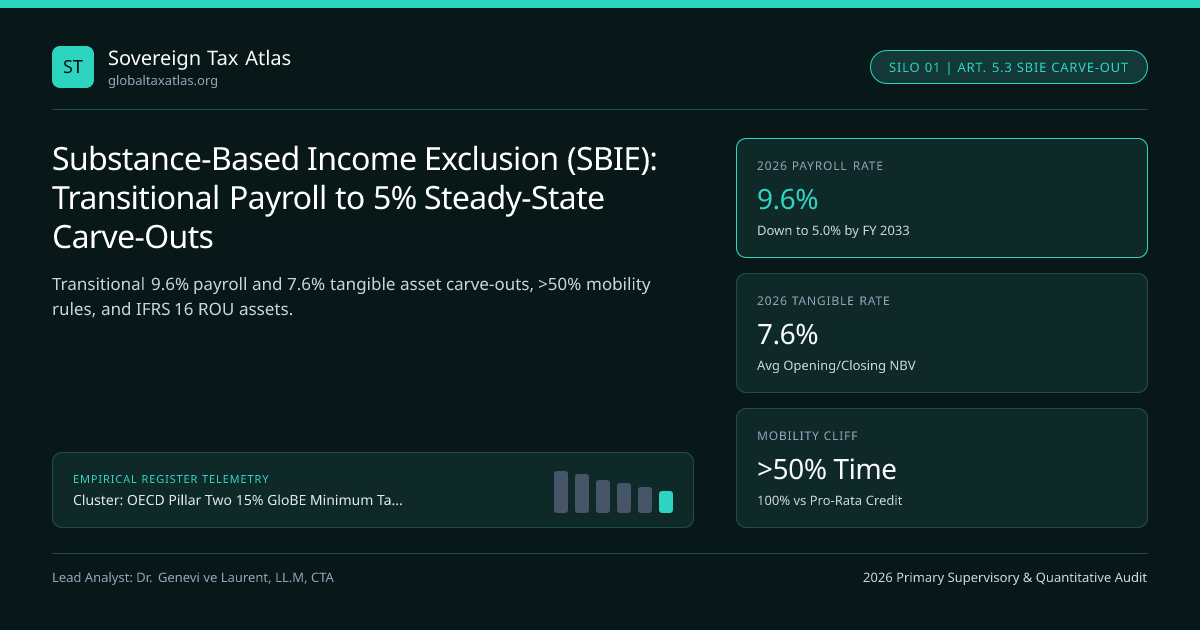
Article 5.3 of the OECD GloBE Model Rules shields routine economic returns on real people and physical capital by subtracting a Substance-Based Income Exclusion (SBIE) from jurisdictional Net GloBE Income before multiplying Excess Profit by the Top-Up Tax Percentage. Critically, SBIE never alters a jurisdiction's Effective Tax Rate—computed earlier via Adjusted Covered Taxes divided by Article 3.2 Net GloBE Income—but as highlighted in our OECD Pillar Two 15% GloBE architecture hub, SBIE can slash or completely eliminate Excess Profit for asset-heavy manufacturing, shipping ancillary, data-center, and regional headquarters hubs across the OECD Pillar Two QDMTT & GloBE cluster.
Ten-Year Transitional Rate Corridor (2023–2032) to 5.0% Steady State#
Under Article 9.2, Inclusive Framework negotiators established an asymmetric 10-year transitional glidepath that starts higher for labor than capital before converging at a uniform 5.0% permanent carve-out from fiscal year 2033 onward:
- Eligible Payroll Costs: Starts at 10.0% in 2023, stepping down by 0.2 percentage points annually through 2027 (9.6% in FY 2026, 9.4% in FY 2027), and then by 0.8 percentage points annually from 2028 through 2032 (9.0%, 8.2%, 7.4%, 6.6%, 5.8%) before reaching 5.0% in 2033.
- Eligible Tangible Assets: Starts at 8.0% in 2023, stepping down by 0.2 percentage points annually through 2027 (7.6% in FY 2026, 7.4% in FY 2027), and then by 0.4 percentage points annually from 2028 through 2032 (7.0%, 6.6%, 6.2%, 5.8%, 5.4%) before reaching 5.0% in 2033.
Note the strategic interaction with the Transitional CbCR Safe Harbor Routine Profits test: through FY 2026, if a jurisdiction's CbCR Profit Before Income Tax is less than or equal to its transitional SBIE amount, top-up tax is immediately deemed zero without performing full GloBE adjustments!
Defining Eligible Employees and Cross-Border Remote Work Allocation#
Article 5.3.3 defines Eligible Employees broadly to include full-time and part-time statutory employees of a Constituent Entity plus independent contractors participating in the ordinary operating activities of the MNE Group under the direction and control of the group (excluding corporate service-provider entities billing lump-sum outsourcing contracts, a frequent pitfall in offshore hubs overseen by CIMA or JFSC). Eligible Payroll Costs encompass gross wages, health insurance, pension contributions, employer social security taxes, and stock-based compensation—excluding payroll capitalized into inventory or self-constructed PP&E (which instead enters the tangible asset base).
July 2023 OECD Administrative Guidance resolved hybrid and cross-border executive travel via a 50% Physical Location Rule:
- If an employee or contractor performs more than 50% of working duties inside the employer Constituent Entity's jurisdiction during the fiscal period, 100% of their Eligible Payroll Costs qualify for that jurisdiction's SBIE.
- If the employee spends 50% or less of working time in the employer's jurisdiction (for instance, a regional managing director splitting 40% in Dubai DIFC, 35% in London, and 25% in Singapore), the employer claims strictly the proportional percentage (40%) attributable to days physically worked inside its jurisdiction!
Quantitative Excess Profit Shelter & Worked Campus Model#
- Top-Up Tax Saving from SBIE = Top-Up Tax % * min(Net GloBE Income, SBIE_2026)
- Worked Data-Center & Regional Hub Example (FY 2026; 9.0% Local ETR -> 6.0% Top-Up Tax %):
- Net GloBE Income = EUR 45,000,000
- 320 Full-Time Engineers (>50% local presence): Gross Payroll + Benefits = EUR 38,000,000 (100% eligible)
- 25 Travelling Specialists (40% local time): Gross Payroll EUR 5,000,000 * 40% = EUR 2,000,000
- > Total Eligible Payroll = EUR 40,000,000 -> Payroll Carve-Out (9.6%) = EUR 3,840,000
- Data-Center Servers & Leased Facility ROU Asset: Opening NBV EUR 240M, Closing NBV EUR 280M
- > Average Tangible NBV = EUR 260,000,000 -> Asset Carve-Out (7.6%) = EUR 19,760,000
- Total FY 2026 SBIE = EUR 3,840,000 + EUR 19,760,000 = EUR 23,600,000
- Excess Profit = EUR 45,000,000 - EUR 23,600,000 = EUR 21,400,000
- Top-Up Tax = 6.0% * EUR 21,400,000 = EUR 1,284,000 (SBIE saved EUR 1,416,000; Effective Total Burden = 11.85%!)
Tangible Asset Carrying Values, Operating Leases, and Investment Property Exclusions#
Under Article 5.3.4, Eligible Tangible Assets comprise Property, Plant, and Equipment (PP&E), natural resources, lessee Right-of-Use (ROU) tangible assets under IFRS 16 / ASC 842, and government licenses for real immovable property or natural resource exploitation—measured strictly as the arithmetic mean of consolidated financial statement carrying values (net of accumulated depreciation/depletion, excluding fair-value revaluation upward step-ups!) at the beginning and end of the fiscal year.
Three strict exclusions police passive asset stuffing:
- Property Held for Sale, Lease, or Investment: Passive real estate investment portfolios, land banks, and equipment held solely to earn third-party operating lease rentals are excluded—except that an operating lessor may include the excess carrying value of a leased asset above the lessee's ROU asset (and 100% for short-term leases ≤30 days such as hotel rooms or daily car rentals), eliminating intra-group double-counting when lessor and lessee belong to the same MNE group.
- Dual-Location Mobile Assets: Aircraft, vessels (outside Article 3.3 International Shipping Exclusion), railcars, and mobile drilling rigs follow the exact same >50% vs proportional physical location rule as mobile employees.
- Annual Electability: Under Article 5.3.1, an MNE group may make an annual election not to claim SBIE in a jurisdiction if gathering contractor and ROU sub-ledger verification costs exceed the top-up tax saved—though groups with FinDB-monitored trading affiliates like Agile Global Limited and Auro Markets must still verify whether local QDMTT rules modify or omit SBIE.
SBIE Payroll & Tangible Asset Qualification Matrix#
| Cost or Asset Category | SBIE Qualification | Measurement Basis | Cross-Border Presence Rule | Common Audit Disallowance Trap |
|---|---|---|---|---|
| Full-Time & Part-Time Staff | Eligible Payroll (Art. 5.3.3) | Gross wages, payroll tax, pension, stock comp | 100% if >50% in country; pro-rata if <=50% | Double-counting payroll already capitalized into PP&E or inventory |
| Directed Individual Contractors | Eligible Payroll (Art. 5.3.3) | Direct fee for ordinary operating duties | Same >50% / pro-rata workday test | Claiming fees paid to corporate BPO/fund administrators (CIMA) |
| Manufacturing PP&E & Servers | Eligible Tangible (Art. 5.3.4) | (Opening + Closing NBV) / 2 in UPE GAAP | 100% if >50% physically situated locally | Failing to strip IAS 16 upward revaluation reserves from NBV |
| Lessee IFRS 16 / ASC 842 ROU | Eligible Tangible (Art. 5.3.4(c)) | Average ROU carrying value | Physical location of underlying leased asset | Including finance/intangible software ROU assets instead of tangibles |
| Investment Property / Land Bank | Excluded (Art. 5.3.4) | 0% Carve-Out | N/A — Mixed-use split by floor space | Claiming vacant floors subleased passively to third-party tenants |
Frequently asked questions
Does a large Substance-Based Income Exclusion raise a jurisdiction above the 15% ETR threshold?
No. Jurisdictional ETR is computed strictly before applying SBIE. Even if SBIE reduces Excess Profit all the way to zero (producing zero Top-Up Tax), the jurisdiction remains technically below 15% ETR—except under the separate Transitional CbCR Safe Harbor Routine Profits test through FY 2026.
Can both an intra-group lessor and an intra-group lessee claim SBIE on the same leased building?
No. July 2023 OECD Administrative Guidance eliminates intra-group double-counting: the lessee claims its IFRS 16/ASC 842 Right-of-Use carrying value, while an operating lessor may only claim any residual accounting carrying value exceeding the lessee ROU asset.
Do independent software contractors hired through a staffing agency count as Eligible Employees?
Natural-person independent contractors working under the daily direction and control of the MNE Group in its ordinary operating activities qualify, provided the MNE can document their physical workdays; lump-sum fees paid to third-party corporate service vendors acting independently do not qualify.
Must a local Qualified Domestic Minimum Top-Up Tax (QDMTT) include the exact GloBE SBIE carve-out?
Interestingly, no! Under OECD QDMTT design rules, a jurisdiction may enact a QDMTT with a narrower SBIE—or zero SBIE at all—and still pass peer review because collecting *more* domestic top-up tax than the GloBE minimum never undermines the 15% floor.
Publication record
- Published
- 14 November 2026
- Updated
- 14 November 2026
- Author
- Dr. Geneviève Laurent, LL.M, CTA
- Review
- Review not recorded
- Automated fact check
- Passed in the stored pipeline record
- Source URLs
- 3 recorded
AI assistance recorded: anthropic/claude-opus-4.6. This field does not establish human review or source verification.
Academic & Institutional Attribution
Cite This Research & Embed Live Data Card
Standard academic & institutional research paper citation format.
Dr. Geneviève Laurent, LL.M, CTA. (2026, November 14). Substance-Based Income Exclusion (SBIE): Transitional Payroll to 5% Steady-State Carve-Outs. Sovereign Tax Atlas. https://globaltaxatlas.org/entries/substance-based-income-exclusion-sbie-payroll-tangible-carveoutRegulatory Directory Cross-Reference
Referenced Institutions & Regulatory Registries
Top Regulated Institutions in This Coverage Slice
Related Oecd Pillar Two Qdmtt Globe & Institutional Briefings
Explore Oecd Pillar Two Qdmtt Globe Hub (20) →Oecd Pillar Two Qdmtt Globe
OECD Pillar Two 15% GloBE Minimum Tax Architecture: QDMTT, IIR, and UTPR Institutional GuideOecd Pillar Two Qdmtt Globe
Qualified Domestic Minimum Top-Up Tax (QDMTT) Safe Harbor and Switch-Off Rule TriggersOecd Pillar Two Qdmtt Globe
Income Inclusion Rule (IIR) Top-Down Ordering and Partially Owned Parent Entity MechanicsOecd Pillar Two Qdmtt Globe
Undertaxed Profits Rule (UTPR) Allocation Key: Employee Headcount and Tangible Asset WeightsOecd Pillar Two Qdmtt Globe
Transitional CbCR Safe Harbor: De Minimis, Simplified ETR, and Routine Profits TestsOecd Pillar Two Qdmtt Globe
Qualified Refundable Tax Credits (QRTCs) vs Marketable Transferable Tax Credits Under GloBEOecd Pillar Two Qdmtt Globe
Bermuda 15% Corporate Income Tax Act vs GloBE QDMTT Parity for Insurers and HoldCosOecd Pillar Two Qdmtt Globe
Crown Dependencies Pillar Two Response: Jersey and Guernsey 15% Multinational Tax RegimesCrs 2 Carf Fatca Exchange Rules
IRS FATCA Registration Portal: GIIN Issuance, Sponsored FFI Hierarchies, and RO CertificationsCrs 2 Carf Fatca Exchange Rules
IRS Form W-8BEN-E Chapter 4 Classification: Active NFFE, Passive NFFE, and Investment EntitiesCrs 2 Carf Fatca Exchange Rules
IRS Form W-8IMY Documentation: Qualified Intermediaries, Withholding Partnerships, and Rate PoolsCrs 2 Carf Fatca Exchange Rules
CRS Controlling Persons Look-Through: 25% AML Thresholds and Discretionary Trust Protectors
Sovereign Tax Atlas Data, Benchmarks & Contributor Records
CC BY 4.0 Open Data
Open Institutional Datasets (CSV / JSON) →
Download desk-compiled quantitative series & schemas.
2026 Reference Matrix
2026 Institutional Benchmarks & Thresholds →
Statutory capital, clearing, margin & rate conventions.
Editorial Records
Authors & Review Records →
View named contributors where those records are available.
Complete Index
Master Research & Dossier Archive →
Browse all published briefings by topic pillar & date.