
Income Inclusion Rule (IIR) Top-Down Ordering and Partially Owned Parent Entity Mechanics
OECD GloBE Articles 2.1 through 2.3 enforce the Income Inclusion Rule from the Ultimate Parent Entity downward—except where a Partially Owned Parent Entity with over 20% external ownership takes statutory priority.
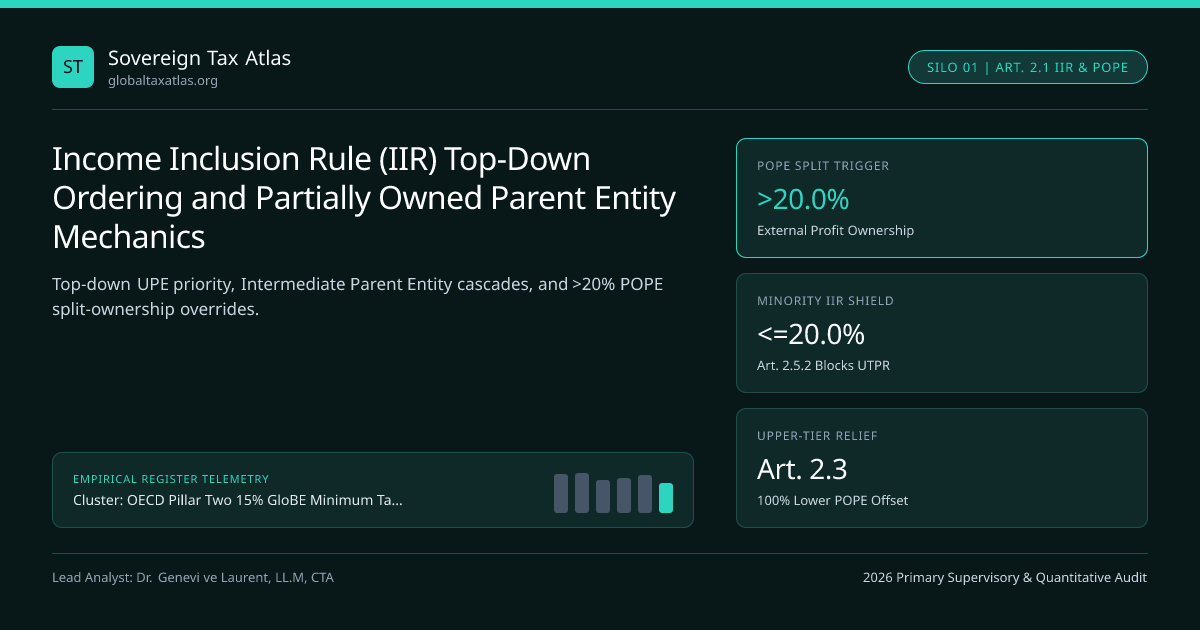
Whenever a low-taxed Constituent Entity is not shielded by a Qualified Domestic Minimum Top-Up Tax, Articles 2.1 through 2.3 of the OECD GloBE Model Rules trigger the Income Inclusion Rule (IIR)—charging parent entities an Allocable Share of the subsidiary's Top-Up Tax according to a strict Top-Down Approach, reversed solely where a Partially Owned Parent Entity (POPE) has more than 20% of its profit interests held outside the MNE Group. Within our OECD Pillar Two 15% GloBE architecture guide, mapping IIR priority chains prevents overlapping parent tax assessments across multi-tier holding stacks before any residual tax reaches the Undertaxed Profits Rule backstop in the OECD Pillar Two QDMTT & GloBE cluster.
Top-Down Approach: UPE Priority Over Intermediate Parent Entities#
Historically, traditional Controlled Foreign Company (CFC) statutes operate "bottom-up," allowing every intermediate holding jurisdiction in a four-tier corporate chain to assert simultaneous CFC inclusions unless bilateral credit rules intervene. GloBE Article 2.1.1 replaces that chaos with clean Top-Down Priority:
- Ultimate Parent Entity (UPE) First: If the UPE is located in a jurisdiction that has implemented a Qualified IIR for the fiscal year (e.g., UK, EU Member States, Japan, South Korea, Canada, Australia, Singapore, Hong Kong), only the UPE applies the IIR across all wholly owned chains, and all lower-tier Intermediate Parent Entities (IPEs) switch off under Article 2.1.3(a).
- Intermediate Parent Entity (IPE) Cascade: When the UPE resides in a jurisdiction without a Qualified IIR (notably the United States, China, India, or Cayman Islands CIMA), IIR obligation steps down to the highest-tier IPE in the ownership chain located in an IIR-implementing country (such as a Luxembourg or Dutch regional sub-holding company), disabling any lower-tier IPEs directly controlled beneath it.
Partially Owned Parent Entity (POPE) Exception and Article 2.3 Offset#
Why does Article 2.1.4 break the Top-Down Approach whenever an intermediate sub-holding company has more than 20% of its Ownership Interests (measured by profit entitlements) held directly or indirectly by persons outside the MNE Group? Suppose a Japanese UPE owns 75% of an Irish sub-holding company (a POPE, since external minority shareholders own 25% > 20%), which in turn owns 100% of a zero-tax BVI operating subsidiary (BVIFSC) owing EUR 10 million in Top-Up Tax.
If only the Japanese UPE applied the IIR, Japan could collect solely its 75% Inclusion Ratio (EUR 7.5 million), allowing 25% (EUR 2.5 million) of the BVI subsidiary's low-taxed profit to escape IIR entirely! To seal that leakage without invoking the blunt UTPR, Article 2.1.4 forces the Irish POPE to apply the IIR first on its 100% ownership of the BVI subsidiary—collecting the full EUR 10.0 million in Ireland! Then, to prevent double taxation on the Japanese UPE's 75% stake, Article 2.3 IIR Offset Mechanism reduces the Japanese UPE's Allocable Share (EUR 7.5 million) by its 75% portion of the IIR tax already paid by the Irish POPE (75% × EUR 10.0 million = EUR 7.5 million), netting the Japanese UPE's additional charge to EUR 0!
- Net Upper-Parent IIR = (UpperInclusionRatio * SubTopUpTax) - (UpperShareofLowerPOPE * POPEIIRPaid)
- Worked Multi-Tier Split-Ownership Example (US Non-IIR UPE -> 70% UK POPE1 -> 80% Dutch POPE2 -> 100% DIFC Sub):
- DIFC Sub Top-Up Tax (pre-QDMTT) = EUR 20,000,000
- External Ownership Check:
- UK POPE1: 30% held outside MNE Group (>20% -> Qualified POPE!)
- Dutch POPE2: 1 - (0.70 * 0.80) = 44% held outside MNE Group (>20% -> Also a POPE, but 80% owned by UK POPE1, NOT wholly owned!)
- Rule Priority (Art. 2.1.5): Because UK POPE1 owns only 80% (not 100%) of Dutch POPE2, Dutch POPE2 does NOT switch off!
- 1. Dutch POPE2 pays IIR on 100% of DIFC Sub = EUR 20,000,000
- 2. UK POPE1 Inclusion Ratio on DIFC Sub = 80% * EUR 20,000,000 = EUR 16,000,000
- 3. Art. 2.3 Offset at UK POPE1 = minus 80% * EUR 20,000,000 paid in Netherlands = -EUR 16,000,000 -> UK Net IIR = EUR 0!
Notice the subtle trap in Article 2.1.5 highlighted above: a lower-tier POPE switches off only if 100% of its MNE-Group-held interests are owned by a higher-tier Qualified POPE! Whenever additional minority investors enter between POPE1 and POPE2, the lower POPE collects first and the upper POPE claims an Article 2.3 offset.
EU Pillar Two Directive Domestic IIR Extension vs OECD Model Rules#
Under pure OECD Model Rules, an IIR applies solely to foreign Low-Taxed Constituent Entities. However, to comply with European Court of Justice freedom-of-establishment jurisprudence, Article 5(2) of EU Council Directive 2022/2523 extends the IIR to domestic low-taxed Constituent Entities located in the same EU Member State as the UPE, IPE, or POPE! For regional European financial structures supervised under ESMA frameworks, a French or Dutch UPE must apply its IIR even to low-taxed domestic subsidiaries (where no domestic QDMTT absorbed the gap).
The 80%–99.9% Direct Subsidiary Sweet Spot vs US UPE Sister-Chain Exposure#
Compare two striking structural outcomes:
- Direct Minority Ownership ≤ 20% Without an Intermediate POPE: If a UK UPE directly owns 85% of a Cayman operating company (CIMA) and third-party co-investors own 15% (≤ 20%, and the Cayman entity owns no lower subsidiaries, so it is not a POPE), the UK UPE collects only 85% of the Cayman entity's Top-Up Tax—and under Article 2.4.3, because all of the UPE's interests in that Cayman entity are held via a Qualified IIR, the remaining 15% minority share is permanently exempt from UTPR too!
- US-Headquartered MNE Parallel Chains: When a US UPE holds one operating chain through a Dutch IPE (subject to Dutch IIR) and a parallel sister chain directly in Bermuda (BMA) or Labuan (Labuan FSA), the Dutch IPE's IIR reaches only subsidiaries underneath the Netherlands—leaving both the US domestic operations and the parallel sister chain exposed to foreign UTPRs once any transitional safe harbor expires, a crucial diligence item for prime brokerage groups such as Island Prime 54 Limited 7584 and Audacity Capital.
Multi-Tier IIR & POPE Priority Comparison Matrix#
| Corporate Ownership Structure | Collector Entity | % of Sub Top-Up Tax Collected | Residual UTPR Exposure? | Governing GloBE Provision |
|---|---|---|---|---|
| IIR-State UPE -> 100% EU IPE -> 100% Cayman Sub | UPE (IPE switches off) | 100.0% | Zero (Art. 2.5.2 full IIR cover) | Art. 2.1.1 & Art. 2.1.3(a) |
| Non-IIR UPE (US) -> 100% UK IPE -> 100% BVI Sub (BVIFSC) | UK IPE | 100.0% of BVI Sub | Zero on BVI Sub; Yes on parallel US-direct subs | Art. 2.1.2 Top-Down IPE Rule |
| IIR-State UPE -> 75% Irish HoldCo (POPE) -> 100% Sub | Irish POPE (UPE offsets to 0) | 100.0% at POPE | Zero | Art. 2.1.4 POPE & Art. 2.3 Offset |
| IIR-State UPE -> 85% Direct Cayman Sub (CIMA) | UPE | 85.0% (Inclusion Ratio) | Zero! (Art. 2.5.2 shuts off UTPR on 15% minority) | Art. 2.2.1 & Art. 2.5.2 |
| Non-IIR UPE (US) -> 60% Direct Sub (No IPE/QDMTT) | UTPR Jurisdictions | 100.0% (incl. 40% minority share!) | 100% collected via UTPR across operating states | Art. 2.5.1 Total UTPR Top-Up |
Frequently asked questions
How is the Inclusion Ratio calculated when a subsidiary issues preferred shares to external investors?
Under Article 2.2.2, hypothetical consolidated financial accounting principles determine how much of the Low-Taxed Constituent Entity FANIL would be attributable to external preferred or tracking-share holders as non-controlling interest, reducing the parent Inclusion Ratio proportionally.
Why does a 60%-owned subsidiary of a US UPE suffer 100% UTPR whereas an 85%-owned subsidiary of a UK UPE pays only 85%?
Because the US has not enacted a Qualified IIR, none of the US UPE interest in the 60% subsidiary is subject to an IIR; therefore Article 2.5.2 relief fails and UTPR captures 100% of the subsidiary Top-Up Tax (even the 40% third-party share!). Conversely, the UK UPE Qualified IIR covers 100% of the MNE stake, switching off UTPR.
Does the EU Pillar Two Directive apply IIR to purely domestic groups with EUR 750M revenue?
Yes. Unlike the OECD Model Rules—which target cross-border MNE Groups with at least one foreign entity or PE—EU Directive 2022/2523 applies both IIR and domestic top-up tax to large-scale purely domestic groups exceeding EUR 750 million within a single EU Member State.
When does a lower-tier POPE switch off in favor of an upper-tier POPE?
Under Article 2.1.5, a lower-tier POPE switches off if and only if it is wholly owned (100% of its MNE-Group ownership interests) directly or through a chain of 100%-owned entities by a higher-tier POPE located in a Qualified IIR jurisdiction.
Publication record
- Published
- 14 November 2026
- Updated
- 14 November 2026
- Author
- Dr. Geneviève Laurent, LL.M, CTA
- Review
- Review not recorded
- Automated fact check
- Passed in the stored pipeline record
- Source URLs
- 3 recorded
AI assistance recorded: anthropic/claude-opus-4.6. This field does not establish human review or source verification.
Academic & Institutional Attribution
Cite This Research & Embed Live Data Card
Standard academic & institutional research paper citation format.
Dr. Geneviève Laurent, LL.M, CTA. (2026, November 14). Income Inclusion Rule (IIR) Top-Down Ordering and Partially Owned Parent Entity Mechanics. Sovereign Tax Atlas. https://globaltaxatlas.org/entries/income-inclusion-rule-iir-top-down-split-ownership-pope-mechanicsRegulatory Directory Cross-Reference
Referenced Institutions & Regulatory Registries
Mentioned Regulated Institutions
Related Oecd Pillar Two Qdmtt Globe & Institutional Briefings
Explore Oecd Pillar Two Qdmtt Globe Hub (20) →Oecd Pillar Two Qdmtt Globe
OECD Pillar Two 15% GloBE Minimum Tax Architecture: QDMTT, IIR, and UTPR Institutional GuideOecd Pillar Two Qdmtt Globe
Undertaxed Profits Rule (UTPR) Allocation Key: Employee Headcount and Tangible Asset WeightsOecd Pillar Two Qdmtt Globe
Transitional CbCR Safe Harbor: De Minimis, Simplified ETR, and Routine Profits TestsOecd Pillar Two Qdmtt Globe
Qualified Refundable Tax Credits (QRTCs) vs Marketable Transferable Tax Credits Under GloBEOecd Pillar Two Qdmtt Globe
Bermuda 15% Corporate Income Tax Act vs GloBE QDMTT Parity for Insurers and HoldCosOecd Pillar Two Qdmtt Globe
Crown Dependencies Pillar Two Response: Jersey and Guernsey 15% Multinational Tax RegimesOecd Pillar Two Qdmtt Globe
Caribbean Pillar Two Enactments: Bahamas 15% DMTT and Barbados 9% to 15% Tiered Tax ReformOecd Pillar Two Qdmtt Globe
UAE 9% Corporate Tax and 15% Supplemental DMTT Across DIFC and DMCC Qualifying Free ZonesCrs 2 Carf Fatca Exchange Rules
IRS Form W-8IMY Documentation: Qualified Intermediaries, Withholding Partnerships, and Rate PoolsCrs 2 Carf Fatca Exchange Rules
CRS Controlling Persons Look-Through: 25% AML Thresholds and Discretionary Trust ProtectorsCrs 2 Carf Fatca Exchange Rules
Cayman Islands DITC Portal Governance: CRS Compliance Forms, CIMA Fund Audits, and PenaltiesCrs 2 Carf Fatca Exchange Rules
BVI ITA and BVIFars Portal Compliance: FATCA/CRS Deadlines, Nil Filings, and ITA Audits
Sovereign Tax Atlas Data, Benchmarks & Contributor Records
CC BY 4.0 Open Data
Open Institutional Datasets (CSV / JSON) →
Download desk-compiled quantitative series & schemas.
2026 Reference Matrix
2026 Institutional Benchmarks & Thresholds →
Statutory capital, clearing, margin & rate conventions.
Editorial Records
Authors & Review Records →
View named contributors where those records are available.
Complete Index
Master Research & Dossier Archive →
Browse all published briefings by topic pillar & date.