
Double Tax Treaty Withholding Lob
Double Tax Treaty Withholding Rates, OECD MLI Principal Purpose Test, and US LOB Reference
Securing 0%, 5%, or 15% treaty withholding relief across more than 3,000 bilateral tax treaties now requires clearing beneficial ownership gates, OECD MLI Principal Purpose Tests, and mechanical US Limitation on Benefits rules.
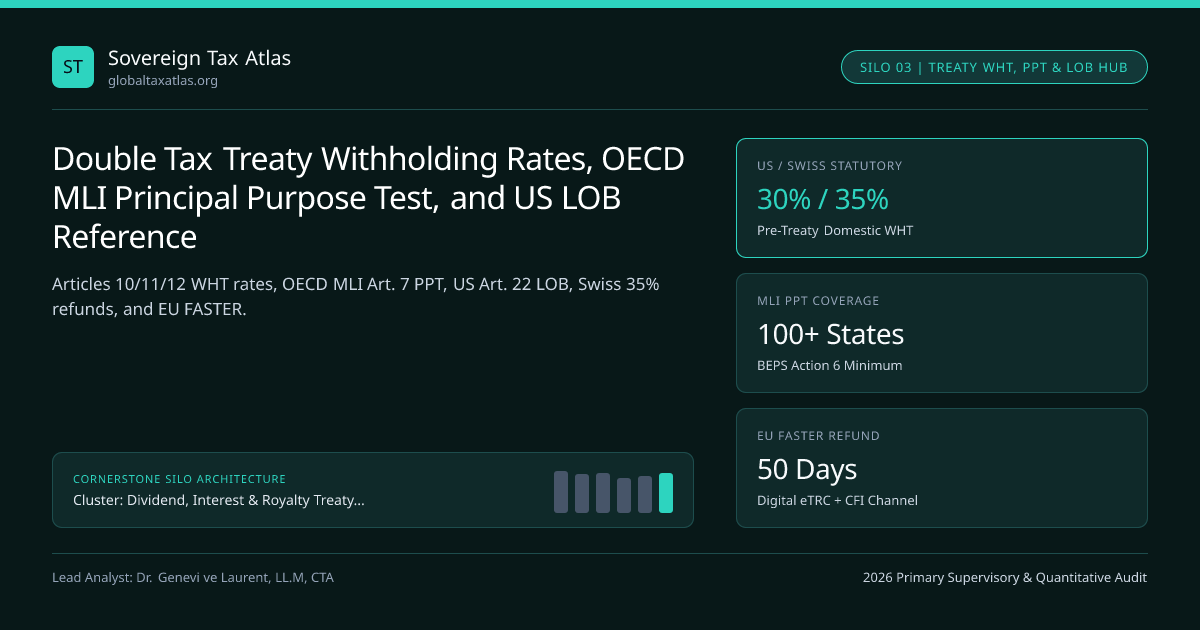
Statutory domestic withholding taxes (WHT) extract 30.0% in the United States, 35.0% in Switzerland, 26.375% in Germany, 25.0% in France, and 20.0% on UK yearly interest before a single dollar of cross-border cash reaches foreign lenders, equity funds, or IP licensors. Reducing those statutory levies to 0.0%, 5.0%, or 15.0% across the global network of 3,000+ bilateral Double Tax Conventions now requires surviving simultaneous anti-abuse gauntlets benchmarked under US Article 22 LOB vs OECD MLI Article 7 PPT and the 2026 Treaty LOB/PPT Benchmark Standard. This cornerstone reference anchors the Dividend, Interest & Royalty Treaty Withholding, PPT & LOB cluster.
Four Sequential Gates Governing Cross-Border Treaty Relief#
Institutional tax counsel never read a bilateral treaty rate table in isolation; securing treaty-reduced withholding requires clearing four sequential legal gates before cash leaves the source jurisdiction:
- Treaty Residence & Fiscal Transparency (Articles 1 & 4): The claimant must be "liable to tax" by reason of domicile, residence, or place of management—proved via an official Certificate of Residence such as Singapore IRAS Board-Control CORs or harmonized EU FASTER digital eTRCs (see EU FASTER 50-day refund mechanics)—while hybrid partnerships apply Article 1(2) transparent look-through rules.
- Substantive Passive Income Allocation (Articles 10, 11 & 12): Classify the payment strictly across Article 10 direct (5%/0%) vs portfolio (15%) dividends, Article 11 interest bank/sovereign exemptions, and Article 12 royalties vs UN Article 12A technical service fees.
- Beneficial Ownership (Articles 10(2), 11(2) & 12(1)): Exclude nominees, agents, back-to-back debt conduits, and manufactured-dividend securities-lending legs obligated contractually or factually to pass receipts onward—enforced fiercely after the ECJ Danish Beneficial Ownership Cases.
- Anti-Treaty-Shopping Clause (Subjective MLI PPT vs Objective US LOB): Clear either the subjective OECD BEPS Multilateral Instrument (MLI) Article 7 Principal Purpose Test (analyzed in HoldCo PPT audits) across 100+ MLI signatories, OR the mechanical US Model Article 22 Limitation on Benefits (LOB) tests (Ownership/Base Erosion & Active Trade plus 95% <=7 Equivalent Beneficiary Derivative Benefits).
Statutory Domestic Carve-Outs vs Bilateral Treaty Corridors#
Before invoking a bilateral tax treaty (and exposing an SPV to LOB or PPT scrutiny!), institutional deal teams check whether domestic statutory law already grants 0.0% inbound withholding:
- United States Domestic Exemptions: Private credit funds rely on the 0% IRC Sections 871(h)/881(c) Portfolio Interest Exemption (policing the strict <10.0% shareholder attribution cliff!), while foreign central banks and government funds guard their 0% IRC Section 892 Sovereign Exemption against commercial-activity taint—and equity-swap desks navigate IRC Section 871(m) delta-one dividend equivalents.
- Premier Bilateral Equity & Credit Corridors: Where domestic exemptions do not apply (such as US-source corporate dividends!), institutional capital concentrates inside US-UK Treaty Article 10(3) 0% subsidiary and pension exemptions, US-Ireland 15% ICAV UCITS ETF structures, Swiss 35% Verrechnungssteuer Form 82 refunds and Old Reserves traps, and UK QAHC & Quoted Eurobond 0% interest corridors.
Quantitative Cash-Drag & Net IRR Impact of Withholding Leakage#
Even when a treaty legally reduces withholding from 35.0% to 0.0% or 15.0%, administrative refund delays (often 18 to 36 months in legacy paper-claim EU states prior to EU FASTER!) erode compound portfolio Net IRR:
- PillarTwoSTTRTopUpWHT = Max(0, 9.0% - PayeeNominalAdjustedCITRate) * GrossCoveredIntragroupPayment [if > EUR 1.0M threshold]
- Worked USD 200M European Dividend Portfolio Held via Irish ICAV UCITS vs Cayman Corporate Feeder (Gross Dividend Yield = 4.00% = USD 8.0M/yr):
- US Portfolio Equities (60% of Fund = USD 4.80M Gross Dividends):
- Cayman Feeder (No US Treaty): 30.0% WHT = USD 1,440,000 permanent annual tax drag -> Net = USD 3,360,000!
- Irish ICAV UCITS (US-Ireland Treaty Art. 10 = 15.0% WHT at Source): 15.0% WHT = USD 720,000 -> Saves USD 720,000/yr (+60 bps equity yield)!
- Swiss Portfolio Equities (40% of Fund = USD 3.20M Gross Dividends; 35.0% Statutory WHT = USD 1,120,000 withheld):
- Treaty reduces net Swiss WHT to 15.0% -> 20.0% (USD 640,000) refundable via Swiss FTA Form 82;
- Cutting refund delay from 2.5 years to 50 days (FASTER-style standard) at 8% opportunity cost recovers USD 110,900/yr in time-value drag!
New 2025–2030 Frontier: Pillar Two STTR, India–Mauritius PPT, and EU FASTER#
Three structural shifts redefine treaty planning between 2026 and 2030: (1) the OECD Pillar Two Subject to Tax Rule (STTR) imposes up to a 9.0% gross source tax on intragroup interest, royalties, and service fees taxed below 9% nominally; (2) emerging-market revenue authorities scrutinize historic gateways under the India–Mauritius MLI PPT protocol and TRC audit regime; and (3) EU Council Directive 2025/50 (FASTER) mandates 1-business-day digital eTRCs and 50-calendar-day Quick Refunds by January 1, 2030!
Global Withholding & Anti-Abuse Architecture Matrix#
Custodians, prime brokers, and institutional treasury teams—vetting counterparties across ESMA, JFSC, CBRD Mauritius, and FinDB-tracked venues such as Bancwesttrade and 360 Capital—benchmark treaty corridors across this master matrix:
| Treaty / Statutory Mechanism | Statutory WHT | Reduced Rate | Anti-Abuse Gate | Primary Execution Form / Channel |
|---|---|---|---|---|
| US Inbound Portfolio Interest (IRC 881(c)) | 30.0% | 0.0% | <10% Voting Shareholder + Non-Bank | Form W-8BEN-E + Registered Debt Book-Entry |
| US–UK Treaty Art. 10(3) Dividends | 30.0% | 0.0% | >=80% 12-Mo Vote + Strict Art. 23 LOB | Form W-8BEN-E Part III Line 14b (80% Box) |
| US–Ireland Treaty UCITS Dividends | 30.0% | 15.0% | Publicly Traded ETF / Art. 23 LOB | QI Relief-at-Source (15% Treaty Pool) |
| Switzerland Dividend Refund | 35.0% | 0.0% / 15.0% | MLI PPT + Swiss "Old Reserves" Doctrine! | Form 823 / 823B / 823C Notification or Refund |
| EU FASTER Directive WHT Relief | 15%–35% | Treaty Rate | Certified Financial Intermediary (CFI) | Digital eTRC + Relief-at-Source / 50d Refund |
Frequently asked questions
What is the core difference between the OECD MLI Principal Purpose Test (PPT) and the US Limitation on Benefits (LOB) clause?
The OECD MLI Article 7 PPT is a subjective facts-and-circumstances anti-abuse rule denying treaty benefits if obtaining that benefit was "one of the principal purposes" of an arrangement; the US Article 22 LOB is an objective mechanical checklist (public listing, >=50% ownership/base-erosion, active business, or >=95% derivative benefits) applied before subjective sham doctrines.
Can a treaty structure face BOTH a Limitation on Benefits (LOB) clause AND a Principal Purpose Test (PPT)?
Yes! Several modern treaties (including renegotiated European treaties, the MLI Simplified LOB option, and updated Japanese/Dutch conventions) layer an objective LOB gateway together with a subjective PPT—meaning a holding company that ticks a mechanical LOB box can still fail if it lacks commercial substance under PPT!
Why does the United Kingdom charge 0% withholding tax on dividends even without a tax treaty?
Under UK domestic tax law, ordinary corporate dividends paid by UK-resident companies (excluding UK REIT Property Income Distributions, which suffer 20% WHT!) carry 0.0% statutory outbound withholding tax to any jurisdiction worldwide—making UK holding companies uniquely friction-free on outbound equity distributions.
Does holding a valid Tax Residency Certificate (TRC) automatically guarantee treaty withholding relief?
No. Courts and tax authorities worldwide (from the ECJ Danish Cases to India Supreme Court and Swiss Federal Supreme Court jurisprudence) hold that a TRC proves Article 4 residence ONLY—tax authorities still audit beneficial ownership, conduit pass-through obligations, and MLI Article 7 PPT!
Publication record
- Published
- 14 November 2026
- Updated
- 14 November 2026
- Author
- Dr. Geneviève Laurent, LL.M, CTA
- Review
- Review not recorded
- Automated fact check
- Passed in the stored pipeline record
- Source URLs
- 4 recorded
AI assistance recorded: anthropic/claude-opus-4.6. This field does not establish human review or source verification.
Academic & Institutional Attribution
Cite This Research & Embed Live Data Card
Standard academic & institutional research paper citation format.
Dr. Geneviève Laurent, LL.M, CTA. (2026, November 14). Double Tax Treaty Withholding Rates, OECD MLI Principal Purpose Test, and US LOB Reference. Sovereign Tax Atlas. https://globaltaxatlas.org/entries/double-tax-treaty-withholding-mli-ppt-us-lob-compliance-guideRegulatory Directory Cross-Reference
Referenced Institutions & Regulatory Registries
Top Regulated Institutions in This Coverage Slice
Related Double Tax Treaty Withholding Lob & Institutional Briefings
Explore Double Tax Treaty Withholding Lob Hub (20) →Double Tax Treaty Withholding Lob
OECD Model Article 10 Dividend Withholding: 5% Direct Participation, 365-Day Hold, and 15% PortfolioDouble Tax Treaty Withholding Lob
OECD Model Article 11 Interest Withholding: Bank Carve-Outs, Gross-Ups, and Arm’s-Length CapsDouble Tax Treaty Withholding Lob
OECD Article 12 Royalties vs UN Model Article 12A and 12B: SaaS Cloud, Copyrights, and Technical FeesDouble Tax Treaty Withholding Lob
BEPS MLI Article 7 Principal Purpose Test (PPT): Defending Intermediate Holding Companies in AuditDouble Tax Treaty Withholding Lob
US Model Article 22 Limitation on Benefits (LOB): Publicly Traded, Base Erosion, and Active TradeDouble Tax Treaty Withholding Lob
Treaty Derivative Benefits Test: 95% Ownership by 7 or Fewer Equivalent Beneficiaries Post-BrexitDouble Tax Treaty Withholding Lob
EU FASTER Directive (2025/50): Digital eTRCs, Certified Intermediaries, and 50-Day Quick RefundsDouble Tax Treaty Withholding Lob
Switzerland 35% Verrechnungssteuer Refunds: Form 823 Notification at Source and the "Old Reserves" TrapEconomic Substance Cfc Transfer Pricing
Offshore Economic Substance Statutes, CFC Attribution Regimes, and OECD Transfer Pricing DEMPE GuideCross Border Fund Spv Tax Neutrality
Cross-Border Fund Tax Neutrality Guide: Blocker SPVs, Check-the-Box Elections, and Treaty PlatformsOecd Pillar Two Qdmtt Globe
GloBE Article 1.1 EUR 750M Consolidated Revenue Scope, M&A Merger, and Demerger RulesOecd Pillar Two Qdmtt Globe
Pillar Two Article 1.5 Excluded Entities: Sovereign Wealth, Pension, and Investment Funds
Sovereign Tax Atlas Data, Benchmarks & Contributor Records
CC BY 4.0 Open Data
Open Institutional Datasets (CSV / JSON) →
Download desk-compiled quantitative series & schemas.
2026 Reference Matrix
2026 Institutional Benchmarks & Thresholds →
Statutory capital, clearing, margin & rate conventions.
Editorial Records
Authors & Review Records →
View named contributors where those records are available.
Complete Index
Master Research & Dossier Archive →
Browse all published briefings by topic pillar & date.