
Qualified Refundable Tax Credits (QRTCs) vs Marketable Transferable Tax Credits Under GloBE
Under OECD GloBE Articles 3.2.4 and 4.1.3, Qualified Refundable Tax Credits and Marketable Transferable Tax Credits preserve jurisdictional ETR as denominator income rather than slashing Covered Taxes.
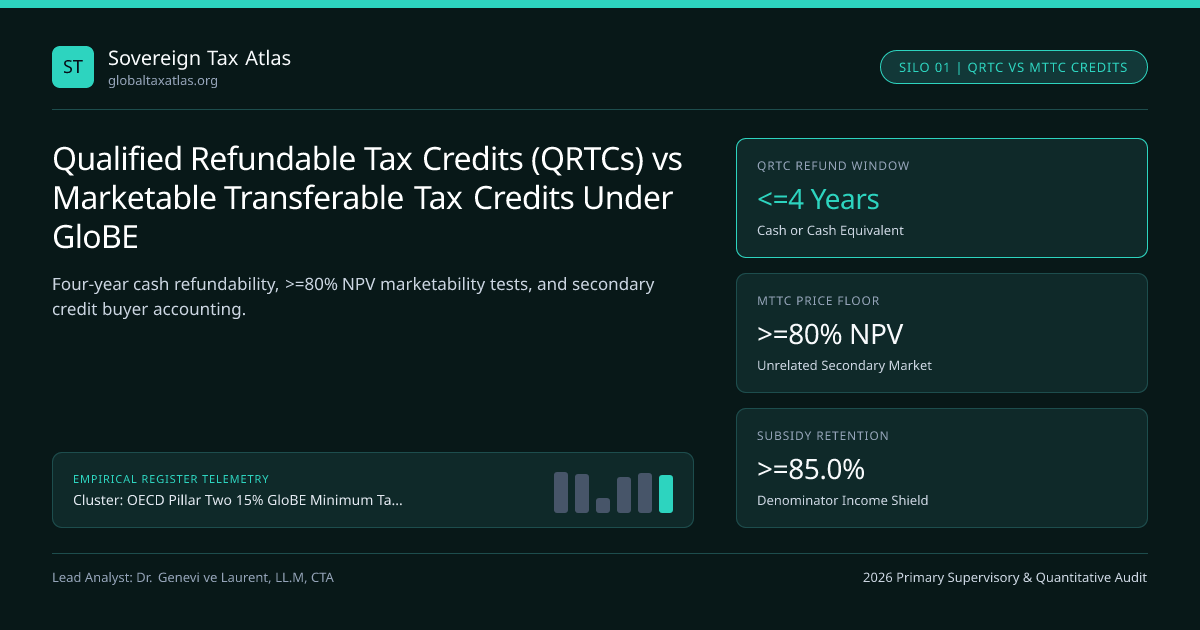
How a sovereign fiscal incentive is legally structured under domestic tax law determines whether OECD Pillar Two claws back up to 100% of the subsidy via 15.0% top-up tax or preserves more than 85% of its net cash value. Within our OECD Pillar Two 15% GloBE architecture guide, non-refundable corporate tax credits directly reduce Chapter 4 Adjusted Covered Taxes in the ETR numerator, whereas Qualified Refundable Tax Credits (QRTCs) and Marketable Transferable Tax Credits (MTTCs) increase Article 3.2 GloBE Income in the denominator—driving wholesale redesign of R&D and clean-energy incentives across Singapore, Ireland, the United Kingdom, and the United States in the OECD Pillar Two QDMTT & GloBE cluster.
Denominator Income vs Numerator Reduction: Why Credit Design Dictates ETR#
Suppose a Constituent Entity earns EUR 100 million pre-tax profit in a 20.0% statutory corporate tax jurisdiction (EUR 20 million baseline tax) and earns a EUR 12 million R&D credit:
- Non-Qualified Refundable/Non-Refundable Tax Credit (NQRTC): Covered Taxes drop from EUR 20 million to EUR 8 million while GloBE Income remains EUR 100 million. Jurisdictional ETR plunges to 8.00%, triggering a 7.00% Top-Up Tax (EUR 7.0 million)—clawing back 58.3% of the government incentive!
- Qualified Refundable Tax Credit (QRTC): Covered Taxes stay intact at EUR 20 million, while the EUR 12 million credit is added to GloBE Income (EUR 112 million). Jurisdictional ETR equals 20 / 112 = 17.86% (above 15.0%!), resulting in EUR 0 Top-Up Tax and 100% subsidy retention! Even in a 15.0% baseline country, adding EUR 12 million to the denominator triggers at most 15% × EUR 12M = EUR 1.8M top-up cost (85% retention).
Strict Four-Year Refundability Gate for QRTCs (Article 10.1)#
Article 10.1 defines a Qualified Refundable Tax Credit as a refundable tax credit designed in such a way that it must be paid as cash or available as cash equivalents (such as offsetting payroll withholding, VAT, or customs duties owed regardless of corporate income tax profitability) within four years from when a Constituent Entity satisfies the statutory conditions for receiving the credit. Credits refundable solely because an ordinary advance corporate tax installment exceeded final liability do not qualify, and substance-less "sham refund" statutes designed exclusively for EUR 750M+ MNEs face anti-abuse challenges during Inclusive Framework peer reviews.
July 2023 Breakthrough: Marketable Transferable Tax Credits (MTTCs)#
Following enactment of US Inflation Reduction Act (IRC Section 6418) clean-energy transferable credits, the July 2023 OECD Administrative Guidance created a dedicated category—Marketable Transferable Tax Credits (MTTCs)—accorded the exact same favorable GloBE Income denominator treatment as QRTCs if the originator satisfies two rigorous tests:
- Legal Transferability Standard: Under domestic credit law, the credit holder may legally transfer the credit to an unrelated party in the origination year or within 15 months after the end of the origination fiscal year.
- Marketability Standard: The credit is actually transferred to an unrelated party at a price at or above 80.0% of its Net Present Value (NPV) (or, if retained by the originator, similar credits trade among unrelated parties at ≥80.0% of NPV, discounted using local government debt yields of matching maturity).
- ETRwithNQRTC = (BaselineCoveredTax - NQRTCUsed) / PreCreditGloBEIncome
- PurchaserMTTCCoveredTaxReduction = FaceValueClaimed - PurchasePricePaid [only discount reduces buyer ETR!]
- Worked MTTC Originator vs Purchaser Numerical Model (US IRC Sec. 45X / 6418 Clean Tech Credit):
- Originator Pre-Credit GloBE Income = USD 90,000,000; Baseline Tax (21% less FDII = 16.0%) = USD 14,400,000
- Originator generates USD 15,000,000 Transferable Credit and sells within 9 months to Unrelated Bank at USD 0.92 (USD 13,800,000; >= 80% NPV):
- Originator GloBE Income = 90,000,000 + 13,800,000 (actual sale proceeds) = USD 103,800,000
- Originator ETR = 14,400,000 / 103,800,000 = 13.87% -> Top-Up Tax % = 1.13% (vs 0% ETR & 15% Top-Up if NQRTC!)
- Unrelated Bank Purchaser (buys USD 15.0M credit for USD 13.8M):
- Only the USD 1,200,000 net economic discount reduces Purchaser Covered Taxes (NOT the full USD 15.0M face value!).
Purchaser Treatment on Secondary Credit Transfers#
Look at the crucial secondary-market rule in the formula above: when a corporate treasury or banking affiliate buys an MTTC at 92 cents on the dollar to settle its domestic tax bill, reducing the buyer's Covered Taxes by the full 100 cents would have destroyed the secondary market for transferable credits! Instead, OECD Administrative Guidance treats the 92 cents paid as cash tax settlement and reduces the buyer's Covered Taxes solely by the 8-cent net economic gain (amortized proportionally as the credit is utilized). Conversely, purchasing a Non-Marketable Transferable Credit treats the buyer far more harshly under cost-recovery rules.
Global Sovereign Legislative Pivot Toward QRTCs (2024–2026)#
To protect inward FDI against Pillar Two clawbacks, major investment hubs rapidly re-engineered legacy tax holidays and super-deductions into four-year refundable credits—examined closely in Singapore Refundable Investment Credits (RIC) and Ireland 30% R&D Tax Credit. Meanwhile, offshore centers supervised by BMA (Bermuda Qualified Refundable Tax Credits consultation) and Labuan IBFC face intense OECD Administrative Standard scrutiny to ensure refundable credits reflect genuine payroll, R&D, or green-transition expenditure rather than circular rebates of QDMTT liabilities—a vital verification step for institutional desks evaluating multi-jurisdictional entities like 360 Capital and Alyra Finance.
| Incentive Instrument | Jurisdictional Archetype | GloBE Classification | Impact on Covered Taxes | Impact on GloBE Income |
|---|---|---|---|---|
| Ireland 30% R&D Credit (3-Yr Cash) | Ireland (IE ICAV/Corp Peer) | QRTC (Art. 3.2.4) | None (EUR 0 reduction) | Added over asset life / current year |
| Singapore Refundable Investment Credit | Singapore (SG Tax Hub) | QRTC (<=4-Yr Cash Refund) | None (EUR 0 reduction) | Included in denominator when earned |
| US IRA Sec. 45X / 48 Transferable Credit | United States (IRC Sec. 6418) | MTTC (>=80% NPV Market) | Originator: None; Buyer: Discount only | Originator includes face or sale cash |
| US Research Credit (IRC Sec. 41) | United States (Non-Refundable) | Non-Qualified Credit (NQRTC) | Dollar-for-dollar numerator cut! | None — Severely depresses US ETR |
| Legacy 10-Yr Free-Zone Tax Holiday | Offshore / SEZ (DMCC / CIMA) | Zero Tax Rate (Not a QRTC) | Covered Tax = EUR 0 | Full 15% Top-Up on Excess Profit |
Frequently asked questions
When is a Qualified Refundable Tax Credit recognized in GloBE Income if tied to buying machinery?
If a QRTC or MTTC relates to the acquisition or construction of property, plant, and equipment and financial accounting (IAS 20) amortizes the government grant over the asset useful life (or nets it against asset cost), GloBE follows that multi-year accounting spread rather than forcing Day-1 lump-sum recognition.
What happens if an MTTC originator holds a transferable credit that expires unused?
If an originator retains an MTTC (included in GloBE Income at origination) and allows the credit to expire unutilized without transferring it, the expired amount is treated as a deductible loss reducing GloBE Income in the fiscal year of expiration.
Why does US IRC Section 41 R&D credit depress US ETR whereas UK RDEC and Irish R&D credits do not?
Because standard US IRC Section 41 credits are neither refundable in cash within four years (outside tiny startup payroll offsets) nor transferable under IRC Section 6418, they are Non-Qualified Tax Credits that reduce US Covered Taxes dollar-for-dollar.
Can a country pay back a company QDMTT liability via a Qualified Refundable Tax Credit?
No. Under the OECD QDMTT Consistency and Administration Standards, any government grant or credit directly or indirectly conditioned on the existence or amount of QDMTT or IIR liability constitutes an impermissible "collateral benefit" that disqualifies the country QDMTT entirely.
Publication record
- Published
- 14 November 2026
- Updated
- 14 November 2026
- Author
- Dr. Geneviève Laurent, LL.M, CTA
- Review
- Review not recorded
- Automated fact check
- Passed in the stored pipeline record
- Source URLs
- 3 recorded
AI assistance recorded: anthropic/claude-opus-4.6. This field does not establish human review or source verification.
Academic & Institutional Attribution
Cite This Research & Embed Live Data Card
Standard academic & institutional research paper citation format.
Dr. Geneviève Laurent, LL.M, CTA. (2026, November 14). Qualified Refundable Tax Credits (QRTCs) vs Marketable Transferable Tax Credits Under GloBE. Sovereign Tax Atlas. https://globaltaxatlas.org/entries/qualified-refundable-tax-credits-qrtc-marketable-transferable-etrRegulatory Directory Cross-Reference
Referenced Institutions & Regulatory Registries
Top Regulated Institutions in This Coverage Slice
Related Oecd Pillar Two Qdmtt Globe & Institutional Briefings
Explore Oecd Pillar Two Qdmtt Globe Hub (20) →Oecd Pillar Two Qdmtt Globe
OECD Pillar Two 15% GloBE Minimum Tax Architecture: QDMTT, IIR, and UTPR Institutional GuideOecd Pillar Two Qdmtt Globe
Bermuda 15% Corporate Income Tax Act vs GloBE QDMTT Parity for Insurers and HoldCosOecd Pillar Two Qdmtt Globe
Crown Dependencies Pillar Two Response: Jersey and Guernsey 15% Multinational Tax RegimesOecd Pillar Two Qdmtt Globe
Caribbean Pillar Two Enactments: Bahamas 15% DMTT and Barbados 9% to 15% Tiered Tax ReformOecd Pillar Two Qdmtt Globe
UAE 9% Corporate Tax and 15% Supplemental DMTT Across DIFC and DMCC Qualifying Free ZonesOecd Pillar Two Qdmtt Globe
Singapore Domestic Top-Up Tax (DTT), Multinational Enterprise Minimum Tax, and RIC IncentivesOecd Pillar Two Qdmtt Globe
Hong Kong Minimum Top-Up Tax (HKMTT) Interaction With Territorial Source and FSIE RulesOecd Pillar Two Qdmtt Globe
Ireland Part 4A Pillar Two Implementation: 12.5% Trading Rate, 15% QDMTT, and 30% R&D CreditCrs 2 Carf Fatca Exchange Rules
BVI ITA and BVIFars Portal Compliance: FATCA/CRS Deadlines, Nil Filings, and ITA AuditsCrs 2 Carf Fatca Exchange Rules
IRS Form 1099-DA Digital Asset Broker Reporting vs OECD CARF: Cost Basis and Non-US ExemptionsCrs 2 Carf Fatca Exchange Rules
Dual Tax Residency Under CRS 2.0 and CARF: Elimination of Treaty Tie-Breaker Self-CertsCrs 2 Carf Fatca Exchange Rules
CRS Preexisting vs New Account Due Diligence: USD 1M High-Value Paper Searches and Curing Indicia
Sovereign Tax Atlas Data, Benchmarks & Contributor Records
CC BY 4.0 Open Data
Open Institutional Datasets (CSV / JSON) →
Download desk-compiled quantitative series & schemas.
2026 Reference Matrix
2026 Institutional Benchmarks & Thresholds →
Statutory capital, clearing, margin & rate conventions.
Editorial Records
Authors & Review Records →
View named contributors where those records are available.
Complete Index
Master Research & Dossier Archive →
Browse all published briefings by topic pillar & date.