
Crown Dependencies Pillar Two Response: Jersey and Guernsey 15% Multinational Tax Regimes
Effective January 1, 2025, Jersey, Guernsey, and the Isle of Man diverged sharply in Pillar Two implementation—pairing Guernsey and Isle of Man QDMTTs with Jersey innovative 15% Multinational Corporate Income Tax (MCIT).
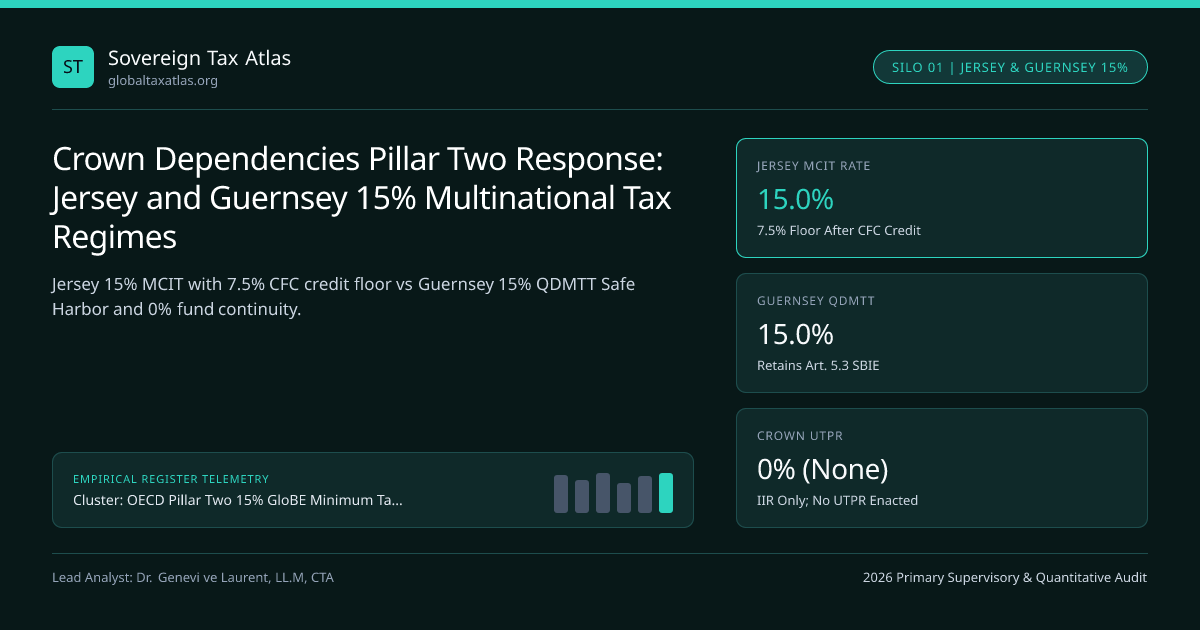
Coordinating closely in May 2023 and enacting legislation taking effect for fiscal years commencing on or after January 1, 2025, the three British Crown Dependencies—Jersey, Guernsey, and the Isle of Man—retained their signature 0% / 10% / 20% corporate tax architecture for mid-market entities and investment funds while adopting two distinct statutory models for EUR 750M+ MNE Groups. Within our OECD Pillar Two 15% GloBE architecture guide, contrasting Guernsey's classical QDMTT + IIR against Jersey's hybrid IIR + 15% Multinational Corporate Income Tax (MCIT)—while omitting UTPR across all three islands—reveals sophisticated cross-border planning nuances for groups regulated by the Jersey Financial Services Commission (JFSC) and Guernsey Financial Services Commission (GFSC) across the OECD Pillar Two QDMTT & GloBE cluster.
Strategic Divergence: Jersey 15% MCIT vs Guernsey 15% QDMTT#
All three Crown Dependencies enacted an Income Inclusion Rule (IIR) effective 2025 and declined to enact an Undertaxed Profits Rule (UTPR). Yet on domestic low-taxed profits, Jersey broke away from Guernsey and the Isle of Man:
- Guernsey & Isle of Man (Classical QDMTT Model): Enacted an OECD-aligned 15.0% Domestic Minimum Top-Up Tax (QDMTT) targeting QDMTT Safe Harbor status (QDMTT Safe Harbor standards), complete with Article 5.3 SBIE payroll and tangible asset carve-outs.
- Jersey (15% Multinational Corporate Income Tax — MCIT): Because roughly half of Jersey's in-scope MNE corporate structures are US-parented—and US foreign tax credit / GILTI rules favor regular corporate income taxes with CFC pushdown over QDMTTs—Jersey enacted the MCIT (Pillar 2) Law 2024: a 15.0% corporate income tax calculated directly on GloBE Income (without an SBIE carve-out, and functioning as a Chapter 4 Covered Tax rather than a QDMTT!).
Jersey's Ingenious Foreign CFC Tax Credit (Capped at 7.5% Floor)#
Look at how Jersey engineered MCIT to solve the exact dilemma we examined in Bermuda 15% CIT vs GloBE parity:
- For a UK or EU UPE (with zero CFC charge on active Jersey operations), the Jersey subsidiary pays 15.0% MCIT directly on its Net GloBE Income. Because MCIT uses the exact GloBE Income base without an SBIE deduction, the subsidiary's GloBE Covered Tax divided by GloBE Income equals exactly 15.00%, eliminating UK/EU IIR top-up tax!
- For a US UPE already paying US GILTI (10.5%–13.125% effective) or Subpart F (21%) on the Jersey subsidiary, Jersey's MCIT grants a unilateral tax credit for qualifying foreign Controlled Foreign Company taxes borne by parent shareholders on those same profits—subject to a floor ensuring Jersey MCIT never drops below 7.5% (or the amount needed so combined Jersey MCIT + GloBE-pushed-down CFC tax still hits 15.0% GloBE ETR!).
- GuernseyQDMTTPayable = max(0, 15.0% - GuernseyBaselineETR) * max(0, GuernseyGloBEIncome - Guernsey_SBIE)
- Worked Comparison: Asset-Light Treasury Sub vs Staff-Heavy Fund Manager (EUR 40M GloBE Income; EUR 12M Payroll):
- Case 1 — US-Parented Asset-Light Treasury Co (EUR 0 Payroll/Assets; Parent pays EUR 4.2M [10.5%] US GILTI):
- In Guernsey (QDMTT): CFC pushdown barred! Pays EUR 6.0M (15.0%) Guernsey QDMTT + seeks US FTC.
- In Jersey (MCIT): Credits US GILTI down to 7.5% floor -> Pays EUR 3.0M (7.5%) Jersey MCIT + EUR 3.0M GILTI pushdown = 15.0% GloBE ETR!
- Case 2 — UK-Parented Fund Management Co (EUR 12M Payroll; 10% legacy financial-services rate = EUR 4.0M baseline tax):
- In Guernsey (QDMTT): 2026 SBIE = 9.6% * 12M = EUR 1.152M -> Excess Profit = EUR 38.848M -> 5% QDMTT = EUR 1.942M (Total Tax = EUR 5.942M).
- In Jersey (MCIT): Replaces 0%/10% rate with flat 15% MCIT on EUR 40M (no SBIE!) -> Total Tax = EUR 6.000M (+EUR 58k higher, simpler single return).
Preservation of 0% Neutrality for Jersey JPF, Guernsey PIF, and UK Real Estate SPVs#
Both islands host trillions in private equity, infrastructure, and UK commercial real estate funds—frequently paired alongside UK Qualifying Asset Holding Company (QAHC) stacks and supervised by JFSC, GFSC, and the Channel Islands Financial Ombudsman (CIFO). Under both Jersey MCIT and Guernsey QDMTT:
- Pooled Investment Funds & REIVs: Jersey Private Funds (JPFs), Expert Funds, and Guernsey Private Investment Funds (PIFs) serving as UPEs—along with their 95%-owned property/credit SPVs and 85%-owned equity DealCos—remain completely outside scope under Article 1.5 Excluded Entity exemptions, continuing at 0.0% island tax with 0.0% dividend/interest withholding.
- Trust & Fiduciary Structures: Standalone discretionary trusts and Private Trust Companies (PTCs) owned by ultra-high-net-worth families do not prepare consolidated GAAP corporate financial statements across unrelated companies, keeping fiduciary wealth pools below or outside MNE scope—though corporate trust administration groups owned by global banks or PE consolidators >EUR 750M shift from the 10% financial-services band to 15%.
Absence of UTPR and IIR Holding Company Positioning#
Because neither Jersey, Guernsey, nor the Isle of Man enacted a UTPR, subsidiary operating entities in St. Helier or St. Peter Port will never be forced to collect lateral backstop taxes on unrelated low-taxed sister chains of a US or Asian parent. Simultaneously, enacting an OECD-qualified IIR means an intermediate holding company domiciled in Jersey or Guernsey does switch off lower-tier IPEs and blocks foreign UTPR attacks on downstream Cayman (CIMA) or BVI (BVIFSC) subsidiaries under Article 2.1 IIR ordering—making Crown Dependency HoldCos attractive regional headquarters for institutional groups and FinDB-monitored trading firms such as Audacity Capital and Archer Hunter.
Filing Deadlines, Registration Portals, and Accounting Alignment#
Both Jersey Revenue and the Guernsey Revenue Service aligned local registration and return deadlines with the GloBE Information Return 15-to-18 month schedule: in-scope entities must register locally within 12 months of the start of their first in-scope accounting period (or 6 months post-period in Guernsey) and file MCIT/QDMTT returns within 15 months of year-end (18 months for the 2025 inaugural year).
| Structural Dimension | Jersey (MCIT + IIR) | Guernsey (QDMTT + IIR) | Isle of Man (QMTT + IIR) | Strategic Selection Criteria |
|---|---|---|---|---|
| Domestic 15% Mechanism | 15% Multinational CIT (Covered Tax) | 15% QDMTT (Safe Harbor Target) | 15% Domestic QMTT (Safe Harbor) | Jersey favors US UPEs; Guernsey favors high-SBIE ops |
| SBIE Payroll/Asset Carve-Out | Omitted inside MCIT (flat 15% on GloBE Income) | Included (9.6% payroll / 7.6% assets in 2026) | Included (standard Art. 5.3 SBIE) | Large physical staff/tangible base pays less in Guernsey |
| Foreign Parent CFC Credit | Yes — Credits parent GILTI/CFC down to 7.5% floor | Prohibited under OECD QDMTT rules | Prohibited under OECD QDMTT rules | Jersey cuts double cash tax for US-parented captives |
| QDMTT Safe Harbor Deeming | No — Parent runs ETR / CbCR Safe Harbor check | Yes — Zeroes foreign IIR/UTPR upon peer review | Yes — Zeroes foreign IIR/UTPR | Guernsey eliminates dual-calculation at UK/EU UPE |
| Fund & Out-of-Scope (<750M) | 0% / 10% / 20% unchanged (JFSC) | 0% / 10% / 20% unchanged (GFSC) | 0% / 10% / 20% unchanged | 100% continuity for private equity & real estate funds |
Frequently asked questions
Why did Jersey omit the Substance-Based Income Exclusion (SBIE) from its 15% MCIT?
Because Jersey MCIT is a regular Chapter 4 Covered Tax rather than a QDMTT, allowing an SBIE deduction inside MCIT would drop the subsidiary Covered Tax below 15% of GloBE Income, leaving a small residual gap that a foreign parent IIR would still have to calculate and collect.
Does a Jersey or Guernsey corporate trust company owned by a private equity fund pay 15%?
Only if consolidated into an MNE Group with >=EUR 750 million revenue. If the PE fund qualifies as an IFRS 10 investment entity that fair-values its portfolio investments without line-by-line consolidation, a standalone EUR 180 million trust administration group remains on the legacy 10% band.
Did Jersey introduce dividend withholding tax alongside the 15% Multinational Corporate Income Tax?
No. Jersey explicitly legislated a 0% withholding tax on dividends, interest, and royalties paid by MCIT-taxpayer companies, ensuring profits taxed at 15% can be repatriated to parent holding companies without secondary withholding friction.
Can a Jersey Holding Company shield Cayman or BVI subsidiaries from EU UTPR assessments?
Yes. Because Jersey enacted an OECD-aligned Qualified Income Inclusion Rule (IIR) effective 2025, a Jersey Intermediate Parent Entity applies the IIR to its wholly owned Cayman or BVI subsidiaries, switching off UTPR exposure across EU operating sister companies under GloBE Article 2.5.2.
Publication record
- Published
- 14 November 2026
- Updated
- 14 November 2026
- Author
- Dr. Geneviève Laurent, LL.M, CTA
- Review
- Review not recorded
- Automated fact check
- Passed in the stored pipeline record
- Source URLs
- 3 recorded
AI assistance recorded: anthropic/claude-opus-4.6. This field does not establish human review or source verification.
Academic & Institutional Attribution
Cite This Research & Embed Live Data Card
Standard academic & institutional research paper citation format.
Dr. Geneviève Laurent, LL.M, CTA. (2026, November 14). Crown Dependencies Pillar Two Response: Jersey and Guernsey 15% Multinational Tax Regimes. Sovereign Tax Atlas. https://globaltaxatlas.org/entries/jersey-guernsey-isle-of-man-15-multinational-corporate-tax-rulesRegulatory Directory Cross-Reference
Referenced Institutions & Regulatory Registries
Top Regulated Institutions in This Coverage Slice
Related Oecd Pillar Two Qdmtt Globe & Institutional Briefings
Explore Oecd Pillar Two Qdmtt Globe Hub (20) →Oecd Pillar Two Qdmtt Globe
OECD Pillar Two 15% GloBE Minimum Tax Architecture: QDMTT, IIR, and UTPR Institutional GuideOecd Pillar Two Qdmtt Globe
Caribbean Pillar Two Enactments: Bahamas 15% DMTT and Barbados 9% to 15% Tiered Tax ReformOecd Pillar Two Qdmtt Globe
UAE 9% Corporate Tax and 15% Supplemental DMTT Across DIFC and DMCC Qualifying Free ZonesOecd Pillar Two Qdmtt Globe
Singapore Domestic Top-Up Tax (DTT), Multinational Enterprise Minimum Tax, and RIC IncentivesOecd Pillar Two Qdmtt Globe
Hong Kong Minimum Top-Up Tax (HKMTT) Interaction With Territorial Source and FSIE RulesOecd Pillar Two Qdmtt Globe
Ireland Part 4A Pillar Two Implementation: 12.5% Trading Rate, 15% QDMTT, and 30% R&D CreditOecd Pillar Two Qdmtt Globe
Luxembourg Pillar Two Law: Investment Undertaking Exemptions and Securitisation SPV RisksOecd Pillar Two Qdmtt Globe
GloBE Information Return (GIR) XML Schema, Centralized Filing, and Transitional PenaltiesCrs 2 Carf Fatca Exchange Rules
Dual Tax Residency Under CRS 2.0 and CARF: Elimination of Treaty Tie-Breaker Self-CertsCrs 2 Carf Fatca Exchange Rules
CRS Preexisting vs New Account Due Diligence: USD 1M High-Value Paper Searches and Curing IndiciaCrs 2 Carf Fatca Exchange Rules
Private Trust Companies (PTCs) and Single-Family Offices: CRS Investment Entity ClassificationCrs 2 Carf Fatca Exchange Rules
Switzerland AEOI Act Overhaul: US FATCA Model 1 IGA Switch, CRS 2.0, and CARF Implementation
Sovereign Tax Atlas Data, Benchmarks & Contributor Records
CC BY 4.0 Open Data
Open Institutional Datasets (CSV / JSON) →
Download desk-compiled quantitative series & schemas.
2026 Reference Matrix
2026 Institutional Benchmarks & Thresholds →
Statutory capital, clearing, margin & rate conventions.
Editorial Records
Authors & Review Records →
View named contributors where those records are available.
Complete Index
Master Research & Dossier Archive →
Browse all published briefings by topic pillar & date.