
Qualified Domestic Minimum Top-Up Tax (QDMTT) Safe Harbor and Switch-Off Rule Triggers
Enacting a Qualified Domestic Minimum Top-Up Tax (QDMTT) that earns OECD Safe Harbor status zeroes out foreign IIR and UTPR liabilities—unless one of five Switch-Off Rule exceptions forces dual calculations.
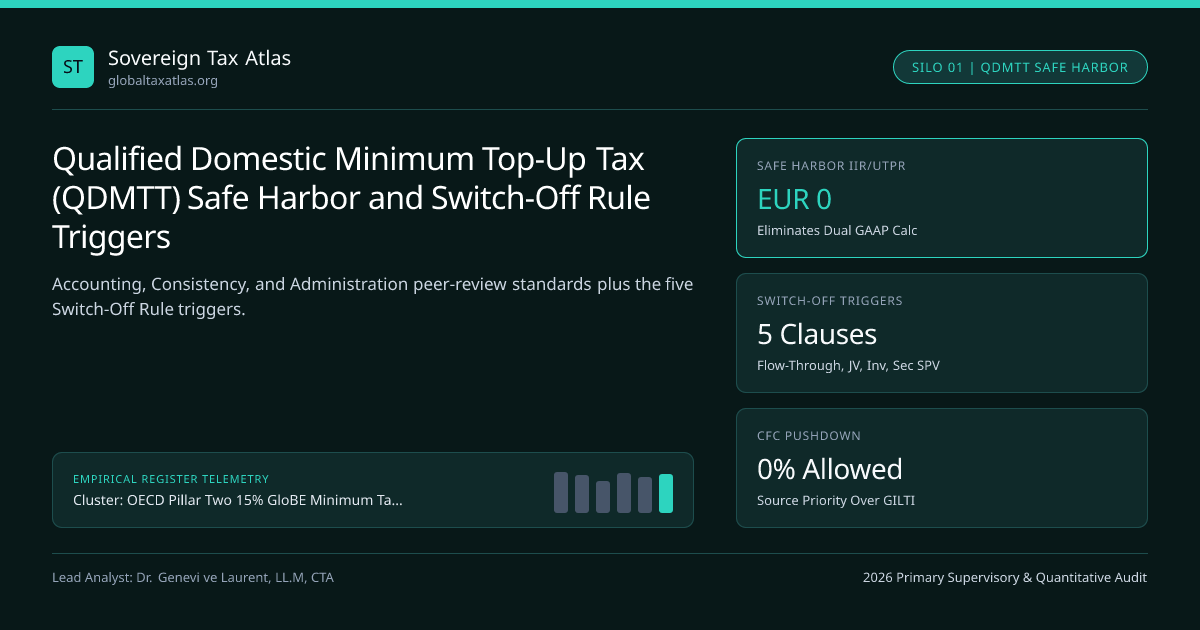
More than 55 jurisdictions have enacted domestic 15.0% minimum taxes so local treasuries—rather than foreign parent tax authorities—collect Pillar Two top-up revenues, yet mere QDMTT status only grants a tax credit, whereas QDMTT Safe Harbor status permanently zeroes out foreign IIR and UTPR calculations. Within our OECD Pillar Two 15% GloBE architecture hub, understanding the legal chasm between a simple Article 5.2.3 QDMTT credit and the July 2023 OECD QDMTT Safe Harbor—alongside its Switch-Off Rule—is essential when evaluating offshore and mid-shore enactments across Bahamas and Barbados DMTTs, UAE supplemental DMTTs, and Ireland Part 4A QDMTT in the OECD Pillar Two QDMTT & GloBE cluster.
Simple QDMTT Credit vs QDMTT Safe Harbor Deeming Rule#
Without the QDMTT Safe Harbor, a multinational parent in London or Tokyo must compute two separate 15% calculations for every subsidiary jurisdiction: first, the local QDMTT return under local GAAP, and second, the parent's IIR calculation under UPE consolidated GAAP (e.g., US GAAP or IFRS), claiming the local QDMTT merely as a dollar-for-dollar offset under Article 5.2.3. Because local GAAP depreciation, FX functional currency, or Substance-Based Income Exclusion allowances often diverge from UPE GAAP, a EUR 1.8 million timing gap still leaks through to parent IIR top-up tax!
To eliminate dual calculations, the July 2023 OECD Administrative Guidance established the permanent QDMTT Safe Harbor: if a jurisdiction's domestic top-up tax passes Inclusive Framework transitional/permanent peer review on three additional strict pillars, foreign IIR and UTPR jurisdictions deem Top-Up Tax to be zero, requiring only a single QDMTT calculation:
- QDMTT Accounting Standard: Computed using either the UPE's Financial Accounting Standard or a compulsory Local Financial Accounting Standard required by domestic corporate/tax law for all local Constituent Entities (with audited fiscal periods matching the UPE).
- Consistency Standard: Mirrors GloBE Model Rules outcomes—save for permitted mandatory variations (no cross-border CFC/PE tax pushdown into a QDMTT, and optional narrower or zero SBIE/de minimis thresholds).
- Administration Standard: Satisfies ongoing OECD peer-review monitoring against collateral benefits or disguised tax rebates.
Ban on Parent CFC and Outbound WHT Pushdown Inside QDMTTs#
One pivotal asymmetry boosts local QDMTT collections far above what a parent IIR would have collected: under OECD QDMTT design rules, a source jurisdiction must exclude foreign parent CFC taxes (such as US GILTI or Subpart F) and foreign main-entity PE taxes that would otherwise push down into Chapter 4 Adjusted Covered Taxes! Consequently, if a US multinational owns an Irish or Barbadian subsidiary earning passive treasury interest taxed locally at 9%, US GILTI cannot shield that subsidiary from paying the full 6% local QDMTT first; instead, the US parent must look to US foreign tax credit rules (Notice 2023-80) to credit the foreign QDMTT against US corporate tax.
- Residual Parent IIR Tax = max(0, (TopUp%UPEGAAP * ExcessProfitUPEGAAP) - QDMTTPayableLocal_GAAP)
- With QDMTT Safe Harbor (No Switch-Off Triggered):
- Residual Parent IIR & UTPR Tax = EUR 0 (even if LocalGAAPQDMTT < HypotheticalUPEGAAP_TopUp!)
- Worked Switch-Off Fallback Case (Securitisation SPV in QDMTT Jurisdiction — June 2024 Guidance):
- Jurisdiction enacts QDMTT exempting Securitisation Entities (Switch-Off Trigger #5 for SPV bucket!)
- Operating Subsidiaries in same country (Net GloBE Income EUR 60M, Local QDMTT EUR 3.6M):
- > Retain QDMTT Safe Harbor! Foreign IIR = EUR 0.
- Securitisation SPV (UPE GAAP Profit EUR 8.0M, Local Tax EUR 0, Local QDMTT Exempt = EUR 0):
- > Switch-Off applies strictly to Securitisation sub-bucket; UPE applies Art. 2.1 IIR (15% * EUR 8.0M = EUR 1.2M) unless QDMTT imposes charge on sibling Constituent Entities!
Five Switch-Off Rule Triggers Restoring Foreign IIR / UTPR Dual Calculations#
Even when a country earns OECD Transitional QDMTT Safe Harbor approval on the Inclusive Framework Central Record, the Switch-Off Rule automatically disables Safe Harbor deeming—dropping the MNE back to the dual-calculation Article 5.2.3 credit mechanism—whenever local law fails to tax specific in-scope structures:
- Flow-Through Ultimate Parent Entities: The QDMTT jurisdiction does not impose QDMTT on a Flow-Through UPE located there.
- Investment Entities Excluded Locally: The QDMTT exempts controlled Investment Entities (Articles 7.4–7.6) rather than taxing them—triggering a targeted Switch-Off solely for the Investment Entity sub-bucket.
- Joint Ventures (JVs) Excluded Locally: Local law omits Article 6.4 50%-held Joint Ventures from QDMTT charge (targeted Switch-Off for the JV group).
- Initial Phase International Activity Conditional QDMTT: Jurisdictions (such as Barbados under certain reciprocal clauses overseen alongside CBB) that condition QDMTT collection on whether the MNE is subject to foreign IIR/UTPR during the Article 9.3 five-year initial phase.
- Securitisation Entities (June 2024 Administrative Guidance): Where local QDMTT law excludes orphan or group Securitisation SPVs (prominent in Luxembourg SPV structures and Ireland) without re-allocating any resulting top-up tax to another non-securitisation Constituent Entity in that same jurisdiction!
Unenforceable or Constitutionally Contested QDMTT Disallowance#
July 2023 Administrative Guidance added a sharp anti-gaming clawback: any QDMTT amount that the MNE Group directly or indirectly challenges on constitutional, bilateral investment treaty, or tax stabilization agreement grounds—or that the local tax authority assesses as uncollectible—is not treated as QDMTT Payable under Article 5.2.3 and disqualifies the MNE from the QDMTT Safe Harbor in that country! Multinational groups holding legacy 20-year fiscal stability concessions in special economic zones (such as Labuan Labuan FSA, Mauritius CBRD, or Dubai DMCC) or transacting through offshore brokerage vehicles like Arbitrage Prime Limited and Alamiya Markets gain zero group-wide benefit from invoking stabilization clauses against a local QDMTT, because blocking the local tax immediately hands 100% of the top-up revenue to the parent IIR or operating-country UTPRs!
QDMTT Safe Harbor Peer-Review & Switch-Off Matrix#
| QDMTT Design Feature | Permitted Under QDMTT Safe Harbor? | Impact on Local Tax Collected | Triggers Switch-Off Rule? | Strategic Takeaway for Tax Counsel |
|---|---|---|---|---|
| Zero or Narrower SBIE Carve-Out | Yes — Explicitly permitted | Increases local QDMTT above GloBE floor | No | Excess QDMTT above 15% is non-refundable under foreign IIR |
| Mandatory Local Statutory GAAP | Yes — If compulsory for 100% local CEs | May diverge from UPE IFRS/US GAAP | Yes, if >=1 CE lacks compulsory local GAAP | If 1 entity lacks compulsory local GAAP, entire group uses UPE GAAP |
| Excluding Parent US GILTI Pushdown | Mandatory requirement | Preserves 100% source taxing priority | No | Claim foreign tax credit on US return under IRS Notice 2023-80 |
| Exempting Securitisation SPVs | Permitted under June 2024 Guidance | SPV pays EUR 0 locally | Yes (SPV bucket only), unless sibling CE charged | Designate sibling local operating CE to bear residual SPV QDMTT |
| Invoking Fiscal Stability Clause | Disallowed (Anti-Contest Rule) | Local QDMTT contested | Yes — Voids Safe Harbor & Credit | Waive stability challenge; pay local QDMTT rather than foreign UTPR |
Frequently asked questions
What happens if three local subsidiaries use mandatory Local GAAP but a fourth Cayman branch in that country does not?
Under the Local Financial Accounting Standard rule, if even one Constituent Entity in the jurisdiction is not legally required to prepare local GAAP financial accounts, the Local GAAP rule fails unless the QDMTT statute forces all entities onto UPE GAAP for QDMTT calculation.
Does a Switch-Off trigger on an Investment Entity taint all operating subsidiaries in the same country?
No. When a QDMTT jurisdiction excludes Investment Entities or Joint Ventures from its domestic top-up charge, the Switch-Off Rule is strictly targeted to those excluded Investment Entities or JVs; regular operating subsidiaries in that country retain QDMTT Safe Harbor protection.
Can a group carry forward excess QDMTT if local GAAP produces a higher tax than UPE GAAP?
No. If a jurisdiction QDMTT exceeds the hypothetical GloBE Top-Up Tax (for instance, because local law omits the SBIE carve-out or has timing differences), the excess neither generates a refundable credit nor reduces top-up taxes in other jurisdictions.
Is Bermuda 2025 15% Corporate Income Tax classified as a QDMTT Safe Harbor?
No. Bermuda enacted a standalone 15% Corporate Income Tax Act rather than a top-up QDMTT. Consequently, Bermuda CIT enters the regular Chapter 4 Covered Taxes numerator rather than acting as a QDMTT Safe Harbor, requiring parent groups to run standard ETR or CbCR Safe Harbor checks.
Publication record
- Published
- 14 November 2026
- Updated
- 15 November 2026
- Author
- Dr. Geneviève Laurent, LL.M, CTA
- Review
- Review not recorded
- Automated fact check
- Passed in the stored pipeline record
- Source URLs
- 3 recorded
AI assistance recorded: anthropic/claude-opus-4.6. This field does not establish human review or source verification.
Academic & Institutional Attribution
Cite This Research & Embed Live Data Card
Standard academic & institutional research paper citation format.
Dr. Geneviève Laurent, LL.M, CTA. (2026, November 15). Qualified Domestic Minimum Top-Up Tax (QDMTT) Safe Harbor and Switch-Off Rule Triggers. Sovereign Tax Atlas. https://globaltaxatlas.org/entries/qdmtt-safe-harbor-accounting-standard-consistency-switch-off-ruleRegulatory Directory Cross-Reference
Referenced Institutions & Regulatory Registries
Top Regulated Institutions in This Coverage Slice
Related Oecd Pillar Two Qdmtt Globe & Institutional Briefings
Explore Oecd Pillar Two Qdmtt Globe Hub (20) →Oecd Pillar Two Qdmtt Globe
OECD Pillar Two 15% GloBE Minimum Tax Architecture: QDMTT, IIR, and UTPR Institutional GuideOecd Pillar Two Qdmtt Globe
Income Inclusion Rule (IIR) Top-Down Ordering and Partially Owned Parent Entity MechanicsOecd Pillar Two Qdmtt Globe
Undertaxed Profits Rule (UTPR) Allocation Key: Employee Headcount and Tangible Asset WeightsOecd Pillar Two Qdmtt Globe
Transitional CbCR Safe Harbor: De Minimis, Simplified ETR, and Routine Profits TestsOecd Pillar Two Qdmtt Globe
Qualified Refundable Tax Credits (QRTCs) vs Marketable Transferable Tax Credits Under GloBEOecd Pillar Two Qdmtt Globe
Bermuda 15% Corporate Income Tax Act vs GloBE QDMTT Parity for Insurers and HoldCosOecd Pillar Two Qdmtt Globe
Crown Dependencies Pillar Two Response: Jersey and Guernsey 15% Multinational Tax RegimesOecd Pillar Two Qdmtt Globe
Caribbean Pillar Two Enactments: Bahamas 15% DMTT and Barbados 9% to 15% Tiered Tax ReformCrs 2 Carf Fatca Exchange Rules
IRS Form W-8BEN-E Chapter 4 Classification: Active NFFE, Passive NFFE, and Investment EntitiesCrs 2 Carf Fatca Exchange Rules
IRS Form W-8IMY Documentation: Qualified Intermediaries, Withholding Partnerships, and Rate PoolsCrs 2 Carf Fatca Exchange Rules
CRS Controlling Persons Look-Through: 25% AML Thresholds and Discretionary Trust ProtectorsCrs 2 Carf Fatca Exchange Rules
Cayman Islands DITC Portal Governance: CRS Compliance Forms, CIMA Fund Audits, and Penalties
Sovereign Tax Atlas Data, Benchmarks & Contributor Records
CC BY 4.0 Open Data
Open Institutional Datasets (CSV / JSON) →
Download desk-compiled quantitative series & schemas.
2026 Reference Matrix
2026 Institutional Benchmarks & Thresholds →
Statutory capital, clearing, margin & rate conventions.
Editorial Records
Authors & Review Records →
View named contributors where those records are available.
Complete Index
Master Research & Dossier Archive →
Browse all published briefings by topic pillar & date.