
Computing GloBE Income or Loss: Article 3.2 Permanent Adjustments to Financial Accounting Net Income
OECD GloBE Article 3.2 converts each Constituent Entity pre-consolidation Financial Accounting Net Income or Loss into the ETR denominator through mandatory permanent adjustments and tax-alignment elections.
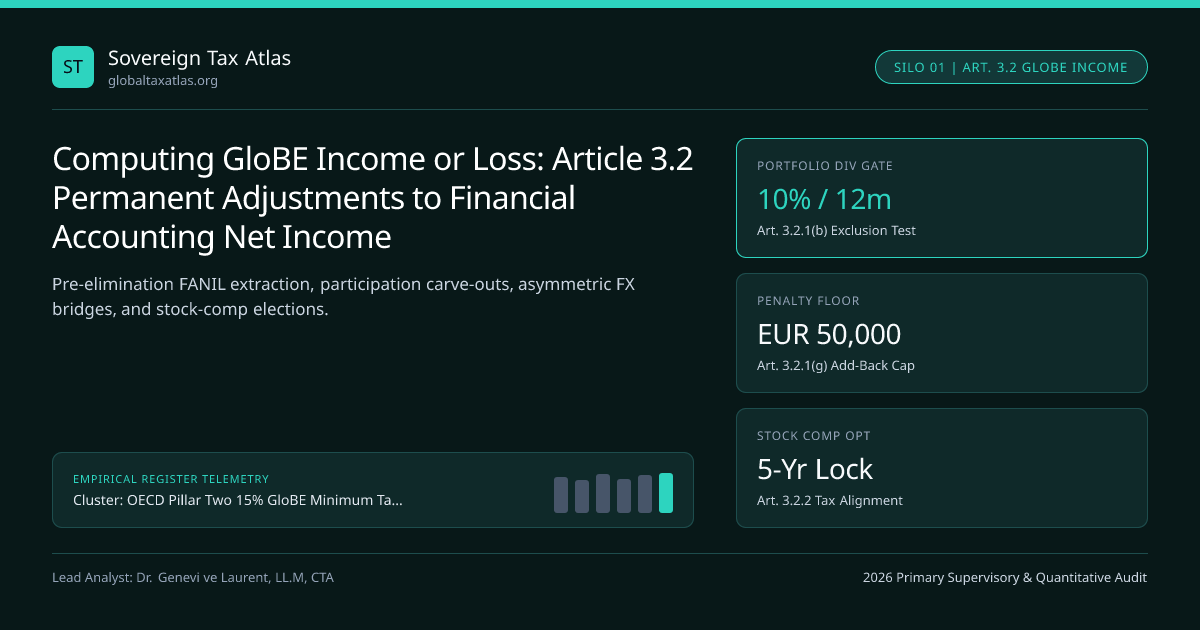
Every jurisdictional Effective Tax Rate calculation rests on its denominator—Net GloBE Income—which begins under Article 3.1.2 with each Constituent Entity's Financial Accounting Net Income or Loss (FANIL) determined before consolidating intra-group eliminations, modified by nine mandatory permanent adjustments and six optional elections under Article 3.2. As established in our OECD Pillar Two 15% GloBE architecture guide and paired with the numerator rules in Adjusted Covered Taxes and deferred tax recapture, failing to strip Excluded Dividends, Asymmetric Foreign Currency Gains, or purchase-accounting pushdown adjustments causes severe artificial ETR distortions across the OECD Pillar Two QDMTT & GloBE cluster.
Starting Baseline: Pre-Elimination Entity FANIL and Purchase Accounting Trap#
Unlike domestic corporate tax returns that begin with statutory local GAAP standalone accounts, Article 3.1.2 requires extracting each Constituent Entity's net income or loss prepared under the Ultimate Parent Entity's consolidated accounting standard (for example, US GAAP or IFRS) prior to intercompany consolidation eliminations. That distinction carries two immediate traps:
- Intercompany Transactions Remain Live: Intra-group management fees, royalties, interest, and cross-border inventory margins must be priced at the Arm's Length Principle under Article 3.2.3; if booked off-market and creating local tax loss/gain mismatches, tax departments must impute transfer pricing adjustments directly into FANIL.
- Prohibition of Purchase Accounting Pushdown: Under Article 3.1.2, fair-value step-ups and intangible goodwill amortization arising from acquiring shares in a target company cannot be pushed down into the target's FANIL (with a narrow historical exception for pre-December 1, 2021 US GAAP pushdown accounting where historical cost records no longer exist).
Excluded Dividends (Article 3.2.1(b)) and Excluded Equity Gains (Article 3.2.1(c))#
Because nearly all onshore and offshore corporate regimes exempt participation dividends and subsidiary share disposals to prevent cascading triple taxation, leaving book dividends or M&A disposal gains inside FANIL while local tax is zero would crash a holding company's ETR toward 0%! Article 3.2 aligns GloBE with participation exemption norms—with sharp quantitative boundaries:
- Excluded Dividends: All dividends from ≥10% ownership interests are excluded regardless of holding period. For Short-Term Portfolio Shareholdings where the group holds less than 10% of profits, capital, reserves, or voting rights, dividends are taxable inside GloBE Income unless the Constituent Entity has economically held full risk of loss on those shares for at least 12 months at the distribution date! (Captive insurers and banks frequently hold <10% public equities; an irrevocable five-year Portfolio Shareholding Election allows including all <10% dividends in GloBE Income to avoid tracking 12-month holding periods lot-by-lot.)
- Excluded Equity Gains or Losses: Gains, losses, and fair-value mark-to-market movements from equity interests where the group holds at least 10% are excluded (even if held less than 12 months!). However, hedging derivatives taken out to hedge foreign currency exposure on a foreign subsidiary equity stake are excluded only if formally designated as an effective net-investment hedge and elected under five-year Equity Investment Inclusion/Hedge rules.
Asymmetric Foreign Currency Gains or Losses (Article 3.2.1(f))#
Treasury hubs in Switzerland, Singapore, Ireland, or DIFC often maintain USD IFRS books while filing tax returns in local currency, creating book-versus-tax FX translation gaps. Article 3.2.1(f) neutralizes all four categories of Asymmetric Foreign Currency Gains or Losses caused by divergence between functional accounting currency and tax functional currency, adding taxable FX gains (and subtracting deductible FX losses) directly to FANIL so numerator and denominator remain synchronized.
- +/- Asymmetric FX Adjustments + Disallowed Fines (>=EUR 50k) - Accrued Pension Expense + Cash Pension Paid
- +/- Stock-Based Comp Tax Alignment (Art. 3.2.2 Election)
- Worked Treasury & HoldCo Denominator Bridge (FY 2026):
- Pre-Elimination IFRS Profit After Tax (FANIL) = EUR 92,000,000
- Add Back Book Income Tax Expense (Art. 3.2.1(a)) = +EUR 8,000,000 -> Pre-Tax Book = EUR 100,000,000
- Less: Dividend from 25% Subsidiary (Art. 3.2.1(b) Excluded) = -EUR 30,000,000
- Portfolio Dividend from 3% ETF Held 7 Months (<10% & <12m) = EUR 0 adjustment (remains taxable!)
- Add: Tax-Functional FX Gain taxed locally but absent in USD book (Art. 3.2.1(f)) = +EUR 4,500,000
- Add: Regulatory Fine Paid to Market Authority (EUR 1,200,000 >= EUR 50k) = +EUR 1,200,000
- Art. 3.2.2 Stock-Comp Election (Book Expense EUR 3.0M vs Tax Deduction on Vesting EUR 7.5M) = -EUR 4,500,000
- Final Entity GloBE Income = 100.0M - 30.0M + 4.5M + 1.2M - 4.5M = EUR 71,200,000
Critical Five-Year Elections: Stock-Based Compensation, Realization, and Consolidation#
Tax directors actively manage denominator volatility using three high-impact five-year elections before calculating the Substance-Based Income Exclusion carve-out:
- Article 3.2.2 Stock-Based Compensation Election: Replaces IFRS 2 / ASC 718 grant-date fair-value amortization with the exact deduction allowed on the local corporate tax return upon employee share exercise or vesting—preventing massive permanent ETR shortfalls when share prices fall below grant value or permanent windfalls when share prices surge.
- Article 3.2.5 Realization Principle Election: Replaces fair-value accounting on tangible property, investment real estate, or sovereign debt portfolios with historical cost realization upon disposal.
- Article 3.2.8 Consolidated Accounting Treatment Election: Permits Constituent Entities in the same jurisdiction that belong to a domestic tax consolidation group to eliminate intra-jurisdictional intercompany asset sales and management charges under UPE consolidated accounting rules, aligning book income with local group-relief filings overseen in hubs like Jersey (JFSC), Labuan (Labuan IBFC), or Europe (ESMA). Counterparty structures involving trading groups like Abc Group and Aftermath Finance must verify whether hybrid debt-equity instruments trigger Article 3.2.7 Intragroup Financing Arrangement disallowances!
Summary of Article 3.2 Book-to-GloBE Adjustments#
| Article 3.2 Adjustment / Election | Statutory Clause | Mandatory vs Elective | Book-to-GloBE Direction | Primary Trap in Audit Reviews |
|---|---|---|---|---|
| Net Taxes Expense Add-Back | Art. 3.2.1(a) | Mandatory | Adds back Covered Taxes & QDMTT | Forgetting to add back deferred tax expense embedded in FANIL |
| Short-Term Portfolio Dividends | Art. 3.2.1(b) | Mandatory (5-yr incl. option) | Excludes >=10% or >=12m stakes | Securities lending/total-return swaps breaking 12-month economic risk |
| Asymmetric FX Gains/Losses | Art. 3.2.1(f) | Mandatory | Syncs Accounting vs Tax FX | Confusing third-currency transaction FX (not adjusted) with functional FX |
| Policy Disallowed Expenses | Art. 3.2.1(g) | Mandatory | Adds back bribes & >=EUR 50k fines | Failing to aggregate recurring daily compliance fines above EUR 50,000 |
| Stock-Based Comp Alignment | Art. 3.2.2 | 5-Year Jurisdictional Election | Substitutes tax-return deduction | Recapture required if unvested options expire after book deduction |
| Intragroup Financing Anti-Abuse | Art. 3.2.7 | Mandatory Anti-Avoidance | Denies borrower interest deduction | Low-tax (CIMA) treasury sub lending to <15% sub without increasing lender tax |
Frequently asked questions
Why are intra-group sales not automatically eliminated when computing GloBE Income?
Because GloBE blends income on a jurisdictional rather than global basis, cross-border sales between Constituent Entities in different countries must remain uneliminated and priced at arm-s length under Article 3.2.3. Only same-jurisdiction consolidated tax groups may elect intra-country elimination under Article 3.2.8.
When does Article 3.2.7 disallow intragroup interest deductions inside GloBE Income?
Article 3.2.7 denies an interest deduction to a Low-Tax Entity borrower when the corresponding interest income is booked by a High-Tax Counterparty whose ETR exceeds 15% and does not increase taxable income due to excess tax attributes or losses, blocking artificial ETR inflation.
How are defined-benefit pension expenses adjusted under Article 3.2.1(i)?
Accrued accounting pension expense (or pension income) under IAS 19 or ASC 715 is backed out of FANIL and replaced strictly with actual cash contributions paid into an external Pension Fund during the fiscal year, aligning GloBE timing with domestic tax deductibility.
Does a EUR 40,000 regulatory fine get added back to GloBE Income under Article 3.2.1(g)?
A standalone EUR 40,000 regulatory fine is deductible and not added back unless it represents periodic penalties imposed for continuing conduct that aggregate to EUR 50,000 or more over the fiscal year; illegal bribes and kickbacks are 100% disallowed from the first euro.
Publication record
- Published
- 14 November 2026
- Updated
- 14 November 2026
- Author
- Dr. Geneviève Laurent, LL.M, CTA
- Review
- Review not recorded
- Automated fact check
- Passed in the stored pipeline record
- Source URLs
- 3 recorded
AI assistance recorded: anthropic/claude-opus-4.6. This field does not establish human review or source verification.
Academic & Institutional Attribution
Cite This Research & Embed Live Data Card
Standard academic & institutional research paper citation format.
Dr. Geneviève Laurent, LL.M, CTA. (2026, November 14). Computing GloBE Income or Loss: Article 3.2 Permanent Adjustments to Financial Accounting Net Income. Sovereign Tax Atlas. https://globaltaxatlas.org/entries/globe-income-or-loss-financial-accounting-net-income-adjustmentsRegulatory Directory Cross-Reference
Referenced Institutions & Regulatory Registries
Top Regulated Institutions in This Coverage Slice
Related Oecd Pillar Two Qdmtt Globe & Institutional Briefings
Explore Oecd Pillar Two Qdmtt Globe Hub (20) →Oecd Pillar Two Qdmtt Globe
OECD Pillar Two 15% GloBE Minimum Tax Architecture: QDMTT, IIR, and UTPR Institutional GuideOecd Pillar Two Qdmtt Globe
Substance-Based Income Exclusion (SBIE): Transitional Payroll to 5% Steady-State Carve-OutsOecd Pillar Two Qdmtt Globe
Qualified Domestic Minimum Top-Up Tax (QDMTT) Safe Harbor and Switch-Off Rule TriggersOecd Pillar Two Qdmtt Globe
Income Inclusion Rule (IIR) Top-Down Ordering and Partially Owned Parent Entity MechanicsOecd Pillar Two Qdmtt Globe
Undertaxed Profits Rule (UTPR) Allocation Key: Employee Headcount and Tangible Asset WeightsOecd Pillar Two Qdmtt Globe
Transitional CbCR Safe Harbor: De Minimis, Simplified ETR, and Routine Profits TestsOecd Pillar Two Qdmtt Globe
Qualified Refundable Tax Credits (QRTCs) vs Marketable Transferable Tax Credits Under GloBEOecd Pillar Two Qdmtt Globe
Bermuda 15% Corporate Income Tax Act vs GloBE QDMTT Parity for Insurers and HoldCosCrs 2 Carf Fatca Exchange Rules
US FATCA Model 1 vs Model 2 Intergovernmental Agreements and IRC Section 1471 30% WithholdingCrs 2 Carf Fatca Exchange Rules
IRS FATCA Registration Portal: GIIN Issuance, Sponsored FFI Hierarchies, and RO CertificationsCrs 2 Carf Fatca Exchange Rules
IRS Form W-8BEN-E Chapter 4 Classification: Active NFFE, Passive NFFE, and Investment EntitiesCrs 2 Carf Fatca Exchange Rules
IRS Form W-8IMY Documentation: Qualified Intermediaries, Withholding Partnerships, and Rate Pools
Sovereign Tax Atlas Data, Benchmarks & Contributor Records
CC BY 4.0 Open Data
Open Institutional Datasets (CSV / JSON) →
Download desk-compiled quantitative series & schemas.
2026 Reference Matrix
2026 Institutional Benchmarks & Thresholds →
Statutory capital, clearing, margin & rate conventions.
Editorial Records
Authors & Review Records →
View named contributors where those records are available.
Complete Index
Master Research & Dossier Archive →
Browse all published briefings by topic pillar & date.