
Transitional CbCR Safe Harbor: De Minimis, Simplified ETR, and Routine Profits Tests
Through fiscal years starting in 2026, the OECD Transitional CbCR Safe Harbor zeroes out jurisdictional Pillar Two top-up tax via De Minimis, 17.0% Simplified ETR, or Routine Profits gates—subject to strict anti-hybrid-arbitrage rules.
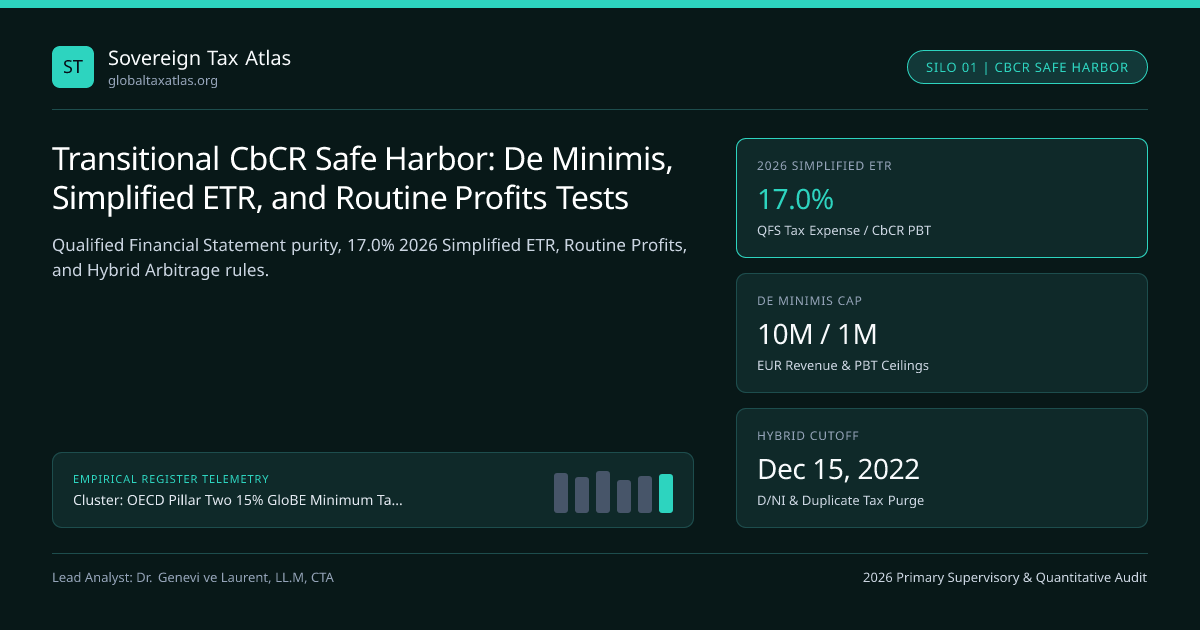
Across the inaugural Pillar Two reporting cycles, multinational tax departments eliminate up to 80% of full-blown Chapter 3 and Chapter 4 calculations by qualifying jurisdictions for the Transitional Country-by-Country Reporting (CbCR) Safe Harbor—applicable to fiscal years beginning on or before December 31, 2026 and ending before June 30, 2028. Grounded in our OECD Pillar Two 15% GloBE architecture hub, this safe harbor deems Top-Up Tax to be zero whenever a jurisdiction passes any one of three quantitative gates, yet the "Once Out, Always Out" cliff and December 2023 Hybrid Arbitrage Arrangement rules invalidate tainted CbCR filings across the OECD Pillar Two QDMTT & GloBE cluster.
Gateway Prerequisite: What Makes a CbC Report "Qualified"?#
Before testing any numerical ratio, an MNE group's CbC Report for that specific jurisdiction must be a Qualified CbC Report—meaning both its Total Revenue and Profit (Loss) Before Income Tax in CbCR Table 1 are sourced exclusively from Qualified Financial Statements (QFS):
- Accounts used to prepare the UPE's Consolidated Financial Statements (reporting packages);
- Separate financial statements of each Constituent Entity prepared under either an Acceptable Financial Accounting Standard or an Authorised Financial Accounting Standard (audited or reliable regulatory accounts); or
- Separate management accountssolely for non-material entities excluded from consolidation on materiality grounds.
Fatal Contamination Traps: Mixing consolidation reporting packages for three subsidiaries with statutory local GAAP accounts for a fourth subsidiary in the same jurisdiction (other than non-material entities)—or plugging top-side Excel adjustments into CbCR Table 1 without journalizing them in QFS, or pushing down post-2021 purchase price allocation (PPA) adjustments without complying with the Consistent Reporting Condition—disqualifies the entire jurisdiction from Transitional CbCR Safe Harbor access!
Quantitative Mechanics of the Three Safe Harbor Gates (FY 2026 Calibration)#
Assuming QFS purity holds and the jurisdiction did not fail the safe harbor in a prior in-scope year ("Once Out, Always Out"), passing any single gate deems Top-Up Tax to be zero:
- Gate 1 — De Minimis Test: Jurisdictional CbCR Total Revenue (including intra-group revenue and sales of Excluded Entities if reported in CbCR!) is less than EUR 10 million AND CbCR Profit (Loss) Before Income Tax (PBT) is less than EUR 1 million (note: a jurisdiction with EUR 18 million revenue and a EUR 2 million loss fails De Minimis on revenue, though it automatically passes Gate 3!).
- Gate 2 — Simplified ETR Test: Simplified Covered Taxes / CbCR PBT >= Transition Rate, which equals 15.0% for FYs beginning in 2023–2024, 16.0% for FYs beginning in 2025, and 17.0% for FYs beginning in 2026! Importantly, Simplified Covered Taxes come from Income Tax Expense on Qualified Financial Statements (including deferred taxes without the 15% recast cap or 5-year recapture of Chapter 4 Adjusted Covered Taxes, minus Uncertain Tax Positions!), not Cash Tax Paid in CbCR Table 1!
- Gate 3 — Routine Profits Test: CbCR PBT is less than or equal to the jurisdiction's Substance-Based Income Exclusion (SBIE) amount calculated solely for Constituent Entities recognized in both CbCR and GloBE (automatically clearing any jurisdiction with zero or negative CbCR PBT, while deferring Article 4.5 GloBE Loss Election until the first post-safe-harbor year!).
- / (CbCR Profit Before Tax - Unrealized Net Fair-Value Share Loss > EUR 50M [if elected] + Hybrid Deductions)
- Worked Anti-Hybrid & Simplified ETR Audit (FY 2026 Tested Jurisdiction):
- Raw CbCR Total Revenue = EUR 64,000,000 (>= EUR 10M -> Fails Gate 1 De Minimis)
- Raw CbCR Profit Before Income Tax (PBT) = EUR 18,000,000 (SBIE = EUR 6,200,000 -> Fails Gate 3 Routine Profits)
- QFS Total Income Tax Expense (Current + Deferred, net of EUR 0.4M UTP) = EUR 3,230,000
- Naive Simplified ETR = 3,230,000 / 18,000,000 = 17.94% (appears >= 17.0% 2026 gate!)
- Audit Finding: In March 2024 (after Dec 15, 2022), local sub paid EUR 2,500,000 interest on a repo/convertible note to a Cayman affiliate (CIMA) that recorded EUR 0 accounting & tax income (Deduction/Non-Inclusion Hybrid!):
- > Adjusted CbCR PBT = EUR 18,000,000 + EUR 2,500,000 = EUR 20,500,000
- > True Simplified ETR = 3,230,000 / 20,500,000 = 15.76% (< 17.0% FY 2026 Transition Rate!)
- Result: Safe Harbor FAILED; group must run full GloBE Chapter 3–5 calculation for FY 2026!
December 2023 Anti-Hybrid Arbitrage Rules: Purging Artificial Safe Harbor Qualification#
In December 2023, the OECD shut down accounting arbitrage transactions entered into or amended after December 15, 2022 designed to manufacture Simplified ETR or De Minimis eligibility across three targeted patterns:
- Deduction / Non-Inclusion (D/NI) Arrangements: One Constituent Entity records an accounting expense or loss in QFS (e.g., hybrid preferred share dividends booked as debt interest, or forgiving debt at a book discount) without a commensurate revenue/taxable inclusion in the counterparty Constituent Entity.
- Duplicate Loss Arrangements: An expense or loss is duplicated in the QFS of two Constituent Entities (or duplicated in both QFS and a foreign tax return).
- Duplicate Tax Recognition Arrangements: Two Constituent Entities record the same income tax expense in their QFS (for example, pushing CFC/branch tax into a subsidiary's standalone accounts without removing it from the parent's QFS).
When detected, the hybrid expense is added back to PBT (or duplicate tax stripped from Simplified Covered Taxes) solely for testing the Safe Harbor!
Special Entities: Joint Ventures, Investment Entities, and Non-CbCR Groups#
What about groups exempt from filing statutory CbCR locally or entities reported abnormally? Under OECD guidance, Investment Entities (Articles 7.4–7.6) taxed in the same residence jurisdiction as their Constituent Entity owners can still shelter behind the host jurisdiction's CbCR Safe Harbor provided no Tax Transparency or Taxable Distribution election applies. Conversely, Stateless Entities, multi-jurisdiction UPE Flow-Through mismatches, and jurisdictions omitted in a prior year ("Once Out, Always Out"—unless the group had zero Constituent Entities there in that prior year) require full GloBE reporting—an essential pre-closing M&A check when evaluating cross-border financial groups alongside ESMA, JFSC, and FinDB-listed counterparties like 5markets and Absolute Markets.
Transitional CbCR Safe Harbor Gate Verification Table#
| Safe Harbor Test / Condition | Metric & Data Source | FY 2026 Benchmark | Key Exclusion or Adjustment | Fatal Disqualification Trap |
|---|---|---|---|---|
| Qualified Financial Statements | UPE Consol Packages OR Local GAAP | 100% uniform within country | Non-material subs may use mgmt accounts | Mixing 2 UPE packages + 1 statutory GAAP in same country |
| Gate 1: De Minimis Test | CbCR Table 1 Revenue & PBT | Rev < EUR 10M AND PBT < EUR 1M | Add back Held-for-Sale revenue omitted from CbCR | Intercompany dividends inflating CbCR Revenue above EUR 10M! |
| Gate 2: Simplified ETR Test | QFS Tax Expense / CbCR PBT | >= 17.0% (FY 2026) | Exclude UTPs & strip intra-group dividends identically | Using CbCR Table 1 "Tax Accrued" (excludes deferred tax!) |
| Gate 3: Routine Profits Test | CbCR PBT vs Art. 5.3 SBIE | CbCR PBT <= Transitional SBIE | Zero or net-loss PBT automatically passes | Including SBIE of Entities Held for Sale excluded from CbCR |
| Anti-Hybrid Arbitrage Rule | Post-Dec 15, 2022 Arrangements | Add back D/NI & Duplicate Losses | Grandfathers unaltered pre-Dec 16, 2022 instruments | Post-2022 interest-rate reset/extension tainting grandfathered loan |
Frequently asked questions
How should intra-group dividends be treated in CbCR Profit Before Tax for the Simplified ETR test?
OECD CbCR guidance already instructs filers to exclude dividends received from other Constituent Entities out of CbCR Revenue and PBT; December 2023 Administrative Guidance requires symmetric treatment between QFS tax expense and CbCR PBT so intra-group dividends do not artificially inflate or depress Simplified ETR.
Does failing the Transitional CbCR Safe Harbor in 2024 block a subsidiary from claiming it in 2026?
Yes, strictly! Under the "Once Out, Always Out" rule, if an MNE group was in Pillar Two scope in FY 2024 and had Constituent Entities in a jurisdiction that failed (or did not claim) the Transitional CbCR Safe Harbor in FY 2024, that jurisdiction is permanently barred for FY 2025 and FY 2026.
Why is there a special EUR 50 million Net Unrealized Fair-Value Loss election?
Without the Unrealized Fair-Value Loss adjustment, a >EUR 50 million mark-to-market drop on >=10% equity stakes (which is excluded under full GloBE!) could turn positive CbCR PBT negative or distort ratios; however, turning PBT negative actually helps pass the Routine Profits test.
Can a group defer its Article 4.5 GloBE Loss Election until after the Transitional CbCR Safe Harbor expires?
Yes! Administrative Guidance explicitly permits an MNE group claiming the Routine Profits Safe Harbor for a loss-making jurisdiction during 2024–2026 to wait and file its irrevocable Article 4.5 GloBE Loss Election on the first GloBE Information Return after Safe Harbor transition ends.
Publication record
- Published
- 14 November 2026
- Updated
- 15 November 2026
- Author
- Dr. Geneviève Laurent, LL.M, CTA
- Review
- Review not recorded
- Automated fact check
- Passed in the stored pipeline record
- Source URLs
- 3 recorded
AI assistance recorded: anthropic/claude-opus-4.6. This field does not establish human review or source verification.
Academic & Institutional Attribution
Cite This Research & Embed Live Data Card
Standard academic & institutional research paper citation format.
Dr. Geneviève Laurent, LL.M, CTA. (2026, November 15). Transitional CbCR Safe Harbor: De Minimis, Simplified ETR, and Routine Profits Tests. Sovereign Tax Atlas. https://globaltaxatlas.org/entries/transitional-cbcr-safe-harbor-de-minimis-simplified-etr-routineRegulatory Directory Cross-Reference
Referenced Institutions & Regulatory Registries
Top Regulated Institutions in This Coverage Slice
Related Oecd Pillar Two Qdmtt Globe & Institutional Briefings
Explore Oecd Pillar Two Qdmtt Globe Hub (20) →Oecd Pillar Two Qdmtt Globe
OECD Pillar Two 15% GloBE Minimum Tax Architecture: QDMTT, IIR, and UTPR Institutional GuideOecd Pillar Two Qdmtt Globe
Qualified Refundable Tax Credits (QRTCs) vs Marketable Transferable Tax Credits Under GloBEOecd Pillar Two Qdmtt Globe
Bermuda 15% Corporate Income Tax Act vs GloBE QDMTT Parity for Insurers and HoldCosOecd Pillar Two Qdmtt Globe
Crown Dependencies Pillar Two Response: Jersey and Guernsey 15% Multinational Tax RegimesOecd Pillar Two Qdmtt Globe
Caribbean Pillar Two Enactments: Bahamas 15% DMTT and Barbados 9% to 15% Tiered Tax ReformOecd Pillar Two Qdmtt Globe
UAE 9% Corporate Tax and 15% Supplemental DMTT Across DIFC and DMCC Qualifying Free ZonesOecd Pillar Two Qdmtt Globe
Singapore Domestic Top-Up Tax (DTT), Multinational Enterprise Minimum Tax, and RIC IncentivesOecd Pillar Two Qdmtt Globe
Hong Kong Minimum Top-Up Tax (HKMTT) Interaction With Territorial Source and FSIE RulesCrs 2 Carf Fatca Exchange Rules
Cayman Islands DITC Portal Governance: CRS Compliance Forms, CIMA Fund Audits, and PenaltiesCrs 2 Carf Fatca Exchange Rules
BVI ITA and BVIFars Portal Compliance: FATCA/CRS Deadlines, Nil Filings, and ITA AuditsCrs 2 Carf Fatca Exchange Rules
IRS Form 1099-DA Digital Asset Broker Reporting vs OECD CARF: Cost Basis and Non-US ExemptionsCrs 2 Carf Fatca Exchange Rules
Dual Tax Residency Under CRS 2.0 and CARF: Elimination of Treaty Tie-Breaker Self-Certs
Sovereign Tax Atlas Data, Benchmarks & Contributor Records
CC BY 4.0 Open Data
Open Institutional Datasets (CSV / JSON) →
Download desk-compiled quantitative series & schemas.
2026 Reference Matrix
2026 Institutional Benchmarks & Thresholds →
Statutory capital, clearing, margin & rate conventions.
Editorial Records
Authors & Review Records →
View named contributors where those records are available.
Complete Index
Master Research & Dossier Archive →
Browse all published briefings by topic pillar & date.