
Jurisdictional ETR Mechanics: Adjusted Covered Taxes and Five-Year Deferred Tax Recapture
OECD GloBE Chapter 4 computes jurisdictional Effective Tax Rates by combining current income taxes with deferred tax adjustments recast at 15% and policed by a strict five-year recapture clock.
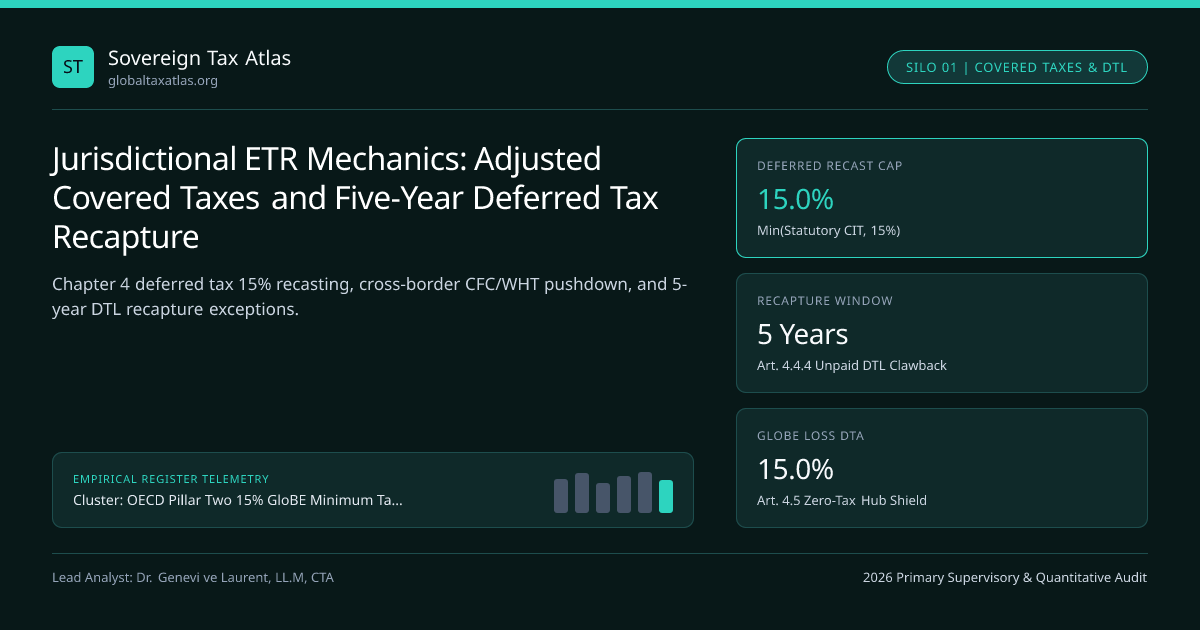
Under Chapter 4 of the OECD GloBE Model Rules, a jurisdiction's Effective Tax Rate (ETR) numerator—Adjusted Covered Taxes—starts with current tax expense accrued in financial accounts, adds the Total Deferred Tax Adjustment Amount recast at a maximum 15.0% rate, and enforces retroactive recapture on non-exempt deferred tax liabilities unpaid within five fiscal years. Within our OECD Pillar Two 15% GloBE architecture hub, timing mismatches between financial accounting recognition (Article 3.2 GloBE Income adjustments) and local cash tax payments would falsely trigger 15% top-up charges every time a capital-intensive business claimed accelerated tax depreciation—making deferred tax accounting the primary volatility stabilizer across the OECD Pillar Two QDMTT & GloBE cluster.
Qualifying Covered Taxes vs Excluded Indirect Levies#
Article 4.2 defines Covered Taxes to encompass taxes recorded on an entity's income or profits, taxes in lieu of a generally applicable corporate income tax (such as gross withholding taxes on interest and royalties or tonnage-equivalent profit substitutes), and taxes levied on retained earnings and corporate equity. Conversely, value-added taxes, digital services taxes (DSTs) calculated purely on gross user revenues without profit nexus, payroll social security contributions, property stamp duties, and top-up taxes paid under a parent IIR, UTPR, or local QDMTT regime are excluded from Covered Taxes.
Cross-border allocation rules under Article 4.3 push taxes back to the jurisdiction that earned the underlying GloBE Income:
- Permanent Establishments (PEs): Main-entity tax paid on PE income moves to the PE jurisdiction.
- Controlled Foreign Company (CFC) & Hybrid Taxes: Parent-level US Subpart F, GILTI, or EU ATAD CFC taxes pushed down to a low-tax subsidiary are capped at 15.0% minus the subsidiary's domestic ETR on Passive Income under Article 4.3.3, preventing high-tax active income from absorbing parent CFC credits.
- Dividend Withholding Taxes: Unlike CFC taxes, outbound dividend withholding tax (such as Swiss 35% Verrechnungssteuer net of refund or US 5%/15% treaty WHT) is pushed back down from the recipient parent to the distributing subsidiary's jurisdiction!
Article 4.4 Deferred Tax Recasting and Valuation Allowance Stripping#
Financial accounting under IAS 12 or ASC 740 books deferred tax assets (DTAs) and deferred tax liabilities (DTLs) at the statutory domestic tax rate (e.g., 25% in the UK or 21% in the US) and applies valuation allowances when future profitability is uncertain. Allowing a 25% DTL accrual to shelter low-tax income dollar-for-dollar against a 15% minimum tax would overstate Covered Taxes by 10 percentage points. Therefore, Article 4.4.1 requires recasting deferred tax expense at 15.0% whenever the domestic tax rate exceeds 15.0% (while leaving deferred taxes booked below 15%, such as Ireland's 12.5% trading rate or UAE's 9% federal rate, at their actual statutory rate).
Furthermore, Article 4.4.1(c) completely strips out accounting valuation allowances and recognition adjustments so subjective management forecasts cannot manipulate jurisdictional ETRs. Tax credits—save for Qualified Refundable Tax Credits treated as income—are also excluded from deferred tax carryforwards, while Uncertain Tax Positions (UTPs) are disallowed upon accrual and credited solely in the fiscal year actually paid upon audit settlement.
- Adjusted Covered Taxes = Qualified Current Tax + Cross-Border Pushdown Tax + Recast Deferred Tax + Equity-Booked Covered Tax
- Worked Jurisdictional ETR & 5-Year Recapture Case (25% Statutory CIT Jurisdiction):
- Year 1 GloBE Income = EUR 80,000,000
- Current Tax Paid = EUR 2,000,000 (low due to EUR 60M intangible reserve deduction)
- Book DTL Accrued on Intangible Reserve at 25% = EUR 15,000,000
- Recast DTL at 15% Cap = EUR 15,000,000 * (15% / 25%) = EUR 9,000,000
- Year 1 Adjusted Covered Taxes = EUR 2,000,000 + EUR 9,000,000 = EUR 11,000,000
- Year 1 ETR = 11,000,000 / 80,000,000 = 13.75% -> Top-Up Tax % = 1.25%
- Year 6 Audit: EUR 6,000,000 of the Recast DTL failed to reverse by End of Year 5 (not an Art. 4.4.5 Recapture Exception Accrual):
- > Recompute Year 1 Adjusted Covered Taxes = 11,000,000 - 6,000,000 = EUR 5,000,000 (ETR drops to 6.25%!)
- > Collect EUR 6,000,000 Additional Current Top-Up Tax in Year 6 under Art. 5.4!
Five-Year Deferred Tax Liability Recapture vs Article 4.4.5 Exceptions#
Without an anti-deferral backstop, taxpayers could book indefinite deferred tax liabilities on goodwill, fair-value markups, or software reserves to hit 15% ETR forever without paying cash tax. Article 4.4.4 mandates that any DTL taken into account in Adjusted Covered Taxes that is not reversed (paid) within the five subsequent fiscal years must be recaptured—reducing Year 1 Covered Taxes retroactively and generating Additional Current Top-Up Tax in Year 6 under Article 5.4. June 2024 OECD Administrative Guidance introduced aggregated DTL category tracking using LIFO/FIFO conventions to spare groups from tracking millions of individual invoice lines.
Article 4.4.5 Recapture Exception Accruals—covering tangible property depreciation, natural resource licenses, R&D expenses, unrealized fair-value/FX gains, and statutory insurance reserves (BMA / FSC)—are exempt from the 5-year clock, whereas goodwill and acquired IP amortization face Year-6 clawback.
Article 4.5 GloBE Loss Election in Zero-Tax and Low-Tax Hubs#
In zero-tax jurisdictions regulated by CIMA or BVIFSC—or newly enacted regimes like UAE DIFC and DMCC Free Zones—entities historically recorded zero deferred tax assets on net operating losses because the statutory rate was 0%. If a group incurs a EUR 40 million startup loss in Year 1 and earns EUR 40 million profit in Year 2 in a 0% hub, absence of a DTA would trigger a EUR 6 million (15%) Year 2 top-up tax despite zero cumulative economic profit! Making the irrevocable first-year Article 4.5 GloBE Loss Election creates a deemed 15.0% GloBE Loss Deferred Tax Asset on net jurisdictional GloBE losses that carries forward indefinitely to shelter future profits, streamlining treasury modeling for multinational groups transacting with entities such as Ac Capital Market and Aus Global.
Cross-Border Pushdown & Recapture Audit Matrix#
| Deferred / Cross-Border Tax Item | Governing GloBE Provision | ETR Numerator Treatment | 5-Year Recapture Exposure | Recommended Compliance Action |
|---|---|---|---|---|
| Tangible Plant Accelerated Depr. | Art. 4.4.5(a) Exception | Included (recast at <=15%) | Exempt from 5-year clock | Segregate tangible vs intangible fixed-asset sub-ledgers |
| Goodwill / Software Amortization | Art. 4.4.4 General Rule | Included (recast at <=15%) | Recaptured in Y+6 if unpaid | Consider Art. 4.4.7 Unclaimed Accrual Election if >5 yrs |
| Outbound Dividend Withholding Tax | Art. 4.3.2(e) Pushdown | Credited to distributing sub's country | None (current cash WHT) | Map parent WHT certificates back to source sub ETR |
| US GILTI / Subpart F CFC Tax | Art. 4.3.2(c) & Art. 4.3.3 | Pushed down; passive capped at (15% - ETR) | None (Blended CFC allocation through FY25) | Model post-2025 expiration of Blended CFC allocation rule |
| Zero-Tax Hub Operating Loss (CIMA) | Art. 4.5 GloBE Loss Election | Generates 15.0% deemed DTA carryforward | No expiration | File Art. 4.5 election on inaugural GloBE Information Return |
Frequently asked questions
Why should a group make an Article 4.4.7 Unclaimed Accrual Election on long-lived intangibles?
If a tax department knows upfront that a deferred tax liability—such as indefinite-lived trademark amortization—will not reverse within five years and Year 1 ETR already exceeds 15% without it, making an Article 4.4.7 Unclaimed Accrual Election excludes that DTL immediately and avoids complex Year 6 recapture tracking.
How are Uncertain Tax Positions (UTPs) under IFRIC 23 or FIN 48 treated in GloBE ETR?
Under Articles 4.1.3(d) and 4.4.6, current and deferred tax expenses attributable to an uncertain tax position are excluded when accrued in financial statements and are added to Adjusted Covered Taxes only in the fiscal year actually paid.
Can a group switch between Article 4.4 deferred tax accounting and the Article 4.5 GloBE Loss Election?
Generally, the Article 4.5 GloBE Loss Election must be filed with the first GloBE Information Return covering that jurisdiction; if subsequently revoked, any remaining GloBE Loss DTA balance is forfeited down to zero upon transition back to Article 4.4.
Do Digital Services Taxes (DSTs) count toward the 15% Pillar Two Effective Tax Rate?
No. Because Digital Services Taxes are levied on gross digital advertising or marketplace revenues regardless of corporate profitability rather than in lieu of a generally applicable income tax, OECD Commentary excludes DSTs from Covered Taxes (though they reduce pre-tax GloBE Income as an operating deduction).
Publication record
- Published
- 14 November 2026
- Updated
- 14 November 2026
- Author
- Dr. Geneviève Laurent, LL.M, CTA
- Review
- Review not recorded
- Automated fact check
- Passed in the stored pipeline record
- Source URLs
- 3 recorded
AI assistance recorded: anthropic/claude-opus-4.6. This field does not establish human review or source verification.
Academic & Institutional Attribution
Cite This Research & Embed Live Data Card
Standard academic & institutional research paper citation format.
Dr. Geneviève Laurent, LL.M, CTA. (2026, November 14). Jurisdictional ETR Mechanics: Adjusted Covered Taxes and Five-Year Deferred Tax Recapture. Sovereign Tax Atlas. https://globaltaxatlas.org/entries/jurisdictional-etr-adjusted-covered-taxes-deferred-tax-recaptureRegulatory Directory Cross-Reference
Referenced Institutions & Regulatory Registries
Mentioned Regulated Institutions
Related Oecd Pillar Two Qdmtt Globe & Institutional Briefings
Explore Oecd Pillar Two Qdmtt Globe Hub (20) →Oecd Pillar Two Qdmtt Globe
OECD Pillar Two 15% GloBE Minimum Tax Architecture: QDMTT, IIR, and UTPR Institutional GuideOecd Pillar Two Qdmtt Globe
Computing GloBE Income or Loss: Article 3.2 Permanent Adjustments to Financial Accounting Net IncomeOecd Pillar Two Qdmtt Globe
Substance-Based Income Exclusion (SBIE): Transitional Payroll to 5% Steady-State Carve-OutsOecd Pillar Two Qdmtt Globe
Qualified Domestic Minimum Top-Up Tax (QDMTT) Safe Harbor and Switch-Off Rule TriggersOecd Pillar Two Qdmtt Globe
Income Inclusion Rule (IIR) Top-Down Ordering and Partially Owned Parent Entity MechanicsOecd Pillar Two Qdmtt Globe
Undertaxed Profits Rule (UTPR) Allocation Key: Employee Headcount and Tangible Asset WeightsOecd Pillar Two Qdmtt Globe
Transitional CbCR Safe Harbor: De Minimis, Simplified ETR, and Routine Profits TestsOecd Pillar Two Qdmtt Globe
Qualified Refundable Tax Credits (QRTCs) vs Marketable Transferable Tax Credits Under GloBECrs 2 Carf Fatca Exchange Rules
EU DAC8 Directive vs OECD CARF: Extraterritorial Single Member State Registration and PenaltiesCrs 2 Carf Fatca Exchange Rules
US FATCA Model 1 vs Model 2 Intergovernmental Agreements and IRC Section 1471 30% WithholdingCrs 2 Carf Fatca Exchange Rules
IRS FATCA Registration Portal: GIIN Issuance, Sponsored FFI Hierarchies, and RO CertificationsCrs 2 Carf Fatca Exchange Rules
IRS Form W-8BEN-E Chapter 4 Classification: Active NFFE, Passive NFFE, and Investment Entities
Sovereign Tax Atlas Data, Benchmarks & Contributor Records
CC BY 4.0 Open Data
Open Institutional Datasets (CSV / JSON) →
Download desk-compiled quantitative series & schemas.
2026 Reference Matrix
2026 Institutional Benchmarks & Thresholds →
Statutory capital, clearing, margin & rate conventions.
Editorial Records
Authors & Review Records →
View named contributors where those records are available.
Complete Index
Master Research & Dossier Archive →
Browse all published briefings by topic pillar & date.