
Singapore Domestic Top-Up Tax (DTT), Multinational Enterprise Minimum Tax, and RIC Incentives
Under the Multinational Enterprise (Minimum Tax) Act 2024, Singapore enacted a 15.0% Domestic Top-Up Tax and IIR from FY 2025 while launching Refundable Investment Credits (RIC) to replace 5%–10% EDB tax holidays.
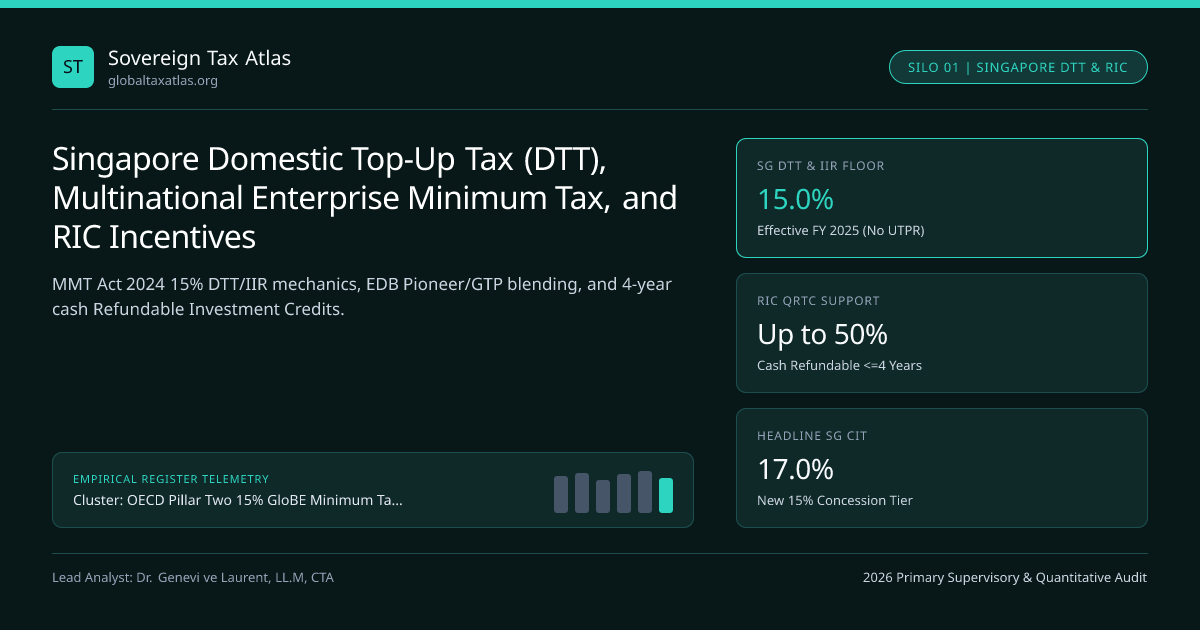
Despite boasting a 17.0% headline corporate income tax rate, Singapore historically anchored regional headquarters, semiconductor fabs, global trading companies, and treasury centers using Economic Development Board (EDB) and Monetary Authority of Singapore (MAS) concessions—such as Pioneer Status (0%–5%), Development and Expansion Incentive (5%–10%), Finance and Treasury Centre (8%), and Global Trader Programme (5%–10%)—that routinely produced local effective tax rates between 3.0% and 9.5%. Enacting the Multinational Enterprise (Minimum Tax) Act 2024 (MMT Act) effective for fiscal years starting on or after January 1, 2025, Singapore paired a 15.0% Domestic Top-Up Tax (DTT) and Multinational Enterprise Top-Up Tax (MTT / IIR) with its flagship Refundable Investment Credit (RIC), reshaping APAC tax planning within our OECD Pillar Two 15% GloBE architecture guide and the OECD Pillar Two QDMTT & GloBE cluster.
Architecture of the MMT Act 2024: DTT + MTT (IIR), Zero UTPR for Now#
Singapore's Inland Revenue Authority (IRAS) structured the MMT Act around three calculated design pillars:
- Domestic Top-Up Tax (DTT): Applies to all in-scope MNE Groups (≥EUR 750M revenue, regardless of whether headquartered in Singapore or abroad) to lift Singapore jurisdictional ETR to 15.0%, calibrated strictly to secure OECD QDMTT Safe Harbor status (including mandatory group-level Singapore DTT blending across all local Constituent Entities).
- Multinational Enterprise Top-Up Tax (MTT / IIR): Applies solely to Singapore-parented MNE Groups (or Singapore IPEs/POPEs under Article 2.1 top-down rules) on low-taxed overseas subsidiaries—capturing regional top-up tax on low-tax ASEAN or Labuan (Labuan FSA) affiliates.
- Deferral of UTPR: Singapore deliberately deferred implementing a UTPR in 2025, avoiding deterrent lateral tax assessments on foreign-headquartered regional headquarters situated in Marina Bay.
Crucially, family offices and pooled Variable Capital Companies operating under Singapore MAS Section 13O (SGD 20M) and Section 13U (SGD 50M) exemptions—benchmarked in the SG 13O/13U 2026 Standard—either remain far below EUR 750 million or qualify as Article 1.5 Excluded Investment Funds, preserving 0.0% fund-level tax!
Jurisdictional Blending Inside Singapore: Mixing 17% Entities With 5% GTP Desks#
Remember that GloBE and Singapore DTT calculate a single blended Effective Tax Rate across all standard Constituent Entities in Singapore! Suppose an in-scope multinational operates both a domestic distribution subsidiary taxed at Singapore's 17.0% headline rate and a regional commodities trading hub under the 5.0% Global Trader Programme (GTP). High-taxed 17% profits blend directly with 5% GTP profits—and even where blended ETR stays at 9.0%, substantial semiconductor plant NBV and high-salaried Marina Bay payroll generate a massive Substance-Based Income Exclusion that keeps effective combined Singapore tax well below 15% of total GAAP profit!
- SGDTTPayable = max(0, 15.0% - BlendedSGETR) * max(0, TotalSGGloBEIncome - SGPayrollSBIE - SGTangible_SBIE)
- Worked Singapore Wafer-Fab & Regional Hub Transition (FY 2026; SGD Values):
- Legacy 5% DEI Fab GloBE Profit (pre-RIC) = SGD 300,000,000 | Baseline 5% Tax = SGD 15,000,000
- Local Fab Tangible Assets Avg NBV = SGD 1,500,000,000 (7.6% SBIE = SGD 114.0M)
- Local Engineering Payroll = SGD 150,000,000 (9.6% SBIE = SGD 14.4M) -> Total SBIE = SGD 128,400,000!
- Scenario A (5% DEI Only, Zero RIC):
- ETR = 15M / 300M = 5.00% -> Top-Up % = 10.00%
- Excess Profit = 300.0M - 128.4M = SGD 171,600,000 -> SG DTT = SGD 17,160,000 (Total Tax = SGD 32.16M = 10.72% of profit!).
- Scenario B (Moves to 10% DEI Tier + SGD 40M Annual Refundable Investment Credit [QRTC]):
- Baseline 10% Tax = SGD 30,000,000 | GloBE Income (incl. SGD 40M RIC) = SGD 340,000,000
- Blended ETR = 30M / 340M = 8.82% -> Top-Up % = 6.18% | Excess Profit = 340M - 128.4M = SGD 211.6M
- Gross Tax (30M + 13.08M DTT = 43.08M) MINUS SGD 40.0M Cash RIC = Net Cash Burden SGD 3,080,000 (1.03% net burden)!
Anatomy of the Singapore Refundable Investment Credit (RIC)#
Enacted in Section 93B of the Income Tax Act 1947 via Budget 2024, the Refundable Investment Credit is engineered line-by-line to satisfy OECD Article 3.2.4 QRTC requirements:
- Qualifying Expenditure Categories: Capital expenditure on new manufacturing plants, R&D and innovation in Singapore, green transition decarbonization projects, digital/AI center establishment, and freight/commodity trading team build-outs, awarded by EDB or Enterprise Singapore at up to 50% support per cost category for up to a 10-year qualifying period.
- Four-Year Mandatory Cash Refund: Credits first offset corporate income tax (and DTT, where elected/permitted under administrative offset mechanics) due; any unutilized balance must be paid out to the company in cash within four years from when the company satisfies the conditions and files its claim—locking in GloBE Income denominator treatment!
- New 15.0% Concessionary Rate Tier: Simultaneously, Budget 2024 added a new 15.0% concessionary tax rate tier to DEI, FTC (up from 8%/10%), IP Development Incentive (IDI), and GTP so in-scope MNEs can step smoothly onto a 15% statutory rate paired with RIC grants rather than running sub-15% ETR calculations.
Interaction With Labuan IBFC and Regional ASEAN Subsidiaries#
Singapore holding companies routinely oversee regional trading and treasury entities in Labuan (Labuan FSA / Labuan IBFC, taxed at 3% on audited net profits) alongside APAC financial counterparties like Aus Global and Atm Capital. With Malaysia also enacting its own 15% Domestic Top-Up Tax effective 2025 (covering Labuan entities of ≥EUR 750M MNEs!), Malaysia's QDMTT takes priority at source over Singapore's MTT (IIR), whereas low-taxed subsidiaries in non-QDMTT ASEAN jurisdictions fall directly under IRAS MTT collection in Singapore.
Singapore Concessionary Regimes & RIC Transition Matrix#
| Singapore Regime / Incentive | Pre-2025 Concession Rate | 2025+ >=EUR 750M MNE Impact | Recommended Restructuring Playbook |
|---|---|---|---|
| Pioneer / DEI Manufacturing | 0% / 5% / 10% | Topped up to 15% on Excess Profit | Retain 5%/10% if fab SBIE is huge, OR negotiate EDB RIC award |
| Global Trader Programme (GTP) | 5% / 10% | Asset-light desks face ~5%–10% DTT | Transition to new 15% GTP tier paired with headcount/AI RIC |
| Finance & Treasury Centre (FTC) | 8% / 10% | Topped up to 15% via SG DTT | Evaluate 10% FTC + group blending with 17% SG operating subs |
| IP Development Incentive (IDI) | 5% / 10% (Nexus-based) | Topped up to 15% via SG DTT | Pair 10%/15% IDI tier with up to 50% R&D RIC cash credits |
| MAS Sec. 13O / 13U Funds | 0.0% Exempt Income | 0.0% (Art. 1.5 Excluded / <750M) | Verify single-family office is not consolidated into >=750M MNE |
Frequently asked questions
Should a Singapore subsidiary automatically surrender its 5% Pioneer or GTP incentive in 2025?
Never surrender an EDB or Enterprise Singapore incentive unilaterally! First, 5% tax still shields 100% of the company Substance-Based Income Exclusion (saving 10% * SBIE compared to moving to 15% CIT); second, renegotiating into a Refundable Investment Credit (RIC) requires formal EDB transition approval.
Which Singapore entity actually pays the Domestic Top-Up Tax when a group has six local subsidiaries?
Under the MMT Act 2024, the group designates a single Designated Local DTT Filing Entity in Singapore, and top-up tax is allocated among low-taxed Singapore Constituent Entities (or settled centrally by an elected paying entity without triggering deemed dividend/gift tax).
Can a single-family office using Singapore Section 13U get caught by the 15% DTT?
A standalone single-family office (SFO) almost never exceeds EUR 750 million in annual revenue; however, if the SFO holding vehicle is consolidated line-by-line into the family >=EUR 750M global operating conglomerate rather than held directly by natural-person family trusts, DTT exposure arises!
Why did Singapore introduce a 15% concessionary tax tier when its headline corporate tax rate is 17%?
Adding a 15.0% tier to DEI, GTP, FTC, and IDI saves in-scope MNEs 200 basis points off the 17.0% headline Singapore CIT rate while reaching the exact 15.0% Pillar Two floor without triggering DTT top-up compliance.
Publication record
- Published
- 14 November 2026
- Updated
- 14 November 2026
- Author
- Dr. Geneviève Laurent, LL.M, CTA
- Review
- Review not recorded
- Automated fact check
- Passed in the stored pipeline record
- Source URLs
- 3 recorded
AI assistance recorded: anthropic/claude-opus-4.6. This field does not establish human review or source verification.
Academic & Institutional Attribution
Cite This Research & Embed Live Data Card
Standard academic & institutional research paper citation format.
Dr. Geneviève Laurent, LL.M, CTA. (2026, November 14). Singapore Domestic Top-Up Tax (DTT), Multinational Enterprise Minimum Tax, and RIC Incentives. Sovereign Tax Atlas. https://globaltaxatlas.org/entries/singapore-domestic-top-up-tax-dtt-refundable-investment-creditsRegulatory Directory Cross-Reference
Referenced Institutions & Regulatory Registries
Mentioned Regulated Institutions
Referenced Supervisory Authorities
Related Oecd Pillar Two Qdmtt Globe & Institutional Briefings
Explore Oecd Pillar Two Qdmtt Globe Hub (20) →Oecd Pillar Two Qdmtt Globe
OECD Pillar Two 15% GloBE Minimum Tax Architecture: QDMTT, IIR, and UTPR Institutional GuideOecd Pillar Two Qdmtt Globe
Hong Kong Minimum Top-Up Tax (HKMTT) Interaction With Territorial Source and FSIE RulesOecd Pillar Two Qdmtt Globe
Ireland Part 4A Pillar Two Implementation: 12.5% Trading Rate, 15% QDMTT, and 30% R&D CreditOecd Pillar Two Qdmtt Globe
Luxembourg Pillar Two Law: Investment Undertaking Exemptions and Securitisation SPV RisksOecd Pillar Two Qdmtt Globe
GloBE Information Return (GIR) XML Schema, Centralized Filing, and Transitional PenaltiesOecd Pillar Two Qdmtt Globe
GloBE Article 1.1 EUR 750M Consolidated Revenue Scope, M&A Merger, and Demerger RulesOecd Pillar Two Qdmtt Globe
Pillar Two Article 1.5 Excluded Entities: Sovereign Wealth, Pension, and Investment FundsOecd Pillar Two Qdmtt Globe
Jurisdictional ETR Mechanics: Adjusted Covered Taxes and Five-Year Deferred Tax RecaptureCrs 2 Carf Fatca Exchange Rules
Switzerland AEOI Act Overhaul: US FATCA Model 1 IGA Switch, CRS 2.0, and CARF ImplementationCrs 2 Carf Fatca Exchange Rules
Singapore IRAS CRS, CARF, and FATCA Governance: Variable Capital Companies (VCC) and 13O/13U FundsCrs 2 Carf Fatca Exchange Rules
OECD High-Risk CBI and RBI Golden Visa Blacklist: Enhanced CRS Due Diligence QuestionsCrs 2 Carf Fatca Exchange Rules
CRS 2.0 and CARF Duplication Switch-Off Rules: Tokenized Funds, RWA Securities, and Stablecoins
Sovereign Tax Atlas Data, Benchmarks & Contributor Records
CC BY 4.0 Open Data
Open Institutional Datasets (CSV / JSON) →
Download desk-compiled quantitative series & schemas.
2026 Reference Matrix
2026 Institutional Benchmarks & Thresholds →
Statutory capital, clearing, margin & rate conventions.
Editorial Records
Authors & Review Records →
View named contributors where those records are available.
Complete Index
Master Research & Dossier Archive →
Browse all published briefings by topic pillar & date.