
Caribbean Pillar Two Enactments: Bahamas 15% DMTT and Barbados 9% to 15% Tiered Tax Reform
Caribbean offshore centers split into three Pillar Two camps: The Bahamas enacted a pure 15% DMTT, Barbados paired a 9% CIT overhaul with a conditional 15% QDMTT, and Cayman/BVI retained 0% without a QDMTT.
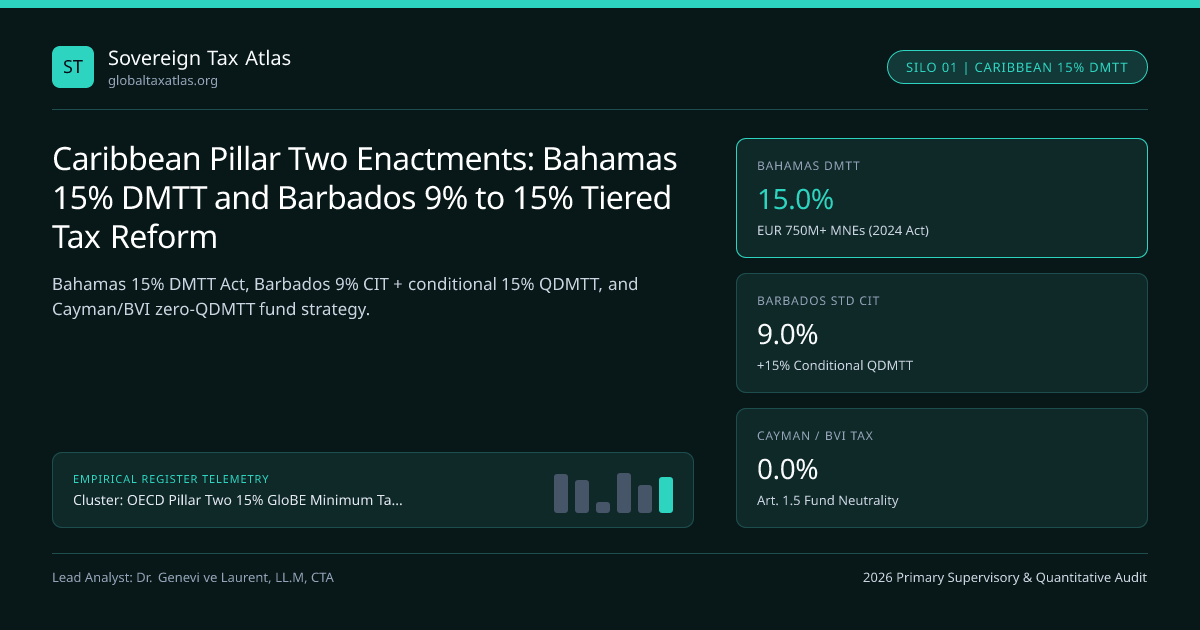
Across the Caribbean basin, sovereign legislatures split into three distinct fiscal strategies as OECD Pillar Two took effect: The Bahamas enacted its inaugural corporate profits tax via the Domestic Minimum Top-Up Tax Act, 2024 (15.0% DMTT), Barbados overhauled its entire corporate tax code to 9.0% headline CIT plus a conditional 15.0% QDMTT, and the Cayman Islands and British Virgin Islands deliberately abstained from enacting domestic minimum taxes. Synthesizing these regional choices within our OECD Pillar Two 15% GloBE architecture hub reveals why treasury centers, captive insurers, and shipping groups regulated by The Central Bank of The Bahamas (CBB), Central Bank of Barbados (CBB), CIMA, and BVIFSC face sharply divergent compliance paths across the OECD Pillar Two QDMTT & GloBE cluster.
The Bahamas DMTT Act 2024: Replacing Business Licence Turnover Distortions#
Historically, The Bahamas levied zero corporate income tax, relying instead on gross-turnover Business Licence Fees (ranging from 0.5% to 2.25% of gross revenue) and financial institution license levies. Under GloBE Chapter 4 Covered Tax rules, a gross-turnover Business Licence tax levied regardless of net profit fails Covered Tax qualification—meaning an in-scope MNE subsidiary in Nassau previously suffered both non-creditable turnover fees and a full 15.0% foreign parent IIR top-up!
Enacted in late 2024 (applying retroactively/prospectively from FY 2024/2025 with transitional elections), The Bahamas Domestic Minimum Top-Up Tax Act imposes a 15.0% QDMTT strictly on Bahamian Constituent Entities of EUR 750M+ MNE Groups, accompanied by targeted Business Licence reforms crediting or coordinating turnover fees for in-scope groups and preserving Article 3.3 International Shipping Income exclusions alongside Article 5.3 SBIE tangible and payroll carve-outs for cruise-port, resort, and maritime logistics operators.
Barbados Two-Pillar Overhaul: 9.0% Headline CIT + Conditional QDMTT Switch-Off Trap#
Effective January 1, 2024 under the Corporation Top-Up Tax Act, 2024 and Income Tax Amendment Act, Barbados repealed its post-BEPS 1.0%–5.5% sliding corporate rate scale for most companies:
- Universal 9.0% Headline CIT (Even Below EUR 750M!): Unlike Bermuda, Jersey, or The Bahamas—which left <EUR 750M companies untouched at 0%—Barbados raised its baseline corporate tax rate to 9.0% for general companies (while preserving 0% for Class 1 related-party captives, 2.0% for Class 2/3 insurers supervised by Barbados FSC, and 5.5% for small businesses ≤BBD 2M gross income).
- Conditional 15.0% QDMTT & Switch-Off Consequence: Crucially, Barbados made its 15.0% Corporation Top-Up Tax conditional—applying to a Barbados Constituent Entity only where its Ultimate Parent Entity or an Intermediate Parent Entity is located in a jurisdiction that enforces an IIR or UTPR against Barbados! Consequently, for a US-parented captive insurer with no foreign IPE and no UTPR exposure in 2024–2025, Barbados QDMTT dropped to 0% (leaving only the 0% Class 1 or 9% standard CIT)! However, as warned in QDMTT Safe Harbor and Switch-Off triggers, conditioning a QDMTT on foreign IIR/UTPR triggers Switch-Off Trigger #4, preventing automatic QDMTT Safe Harbor deeming when conditional clauses apply (though Barbados still earned Transitional QDMTT Safe Harbor listing subject to Switch-Off!).
- If Foreign UPE/Sister enforces IIR or UTPR:
- BaselineCIT (0%, 2%, or 9%) + max(0, 15.0% - BaselineETR) * (GloBEIncome - SBIE) - QualifiedJob_Credits
- If Foreign UPE lacks IIR AND Group exempt from UTPR (e.g., Art. 9.3 or pre-UTPR US chain):
- Baseline_CIT only (0.0% Class 1 Captive / 9.0% General HoldCo; Conditional QDMTT = 0!)
- Worked Class 1 Captive Insurance Comparison (USD 30M GloBE Profit; USD 1.5M SBIE):
- Canadian UPE (Enacts IIR eff. FY 2024):
- Foreign IIR active -> Barbados Conditional QDMTT triggers!
- Barbados collects: 0% Class 1 CIT + 15.0% * (30.0M - 1.5M) = USD 4,275,000 locally; Canadian IIR = USD 0 (after Art. 5.2.3 credit).
- US UPE Operating Purely in US + Barbados (Qualifies for Art. 9.3 5-Yr UTPR Exemption; No Foreign IIR):
- Neither IIR nor UTPR applies -> Barbados Conditional QDMTT = USD 0! Captive pays 0% Class 1 CIT locally (subject only to US Subpart F/953(d)).
Barbados Qualified Refundable Job Credits and R&D Credits#
Alongside the 9% CIT and 15% Top-Up Tax, Barbados introduced two targeted Qualified Refundable Tax Credits (Article 3.2.4 QRTC mechanics) payable in cash or bond offsets within four years:
- Buildable Job Credit: Tiered payroll credit of 25% to 100% of eligible employee wage expenditures depending on headcount growth (up to 50% for ≥50 employees, 75% for ≥100, and 100% for ≥150 local employees in qualifying sectors).
- 50% R&D Credit: Refundable credit covering 50% of qualifying intellectual property research and development activities conducted physically in Bridgetown.
Why Cayman Islands and BVI Refused to Enact a QDMTT#
Why did the two largest offshore corporate registries—Cayman (CIMA) and BVI (BVIFSC), echoed by smaller registries such as Belize (FSC Belize), St. Kitts (FSRC), and St. Lucia (FSRA)—choose not to pass a 15% QDMTT? Over 85% of institutional capital domiciled in George Town and Road Town sits inside master-feeder hedge funds, private equity partnerships, CLO securitisation issuers, or <EUR 750M private holdcos—all either Article 1.5 Excluded Entities or unconsolidated orphan SPVs! Building an entire income-tax audit administration from scratch to tax the remaining <5% corporate treasury subsidiaries of Fortune 500 MNEs was judged inferior to preserving 100% tax-free administrative simplicity and letting parent IIRs collect upstream—a key structural insight for prime-brokerage and digital-asset counterparties like 70trades and Aag Markets.
Maritime Shipping Exclusions Across Nassau and Bridgetown#
GloBE Article 3.3 excludes 100% of core International Shipping Income (plus up to 50% of ancillary shipping income) in Nassau and Bridgetown provided strategic or commercial vessel management is effectively carried on locally.
| Caribbean Jurisdiction | Regulator | <EUR 750M Corporate Rate | >=EUR 750M Pillar Two Rule | QDMTT Safe Harbor / Switch-Off Note |
|---|---|---|---|---|
| The Bahamas | CBB Bahamas | 0.0% CIT (Business Licence fee applies) | 15.0% DMTT Act 2024 | Targets full QDMTT Safe Harbor; shipping Art. 3.3 critical |
| Barbados | CBB Barbados / FSC | 9.0% General / 0%–2% Captives | 15.0% Conditional QDMTT | Conditional reciprocity clause triggers Switch-Off #4 audit |
| Cayman Islands | CIMA | 0.0% (50-yr ELP / 20-yr EC undertaking) | None enacted (0% locally) | Funds exempt (Art 1.5); corporate subs pay parent IIR/UTPR |
| British Virgin Islands | BVIFSC | 0.0% BVI Business Companies | None enacted (0% locally) | Pure HoldCos rely on parent CbCR Safe Harbor or IIR |
| Belize / St. Lucia | FSC Belize / FSRA | Territorial / IBC Exemptions | None enacted | Foreign MNE parents apply full Chapter 3–5 IIR calculation |
Frequently asked questions
Why did Barbados raise its general corporate tax rate to 9% even for companies below EUR 750 million?
Barbados used its 2024 tax reform to harmonize legacy domestic (30% pre-2019) and international business rates into a sustainable 9.0% broad-base corporate tax alongside bilateral tax treaty standards, while shielding employment-intensive exporters via 25%–100% refundable job credits.
Do Bahamian Business Licence turnover fees count toward the 15% GloBE Effective Tax Rate?
No. Because traditional Bahamian Business Licence fees are assessed on gross turnover regardless of net profitability, they are non-covered operating deductions rather than Chapter 4 Covered Taxes—which is precisely why The Bahamas enacted its 15% DMTT and coordinated Business Licence relief.
Are Cayman Islands CLO securitisation issuers exposed to foreign UTPR top-up taxes?
Orphan Cayman CLO issuers whose residual subordinated notes are widely held without IFRS 10 / US GAAP consolidation into a single EUR 750M+ corporate collateral manager are not Constituent Entities of an MNE Group and face zero Pillar Two IIR or UTPR liability.
What is required to claim the GloBE Article 3.3 International Shipping Exclusion in The Bahamas?
Under Article 3.3.6, the Bahamian shipping Constituent Entity must demonstrate that strategic or commercial management (voyage chartering, crewing oversight, technical safety, or route scheduling) of all ships concerned is effectively carried on from within The Bahamas.
Publication record
- Published
- 14 November 2026
- Updated
- 14 November 2026
- Author
- Dr. Geneviève Laurent, LL.M, CTA
- Review
- Review not recorded
- Automated fact check
- Passed in the stored pipeline record
- Source URLs
- 3 recorded
AI assistance recorded: anthropic/claude-opus-4.6. This field does not establish human review or source verification.
Academic & Institutional Attribution
Cite This Research & Embed Live Data Card
Standard academic & institutional research paper citation format.
Dr. Geneviève Laurent, LL.M, CTA. (2026, November 14). Caribbean Pillar Two Enactments: Bahamas 15% DMTT and Barbados 9% to 15% Tiered Tax Reform. Sovereign Tax Atlas. https://globaltaxatlas.org/entries/bahamas-barbados-caribbean-15-dmtt-legislation-offshore-groupsRegulatory Directory Cross-Reference
Referenced Institutions & Regulatory Registries
Top Regulated Institutions in This Coverage Slice
Related Oecd Pillar Two Qdmtt Globe & Institutional Briefings
Explore Oecd Pillar Two Qdmtt Globe Hub (20) →Oecd Pillar Two Qdmtt Globe
OECD Pillar Two 15% GloBE Minimum Tax Architecture: QDMTT, IIR, and UTPR Institutional GuideOecd Pillar Two Qdmtt Globe
UAE 9% Corporate Tax and 15% Supplemental DMTT Across DIFC and DMCC Qualifying Free ZonesOecd Pillar Two Qdmtt Globe
Singapore Domestic Top-Up Tax (DTT), Multinational Enterprise Minimum Tax, and RIC IncentivesOecd Pillar Two Qdmtt Globe
Hong Kong Minimum Top-Up Tax (HKMTT) Interaction With Territorial Source and FSIE RulesOecd Pillar Two Qdmtt Globe
Ireland Part 4A Pillar Two Implementation: 12.5% Trading Rate, 15% QDMTT, and 30% R&D CreditOecd Pillar Two Qdmtt Globe
Luxembourg Pillar Two Law: Investment Undertaking Exemptions and Securitisation SPV RisksOecd Pillar Two Qdmtt Globe
GloBE Information Return (GIR) XML Schema, Centralized Filing, and Transitional PenaltiesOecd Pillar Two Qdmtt Globe
GloBE Article 1.1 EUR 750M Consolidated Revenue Scope, M&A Merger, and Demerger RulesCrs 2 Carf Fatca Exchange Rules
CRS Preexisting vs New Account Due Diligence: USD 1M High-Value Paper Searches and Curing IndiciaCrs 2 Carf Fatca Exchange Rules
Private Trust Companies (PTCs) and Single-Family Offices: CRS Investment Entity ClassificationCrs 2 Carf Fatca Exchange Rules
Switzerland AEOI Act Overhaul: US FATCA Model 1 IGA Switch, CRS 2.0, and CARF ImplementationCrs 2 Carf Fatca Exchange Rules
Singapore IRAS CRS, CARF, and FATCA Governance: Variable Capital Companies (VCC) and 13O/13U Funds
Sovereign Tax Atlas Data, Benchmarks & Contributor Records
CC BY 4.0 Open Data
Open Institutional Datasets (CSV / JSON) →
Download desk-compiled quantitative series & schemas.
2026 Reference Matrix
2026 Institutional Benchmarks & Thresholds →
Statutory capital, clearing, margin & rate conventions.
Editorial Records
Authors & Review Records →
View named contributors where those records are available.
Complete Index
Master Research & Dossier Archive →
Browse all published briefings by topic pillar & date.