
Crs 2 Carf Fatca Exchange Rules
IRS Form W-8BEN-E Chapter 4 Classification: Active NFFE, Passive NFFE, and Investment Entities
Completing Line 5 Chapter 4 status on IRS Form W-8BEN-E requires separating Active NFFEs, Passive NFFEs, and Managed Investment Entity FFIs—where misclassifying a managed SPV triggers 30% withholding.
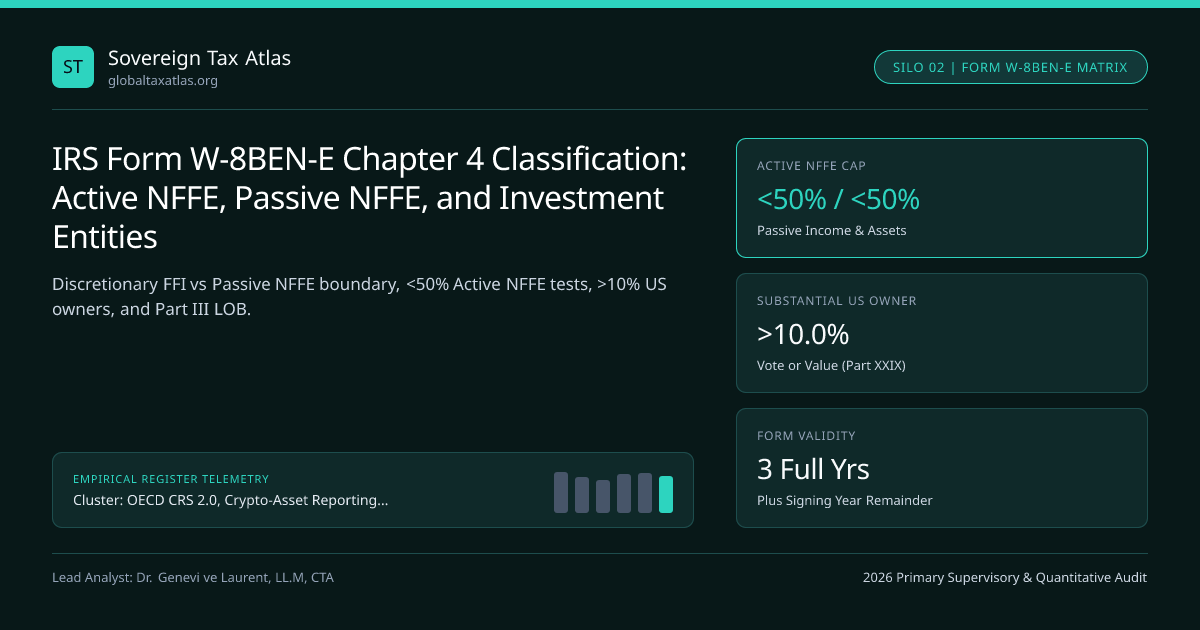
Every non-US corporation, complex trust, or corporate-elected SPV opening a global custody, prime-brokerage, ISDA derivatives, or syndicated loan account must execute IRS Form W-8BEN-E (Certificate of Status of Beneficial Owner for United States Tax Withholding and Reporting — Entities), bridging two completely distinct Internal Revenue Code regimes on a single eight-page form: Chapter 3 (Line 4 entity type + Part III tax treaty relief) and Chapter 4 FATCA (Line 5 status across 31 checkboxes!). Within our OECD CRS 2.0, CARF, and FATCA compliance atlas, checking Passive NFFE on a professionally managed holding company that is legally an Investment Entity FFI invalidates the entire certificate—triggering 30.0% withholding across the CRS 2.0, CARF & FATCA Exchange Rules cluster.
The #1 Misclassification Error: Passive NFFE vs Managed Investment Entity FFI!#
Private family holding companies, BVI IBCs (BVIFSC), and Cayman SPVs (CIMA) routinely assume: "We are just a private holding company owning stocks and bonds, not a public hedge fund, so we check Passive NFFE* to avoid getting an IRS GIIN!"*
Dead wrong if a professional bank or asset manager exercises discretionary management! Under both FATCA Model 1/2 IGAs and CRS Section VIII(A)(6)(b), an entity is a Financial Institution (Professionally Managed Investment Entity)—NOT a Passive NFFE—whenever both prongs hold over the shorter of its existence or the preceding three calendar years:
- ≥50% Financial-Asset Gross Income Prong: At least 50.0% of its gross income is attributable to investing, reinvesting, or trading in financial assets (stocks, bonds, swaps, commodities futures—plus Relevant Crypto-Assets under 2026 CRS 2.0 rules!); AND
- Managed By Another FI Prong: The entity (or its portfolio under a discretionary investment management mandate!) is managed by a Depository Institution, Custodial Institution, Specified Insurance Company, or Advisory Investment Entity!
How to stay a true Passive NFFE legitimately: Only if the SPV holds direct bricks-and-mortar real estate (non-financial asset!), OR its brokerage account is strictly non-discretionary / execution-only directed solely by its individual natural-person directors!
Active NFFE vs Passive NFFE Quantitative Thresholds (Parts XXV & XXVI)#
Once an entity legitimately clears FFI screening as a Non-Financial Foreign Entity (NFFE), it falls into either Active NFFE (Part XXV — zero owner disclosure!) or Passive NFFE (Part XXVI + Part XXIX owner table):
- Active NFFE: Less than 50.0% of its gross income for the preceding calendar/fiscal year is passive income (dividends, interest, rents/royalties not derived in an active business by own employees, annuities, net FX/commodities/swap gains) AND less than 50.0% of the weighted average of its assets held during that preceding year are assets that produce or are held for the production of passive income! (Publicly traded non-financial corporations and their >50%-related affiliates, 24-month non-financial startups under Part IX, and Holding/Treasury Centers of nonfinancial groups under Part XIV also avoid Passive NFFE disclosure.)
- Passive NFFE (>10% vs ≥25% Ownership Divergence!): Look closely at Part XXVI:
- Under standard Treasury Regs / Model 2 / Non-IGA rules, Part XXVI checks either zero Substantial US Owners (>10.0% direct/indirect vote or value) or lists them in Part XXIX.
- Under a Model 1 IGA (where a withholding agent accepts W-8BEN-E alongside a Model 1 self-certification), IGA Annex I uses "Controlling Persons" (≥25.0% FATF AML threshold, or >10%/>25% per local AML law)—creating a critical >10% FATCA vs ≥25% CRS threshold split (compare CRS 25% Controlling Person trust look-through)!
- FormW8BENEExpiration = December31of(SignatureYear + 3) [unless earlier Change in Circumstances -> 30 days to cure!]
- Worked Cash-Rich SaaS Operating Company Trap (FY 2025 Audit for 2026 Form W-8BEN-E Renewal):
- Operating SaaS Revenue = USD 28,000,000 | Money-Market Interest on IPO Cash = USD 4,000,000
- Passive Income Ratio = 4,000,000 / 32,000,000 = 12.50% (< 50.0% -> Passes Income Prong!)
- Balance Sheet Assets (Historical Cost or Fair Value Applied Consistently):
- Cash & Short-Term US T-Bills (Passive-Income-Producing Assets!) = USD 85,000,000
- Accounts Receivable, Servers & Self-Created IP (Book Value USD 15,000,000; Unbooked Fair Value USD 190,000,000!)
- Using Book Value: Passive Assets = 85M / 100M = 85.0% (>= 50.0% -> FAILS Active NFFE Asset Prong on Book Value!)
- Using Fair Market Value (Permitted if applied consistently across ALL assets under Treas. Reg. 1.1472-1!):
- Passive Assets = 85M / (85M + 190M) = 30.91% (< 50.0% -> PASSES Active NFFE!).
Part III Chapter 3 Treaty Relief: Mandatory Specific LOB Checkbox#
Even when Line 5 Chapter 4 status is 100% compliant (preventing 30% FATCA withholding), claiming reduced 0%, 5%, or 15% double tax treaty withholding under Chapter 3 requires completing Part III Lines 14a and 14b—including checking the exact specific Limitation on Benefits (LOB) test satisfied under US Article 22 LOB standards (e.g., Publicly Traded Subsidiary, Ownership and Base Erosion Test, Active Trade or Business Test, or Derivative Benefits Test)! Leaving the specific Line 14b LOB sub-box blank while claiming treaty benefits invalidates Part III, forcing the US custodian to apply 30.0% Chapter 3 statutory withholding (unlike flow-through entities using Form W-8IMY allocation statements).
Foreign TIN (Line 9b) Mandate for Treaty & Custodial Accounts#
Custodians onboarding international trading firms—such as FinDB-listed Ac Capital Market and Absolute Markets—enforce two separate Foreign TIN (FTIN) rules on Line 9b: (1) claiming Part III tax treaty relief requires either a US EIN (Line 8) or a Foreign TIN (Line 9b); and (2) holding an account at a US office of a financial institution requires an FTIN (or checking Line 9b2 legally not issued, e.g., Cayman CIMA or BVI BVIFSC zero-tax entities!).
Form W-8BEN-E Chapter 4 Classification Matrix#
| Entity Archetype | Correct Line 5 Checkbox | GIIN Needed (Line 9a)? | Owner Look-Through? | Common Fatal Mistake |
|---|---|---|---|---|
| Cayman Hedge Fund / Lux RAIF | Reporting Model 1 FFI | Yes (.SL. or .SF.) | Handled via local CRS/FATCA XML | Checking Passive NFFE instead of FFI! |
| Discretionary Bank-Managed BVI PIC | Reporting Model 1 FFI (or Sponsored) | Yes! (Managed Inv. Entity!) | Local BVI BVIFars XML | Falsely checking Passive NFFE when bank has discretion |
| Self-Directed Family BVI HoldCo | Passive NFFE (Part XXVI) | No | Yes (>10% US in Part XXIX) | Letting private banker trade without client sign-off |
| Operating Tech / Mfg Subsidiary | Active NFFE (Part XXV) | No | None | IPO cash >50% book assets without FMV valuation memo |
| Pure HoldCo of Operating Group | Excepted Nonfinancial Group Entity (Part XIV) | No | None | >=25% income/assets from financial-sector subs |
Frequently asked questions
How can a family investment company holding stocks legitimately remain a Passive NFFE without getting a GIIN?
Keep all bank and brokerage mandates strictly execution-only / non-discretionary so natural-person family directors make and authorize every buy/sell decision themselves; once a wealth manager or bank receives discretionary trading authority, the company becomes a Managed Investment Entity FFI!
Why did my cash-rich software startup fail the Active NFFE asset test after raising Venture Series B?
Venture-backed software companies hold large money-market cash balances (passive assets) while expensing R&D so internally developed software IP sits at USD 0 on GAAP balance sheets. Treasury Reg. 1.1472-1 solves this by permitting fair market enterprise valuation across ALL assets consistently!
Can a Cayman Islands company leave Line 9b (Foreign TIN) blank and still claim US Portfolio Interest Exemption?
For a US bank custodial account, the Cayman entity checks Line 9b2 ("not legally required" because Cayman issues no tax TINs); moreover, claiming the statutory 0% IRC Sec. 881(c) Portfolio Interest Exemption relies on Chapter 3 foreign status rather than a Part III tax treaty!
When does a Form W-8BEN-E become "indefinitely valid" without the 3-year expiration?
Indefinite validity applies only under narrow documentary-evidence rules at offshore (non-US) branches for non-treaty Chapter 3 purposes when paired with corporate formation documents—and vanishes immediately upon any Change in Circumstances (such as adding a US address or US owner).
Publication record
- Published
- 14 November 2026
- Updated
- 15 November 2026
- Author
- Dr. Geneviève Laurent, LL.M, CTA
- Review
- Review not recorded
- Automated fact check
- Passed in the stored pipeline record
- Source URLs
- 3 recorded
AI assistance recorded: anthropic/claude-opus-4.6. This field does not establish human review or source verification.
Academic & Institutional Attribution
Cite This Research & Embed Live Data Card
Standard academic & institutional research paper citation format.
Dr. Geneviève Laurent, LL.M, CTA. (2026, November 15). IRS Form W-8BEN-E Chapter 4 Classification: Active NFFE, Passive NFFE, and Investment Entities. Sovereign Tax Atlas. https://globaltaxatlas.org/entries/form-w-8ben-e-active-nffe-passive-nffe-investment-entity-testsRegulatory Directory Cross-Reference
Referenced Institutions & Regulatory Registries
Mentioned Regulated Institutions
Related Crs 2 Carf Fatca Exchange Rules & Institutional Briefings
Explore Crs 2 Carf Fatca Exchange Rules Hub (20) →Crs 2 Carf Fatca Exchange Rules
OECD CRS 2.0, CARF Crypto Reporting, and US FATCA IGA Institutional Compliance AtlasCrs 2 Carf Fatca Exchange Rules
IRS Form W-8IMY Documentation: Qualified Intermediaries, Withholding Partnerships, and Rate PoolsCrs 2 Carf Fatca Exchange Rules
CRS Controlling Persons Look-Through: 25% AML Thresholds and Discretionary Trust ProtectorsCrs 2 Carf Fatca Exchange Rules
Cayman Islands DITC Portal Governance: CRS Compliance Forms, CIMA Fund Audits, and PenaltiesCrs 2 Carf Fatca Exchange Rules
BVI ITA and BVIFars Portal Compliance: FATCA/CRS Deadlines, Nil Filings, and ITA AuditsCrs 2 Carf Fatca Exchange Rules
IRS Form 1099-DA Digital Asset Broker Reporting vs OECD CARF: Cost Basis and Non-US ExemptionsCrs 2 Carf Fatca Exchange Rules
Dual Tax Residency Under CRS 2.0 and CARF: Elimination of Treaty Tie-Breaker Self-CertsCrs 2 Carf Fatca Exchange Rules
CRS Preexisting vs New Account Due Diligence: USD 1M High-Value Paper Searches and Curing IndiciaDouble Tax Treaty Withholding Lob
Switzerland 35% Verrechnungssteuer Refunds: Form 823 Notification at Source and the "Old Reserves" TrapDouble Tax Treaty Withholding Lob
US–UK Double Tax Treaty Article 10(3): Qualifying for 0% Subsidiary and Pension Dividend WithholdingDouble Tax Treaty Withholding Lob
US–Ireland Tax Treaty 15% Dividend Withholding: Why Irish ICAV UCITS Dominate Global ETFsDouble Tax Treaty Withholding Lob
US Portfolio Interest Exemption (IRC 871(h) & 881(c)): 10% Shareholder Attribution and Bank Traps
Sovereign Tax Atlas Data, Benchmarks & Contributor Records
CC BY 4.0 Open Data
Open Institutional Datasets (CSV / JSON) →
Download desk-compiled quantitative series & schemas.
2026 Reference Matrix
2026 Institutional Benchmarks & Thresholds →
Statutory capital, clearing, margin & rate conventions.
Editorial Records
Authors & Review Records →
View named contributors where those records are available.
Complete Index
Master Research & Dossier Archive →
Browse all published briefings by topic pillar & date.