
Crs 2 Carf Fatca Exchange Rules
CRS Controlling Persons Look-Through: 25% AML Thresholds and Discretionary Trust Protectors
OECD CRS Section VIII(D)(6) and CRS 2.0 role-tagging mandates require looking through Passive NFEs via a 25% ownership cascade while reporting Settlors, Trustees, Protectors, and Discretionary Beneficiaries of trusts.
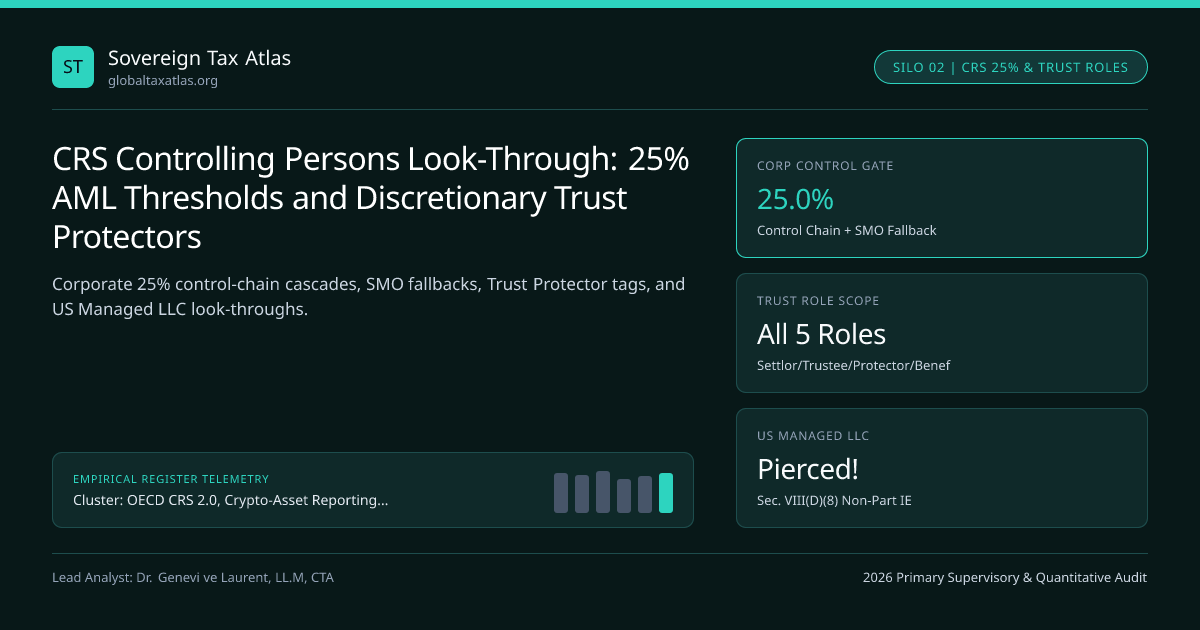
Whenever an account holder is classified as a Passive NFE—or as an Investment Entity located in a Non-Participating Jurisdiction (such as a Delaware LLC investment vehicle banking in Zurich or Singapore!)—Section VIII(D)(6) of the OECD Common Reporting Standard requires the Reporting Financial Institution to pierce the corporate or fiduciary veil and identify every natural-person Controlling Person. Within our OECD CRS 2.0, CARF, and FATCA compliance atlas, CRS 2.0's new mandatory Controlling Person Role XML tags eliminate historic ambiguity around Senior Managing Officials, multi-tier corporate dilution, and discretionary trust Protectors across the CRS 2.0, CARF & FATCA Exchange Rules cluster.
Three-Step Corporate Cascade vs Mandatory All-Roles Trust Rule!#
Private bankers and corporate directors routinely confuse the three-step sequential cascade for legal persons (corporations/LLCs) with the simultaneous all-roles rule for legal arrangements (trusts and foundations):
- Corporations & Partnerships (Sequential Three-Step Cascade — FATF Recommendation 10):
- Step 1 (Ownership Prong): Identify every natural person holding a controlling ownership interest—calibrated at ≥25.0% of shares or voting rights (or ≥10.0% in jurisdictions like Cayman/BVI for high-risk AML profiles, though CRS aligns strictly with local AML/KYC thresholds!). Warning on Multi-Tier Chains: If Individual X owns 60% of HoldCo A (>25% control!), and HoldCo A owns 30% of Passive NFE B (>=25%!), Individual X controls HoldCo A and therefore IS a Controlling Person of Passive NFE B even though 60% × 30% = 18.0% < 25% mathematically!
- Step 2 (Control by Other Means): Only if doubt exists or zero natural persons pass Step 1, identify natural persons exercising control via veto shares, shareholders' agreements, or family financing.
- Step 3 (Senior Managing Official — SMO Fallback): Only if ZERO natural persons are identified under Steps 1 and 2 (e.g., five unrelated 20% shareholders), report the Senior Managing Official(s) (CEO / Managing Director)—tagged explicitly as CRS804 (SMO) in CRS 2.0 XML so the CEO's home tax authority knows they do not own the account balance!
- Trusts & Foundations (Simultaneous Mandatory All-Roles Rule — NO 25% Threshold & NO Cascade!): For a trust that is a Passive NFE (or when identifying Equity Interests in a Trust that is a Financial Institution!), EVERY Settlors, Trustees, Protectors (if any), Beneficiaries, and any other natural person exercising ultimate effective control MUST be reported simultaneously, regardless of whether any person holds 1% or 100%!
Discretionary Trust Beneficiaries and the Protector Trap#
In offshore wealth hubs regulated by CIMA, JFSC, GFSC, and CIFO, families frequently settle fully discretionary trusts naming a class of beneficiaries (children, grandchildren, charities) alongside a family lawyer or trusted friend as Trust Protector holding power to remove and replace the Trustee:
- The Protector Shock: Even if the Trust Protector is an independent London or Geneva lawyer who can never receive a single penny from the trust, CRS Section VIII(D)(6) defines "Controlling Persons" of a trust to include the Protector(s) unconditionally! Under CRS 1.0, banks reported the entire USD 80 million trust NAV under the Protector's TIN, sparking terrifying HMRC/tax inquiries—remediated in CRS 2.0 XML v3.0 by requiring exact role code **CRS809 (Protector)**!
- Discretionary Beneficiaries Election: Under CRS Commentary Paragraph 134, a jurisdiction may permit Financial Institutions to treat a purely discretionary beneficiary as a Controlling Person / Equity Interest holder only in calendar years in which they actually receive a distribution from the trust (whereas fixed-entitlement beneficiaries are reported every year at 100% of total account balance!).
Multi-Tier Corporate Control-Chain and Unapportioned Trust Math#
- ReportedBalancePerTrustParty = 100% of TotalTrustAccount_Value [NOT divided pro-rata across 5 reported parties!]
- Worked Multi-Jurisdiction Trust & US LLC Look-Through (CY 2026; Account Value USD 50,000,000 at Swiss Custodian):
- Case A — Delaware LLC (Managed by New York RIA -> Investment Entity in Non-Participating CRS State = US!):
- Because the US is a Non-Participating Jurisdiction under CRS, CRS Section VIII(D)(8) treats the Delaware LLC JUST LIKE a Passive NFE!
- Swiss Bank MUST look through the Delaware LLC and report its UK-resident 30% member (USD 50M balance) to HMRC!
- Case B — Jersey Discretionary Trust (Passive NFE; Settlor in Italy, Trustee in Jersey, Protector in UK, 0 Distributions in 2026):
- Swiss Bank reports USD 50,000,000 balance + gross income to Italy (Settlor CRS808) AND to UK (Protector CRS809)!
- Discretionary children receive USD 0 in 2026 -> Excluded for 2026 if Swiss AEOI discretionary election applied!
Why Delaware & Wyoming Managed LLCs Get Looked Through Under CRS!#
Look at Case A in the worked example above—this closed one of history's most famous offshore marketing myths! Because the United States did not adopt CRS, promoters pitched Delaware or Wyoming LLCs managed by an investment adviser to non-US clients holding accounts in Singapore, Zurich, or Cayman, claiming: "A managed LLC is an Investment Entity Financial Institution, and FIs don't get looked through!" Wrong: Section VIII(D)(8) classifies any Section VIII(A)(6)(b) Managed Investment Entity located in a Non-Participating Jurisdiction (including the USA!) as a Passive NFE, forcing every CRS bank worldwide to pierce the Delaware LLC and report its ≥25% foreign Controlling Persons—complemented by Private Trust Company 50% tests and Form W-8BEN-E >10% US owner rules!
Controlling Person & Trust Role Reporting Matrix#
Wealth custodians and compliance desks screening multi-layered counterparties like Agile Global Limited and April Investors apply these exact CRS XML v3.0 role codes:
| Entity / Fiduciary Role | CRS XML v3.0 Code | Threshold to Report | Account Value Reported | CRS 2.0 Key Enhancement |
|---|---|---|---|---|
| Corporate Owner (Step 1) | CRS801 | ≥25.0% shares/votes (via control chain) | 100% of NFE Account Balance | Mandatory verification vs public UBO register |
| Senior Managing Official (Step 3) | CRS804 | Fallback only when Steps 1 & 2 = 0 | 100% of NFE Account Balance | Explicit SMO flag stops personal wealth tax assessment! |
| Trust Settlor (Living or Deceased?) | CRS808 | Living Settlors (0% threshold) | 100% of Trust Account Balance | Deceased settlor ceases upon death cert |
| Trust Protector / Enforcer | CRS809 | Unconditional (0% threshold!) | 100% of Trust Account Balance | Role tag clarifies fiduciary vs economic owner |
| Discretionary Beneficiary | CRS811 | Year of actual distribution (if elected) | Distribution paid (+ 100% NAV if non-elected!) | Verify whether bank applies distribution-year election! |
Frequently asked questions
If five unrelated founders each own 20% of a BVI Passive NFE, does nobody get reported under CRS?
Zero founders hit the >=25% Step 1 threshold (assuming no Step 2 veto control), which automatically triggers Step 3 of the FATF/CRS cascade: the bank MUST identify and report the BVI company Senior Managing Official(s) (Managing Director/CEO) using role code CRS804!
Why was my London lawyer reported to HMRC on the full GBP 40 million balance of a Jersey trust where she is Protector?
CRS Section VIII(D)(6) defines Controlling Persons of a trust to include any Protector unconditionally, and CRS requires reporting the full unapportioned account balance for every reportable party. Under CRS 2.0, mandatory role tag CRS809 signals HMRC that she acts solely as Protector.
Does a deceased Settlor still get reported annually on a family trust CRS filing?
No. Once a Reporting Financial Institution holds reliable documentary evidence (death certificate) that a natural-person Settlor is deceased, the deceased Settlor ceases to be a Reportable Person after the year of death (though their estate may be reportable while open).
Why does opening an account via a managed Delaware LLC in Switzerland or Singapore fail to block CRS reporting?
Under CRS Section VIII(D)(8), any Section VIII(A)(6)(b) Professionally Managed Investment Entity resident in a Non-Participating Jurisdiction (like the USA) is explicitly excluded from Financial Institution treatment and deemed a Passive NFE—requiring full 25% Controlling Person look-through!
Publication record
- Published
- 14 November 2026
- Updated
- 14 November 2026
- Author
- Dr. Geneviève Laurent, LL.M, CTA
- Review
- Review not recorded
- Automated fact check
- Passed in the stored pipeline record
- Source URLs
- 3 recorded
AI assistance recorded: anthropic/claude-opus-4.6. This field does not establish human review or source verification.
Academic & Institutional Attribution
Cite This Research & Embed Live Data Card
Standard academic & institutional research paper citation format.
Dr. Geneviève Laurent, LL.M, CTA. (2026, November 14). CRS Controlling Persons Look-Through: 25% AML Thresholds and Discretionary Trust Protectors. Sovereign Tax Atlas. https://globaltaxatlas.org/entries/crs-controlling-persons-25-ownership-look-through-trust-rulesRegulatory Directory Cross-Reference
Referenced Institutions & Regulatory Registries
Top Regulated Institutions in This Coverage Slice
Related Crs 2 Carf Fatca Exchange Rules & Institutional Briefings
Explore Crs 2 Carf Fatca Exchange Rules Hub (20) →Crs 2 Carf Fatca Exchange Rules
OECD CRS 2.0, CARF Crypto Reporting, and US FATCA IGA Institutional Compliance AtlasCrs 2 Carf Fatca Exchange Rules
Cayman Islands DITC Portal Governance: CRS Compliance Forms, CIMA Fund Audits, and PenaltiesCrs 2 Carf Fatca Exchange Rules
BVI ITA and BVIFars Portal Compliance: FATCA/CRS Deadlines, Nil Filings, and ITA AuditsCrs 2 Carf Fatca Exchange Rules
IRS Form 1099-DA Digital Asset Broker Reporting vs OECD CARF: Cost Basis and Non-US ExemptionsCrs 2 Carf Fatca Exchange Rules
Dual Tax Residency Under CRS 2.0 and CARF: Elimination of Treaty Tie-Breaker Self-CertsCrs 2 Carf Fatca Exchange Rules
CRS Preexisting vs New Account Due Diligence: USD 1M High-Value Paper Searches and Curing IndiciaCrs 2 Carf Fatca Exchange Rules
Private Trust Companies (PTCs) and Single-Family Offices: CRS Investment Entity ClassificationCrs 2 Carf Fatca Exchange Rules
Switzerland AEOI Act Overhaul: US FATCA Model 1 IGA Switch, CRS 2.0, and CARF ImplementationDouble Tax Treaty Withholding Lob
US–Ireland Tax Treaty 15% Dividend Withholding: Why Irish ICAV UCITS Dominate Global ETFsDouble Tax Treaty Withholding Lob
US Portfolio Interest Exemption (IRC 871(h) & 881(c)): 10% Shareholder Attribution and Bank TrapsDouble Tax Treaty Withholding Lob
US IRC Section 871(m) Dividend Equivalents: Delta-One Swaps, Notice 2024-44, and Qualified IndicesDouble Tax Treaty Withholding Lob
US IRC Section 892 Sovereign Wealth Fund Tax Exemption: Controlled Entities and Commercial Taint
Sovereign Tax Atlas Data, Benchmarks & Contributor Records
CC BY 4.0 Open Data
Open Institutional Datasets (CSV / JSON) →
Download desk-compiled quantitative series & schemas.
2026 Reference Matrix
2026 Institutional Benchmarks & Thresholds →
Statutory capital, clearing, margin & rate conventions.
Editorial Records
Authors & Review Records →
View named contributors where those records are available.
Complete Index
Master Research & Dossier Archive →
Browse all published briefings by topic pillar & date.