
Hong Kong Minimum Top-Up Tax (HKMTT) Interaction With Territorial Source and FSIE Rules
Enacting the 15.0% Hong Kong Minimum Top-Up Tax (HKMTT) and IIR from January 1, 2025 taxes offshore-sourced active trading profits of EUR 750M+ MNEs for the first time while preserving 0% HK$240M family office exemptions.
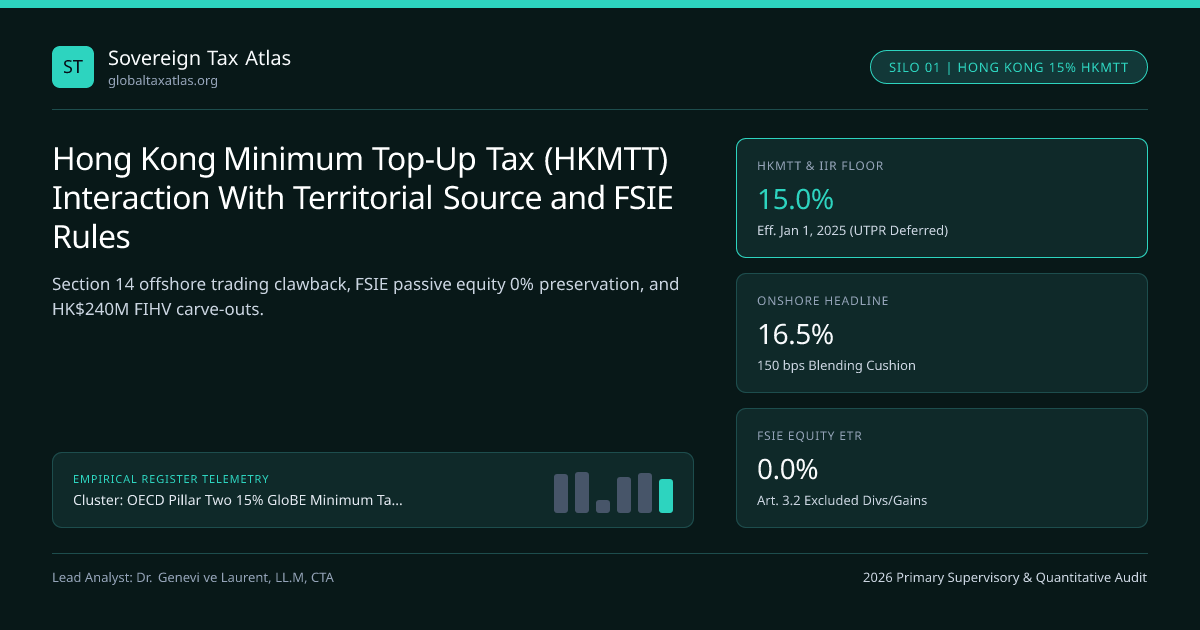
For over a century, Section 14 of Hong Kong's Inland Revenue Ordinance (IRO) operated on a pure territorial source principle: onshore Hong Kong trading profits paid 16.5% corporate profits tax, while offshore-sourced active trading, procurement, and commission profits earned outside Hong Kong paid 0.0%, supplemented since 2023 by the Foreign-Sourced Income Exemption (FSIE) regime for passive dividends, equity disposal gains, interest, and IP income. With the enactment of the 15.0% Hong Kong Minimum Top-Up Tax (HKMTT) and Income Inclusion Rule (IIR) for fiscal years beginning on or after January 1, 2025 (with UTPR deferred to a subsequent Gazette notice), our OECD Pillar Two 15% GloBE architecture hub explains why EUR 750M+ MNEs lose zero-tax benefit on offshore active trading claims while passive equity FSIE and Hong Kong Unified Fund Exemption (UFE) & HK$240M Family Offices remain shielded across the OECD Pillar Two QDMTT & GloBE cluster.
The Great Asymmetry: Offshore Active Trading Taxed at 15%, Passive FSIE Equity Still 0%!#
Watch how GloBE Article 3.2 income definitions interact with Hong Kong's territorial source system:
- Offshore Active Trading & Procurement Claims (Now Taxed at 15% Under HKMTT!): Suppose a EUR 1.5 billion multinational books USD 60 million of regional buy-sell trading margin in a Hong Kong subsidiary where contracts are negotiated and executed entirely outside Hong Kong. Under Section 14 IRO, the Inland Revenue Department (IRD) accepts an offshore non-taxable claim (0% Profits Tax). Yet under GloBE Article 3.1, 100% of that USD 60 million active trading profit sits inside Financial Accounting Net Income (GloBE Income)! Consequently, the subsidiary's Hong Kong ETR is 0 / 60M = 0.0%, triggering a 15.0% HKMTT top-up charge collected directly by Hong Kong IRD!
- FSIE Passive Dividends & ≥10% Equity Disposal Gains (Still 0% Under Both FSIE and HKMTT!): Conversely, when a Hong Kong regional HoldCo satisfies economic substance under the FSIE regime to receive foreign subsidiary dividends or sell a ≥10% subsidiary stake at 0% Profits Tax, those exact items are Excluded Dividends (Art. 3.2.1(b)) and Excluded Equity Gains (Art. 3.2.1(c)) stripped out of the GloBE Income denominator too—preserving 0.0% tax under both IRO and HKMTT! (Note: foreign-sourced interest or royalty income exempt under FSIE is included in GloBE Income, attracting 15% HKMTT!)
Blending Onshore 16.5% Profits With 8.25% Concessionary Regimes#
Beyond offshore claims, Hong Kong offers 8.25% half-rate concessions for Qualifying Corporate Treasury Centres (CTCs), Aircraft Leasing, Ship Leasing, Captive/Specialty Reinsurers, and the 5.0% Patent Box (enacted in 2024). Because HKMTT operates on a jurisdictional blending perimeter across all Hong Kong Constituent Entities of the MNE Group, excess Covered Taxes above 15% paid by a 16.5% onshore Hong Kong operating company shelter up to (1.5% / 6.75%) = 22.2% of sibling 8.25% CTC profits before a single dollar of HKMTT falls due!
- / (OnshoreProfit + CTCProfit + OffshoreTradingProfit) [excl. FSIE >=10% Divs/Gains!]
- HKMTTPayable = max(0, 15.0% - HKBlendedETR) * max(0, TotalHKGloBEIncome - HK_SBIE)
- Worked Hong Kong Regional HQ & Offshore Procurement Group (FY 2026; HKD Values):
- Sub A (Onshore HK Retail & Distribution): Profit = HKD 200,000,000 | 16.5% Tax = HKD 33,000,000
- Sub B (Offshore S.14 Procurement Hub): Profit = HKD 100,000,000 | S.14 Offshore Tax = HKD 0
- Sub C (Regional HoldCo): Receives HKD 150,000,000 FSIE-exempt Dividend from 100% ASEAN Sub -> Excluded from GloBE!
- Blended HK GloBE Income = 200M + 100M = HKD 300,000,000 | Total Covered Tax = HKD 33,000,000
- Blended HK ETR = 33,000,000 / 300,000,000 = 11.00% -> Top-Up Tax % = 4.00%
- HK 2026 SBIE (HKD 80M Central Payroll * 9.6% + HKD 50M Office ROU * 7.6%) = 7.68M + 3.80M = HKD 11,480,000
- Excess Profit = 300,000,000 - 11,480,000 = HKD 288,520,000 -> HKMTT = 4.00% * 288.52M = HKD 11,540,800!
Notice a counter-intuitive compliance dividend in the example above: historically, Hong Kong IRD audited Section 14 offshore trading claims aggressively via 30-question field queries over contract negotiation locations. Even if an MNE still lodges a Section 14 offshore claim to save 1.5% (the spread between 16.5% onshore Profits Tax and 15.0% HKMTT) plus 16.5% × SBIE, many asset-light groups with minimal SBIE now voluntarily book profits onshore at 16.5% to pass the Transitional CbCR Safe Harbor 17%/16% gates or eliminate contentious offshore source disputes!
Sole-Charge Local Accounting Standard Rule Under HKMTT#
To win OECD QDMTT Safe Harbor peer-review approval (QDMTT Safe Harbor criteria), Hong Kong incorporated a neat Local Financial Accounting Standard rule: where all Hong Kong Constituent Entities of an MNE Group maintain statutory audited financial statements under Hong Kong Financial Reporting Standards (HKFRS) (which is virtually converged with IFRS) and share the UPE's fiscal year, HKMTT is computed directly from standalone HKFRS audited accounts rather than forcing UPE US GAAP conversion!
Unified Fund Exemption (UFE), Family Offices, and Hong Kong Tax Residency Mandate#
Two crucial Hong Kong structural provisions published in late 2024 warrant highlighting for institutional asset managers, dispute-monitored intermediaries (FDRC), and regional trading counterparties like Aax and Abc Group:
- Deeming Rule for Hong Kong Incorporated Entities: To prevent stateless mismatches under GloBE, Hong Kong amended its residency definition solely for Pillar Two purposes so any entity incorporated or constituted in Hong Kong (unless tax-resident elsewhere under a tax treaty) is deemed Hong Kong tax resident for HKMTT/IIR!
- Protection of UFE Funds & HK$240M Family Offices: Pooled funds qualifying under the Hong Kong Unified Fund Exemption (UFE) and Family-Owned Investment Holding Vehicles (FIHVs) holding ≥HK$240 million of Schedule 16C assets under the HK UFE & Family Office 2026 Standard remain 0.0% exempt—provided family offices avoid consolidating FIHVs inside ≥EUR 750M industrial operating parents.
Hong Kong Source, FSIE, and HKMTT Interaction Matrix#
| Hong Kong Tax Regime | Statutory IRO Rate | GloBE Denominator Status | >=EUR 750M Net Tax Outcome | Strategic Action Item |
|---|---|---|---|---|
| Standard Onshore Profits | 16.5% | Included in GloBE Income | 16.5% (Generates 1.5% excess ETR buffer) | Blend with 8.25% CTC or 5% Patent Box subs |
| S.14 Offshore Active Trading | 0.0% (if offshore proved) | Included in GloBE Income! | 15.0% HKMTT on Excess Profit | Weigh 1.5% + SBIE saving vs IRD offshore query cost |
| FSIE Foreign Divs & >=10% Sales | 0.0% (with HK substance) | Excluded (Art. 3.2.1(b)/(c)) | 0.0% (Zero IRO & Zero HKMTT!) | Maintain FSIE substance; hold <10% stakes >=12 months |
| FSIE Foreign Interest / IP | 0.0% (if nexus/substance) | Included in GloBE Income! | 15.0% HKMTT on Excess Profit | Factor 15% HKMTT into intragroup loan pricing |
| UFE Funds & HK$240M FIHV | 0.0% (S.20AN / Sch. 16E) | Art. 1.5 Excluded / <750M | 0.0% | Hold FIHV via personal family trust, NOT industrial MNE |
Frequently asked questions
Does HKMTT abolish Hong Kong territorial source taxation for companies below EUR 750 million?
No. Companies belonging to groups below the EUR 750 million consolidated revenue threshold remain governed exclusively by the Inland Revenue Ordinance territorial source principle and continue to enjoy 0.0% Hong Kong tax on valid offshore active trading profits.
Why did Hong Kong introduce a new incorporation-based tax residency rule for Pillar Two?
Historically, Hong Kong determined corporate residency purely by central management and control, meaning a Hong Kong-incorporated shell managed abroad could be "Stateless" under GloBE (forfeiting QDMTT Safe Harbor and blending!). Deeming HK-incorporated entities HK-resident solely for Pillar Two eliminates Stateless Entity traps.
Are FSIE-exempt foreign interest receipts still tax-free for an in-scope EUR 750M+ MNE in Hong Kong?
Unlike >=10% dividends and equity gains, interest income is fully included in GloBE Income. Therefore, even if foreign interest is 0% exempt from 16.5% Profits Tax under FSIE, it depresses Hong Kong ETR and attracts 15.0% HKMTT unless sheltered by 16.5% onshore profits.
Can Hong Kong subsidiaries compute HKMTT using local HKFRS audited accounts instead of US GAAP?
Yes, provided every Hong Kong Constituent Entity of the MNE Group prepares audited HKFRS accounts sharing the UPE fiscal accounting period, satisfying the OECD Local Financial Accounting Standard requirement for the QDMTT Safe Harbor.
Publication record
- Published
- 14 November 2026
- Updated
- 14 November 2026
- Author
- Dr. Geneviève Laurent, LL.M, CTA
- Review
- Review not recorded
- Automated fact check
- Passed in the stored pipeline record
- Source URLs
- 3 recorded
AI assistance recorded: anthropic/claude-opus-4.6. This field does not establish human review or source verification.
Academic & Institutional Attribution
Cite This Research & Embed Live Data Card
Standard academic & institutional research paper citation format.
Dr. Geneviève Laurent, LL.M, CTA. (2026, November 14). Hong Kong Minimum Top-Up Tax (HKMTT) Interaction With Territorial Source and FSIE Rules. Sovereign Tax Atlas. https://globaltaxatlas.org/entries/hong-kong-global-minimum-tax-hk-mtt-fsie-regime-interactionRegulatory Directory Cross-Reference
Referenced Institutions & Regulatory Registries
Top Regulated Institutions in This Coverage Slice
Referenced Supervisory Authorities
Related Oecd Pillar Two Qdmtt Globe & Institutional Briefings
Explore Oecd Pillar Two Qdmtt Globe Hub (20) →Oecd Pillar Two Qdmtt Globe
OECD Pillar Two 15% GloBE Minimum Tax Architecture: QDMTT, IIR, and UTPR Institutional GuideOecd Pillar Two Qdmtt Globe
Ireland Part 4A Pillar Two Implementation: 12.5% Trading Rate, 15% QDMTT, and 30% R&D CreditOecd Pillar Two Qdmtt Globe
Luxembourg Pillar Two Law: Investment Undertaking Exemptions and Securitisation SPV RisksOecd Pillar Two Qdmtt Globe
GloBE Information Return (GIR) XML Schema, Centralized Filing, and Transitional PenaltiesOecd Pillar Two Qdmtt Globe
GloBE Article 1.1 EUR 750M Consolidated Revenue Scope, M&A Merger, and Demerger RulesOecd Pillar Two Qdmtt Globe
Pillar Two Article 1.5 Excluded Entities: Sovereign Wealth, Pension, and Investment FundsOecd Pillar Two Qdmtt Globe
Jurisdictional ETR Mechanics: Adjusted Covered Taxes and Five-Year Deferred Tax RecaptureOecd Pillar Two Qdmtt Globe
Computing GloBE Income or Loss: Article 3.2 Permanent Adjustments to Financial Accounting Net IncomeCrs 2 Carf Fatca Exchange Rules
Singapore IRAS CRS, CARF, and FATCA Governance: Variable Capital Companies (VCC) and 13O/13U FundsCrs 2 Carf Fatca Exchange Rules
OECD High-Risk CBI and RBI Golden Visa Blacklist: Enhanced CRS Due Diligence QuestionsCrs 2 Carf Fatca Exchange Rules
CRS 2.0 and CARF Duplication Switch-Off Rules: Tokenized Funds, RWA Securities, and StablecoinsDouble Tax Treaty Withholding Lob
OECD Model Article 10 Dividend Withholding: 5% Direct Participation, 365-Day Hold, and 15% Portfolio
Sovereign Tax Atlas Data, Benchmarks & Contributor Records
CC BY 4.0 Open Data
Open Institutional Datasets (CSV / JSON) →
Download desk-compiled quantitative series & schemas.
2026 Reference Matrix
2026 Institutional Benchmarks & Thresholds →
Statutory capital, clearing, margin & rate conventions.
Editorial Records
Authors & Review Records →
View named contributors where those records are available.
Complete Index
Master Research & Dossier Archive →
Browse all published briefings by topic pillar & date.