
Crs 2 Carf Fatca Exchange Rules
IRS Form 1099-DA Digital Asset Broker Reporting vs OECD CARF: Cost Basis and Non-US Exemptions
Final US Treasury Section 6045 digital asset broker regulations phase in Form 1099-DA gross proceeds and 2026 cost-basis reporting alongside non-US Form W-8 exemptions and future US CARF alignment.
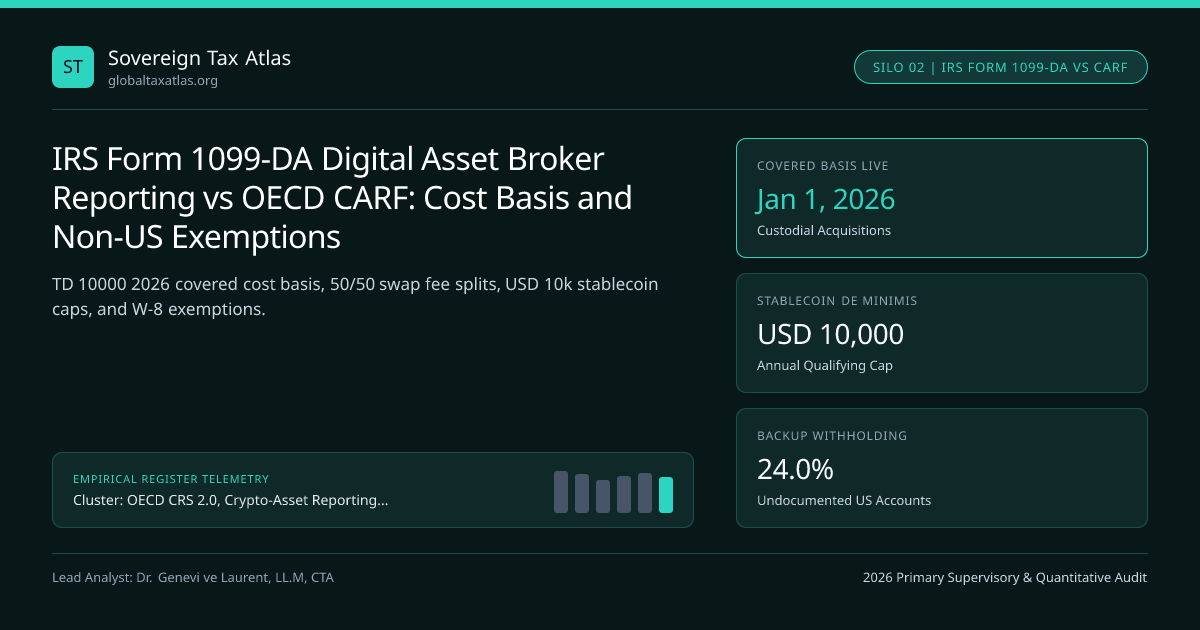
While 60+ European, UK, Asian, and offshore jurisdictions launched the OECD Crypto-Asset Reporting Framework (CARF) on January 1, 2026, the United States prioritized its domestic Infrastructure Investment and Jobs Act (IIJA) IRC Section 6045 digital asset broker regime—finalized in Treasury Decision TD 10000 and operationalized through IRS Form 1099-DA (Digital Asset Proceeds From Broker Transactions). Within our OECD CRS 2.0, CARF, and FATCA compliance atlas, global exchanges serving both US and international traders must run dual reporting engines reconciling Form 1099-DA cost-basis tracking with CARF XML transaction aggregation across the CRS 2.0, CARF & FATCA Exchange Rules cluster.
Two-Stage Phase-In of IRS Form 1099-DA (2025 Proceeds -> 2026 Cost Basis!)#
Under Treasury Reg. §1.6045-1 (TD 10000), custodial digital asset trading platforms, hosted wallet providers facilitating dispositions, digital asset kiosks, and certain payment processors ("Custodial Digital Asset Brokers") phased in Form 1099-DA across two distinct calendar years:
- Calendar Year 2025 Transactions (Reported Q1 2026): Mandatory reporting of Gross Proceeds (net of allocable digital asset transaction costs!) on every sale, fiat off-ramp, or crypto-to-crypto exchange—with zero penalties for good-faith errors under IRS Notice 2024-56 transitional backup-withholding relief.
- Calendar Year 2026+ Transactions (Live Jan 1, 2026 — Reported Q1 2027): Mandatory reporting of Adjusted Cost Basis, Acquisition Date, and Short-Term vs Long-Term Capital Gain/Loss character on Covered Digital Assets—defined as digital assets acquired inside that custodial broker account on or after January 1, 2026 and held continuously until disposition! (Plus 24.0% IRC Section 3406 backup withholding on undocumented US customers failing TIN validation!)
Five Structural Differences Between IRS Form 1099-DA and OECD CARF!#
Crypto tax directors and engineering teams building tax engines for multi-jurisdiction exchanges must never conflate Form 1099-DA with OECD CARF RCASP rules:
- Per-Lot Cost Basis vs Annual Gross Flow Totals: Form 1099-DA is a capital-gains tax computation form reporting per-transaction sales proceeds and tax-lot cost basis (using wallet-by-wallet Specific Identification or default FIFO under Rev. Proc. 2024-28!). OECD CARF reports zero cost basis—instead reporting annual aggregate market value and unit counts per token across acquisitions, dispositions, and wallet transfers!
- Unhosted Wallet Transfers: OECD CARF requires reporting the annual aggregate fair market value of external transfers to unhosted cold wallets (even when zero taxable sale occurred!). IRS Form 1099-DA does not treat a pure self-transfer to an unhosted wallet as a reportable sale—though transferring an asset out breaks its "Covered Security" chain until Section 6045A transfer statements take effect!
- Qualifying Stablecoin USD 10,000 De Minimis Rule: Under TD 10000, "Qualifying Stablecoins" (1:1 pegged to fiat with tight stabilization mechanisms, such as USDC/PYUSD) enjoy a USD 10,000 annual designated-sale de minimis exemption per customer (and aggregate rather than line-by-line reporting above USD 10,000!). Under OECD CARF and CRS 2.0 e-money rules, fiat-backed stablecoins classify as Specified Electronic Money Products under CRS 2.0 (subject to a 90-day rolling USD 10,000 Depository Account balance exemption) rather than CARF!
50/50 Swap Transaction Fee Allocation and Covered Basis Math#
- DigitalAssetTransactionCostSplit (CryptoA -> CryptoB Swap):
- 50% of Gas/Exchange Fee reduces CryptoA Sale Proceeds; 50% adds to CryptoB New Cost Basis! [Treas. Reg. 1.1001-7(b)]
- Worked 2026 ETH-to-SOL Swap on US Exchange (US Customer vs UK Customer on Same Platform):
- Customer swaps 10 ETH (bought Feb 2, 2026 for USD 26,000) for 200 SOL worth USD 34,000; pays USD 100 fee:
- US Customer (Form W-9 -> Form 1099-DA):
- 50/50 Fee Split Rule: Net ETH Sale Proceeds = 34,000 - 50 = USD 33,950 | Covered Basis = USD 26,000 (Short-Term Gain = USD 7,950);
- New 200 SOL Covered Basis = 34,000 + 50 = USD 34,050!
- UK Customer (Form W-8BEN -> Exempt Foreign Person on 1099-DA!):
- Zero Form 1099-DA issued! If exchange has UK/EU DAC8 CARF nexus (S[4]), reports 10 ETH Crypto-to-Crypto Out (USD 34k) + 200 SOL In (USD 34k) via CARF XML!
How Non-US Traders Avoid Form 1099-DA & 24% Backup Withholding#
How does a non-US resident trading on Coinbase, Kraken, or a US-connected prime desk avoid Form 1099-DA and 24.0% backup withholding? Under Treasury Reg. §1.6045-1(g), a custodial broker treats a customer as an Exempt Foreign Person once the customer furnishes a valid Form W-8BEN (individuals) or Form W-8BEN-E (entities) with no un-cured US Indicia (such as a US residence/mailing address, US telephone number, standing wire instructions to a US bank, or transfers predominantly from US-based brokers unless cured with non-US passport + government certificate of residence!). Meanwhile, non-custodial DeFi front-end rules originally proposed for 2027 were repealed by Joint Congressional Resolution (CRA) in 2025, confining Form 1099-DA strictly to custodial intermediaries!
Form 1099-DA vs CARF Compliance Matrix#
Digital-asset trading desks and multi-venue platforms—such as FinDB-tracked 0xchange, Basefex, and Aax—segment customer tax reporting across these exact statutory buckets:
| Transaction / Customer Scenario | IRS Form 1099-DA (2026 Rules) | OECD CARF / EU DAC8 | CRS 2.0 (Switch-Off) |
|---|---|---|---|
| US Resident Selling Covered BTC/ETH | Line-by-Line Proceeds + Basis | Domestic US (CARF N/A intra-US) | US Outside CRS |
| US Resident Selling <=USD 10k USDC | Exempt (Qualifying Stablecoin Cap) | N/A | N/A |
| Non-US Resident (Valid Form W-8BEN) | Exempt Foreign Person (0 1099-DA) | Reported via CARF XML (if nexus) | Fiat cash reported under CRS |
| Undocumented US Indicia Customer | 24.0% Backup Withholding + 1099-DA! | Reportable if dual EU/CARF indicia | Reportable if CRS indicia |
| Non-Custodial DeFi AMM Protocol | Out of Scope (CRA Repeal of DeFi Rule) | Scoped only if team holds control | Out of Scope |
Frequently asked questions
Why did my 2026 Form 1099-DA leave the Cost Basis box blank when I sold Bitcoin that I transferred in from a hardware wallet?
Under TD 10000, digital assets transferred into a broker from an external unhosted wallet (or acquired prior to January 1, 2026) are "Noncovered Securities." The broker reports Gross Proceeds on Form 1099-DA while leaving Cost Basis blank so you report your historical wallet-by-wallet basis on Form 8949!
What is Rev. Proc. 2024-28 wallet-by-wallet accounting vs the old universal-wallet method?
Starting January 1, 2025, IRS regulations outlawed "universal wallet" tax-lot cherry-picking across multiple exchanges and cold wallets; taxpayers MUST track cost basis separately inside each distinct custodial account or blockchain wallet address (with Specific Identification elected prior to trade execution, otherwise defaulting to FIFO).
Are decentralized exchanges like Uniswap or Raydium required to issue Form 1099-DA?
No. Following the 2025 Congressional Review Act (CRA) repeal of the late-2024 Treasury DeFi front-end broker rule, pure non-custodial smart-contract protocols and DeFi front-ends that never take custody of user private keys or assets have zero Form 1099-DA obligations.
Has the United States signed onto OECD CARF to exchange foreign crypto user data reciprocally?
US Treasury proposed separate CARF alignment regulations to capture foreign crypto users on US exchanges so the US can receive reciprocal CARF data on US taxpayers trading offshore—targeted on a later timeline (2028/2029 exchanges) behind the 2026 domestic Form 1099-DA rollout.
Publication record
- Published
- 14 November 2026
- Updated
- 14 November 2026
- Author
- Dr. Geneviève Laurent, LL.M, CTA
- Review
- Review not recorded
- Automated fact check
- Passed in the stored pipeline record
- Source URLs
- 3 recorded
AI assistance recorded: anthropic/claude-opus-4.6. This field does not establish human review or source verification.
Academic & Institutional Attribution
Cite This Research & Embed Live Data Card
Standard academic & institutional research paper citation format.
Dr. Geneviève Laurent, LL.M, CTA. (2026, November 14). IRS Form 1099-DA Digital Asset Broker Reporting vs OECD CARF: Cost Basis and Non-US Exemptions. Sovereign Tax Atlas. https://globaltaxatlas.org/entries/irs-form-1099-da-digital-asset-broker-basis-vs-carf-reportingRegulatory Directory Cross-Reference
Referenced Institutions & Regulatory Registries
Top Regulated Institutions in This Coverage Slice
Related Crs 2 Carf Fatca Exchange Rules & Institutional Briefings
Explore Crs 2 Carf Fatca Exchange Rules Hub (20) →Crs 2 Carf Fatca Exchange Rules
OECD CRS 2.0, CARF Crypto Reporting, and US FATCA IGA Institutional Compliance AtlasCrs 2 Carf Fatca Exchange Rules
Dual Tax Residency Under CRS 2.0 and CARF: Elimination of Treaty Tie-Breaker Self-CertsCrs 2 Carf Fatca Exchange Rules
CRS Preexisting vs New Account Due Diligence: USD 1M High-Value Paper Searches and Curing IndiciaCrs 2 Carf Fatca Exchange Rules
Private Trust Companies (PTCs) and Single-Family Offices: CRS Investment Entity ClassificationCrs 2 Carf Fatca Exchange Rules
Switzerland AEOI Act Overhaul: US FATCA Model 1 IGA Switch, CRS 2.0, and CARF ImplementationCrs 2 Carf Fatca Exchange Rules
Singapore IRAS CRS, CARF, and FATCA Governance: Variable Capital Companies (VCC) and 13O/13U FundsCrs 2 Carf Fatca Exchange Rules
OECD High-Risk CBI and RBI Golden Visa Blacklist: Enhanced CRS Due Diligence QuestionsCrs 2 Carf Fatca Exchange Rules
CRS 2.0 and CARF Duplication Switch-Off Rules: Tokenized Funds, RWA Securities, and StablecoinsDouble Tax Treaty Withholding Lob
US IRC Section 892 Sovereign Wealth Fund Tax Exemption: Controlled Entities and Commercial TaintDouble Tax Treaty Withholding Lob
EU Parent-Subsidiary and Interest-Royalties Directives After the ECJ Danish Beneficial Ownership CasesDouble Tax Treaty Withholding Lob
OECD Pillar Two Subject to Tax Rule (STTR): 9% Gross Withholding, Markup Caps, and MLI RolloutDouble Tax Treaty Withholding Lob
India–Mauritius Tax Treaty 2024 PPT Protocol, Grandfathered Capital Gains, and Indian TRC Audit Rules
Sovereign Tax Atlas Data, Benchmarks & Contributor Records
CC BY 4.0 Open Data
Open Institutional Datasets (CSV / JSON) →
Download desk-compiled quantitative series & schemas.
2026 Reference Matrix
2026 Institutional Benchmarks & Thresholds →
Statutory capital, clearing, margin & rate conventions.
Editorial Records
Authors & Review Records →
View named contributors where those records are available.
Complete Index
Master Research & Dossier Archive →
Browse all published briefings by topic pillar & date.