
Crs 2 Carf Fatca Exchange Rules
Dual Tax Residency Under CRS 2.0 and CARF: Elimination of Treaty Tie-Breaker Self-Certs
OECD CRS 2.0 and CARF ban account holders from using bilateral tax treaty Article 4 tie-breaker rules on self-certifications to suppress dual tax residency—requiring reporting to ALL residence states.
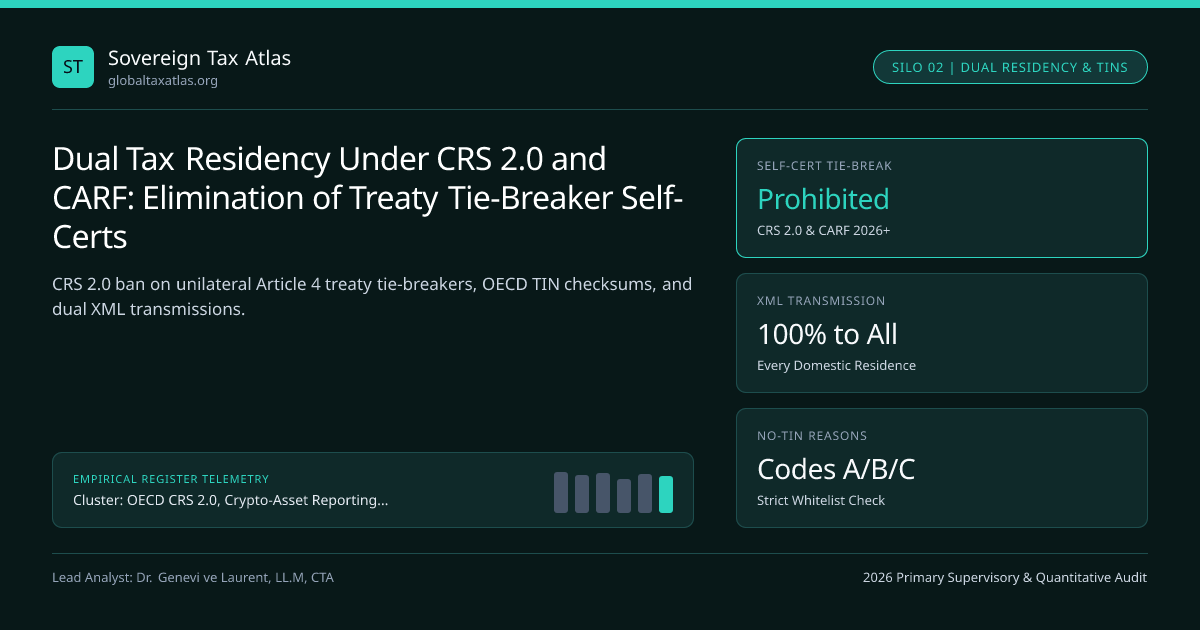
Under the original 2014 Common Reporting Standard, mobile executives, remote founders, and cross-border retirees who triggered domestic statutory tax residency in two countries simultaneously (for example, spending 190 days in Spain while maintaining a UK Statutory Residence Test home, or holding French fiscal domicile while relocating to Italy) routinely listed only one country on their bank CRS Self-Certification—relying on bilateral Double Tax Treaty Article 4 tie-breaker rules! Starting January 1, 2026, OECD CRS 2.0 and CARF explicitly prohibit treaty tie-breaker reliance on self-certifications, reshaping wealth-management onboarding across our OECD CRS 2.0, CARF, and FATCA compliance atlas and the CRS 2.0, CARF & FATCA Exchange Rules cluster.
The Blockbuster CRS 2.0 Amendment: Report ALL Domestic Tax Residencies!#
Read Amended CRS Commentary on Section IV & VII (and identical CARF Section IV rules) carefully:
- Old CRS 1.0 Loophole: Previously, if an individual was a domestic tax resident of Country A and Country B under each country's domestic law, they could self-assess Article 4(2) of the A–B Double Tax Treaty (permanent home -> center of vital interests -> habitual abode -> nationality) and certify only Country B on their bank self-certification—keeping Country A's tax authority completely in the dark!
- New Mandatory 2026 CRS 2.0 & CARF Rule: For all new and updated self-certifications under CRS 2.0 and CARF, an Account Holder or Controlling Person who is resident for tax purposes in two or more jurisdictions under domestic laws MUST declare ALL such jurisdictions of tax residence (and provide a TIN for EVERY jurisdiction!), without applying tax treaty tie-breaker rules—unless a formal Competent Authority Mutual Agreement or official Certificate of Tax Residence expressly resolving the treaty tie-breaker has already been issued by the tax authority!
- Consequence: The Swiss, Singapore, or Cayman custodian transmits full 100% account-balance XML records to BOTH Country A AND Country B, leaving the taxpayer to claim treaty tie-breaker relief openly on their domestic tax returns!
Mandatory TIN Validation Algorithms and Permitted "No-TIN" Codes#
OECD peer reviews exposed millions of CRS 1.0 XML records stuffed with fake TINs (111111111, 999999999, or passport numbers typed into TIN fields!). Under CRS 2.0 XML v3.0 and local portals like Cayman DITC, BVI BVIFars, and Singapore IRAS, Financial Institutions must run automated TIN format and checksum validation against the OECD Automatic Exchange Portal TIN Specifications:
- Format & Check-Digit Verification: For example, a UK Unique Taxpayer Reference (UTR) must be exactly 10 digits ([0-9]{10}) or a UK National Insurance Number 2 letters + 6 digits + A/B/C/D; an Italian Codice Fiscale must match its exact 16-character alphanumeric checksum; a Spanish NIF/NIE must pass Modulo-23 validation!
- Only Three Legitimate Reason Codes for a Blank TIN:
- Reason A: The jurisdiction of tax residence does not issue TINs to its residents (e.g., Cayman Islands CIMA, UAE individuals without corporate tax registration, Bermuda BMA, Bahamas CBB, Monaco). Trap: Claiming "Reason A" for UK, France, Germany, China (18-digit Resident ID Card = statutory TIN!), India (PAN!), or Singapore (NRIC/FIN!) triggers an instant automated XML rejection!
- Reason B: Account holder is unable to obtain a TIN (requires specific factual explanation—e.g., newly arrived infant or pending first-year immigration issuance—reviewed every year!).
- Reason C: No TIN is required under domestic law of that Reportable Jurisdiction (strictly limited to rare countries like Australia where quoting a TFN cannot legally be compelled!).
Multi-Jurisdiction XML Transmission and Tie-Breaker Modeling#
- [Exception ONLY if OfficialCompetentAuthorityTieBreakerDeterminationIssued(J_loser) == TRUE]
- Worked Dual-Resident Tech Founder Example (CY 2026 Custody Account at Zurich Bank = CHF 18,000,000):
- Founder holds French family apartment (foyer / center of economic interests under French CGI Art. 4B) AND relocates to Milan under Italy's EUR 300k Flat Tax regime (195 days in Italy -> Italian TUIR Art. 2 resident!).
- Under CRS 1.0 (Pre-2026): Founder's tax lawyer wrote a private memo citing France-Italy Treaty Art. 4 -> Certified ONLY Italy on bank self-cert.
- Under CRS 2.0 (2026+): Private lawyer memo CANNOT omit France! Self-cert MUST list BOTH Italy (Codice Fiscale) AND France (13-digit Numéro Fiscal)!
- Swiss FTA exchanges CHF 18,000,000 account XML to BOTH Agenzia delle Entrate (Italy) AND DGFiP (France)!
Interplay With Golden Visas and US Citizenship-Based FATCA#
Dual residency intersects explosively with two recurring wealth-structuring profiles:
- US Citizens Living Abroad: Because the United States taxes based on citizenship, an American living in London or Singapore is always dual-reported: reported to the IRS under FATCA Model 1/2 IGAs (requiring a 9-digit US SSN—never waivable for an adult US citizen!) AND reported locally/cross-border under CRS if banking in a third country like Switzerland or Jersey (JFSC)!
- CBI / RBI Passport Holders: When an account holder presents a zero-tax St. Kitts (FSRC), Dominica (FSU Dominica), or Vanuatu (RBV) certificate alongside European/Asian lifestyle indicia, OECD High-Risk CBI/RBI enhanced due diligence forces mandatory five-year physical-presence questioning to uncover every true underlying tax residence!
Dual-Residency & TIN Validation Matrix#
Global private banks and prime brokerages—onboarding international trading clients alongside entities like Agra Markets and Alkimiya Markets—enforce these exact TIN and dual-residency rules:
| Client Profile | Pre-2026 CRS 1.0 Practice | Mandatory 2026+ CRS 2.0 / CARF Rule | TIN Requirement |
|---|---|---|---|
| Dual UK + Spain Statutory Resident | Self-certified 1 state via lawyer Art. 4 memo | Must list BOTH UK & Spain (unless MAP cert) | 10-digit UK UTR/NINO + 9-char Spanish NIF |
| US Citizen Resident in Switzerland (Banked in SG) | Reported to US (FATCA) + Swiss (CRS) | Reported to BOTH IRS (FATCA) & Swiss FTA (CRS) | 9-digit US SSN + 13-digit Swiss AHV |
| PRC National Living in Dubai (120 days in PRC) | Claimed UAE sole residence via Golden Visa | CBI/RBI Inquiry tests PRC domicile/183-day rule | UAE Reason A + 18-digit PRC ID if dual! |
| Newly Relocated Expat (TIN Pending Issuance) | Left blank indefinitely | Reason B accepted temporarily (90-day / annual follow-up!) | Must update TIN upon first tax registration |
| Cayman Islands Exempted Company | Blank TIN | Reason A (Cayman issues zero tax TINs) | Verified via CIMA / Reg. Cert |
Frequently asked questions
Does dual reporting under CRS 2.0 mean both countries can legally tax 100% of my investment income twice?
No! CRS 2.0 is an information-reporting rule, not a substantive taxing statute. Once both Country A and Country B receive the CRS XML file, you still invoke Article 4 treaty tie-breaker residency (or foreign tax credits) on your domestic tax returns—you simply can no longer hide the account from Country A at the bank onboarding stage!
What kind of official document allows a dual-resident taxpayer to omit the "losing" country on a CRS 2.0 self-certification?
Only an official government determination—such as a Bilateral Mutual Agreement Procedure (MAP) resolution or a formal Certificate of Tax Residence issued by a tax authority that explicitly confirms treaty residence vis-a-vis the other treaty state—NOT a private law-firm or CPA opinion letter!
Why did my Singapore bank reject my CRS self-certification when I checked "Country does not issue TINs" for China or India?
OECD TIN validation tables classify China 18-digit Resident Identity Card number and India 10-character Permanent Account Number (PAN) as mandatory automatic TINs; automated bank engines cross-check Reason A claims against the official OECD non-TIN whitelist and block invalid submissions.
Can a US Green Card holder who moved back to Europe 5 years ago omit the United States on bank onboarding forms if their plastic Green Card expired?
Never! Under IRC Section 7701(b)(6), an expired plastic Green Card does NOT end US lawful permanent resident tax status until the individual formally files USCIS Form I-407 (and clears IRC Section 877A expatriation Form 8854)—meaning they remain a US Person under FATCA alongside their European CRS residency!
Publication record
- Published
- 14 November 2026
- Updated
- 15 November 2026
- Author
- Dr. Geneviève Laurent, LL.M, CTA
- Review
- Review not recorded
- Automated fact check
- Passed in the stored pipeline record
- Source URLs
- 3 recorded
AI assistance recorded: anthropic/claude-opus-4.6. This field does not establish human review or source verification.
Academic & Institutional Attribution
Cite This Research & Embed Live Data Card
Standard academic & institutional research paper citation format.
Dr. Geneviève Laurent, LL.M, CTA. (2026, November 15). Dual Tax Residency Under CRS 2.0 and CARF: Elimination of Treaty Tie-Breaker Self-Certs. Sovereign Tax Atlas. https://globaltaxatlas.org/entries/dual-tax-residency-tie-breaker-certificates-crs-tin-validationRegulatory Directory Cross-Reference
Referenced Institutions & Regulatory Registries
Top Regulated Institutions in This Coverage Slice
Related Crs 2 Carf Fatca Exchange Rules & Institutional Briefings
Explore Crs 2 Carf Fatca Exchange Rules Hub (20) →Crs 2 Carf Fatca Exchange Rules
OECD CRS 2.0, CARF Crypto Reporting, and US FATCA IGA Institutional Compliance AtlasCrs 2 Carf Fatca Exchange Rules
CRS Preexisting vs New Account Due Diligence: USD 1M High-Value Paper Searches and Curing IndiciaCrs 2 Carf Fatca Exchange Rules
Private Trust Companies (PTCs) and Single-Family Offices: CRS Investment Entity ClassificationCrs 2 Carf Fatca Exchange Rules
Switzerland AEOI Act Overhaul: US FATCA Model 1 IGA Switch, CRS 2.0, and CARF ImplementationCrs 2 Carf Fatca Exchange Rules
Singapore IRAS CRS, CARF, and FATCA Governance: Variable Capital Companies (VCC) and 13O/13U FundsCrs 2 Carf Fatca Exchange Rules
OECD High-Risk CBI and RBI Golden Visa Blacklist: Enhanced CRS Due Diligence QuestionsCrs 2 Carf Fatca Exchange Rules
CRS 2.0 and CARF Duplication Switch-Off Rules: Tokenized Funds, RWA Securities, and StablecoinsCrs 2 Carf Fatca Exchange Rules
OECD CRS 2.0 Expansion to Specified Electronic Money Products and Central Bank Digital CurrenciesDouble Tax Treaty Withholding Lob
EU Parent-Subsidiary and Interest-Royalties Directives After the ECJ Danish Beneficial Ownership CasesDouble Tax Treaty Withholding Lob
OECD Pillar Two Subject to Tax Rule (STTR): 9% Gross Withholding, Markup Caps, and MLI RolloutDouble Tax Treaty Withholding Lob
India–Mauritius Tax Treaty 2024 PPT Protocol, Grandfathered Capital Gains, and Indian TRC Audit RulesDouble Tax Treaty Withholding Lob
Singapore IRAS Certificate of Residence (COR): Foreign-Owned HoldCo Substance and 90+ APAC Treaties
Sovereign Tax Atlas Data, Benchmarks & Contributor Records
CC BY 4.0 Open Data
Open Institutional Datasets (CSV / JSON) →
Download desk-compiled quantitative series & schemas.
2026 Reference Matrix
2026 Institutional Benchmarks & Thresholds →
Statutory capital, clearing, margin & rate conventions.
Editorial Records
Authors & Review Records →
View named contributors where those records are available.
Complete Index
Master Research & Dossier Archive →
Browse all published briefings by topic pillar & date.