
Crs 2 Carf Fatca Exchange Rules
CRS Preexisting vs New Account Due Diligence: USD 1M High-Value Paper Searches and Curing Indicia
OECD CRS Sections III through VI establish distinct due-diligence tracks for Lower-Value, USD 1M+ High-Value, and USD 250k+ Entity Preexisting Accounts—including six statutory indicia and curing rules.
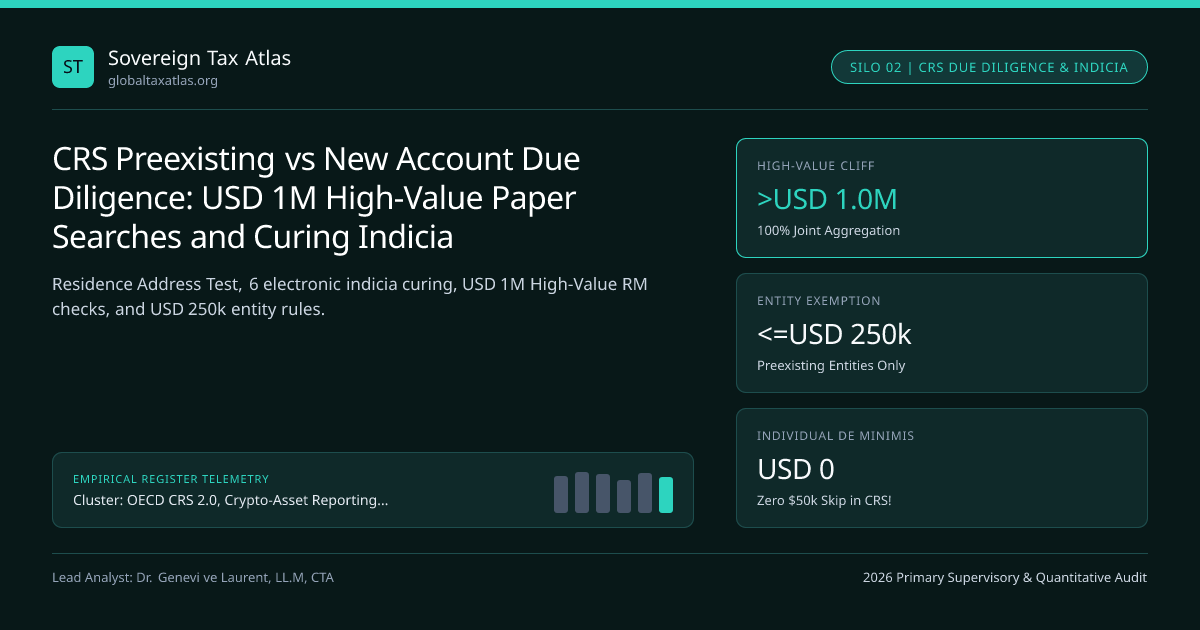
Every time a new jurisdiction joins the OECD Common Reporting Standard—or CRS 2.0 brings newly in-scope e-money providers, crypto custodians, and investment managers into Reporting Financial Institution status on January 1, 2026!—thousands of legacy customer accounts opened before the cutoff date become Preexisting Accounts governed by CRS Sections III and V. Within our OECD CRS 2.0, CARF, and FATCA compliance atlas, mastering the Residence Address Test, the six electronic indicia, USD 1,000,000 High-Value paper searches & Relationship Manager inquiries, and the USD 250,000 Preexisting Entity exemption prevents systemic audit failures across the CRS 2.0, CARF & FATCA Exchange Rules cluster.
Why Preexisting Accounts Matter Again in 2026 Under CRS 2.0!#
Compliance officers often think "Preexisting Accounts" meant only accounts open on December 31, 2015 or 2016. Not under CRS 2.0! Under the Transitional Rules to the 2023 CRS Amendments:
- Any Financial Account maintained as of December 31, 2025 that becomes a Financial Account solely by virtue of the CRS 2.0 amendments—such as Specified Electronic Money Accounts (>USD 10k 90-day average), newly scoped derivative/crypto Custodial Accounts, or newly classified Investment Entities—qualifies as a Preexisting Account (giving newly regulated fintechs and fund managers structured electronic-search review windows rather than freezing live accounts on Day 1!).
- Conversely, any New Account opened on or after January 1, 2026 requires a valid self-certification at account opening (or within a tightly policed 90-day day-two operational exception before account blocking!).
The Six Statutory CRS Electronic Indicia & Exact Curing Evidence#
When a bank or custodian runs an Electronic Record Search under CRS Section III(B)(2) (or whenever a Change in Circumstances hits any New or Preexisting Account!), its core banking engine scans for six statutory foreign tax-residency indicia:
- Identification of the Account Holder as a resident of a Reportable Jurisdiction;
- Current mailing or residence address (including a P.O. Box!) in a Reportable Jurisdiction;
- One or more telephone numbers in a Reportable Jurisdiction (and no telephone number in the FI's own jurisdiction!—note: having both a local phone and a foreign mobile requires curing!);
- Standing instructions (other than with respect to a Depository Account!) to transfer funds to an account maintained in a Reportable Jurisdiction;
- Currently effective Power of Attorney (POA) or signatory authority granted to a person with an address in a Reportable Jurisdiction; or
- A "hold mail" instruction or "in-care-of" address in a Reportable Jurisdiction if the FI has zero other address on file for the Account Holder!
Crucial Curing Rule (CRS Section III(B)(6)): If electronic search uncovers Indicia #2, #3, #4, or #5 (e.g., an Italian-resident retiree has a UK mobile number or gives POA to her daughter in London!), the bank MUST report the account to BOTH Italy AND the UK unless it collects BOTH: (a) a Self-Certification showing non-UK residency AND (b) Documentary Evidence (such as a valid Italian Certificate of Tax Residence or non-UK passport + local utility/tax assessment) proving non-reportable status!
Unapportioned Joint Account Aggregation and High-Value Cliff Math#
- AggregatedBalance(ClientX) = Sum(AllIndividualAccountsofX) + Sum(100%JointAccountsofX) + Sum(RMLinkedEntity_Accounts)
- [Computerized aggregation mandatory across all accounts linked by Client ID / TIN; PLUS all accounts a Relationship Manager knows are owned/controlled by X!]
- Worked Relationship Manager Aggregation Trap (Private Bank in Geneva & Nassau [CBB]):
- Individual Account A = USD 600,000 | Joint Account B (with Spouse) = USD 550,000:
- Aggregated Balance for Client = 600,000 + 550,000 (100% unapportioned!) = USD 1,150,000 (> USD 1,000,000!)
- Both Account A and Account B escalate immediately to HIGH-VALUE ACCOUNTS!
- Bank must conduct 5-Year Paper Record Search (if electronic DB incomplete) AND poll the Private Banker annually on Actual Knowledge!
Zero USD 50,000 Individual De Minimis in CRS (vs US FATCA!)#
Never apply US FATCA's USD 50,000 individual threshold to CRS! Under US FATCA Model 1/2 IGAs, banks can elect to exclude Preexisting Individual Depository Accounts <= USD 50,000 (and New Individual Depository Accounts <= USD 50,000). OECD CRS has ZERO USD 50,000 de minimis threshold for individuals—a dormant EUR 500 savings account (unless qualifying as an excluded $<= ext{USD } 1,000$ statutory Dormant Account!) is 100% reportable! Only two monetary exclusions exist in CRS: (1) Preexisting Entity Accounts <= USD 250,000** (optional until year-end balance exceeds USD 250,000), and (2) CRS 2.0's new USD 10,000 90-day rolling average exemption** confined strictly to Specified Electronic Money Products and CBDCs!
Preexisting vs New Account Due Diligence Matrix#
Custodians and wealth managers supervised by JFSC, GFSC, CBB Bahamas, and CBRD Mauritius—alongside institutional execution desks like Alyra Finance and Archer Hunter—enforce this due-diligence matrix:
| Account Category | Monetary Threshold | Self-Cert Required? | Indicia Search Scope | Annual RM Inquiry? |
|---|---|---|---|---|
| Preexisting Individual (Lower Value) | <= USD 1,000,000 | Only to cure conflicting indicia | Residence Address Test OR 6-Indicia Electronic | No |
| Preexisting Individual (High Value) | > USD 1,000,000 (Aggregated!) | To cure indicia | Electronic + 5-Yr Paper (if gaps) | Yes — Every Year! |
| New Individual Account | USD 0 (Except >$10k e-money) | Mandatory Day-1 Self-Cert! | Validate reasonableness vs AML/KYC | Change in Circumstances |
| Preexisting Entity Account | Exempt if <= USD 250,000 | For Passive NFE Controlling Persons (>$1M) | AML/KYC + Public Registry + Self-Cert | Via RM Aggregation |
| New Entity Account | USD 0! (Zero $250k skip!) | Mandatory Day-1 Entity + CP Self-Cert! | Full AML + TIN Checksum | Continuous AML/KYC |
Frequently asked questions
Can a bank rely solely on the Residence Address Test for a USD 2.5 million Preexisting Individual Account?
Never! The simplified Residence Address Test (relying on a current physical residence address backed by government Documentary Evidence without running a 6-indicia search) applies strictly to Lower-Value Preexisting Individual Accounts (<=USD 1,000,000); High-Value accounts (>USD 1,000,000) must undergo full electronic, paper, and annual Relationship Manager reviews.
How are joint accounts aggregated when testing the USD 1,000,000 High-Value threshold?
Under CRS Section VII(C)(1), the ENTIRE balance of a joint account (100%, never 50/50!) is attributed to each joint account holder when aggregating their accounts to test the USD 1,000,000 threshold—and if reportable, 100% of the joint balance is reported for each reportable joint holder.
Does the USD 250,000 entity exemption apply to a newly incorporated Cayman or BVI company opening an account in 2026?
No! The optional USD 250,000 threshold applies strictly to Preexisting Entity Accounts; every New Entity Account has a USD 0 threshold and must furnish a valid entity (and Controlling Person, if Passive NFE) self-certification upon onboarding.
What qualifies as a "Dormant Account" exempt from CRS reporting?
In jurisdictions adopting the Annex C / Commentary excluded-account option, an account with a year-end balance <=USD 1,000 where the holder has initiated zero transactions for 3 years across all accounts at the FI and had zero communication with the FI for 6 years (not being an annuity contract).
Publication record
- Published
- 14 November 2026
- Updated
- 14 November 2026
- Author
- Dr. Geneviève Laurent, LL.M, CTA
- Review
- Review not recorded
- Automated fact check
- Passed in the stored pipeline record
- Source URLs
- 3 recorded
AI assistance recorded: anthropic/claude-opus-4.6. This field does not establish human review or source verification.
Academic & Institutional Attribution
Cite This Research & Embed Live Data Card
Standard academic & institutional research paper citation format.
Dr. Geneviève Laurent, LL.M, CTA. (2026, November 14). CRS Preexisting vs New Account Due Diligence: USD 1M High-Value Paper Searches and Curing Indicia. Sovereign Tax Atlas. https://globaltaxatlas.org/entries/crs-preexisting-account-residence-address-electronic-indiciaRegulatory Directory Cross-Reference
Referenced Institutions & Regulatory Registries
Top Regulated Institutions in This Coverage Slice
Related Crs 2 Carf Fatca Exchange Rules & Institutional Briefings
Explore Crs 2 Carf Fatca Exchange Rules Hub (20) →Crs 2 Carf Fatca Exchange Rules
OECD CRS 2.0, CARF Crypto Reporting, and US FATCA IGA Institutional Compliance AtlasCrs 2 Carf Fatca Exchange Rules
Private Trust Companies (PTCs) and Single-Family Offices: CRS Investment Entity ClassificationCrs 2 Carf Fatca Exchange Rules
Switzerland AEOI Act Overhaul: US FATCA Model 1 IGA Switch, CRS 2.0, and CARF ImplementationCrs 2 Carf Fatca Exchange Rules
Singapore IRAS CRS, CARF, and FATCA Governance: Variable Capital Companies (VCC) and 13O/13U FundsCrs 2 Carf Fatca Exchange Rules
OECD High-Risk CBI and RBI Golden Visa Blacklist: Enhanced CRS Due Diligence QuestionsCrs 2 Carf Fatca Exchange Rules
CRS 2.0 and CARF Duplication Switch-Off Rules: Tokenized Funds, RWA Securities, and StablecoinsCrs 2 Carf Fatca Exchange Rules
OECD CRS 2.0 Expansion to Specified Electronic Money Products and Central Bank Digital CurrenciesCrs 2 Carf Fatca Exchange Rules
CARF Reporting Crypto-Asset Service Provider (RCASP) Nexus Hierarchy and DeFi Control TestsDouble Tax Treaty Withholding Lob
OECD Pillar Two Subject to Tax Rule (STTR): 9% Gross Withholding, Markup Caps, and MLI RolloutDouble Tax Treaty Withholding Lob
India–Mauritius Tax Treaty 2024 PPT Protocol, Grandfathered Capital Gains, and Indian TRC Audit RulesDouble Tax Treaty Withholding Lob
Singapore IRAS Certificate of Residence (COR): Foreign-Owned HoldCo Substance and 90+ APAC TreatiesDouble Tax Treaty Withholding Lob
UK Qualifying Asset Holding Company (QAHC) vs Quoted Eurobond: 0% Outbound Interest Withholding
Sovereign Tax Atlas Data, Benchmarks & Contributor Records
CC BY 4.0 Open Data
Open Institutional Datasets (CSV / JSON) →
Download desk-compiled quantitative series & schemas.
2026 Reference Matrix
2026 Institutional Benchmarks & Thresholds →
Statutory capital, clearing, margin & rate conventions.
Editorial Records
Authors & Review Records →
View named contributors where those records are available.
Complete Index
Master Research & Dossier Archive →
Browse all published briefings by topic pillar & date.