
Crs 2 Carf Fatca Exchange Rules
Private Trust Companies (PTCs) and Single-Family Offices: CRS Investment Entity Classification
Ultra-high-net-worth families using Cayman, BVI, Jersey, or Singapore Private Trust Companies (PTCs) and Single-Family Offices must test three CRS/FATCA Investment Entity prongs to prevent double reporting or hidden FI defaults.
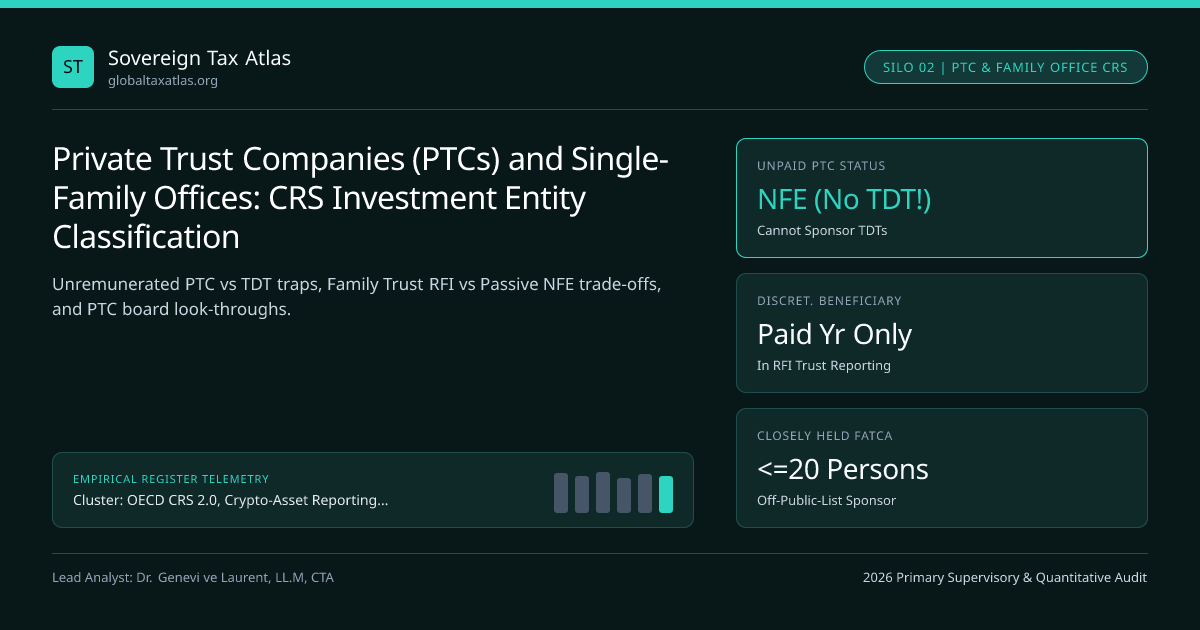
Billionaire dynasties across Asia, Europe, and the Middle East frequently place a Private Trust Company (PTC)—incorporated in the Cayman Islands (CIMA), BVI (BVIFSC VISTA regime), Jersey (JFSC), Guernsey (GFSC), or Singapore—at the apex of their family trusts and Single-Family Office (SFO) holding structures so family members can sit on the PTC board alongside professional fiduciary directors. Within our OECD CRS 2.0, CARF, and FATCA compliance atlas, misclassifying whether the PTC itself, the underlying Family Trust, and the Single-Family Office advisory company are Reporting Financial Institutions vs Passive NFEs triggers severe compliance breaches across the CRS 2.0, CARF & FATCA Exchange Rules cluster.
Testing All Three Entities Separately: The PTC, the Family Trust, and the SFO!#
Never analyze a Private Trust Company family structure as a single monolith—CRS Section VIII and FATCA IGAs test each legal entity and trust separately:
- Entity #1 — The Private Trust Company (PTC) Itself: A PTC formed solely to act as unremunerated (or cost-reimbursed!) trustee for connected family trusts rarely qualifies as a Section VIII(A)(6)(a) "Customer-Facing" Financial Institution, because an unremunerated PTC is not conducting a commercial business "for or on behalf of a customer"! Nor is the PTC's own tiny USD 25,000 share-capital bank account managed for financial-asset returns (<50% financial-asset income). Result: Most unremunerated PTCs are Non-Financial Entities (NFEs)—which crucially prevents the PTC from using the "Trustee-Documented Trust" (TDT) shortcut (because TDT status requires the Trustee itself to be a Reporting Financial Institution!).
- Entity #2 — The Underlying Family Trust: Even when its PTC trustee is an NFE, the Family Trust itself BECOMES a Reporting Financial Institution (Managed Investment Entity) whenever >=50% of the Trust's 3-year gross income derives from financial assets AND the Trust's portfolio is discretionarily managed by a third-party private bank or licensed SFO! Conversely, if the Trust holds direct operating company shares (only dividends from a family manufacturing group = financial assets! Be careful!) without any FI exercising discretionary management over the Trust, the Trust is a Passive NFE!
- Entity #3 — The Single-Family Office (SFO) Management Company: Under Singapore MAS Section 13O/13U or Hong Kong HK$240M Family Office FIHV structures, if the SFO advisory company earns investment management fees (>=50% gross income) for managing financial assets on behalf of the family fund/trust vehicles, OECD CRS FAQ guidance classifies a remunerated, corporate SFO managing family vehicles as a Section VIII(A)(6)(a) Investment Entity FI!
Critical Difference: "Family Trust = RFI" vs "Family Trust = Passive NFE"!#
Look closely at what actually changes in XML reporting depending on whether the Family Trust is classified as a Reporting Financial Institution (RFI) vs a Passive NFE:
- When Family Trust = Passive NFE: The Family Trust files zero local DITC/BVIFars returns; instead, every private bank (in Zurich, Singapore, London, Dubai) pierces the Trust under Section VIII(D)(6) Controlling Person rules and reports Settlors, PTC natural-person directors/shareholders!, Protectors, and Beneficiaries!
- When Family Trust = Reporting Financial Institution (RFI): Private banks treat the Trust as a Financial Institution (zero bank-level CRS reporting on the family!). Instead, the Trust ITSELF (acting through its PTC trustee) must register on Cayman DITC / BVI BVIFars / Jersey AEOI, obtain an IRS GIIN, and report all Equity Interests in the Trust—defined in CRS Section VIII(C)(4) as any Settlor, any Beneficiary of all or a portion of the trust (mandatory fixed, or discretionary in years of actual distribution!), and any other natural person exercising ultimate effective control over the trust (including Protectors and PTC controlling shareholders!).
Trust Equity Interest Valuation: Mandatory vs Discretionary Roles#
- SettlororMandatoryBeneficiaryorUltimateController = 100% of TotalTrustYearEndNAV + Gross_Income
- PurelyDiscretionaryBeneficiary (with Election) = GrossDistributionPaidinCalendarYearONLY! (USD 0 if 0 paid!)
- Worked USD 250M Cayman STAR Trust + Cayman Registered PTC + Zurich Bank Discretionary Mandate:
- PTC is unremunerated (cost-recovery only) -> PTC = Active/Passive NFE (cannot act as TDT Reporting Trustee!).
- Trust earns USD 11M bond/equity income (100% >= 50%) under Zurich Bank discretionary mandate -> Trust ITSELF = Cayman RFI!
- Action Plan:
- 1. Register the Trust (via PTC as PPoC/AP delegate) on Cayman DITC Portal + obtain Standalone Model 1 GIIN (.SL.136)!
- 2. Hand Trust Form W-8BEN-E (Reporting Model 1 FFI + GIIN) + CRS FI Self-Cert to Zurich Bank -> Zurich Bank files ZERO CRS!
- 3. By July 31, PTC files Cayman DITC XML reporting Living Settlor (USD 250M), Protector (USD 250M), & Daughter (USD 2.0M distribution received)!
Who Gets Reported Behind the PTC Corporate Curtain?#
Promoters once claimed that interposing a corporate PTC hides human trustees! OECD CRS FAQ (Section VIII, Question 5) slammed that door shut: whether a trust is an RFI ("natural person exercising ultimate effective control") or a Passive NFE ("Trustee"), when the Trustee is a corporate entity (like a PTC), the Reporting FI must look through the corporate PTC to identify the natural persons controlling/directing the PTC (its family shareholders, board directors, or appointer/enforcer of a purpose trust owning PTC shares!).
PTC & Single-Family Office Classification Matrix#
Fiduciary boards across JFSC, GFSC, DIFC, and Labuan IBFC—advising private wealth accounts alongside platforms like Astrovault and Atm Capital—apply this three-tier classification matrix:
| Structure Component | Remunerated / Managed? | CRS Status | FATCA Status (W-8BEN-E) | Who Files XML Reports? |
|---|---|---|---|---|
| Unremunerated Cayman/BVI PTC | Cost-reimbursed only | Active / Passive NFE | Passive / Excepted NFFE | Own tiny cash bank (if Passive NFE) |
| Commercial Licensed Trust Co | Fees from multi-family clients | Reporting FI | Reporting Model 1/2 FFI | Sponsors Trustee-Documented Trusts (TDTs)! |
| Family Trust (Discretionary Bank) | Bank manages >=50% fin assets | Reporting FI (Trust itself!) | Reporting M1/M2 FFI (or Sponsored) | Trust files via DITC / BVIFars / IRAS |
| Family Trust (Self-Directed PTC) | Zero discretionary FI manager | Passive NFE | Passive NFFE | Custodian banks look through Trust & PTC! |
| Corporate SFO (13O/13U/FIHV) | Earns advisory fee from Fund | Investment Entity FI (CRS 2.0!) | Certified Deemed-Compliant Inv. Advisor | Verify zero Equity/Debt customer accounts! |
Frequently asked questions
Why do shares of our 100%-owned family manufacturing company count as "Financial Assets" under CRS?
CRS Section VIII(A)(7) defines "Financial Asset" broadly to include ANY security (including shares of stock in a private operating corporation!). Thus, if a Family Trust holds private operating-company dividends (>=50% gross income) AND hires a professional corporate SFO/FI to manage the Trust, the Trust can still trigger Investment Entity FI status!
What is the single biggest advantage of classifying a Family Trust as a Reporting FI rather than a Passive NFE?
Centralized reporting control and distribution-only beneficiary reporting! When the Family Trust is a Reporting FI, custodian banks across 6 countries file ZERO CRS reports on family members; instead, the PTC files ONE centralized CRS return in Cayman/Jersey—and reports discretionary beneficiaries ONLY on actual cash distributed rather than 100% of Trust NAV!
How does a US-connected Single-Family Office use "Sponsored Closely Held Investment Vehicle" status under FATCA?
If <=20 individuals own 100% of all debt and equity interests in the family investment vehicle, a corporate Sponsoring Entity (.SP. GIIN) can sponsor it under FATCA so the family vehicle never registers its own public .SF. or .SL. name on the public monthly IRS FFI List!
If our PTC shares are held by a Cayman STAR Purpose Trust or Guernsey Purpose Trust, who is reported for the PTC?
When a Purpose Trust owns 100% of the PTC shares, look-through rules identify the natural-person Settlor, Enforcer, and Trustees of the Purpose Trust alongside the natural-person Board Directors of the PTC exercising ultimate effective control.
Publication record
- Published
- 14 November 2026
- Updated
- 15 November 2026
- Author
- Dr. Geneviève Laurent, LL.M, CTA
- Review
- Review not recorded
- Automated fact check
- Passed in the stored pipeline record
- Source URLs
- 3 recorded
AI assistance recorded: anthropic/claude-opus-4.6. This field does not establish human review or source verification.
Academic & Institutional Attribution
Cite This Research & Embed Live Data Card
Standard academic & institutional research paper citation format.
Dr. Geneviève Laurent, LL.M, CTA. (2026, November 15). Private Trust Companies (PTCs) and Single-Family Offices: CRS Investment Entity Classification. Sovereign Tax Atlas. https://globaltaxatlas.org/entries/private-trust-company-family-office-crs-investment-entity-testRegulatory Directory Cross-Reference
Referenced Institutions & Regulatory Registries
Top Regulated Institutions in This Coverage Slice
Related Crs 2 Carf Fatca Exchange Rules & Institutional Briefings
Explore Crs 2 Carf Fatca Exchange Rules Hub (20) →Crs 2 Carf Fatca Exchange Rules
OECD CRS 2.0, CARF Crypto Reporting, and US FATCA IGA Institutional Compliance AtlasCrs 2 Carf Fatca Exchange Rules
Switzerland AEOI Act Overhaul: US FATCA Model 1 IGA Switch, CRS 2.0, and CARF ImplementationCrs 2 Carf Fatca Exchange Rules
Singapore IRAS CRS, CARF, and FATCA Governance: Variable Capital Companies (VCC) and 13O/13U FundsCrs 2 Carf Fatca Exchange Rules
OECD High-Risk CBI and RBI Golden Visa Blacklist: Enhanced CRS Due Diligence QuestionsCrs 2 Carf Fatca Exchange Rules
CRS 2.0 and CARF Duplication Switch-Off Rules: Tokenized Funds, RWA Securities, and StablecoinsCrs 2 Carf Fatca Exchange Rules
OECD CRS 2.0 Expansion to Specified Electronic Money Products and Central Bank Digital CurrenciesCrs 2 Carf Fatca Exchange Rules
CARF Reporting Crypto-Asset Service Provider (RCASP) Nexus Hierarchy and DeFi Control TestsCrs 2 Carf Fatca Exchange Rules
CARF XML Schema Valuations: Crypto-to-Crypto Swaps, Wallet Transfers, and USD 50,000 Retail ThresholdDouble Tax Treaty Withholding Lob
India–Mauritius Tax Treaty 2024 PPT Protocol, Grandfathered Capital Gains, and Indian TRC Audit RulesDouble Tax Treaty Withholding Lob
Singapore IRAS Certificate of Residence (COR): Foreign-Owned HoldCo Substance and 90+ APAC TreatiesDouble Tax Treaty Withholding Lob
UK Qualifying Asset Holding Company (QAHC) vs Quoted Eurobond: 0% Outbound Interest WithholdingDouble Tax Treaty Withholding Lob
Cross-Border Securities Lending, Manufactured Dividends, and Post-Cum-Ex Anti-Dividend-Washing Rules
Sovereign Tax Atlas Data, Benchmarks & Contributor Records
CC BY 4.0 Open Data
Open Institutional Datasets (CSV / JSON) →
Download desk-compiled quantitative series & schemas.
2026 Reference Matrix
2026 Institutional Benchmarks & Thresholds →
Statutory capital, clearing, margin & rate conventions.
Editorial Records
Authors & Review Records →
View named contributors where those records are available.
Complete Index
Master Research & Dossier Archive →
Browse all published briefings by topic pillar & date.