
Economic Substance Cfc Transfer Pricing
US GILTI / Net CFC Tested Income (IRC Section 951A): 2026 OBBBA Reforms, Section 250, and FTC Haircuts
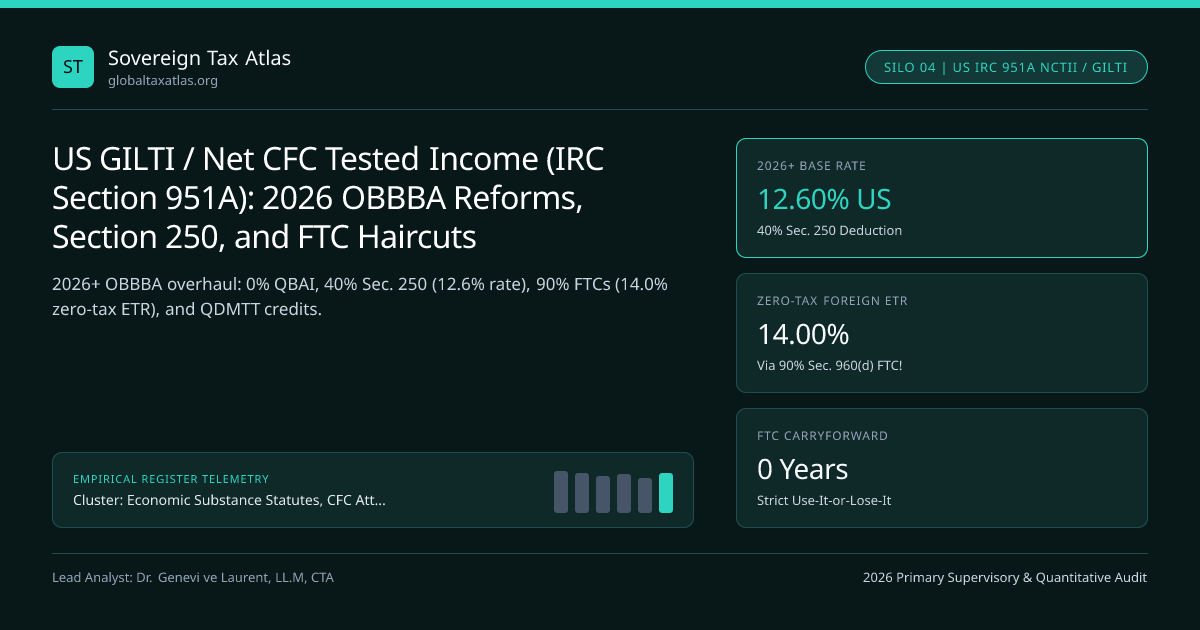
Overhauled for taxable years beginning after December 31, 2025 under the One Big Beautiful Bill Act (OBBBA), IRC Section 951A transforms GILTI into Net CFC Tested Income (NCTII)—repealing 10% QBAI while setting a 12.6%–14.0% effective band.
Enacted in the 2017 Tax Cuts and Jobs Act (TCJA) as Global Intangible Low-Taxed Income (GILTI — IRC Section 951A), the United States paired Subpart F passive inclusions with a minimum tax on active CFC profits alongside EU ATAD CFC rules—operating on a worldwide blended pool rather than OECD Pillar Two country-by-country 15% GloBE calculations. Then, for taxable years beginning after December 31, 2025, landmark US tax legislation (the July 2025 One Big Beautiful Bill Act — OBBBA) overhauled IRC Section 951A—renaming GILTI as Net CFC Tested Income (NCTII)! Anchored in our Economic Substance, CFC, and Transfer Pricing DEMPE guide, every CFO modeling 2025 vs 2026+ US Form 8992 returns must track four monumental statutory changes across the Economic Substance Statutes, CFC Attribution & Transfer Pricing DEMPE cluster.
Side-by-Side Statutory Shift: Legacy GILTI (2018–2025) vs New NCTII (2026+)!#
Compare the old TCJA sunset cliff that was scheduled for 2026 against what Congress actually enacted for 2026+ under amended IRC Sections 951A, 250, and 960(d):
- Repeal of the 10% QBAI Tangible Asset Carve-Out (Net Deemed Tangible Income Return = USD 0!): From 2018 through 2025, a US parent subtracted 10.0% of Qualified Business Asset Investment (QBAI — depreciable overseas factories/machinery) minus specified interest before computing GILTI! Starting January 1, 2026, the 10% QBAI exemption is REPEALED (0%)—converting Section 951A into a clean Net CFC Tested Income (NCTII) tax on 100% of active non-Subpart-F CFC net profits!
- Section 250 Deduction Set Permanently at 40.0% (Headline Minimum Rate = 12.60%!): Instead of dropping from 50.0% (10.50% rate) all the way down to the originally scheduled TCJA cliff of 37.5% (13.125% rate), Congress fixed the IRC Section 250 deduction at 40.0%—producing a permanent 12.60% US statutory rate (21% × (1 - 0.40) = 12.60%) when foreign tax equals zero!
- Section 960(d) Foreign Tax Credit Haircut Cut in Half (80% -> 90.0% Creditable!): Previously, US corporations lost 20.0% of foreign corporate taxes paid (only 80% creditable), meaning zero residual GILTI required a 10.5% / 0.80 = 13.125% foreign ETR. For 2026+, 90.0% of foreign Tested Income taxes are creditable (only a 10% haircut!)—meaning zero residual US Section 951A tax is owed whenever blended foreign ETR reaches 12.60% / 0.90 = 14.00%****!
- Elimination of Interest & R&D Expense Allocation into the Tested Income FTC Basket (IRC Sec. 904)!: Historically, US headquarters interest and R&D expenses allocated into the Section 951A FTC basket crushed the Section 904 FTC limitation—forcing US multinationals paying 25% foreign tax to STILL owe US GILTI tax! 2026+ reforms eliminate headquarters R&D/interest expense allocation against NCTII, stopping phantom double taxation on >=14%-taxed CFCs (including 15% Pillar Two QDMTT jurisdictions!)!
Crucial Strategic Interaction: 14.00% US NCTII vs 15.00% OECD Pillar Two QDMTT!#
Look at how cleanly 14.00% interacts with 15.00% Pillar Two QDMTTs across Ireland, Switzerland, Singapore, UAE, and Europe in 2026+:
- Because a Qualified Domestic Minimum Top-Up Tax (QDMTT) is a creditable foreign income tax for US Foreign Tax Credit purposes (per Treasury Final FTC Regs & IRS Notice 2023-80!), a US multinational whose Irish or Swiss subsidiary pays 15.00% total local tax (CIT + QDMTT) sits above the 14.00% zero-residual-tax threshold (90% × 15.00% = 13.50% FTC > 12.60% US tentative tax)—owing USD 0 residual US Section 951A tax AND generating 0.90% of excess cross-crediting shield to shelter any 0% Cayman or BVI CFC profits in the same global pool!
- When Should You Elect the GILTI / NCTII High-Tax Exclusion (>18.90% — Treas. Reg. §1.951A-2(c)(7))?: Wait—if UK/German CFCs pay 25%–30% foreign tax, should you leave them inside the Section 951A pool to cross-credit 0% Cayman CFCs, OR elect the >18.9% High-Tax Exclusion?
- Leave Inside Pool: When you have low-taxed (0%–10%) CFCs needing excess FTCs from high-taxed CFCs!
- Elect >18.9% High-Tax Exclusion: Remember the "All-or-Nothing Consistency Rule"—electing GILTI/NCTII High-Tax Exclusion applies to ALL >18.9%-taxed CFC Tested Units across the entire controlled group (useful if domestic losses or Section 250(a)(2) taxable-income caps apply)!
Quantitative 2025 vs 2026+ IRC Section 951A Tax Calculation Comparison#
- = 12.60% * PreTaxCFCTestedIncome
- 2026ResidualUS951ATax = Max(0, 12.60% * PreTaxCFCTestedIncome - 90.0% * ForeignIncome&QDMTTTaxes_Paid)
- Worked US Manufacturing & Software Group With Two CFCs in FY 2026 (Irish CFC + Cayman Trading CFC):
- Irish CFC: Pre-Tax Active Profit = USD 80,000,000 | Pays 15.0% (12.5% IE CIT + 2.5% IE QDMTT) = USD 12,000,000 Tax (Net = USD 68.0M).
- Cayman Trading CFC: Pre-Tax Active Non-Subpart-F Profit = USD 20,000,000 | Pays 0.0% Tax = USD 0 (Net = USD 20.0M).
- Global Blended Calculation (FY 2026 Post-OBBBA Rules):
- 1. Net CFC Tested Income = 68.0M + 20.0M = USD 88,000,000 | Section 78 Gross-Up = USD 12,000,000 -> Total Pre-Tax Base = USD 100,000,000!
- 2. Section 250 Deduction (40.0%) = USD 40,000,000 -> US Taxable Base = USD 60,000,000 * 21.0% = USD 12,600,000 Tentative US Tax!
- 3. Section 960(d) Foreign Tax Credit (90.0% * USD 12,000,000) = USD 10,800,000!
- 4. Residual US Section 951A Tax Owed to IRS = 12,600,000 - 10,800,000 = USD 1,800,000 (Combined Global Tax = 13.80% on USD 100M!).
Benchmarking Legacy GILTI, 2026+ NCTII, Subpart F, and Pillar Two GloBE#
IRC Section 951A Shareholder & Entity Matrix#
US multinational VPs of Tax, private equity fund GPs, and cross-border advisers—working across CIMA, BMA, and global execution firms like Ac Capital Market and 5Markets—plan around exact shareholder-type asymmetries in Section 951A:
| US Shareholder Type | Eligible for 40% Sec. 250 Deduction? | Eligible for 90% Sec. 960(d) FTC? | Effective 2026+ Tax Rate on 0%-Tax CFC | Mandatory Structuring Move |
|---|---|---|---|---|
| US C-Corporation | YES (40.0%) | YES (90.0%) | 12.60% (0% US if Foreign ETR >=14.0%!) | Pool 15% QDMTT CFCs against <14% CFCs! |
| US Individual / Trust (>=10%, No Election) | NO (0%!) | NO (0%!) | 37.0% (+ double tax risk!) | NEVER leave un-elected! |
| US Individual Making IRC Sec. 962 Election | YES (40.0%** via Smith!)** | YES (90.0%) | 12.60% Step 1 (+ 23.8% on later treaty div) | File Form 8992 + Sec. 962 Statement annually! |
| US Individual (<10% LP in Delaware Fund) | N/A | N/A | 0% NCTII (Treas. Reg. 1.958-1(d) look-through!) | Screen solely for PFIC Form 8621 (50%/75% passive)! |
| US Tax-Exempt Endowment / Pension | N/A | N/A | 0% UBTI! (NCTII/Subpart F != UBTI unless insurance!) | Direct CFC stock avoids debt-financed UBTI! |
Frequently asked questions
Why did repealing the 10% QBAI tangible-asset carve-out hit capital-intensive overseas factories harder than asset-light software companies?
Asset-light SaaS CFCs already had almost USD 0 of QBAI (paying tax on ~100% of profit anyway, so keeping a 12.6% rate + 90% FTC with zero R&D expense drag actually HELPED software groups!), whereas low-tax overseas manufacturing plants lost their tax-free 10% return on physical plant and equipment!
Can excess Foreign Tax Credits in the Section 951A (GILTI / NCTII) basket be carried back 1 year or carried forward 10 years like General Basket FTCs?
NO! IRC Section 904(c) explicitly prohibits carrying back or carrying forward ANY excess Foreign Tax Credits in the Section 951A basket—making it strictly a "use-it-or-lose-it" single-year cross-crediting pool!
Does a US tax-exempt university endowment or pension plan owe Unrelated Business Taxable Income (UBTI) on Subpart F or GILTI/NCTII inclusions?
No! Except for very narrow captive-insurance Subpart F income under IRC Section 512(b)(17), Subpart F and Section 951A inclusions from debt-free CFC shares are treated like passive corporate dividends—100% exempt from UBTI (which is why endowments love offshore corporate Blockers)!
How do Pillar Two "Blended CFC Regime" rules allocate a US Parent 12.6% NCTII tax down to foreign subsidiaries?
Under OECD Pillar Two Administrative Guidance on Blended CFC Regimes, a US Parent global Section 951A tax is allocated preferentially down to the lowest-ETR (<15%) foreign jurisdictions weighted by (15% - GloBE_ETR) * Attributable_Income, boosting their Covered Taxes before UTPR applies (whereas local QDMTTs collect locally first)!
Publication record
- Published
- 13 November 2026
- Updated
- 14 November 2026
- Author
- Dr. Geneviève Laurent, LL.M, CTA
- Review
- Review not recorded
- Automated fact check
- Passed in the stored pipeline record
- Source URLs
- 3 recorded
AI assistance recorded: anthropic/claude-opus-4.6. This field does not establish human review or source verification.
Academic & Institutional Attribution
Cite This Research & Embed Live Data Card
Standard academic & institutional research paper citation format.
Dr. Geneviève Laurent, LL.M, CTA. (2026, November 14). US GILTI / Net CFC Tested Income (IRC Section 951A): 2026 OBBBA Reforms, Section 250, and FTC Haircuts. Sovereign Tax Atlas. https://globaltaxatlas.org/entries/us-gilti-nctii-irc-951a-qbai-section-250-ftc-haircut-reformsRegulatory Directory Cross-Reference
Referenced Institutions & Regulatory Registries
Mentioned Regulated Institutions
Related Economic Substance Cfc Transfer Pricing & Institutional Briefings
Explore Economic Substance Cfc Transfer Pricing Hub (20) →Economic Substance Cfc Transfer Pricing
Offshore Economic Substance Statutes, CFC Attribution Regimes, and OECD Transfer Pricing DEMPE GuideEconomic Substance Cfc Transfer Pricing
EU Anti-Tax Avoidance Directive (ATAD) Articles 7–8 CFC Rules: Model A Passive Categories vs Model B SPFEconomic Substance Cfc Transfer Pricing
UK TIOPA 2010 Part 9A CFC Regime: Chapter 3 Gateways, 75% Tax Exemption, and Chapter 9 Finance Company RulesEconomic Substance Cfc Transfer Pricing
OECD Transfer Pricing Guidelines Chapter VI: Intangible DEMPE Functions vs Legal IP OwnershipEconomic Substance Cfc Transfer Pricing
Hard-to-Value Intangibles (HTVI): Ex-Post Outcomes, the 20% Valuation Corridor, and Price AdjustmentsEconomic Substance Cfc Transfer Pricing
OECD Pillar One Amount B (2025+): Baseline Wholesale Marketing and Distribution Return-on-Sales MatrixEconomic Substance Cfc Transfer Pricing
OECD Transfer Pricing Chapter X: Intragroup Loans, Implicit Halo Support, Cash Pools, and GuaranteesEconomic Substance Cfc Transfer Pricing
Cost Contribution Arrangements (CCAs) and US IRC Section 482 Cost Sharing: Buy-In PCTs and DEMPECross Border Fund Spv Tax Neutrality
US IRC Section 864(b)(2) Trading Safe Harbor vs Direct Lending Loan Origination ECI RisksCross Border Fund Spv Tax Neutrality
US UBTI and IRC Section 514 Acquisition Indebtedness: Offshore Feeder Blockers and Section 514(c)(9)Cross Border Fund Spv Tax Neutrality
Singapore MAS Section 13O and Section 13U Tax Exemptions: VCC Umbrellas and 2025/2026 Tiered SpendingCross Border Fund Spv Tax Neutrality
Hong Kong Unified Fund Exemption (UFE) and HK$240M Family Office FIHV Zero-Tax Regime
Sovereign Tax Atlas Data, Benchmarks & Contributor Records
CC BY 4.0 Open Data
Open Institutional Datasets (CSV / JSON) →
Download desk-compiled quantitative series & schemas.
2026 Reference Matrix
2026 Institutional Benchmarks & Thresholds →
Statutory capital, clearing, margin & rate conventions.
Editorial Records
Authors & Review Records →
View named contributors where those records are available.
Complete Index
Master Research & Dossier Archive →
Browse all published briefings by topic pillar & date.