
Economic Substance Cfc Transfer Pricing
Cost Contribution Arrangements (CCAs) and US IRC Section 482 Cost Sharing: Buy-In PCTs and DEMPE
Tech and pharma giants co-develop global IP without ongoing cross-border royalties via OECD Chapter VIII Cost Contribution Arrangements (CCAs)—provided every participant employs DEMPE risk-controllers and prices Platform Contribution Buy-Ins at full fair value.
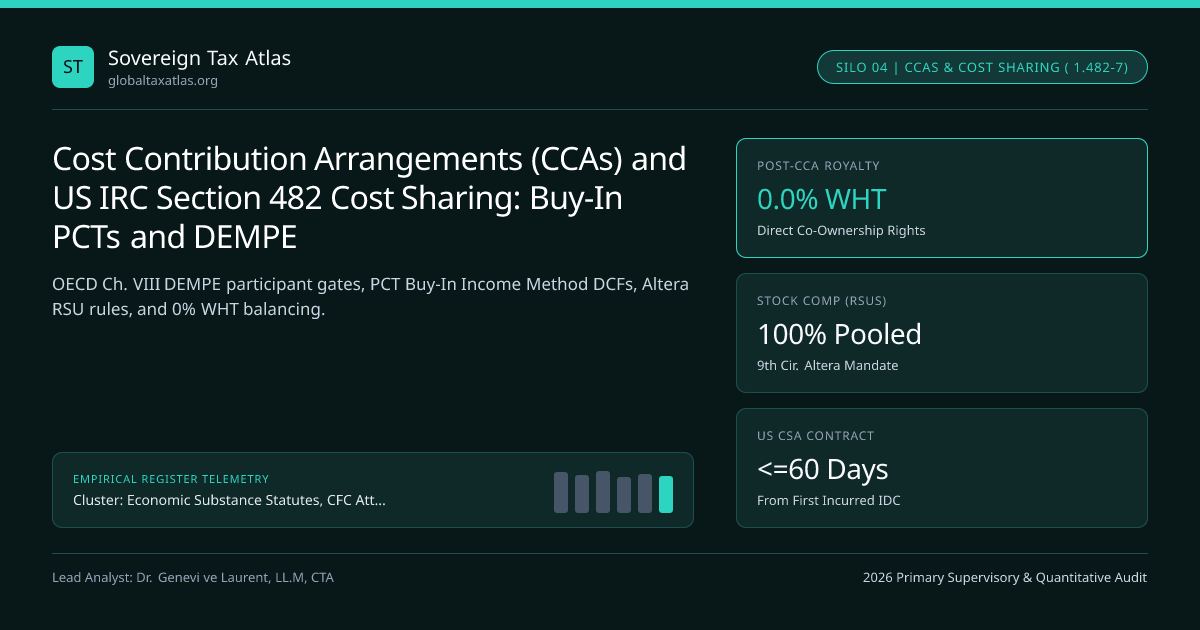
Why do Apple, Alphabet, Meta, Nvidia, and global biopharma leaders co-develop next-generation intellectual property under OECD Chapter VIII Cost Contribution Arrangements (CCAs) and US Treasury Reg. §1.482-7 Qualified Cost Sharing Arrangements (CSAs)? Because once an onshore US Parent and an Irish, Singaporean, or Swiss Co-Entrepreneur validly co-own regional rights under a CCA, ongoing future IP profits earned in each participant's territory owe ZERO cross-border royalties (eliminating both Article 12 royalty WHT and 9% Pillar Two STTR gross taxes)! Anchored in our Economic Substance, CFC, and Transfer Pricing DEMPE guide, post-BEPS value-based contribution rules and Platform Contribution Transaction (PCT / "Buy-In") DCF audits govern every CCA across the Economic Substance Statutes, CFC Attribution & Transfer Pricing DEMPE cluster.
Two Non-Negotiable Rules of OECD Chapter VIII Development CCAs!#
Before BEPS Actions 8–10, multinationals stuffed a zero-staff Cayman or Bermuda shell into a Cost Sharing Agreement—having the shell wire 60% of R&D accounting costs (USD 120M) to US engineers in exchange for 60% of global IP billions! OECD Chapter VIII (Paras 8.12–8.33) killed Cash-Box CCAs with two ironclad rules:
- Rule #1 — Mandatory Risk-Control Capability (No Cash-Box Participants Allowed!): An entity CANNOT be a participant in a Development CCA unless its own human personnel have the capability and authority to control the operational risks of the CCA's R&D activities (aligning 100% with Chapter VI DEMPE!)! A pure funding company lacking R&D risk-control executives is kicked out of the CCA completely and treated as a mere financing lender earning a risk-free/risk-adjusted interest coupon!
- Rule #2 — Contributions Measured at ARM'S-LENGTH VALUE, NOT Accounting Cost!: Look at OECD Paragraph 8.25: historically, companies measured ongoing R&D contributions at raw accounting cost (salaries + lab supplies). Under revised Chapter VIII, current R&D contributions to a Development CCA must be valued at their ARM'S-LENGTH VALUE (except where practical administrative cost-plus approximations closely mirror relative value, or inside Services CCAs for 5% LVAS routine services!)—while Pre-Existing IP / Platform Contributions ("Buy-Ins") MUST ALWAYS be priced at full Fair Market Value! (Contrast US Treas. Reg. §1.482-7(d), which uniquely permits ongoing Intangible Development Costs [IDCs]—including Stock-Based Compensation* upheld in the landmark Ninth Circuit **Altera Corp. v. Commissioner (2019/2020)!—to be shared at cost in proportion to Reasonably Anticipated Benefits [RAB], while taxing the PCT Buy-In via the strict Income Method DCF*!)
Landmark US Tax Court Battles: Veritas, Amazon, Facebook/Meta, and Altera!#
Why have the biggest transfer-pricing trials in US history centered on PCT "Buy-In" valuations when setting up a Cost Sharing Agreement?
- *Pre-2009 Regulations (Veritas* & Amazon Taxpayer Wins): Under pre-2009 cost-sharing regulations, Amazon and Veritas defeated multi-billion-dollar IRS assessments by valuing transferred software/website code with finite 7-year useful-life decay curves (CUT** method) rather than perpetual goodwill!
- *Current Final Regulations (Treas. Reg. §1.482-7(g) — Facebook / Meta* Era!): Today's regulations codify the Investor Model & Income Method DCF—valuing the entire "Platform Contribution" (not just Version 1.0 code lines that decay in 5 years, but the perpetual head-start platform upon which Version 2.0, 3.0, and 4.0 are built!), discounted at the risk-adjusted WACC of the R&D platform—and subject strictly to IRC §482 Periodic Adjustments (80%–120% CWI / HTVI 20% corridor)**!
- **Altera Corp. v. Commissioner (9th Cir. 2019, Cert. Denied by Supreme Court 2020!): Settled once and for all that US companies MUST include employee Stock-Based Compensation (RSUs and stock options!) inside the shared Intangible Development Cost (IDC) pool**—preventing US parents from deducting 100% of Silicon Valley RSU billions in the US while gifting 50% of the resulting code to Dublin!
Quantitative RAB Share & Annual CCA Balancing Payment Math#
- NetAnnualCCABalancingPayment(Entityi) = ParticipantTargetCostSharei - DirectIncurredCCACosts_i
- [Crucial Tax Character (OECD Para 8.50 & §1.482-7): Balancing Payment reduces Payee R&D Expense & increases Payer R&D Cost — NOT a WHT Royalty!]
- Worked FY 2026 Semiconductor AI-Chip Cost Sharing Agreement (US Parent = 60.0% Americas/Asia-1 RAB | Dublin DEMPE Hub = 40.0% EMEA/Asia-2 RAB):
- Incurred FY 2026 R&D Costs (Cash Salaries + Lab Masks + RSU Stock-Based Comp per Altera):
- US Parent Incurs Directly = USD 320,000,000 (incl. USD 90M RSU Stock-Based Comp!)
- Dublin Hub Incurs Directly = USD 80,000,000 (75 Dublin VLSI Engineers + DEMPE Chip Architects)
- Total Combined IDC Pool = USD 400,000,000
- Target RAB Cost Allocation:
- US Parent Target (60.0% * 400M) = USD 240,000,000
- Dublin Hub Target (40.0% * 400M) = USD 160,000,000
- Annual CCA Balancing Payment: Dublin Hub wires (160M - 80M) = USD 80,000,000 to US Parent at 0.0% Withholding Tax!
- (Plus Dublin pays scheduled PCT Buy-In payment for pre-existing Gen-1 chip platform IP!).
Benchmarking Development CCAs vs Services CCAs vs Licensing#
CCA & Cost Sharing Governance Matrix#
Silicon Valley/European tech VPs of Tax and life-sciences IP counsel—operating across ESMA, Ireland KDB/ICAV ecosystems, and Singapore R&D hubs, alongside Web3/AI builders like Band Protocol and Axie Infinity—verify five strict CCA rules:
| CCA Governance Element | US Treas. Reg. §1.482-7 Rule | OECD Chapter VIII Rule | Fatal Compliance Error |
|---|---|---|---|
| Participant Substance | Capability to manage risk / territorial exploitation | Mandatory DEMPE risk-control staff (Para 8.15)! | Including an unstaffed Cayman/BVI cash-box! |
| Stock-Based Comp (RSUs) | Mandatory in IDC Pool (Altera!) | Included in arm's-length R&D value | Omitting RSUs -> Loses Qualified CSA status! |
| Ongoing Contributions | Valued at Cost (IDCs) | Valued at Arm's-Length Value (check bilateral gap!) | Ignoring US-Cost vs EU-Value mismatch without APA! |
| Pre-Existing IP ("Buy-In") | PCT via Income Method DCF (80%–120% CWI) | Buy-In at FMV (Subject to HTVI +-20%) | Using narrow 4-year software decay (Pre-2009 trap!) |
| Formal Contract Window | Written CSA within 60 days of first IDC + Tax Return Statement! | Contemporaneous written agreement (Action 13) | Backdating a Cost Sharing Agreement after year-end! |
Frequently asked questions
Why are CCA Balancing Payments exempt from withholding tax in almost every country?
Under OECD Chapter VIII Paragraph 8.50 (and US Treas. Reg. §1.482-7(j)(3)), because each CCA participant is an original economic co-owner of its territorial rights from inception, a Balancing Payment is NOT a royalty for using another party IP—it is a net cost-reimbursement adjustment to R&D expenditure!
What happens if a company misses the 60-day formal contract deadline under US Treasury Reg. §1.482-7(k)(1)?
Missing the strict 60-day contemporaneous written contract requirement (and annual CSA Statement attached to the US tax return) forfeits automatic "Qualified Cost Sharing Arrangement" protection, empowering the IRS to recharacterize the arrangement as a taxable partnership or traditional royalty license!
When is a simple "Principal IP Hub + Contract R&D (Cost + 8%)" cleaner than a two-sided Development CCA?
When 90%+ of senior DEMPE leadership sits in ONE jurisdiction (e.g., US HQ or UK HQ) and foreign engineering labs merely execute assigned coding/testing sprints! Centralizing 100% IP ownership in one Principal Hub and paying foreign labs Cost + 8% avoids complex PCT Buy-In DCF valuations and annual RAB re-forecasts completely!
What is a "Buy-Out Payment" when a subsidiary exits or terminates a CCA?
Just as entering a CCA with pre-existing IP requires a Fair Market Value "Buy-In" payment, when a participant leaves a CCA and surrenders its co-ownership interest in work-in-progress/completed CCA intangibles to the remaining participants, OECD Para 8.45 requires an arm-length Fair Market Value "Buy-Out" payment!
Publication record
- Published
- 13 November 2026
- Updated
- 14 November 2026
- Author
- Dr. Geneviève Laurent, LL.M, CTA
- Review
- Review not recorded
- Automated fact check
- Passed in the stored pipeline record
- Source URLs
- 3 recorded
AI assistance recorded: anthropic/claude-opus-4.6. This field does not establish human review or source verification.
Academic & Institutional Attribution
Cite This Research & Embed Live Data Card
Standard academic & institutional research paper citation format.
Dr. Geneviève Laurent, LL.M, CTA. (2026, November 14). Cost Contribution Arrangements (CCAs) and US IRC Section 482 Cost Sharing: Buy-In PCTs and DEMPE. Sovereign Tax Atlas. https://globaltaxatlas.org/entries/cost-contribution-arrangements-cca-platform-buy-in-valuationsRegulatory Directory Cross-Reference
Referenced Institutions & Regulatory Registries
Top Regulated Institutions in This Coverage Slice
Referenced Supervisory Authorities
Related Economic Substance Cfc Transfer Pricing & Institutional Briefings
Explore Economic Substance Cfc Transfer Pricing Hub (20) →Economic Substance Cfc Transfer Pricing
Offshore Economic Substance Statutes, CFC Attribution Regimes, and OECD Transfer Pricing DEMPE GuideEconomic Substance Cfc Transfer Pricing
Transfer Pricing Bilateral APAs and Tax Treaty Article 25 Mandatory Binding ArbitrationEconomic Substance Cfc Transfer Pricing
Labuan IBFC Economic Substance Requirements: FTE Headcount, MYR Opex Gates, and the 3% vs 24% LBATA CliffEconomic Substance Cfc Transfer Pricing
UAE Economic Substance Repeal & Integration Into 0% Qualifying Free Zone Person (QFZP) Corporate Tax AuditsEconomic Substance Cfc Transfer Pricing
BEPS Action 13 Three-Tier Transfer Pricing Documentation: Master File, Local File, and Penalty ProtectionEconomic Substance Cfc Transfer Pricing
Low Value-Adding Intra-Group Services (LVAS): OECD 5% Markup Safe Harbor, US SCM, and Benefit TestsEconomic Substance Cfc Transfer Pricing
OECD Transfer Pricing Chapter IX Business Restructurings: Principal Conversions and IP Exit TaxesEconomic Substance Cfc Transfer Pricing
Cayman Islands Economic Substance Act: Nine Relevant Activities, CIGA Outsourcing, and Pure Equity HoldCosCross Border Fund Spv Tax Neutrality
US Branch Profits Tax (IRC Section 884): Dividend Equivalent Amounts, Treaties, and Complete TerminationCross Border Fund Spv Tax Neutrality
Jersey Private Funds (JPFs), Guernsey PIFs, JPUTs, and UK NRCGT Schedule 5AAA Transparency ElectionsCross Border Fund Spv Tax Neutrality
Subscription Credit Lines and NAV Facilities: Withholding Tax, UBTI Bridges, and EU ATAD 2 Anti-Hybrid RulesCross Border Fund Spv Tax Neutrality
GP-Led Continuation Funds and LP Secondaries: IRC Section 1446(f) 10% Gross Withholding and Rollovers
Sovereign Tax Atlas Data, Benchmarks & Contributor Records
CC BY 4.0 Open Data
Open Institutional Datasets (CSV / JSON) →
Download desk-compiled quantitative series & schemas.
2026 Reference Matrix
2026 Institutional Benchmarks & Thresholds →
Statutory capital, clearing, margin & rate conventions.
Editorial Records
Authors & Review Records →
View named contributors where those records are available.
Complete Index
Master Research & Dossier Archive →
Browse all published briefings by topic pillar & date.