
Economic Substance Cfc Transfer Pricing
Hard-to-Value Intangibles (HTVI): Ex-Post Outcomes, the 20% Valuation Corridor, and Price Adjustments
OECD Transfer Pricing Guidelines Section D.4 (and US IRC Section 482 commensurate-with-income rules) empower tax auditors to use actual ex-post financial results to reprice early-stage IP transfers—unless protected by a 20% corridor or four statutory exemptions.
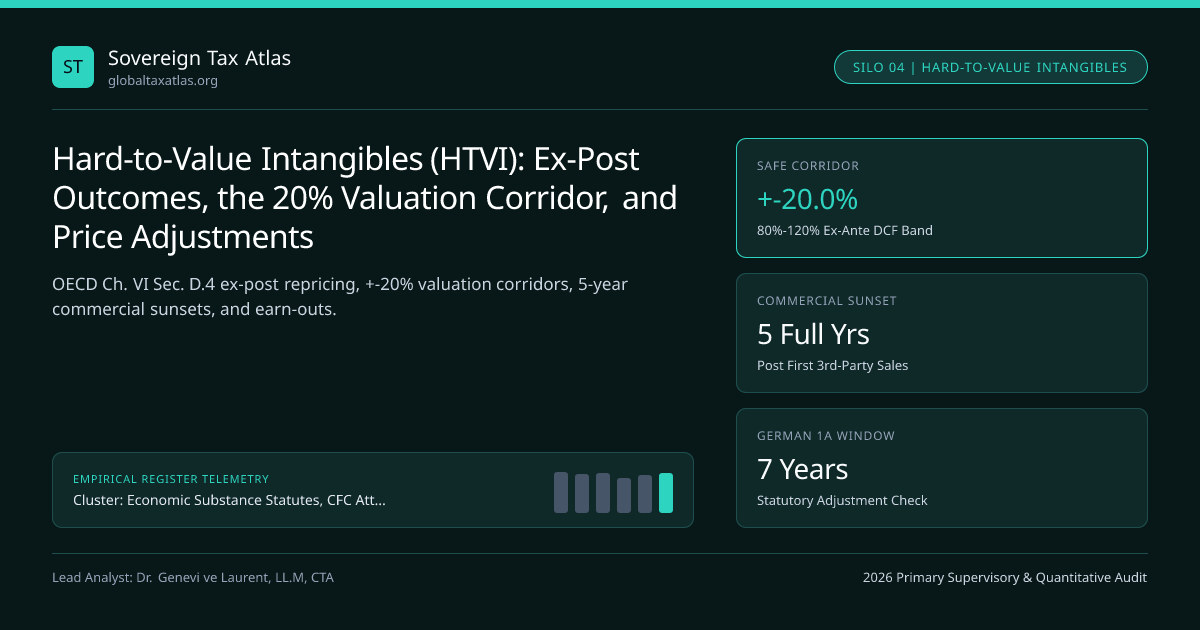
Suppose a US or German biotech or AI startup develops a promising Phase-II drug molecule or early foundation model, commissions a Big Four valuation pegging its discounted cash flow (DCF) value at USD 80 million, sells the IP outright to its 15%-taxed Irish or Swiss IP Hub, and four years later the drug becomes a USD 3 billion/year blockbuster! Historically, taxpayers argued: "Hindsight is forbidden—our ex-ante DCF was reasonable on the transfer date!" Under BEPS Action 8 / OECD Chapter VI Section D.4 — Hard-to-Value Intangibles (HTVI) (mirroring the US IRC Section 482 "Commensurate With Income" [CWI] rule!), tax authorities now use ex-post actual profits as presumptive evidence that the ex-ante USD 80M price was too low—anchored in our Economic Substance, CFC, and Transfer Pricing DEMPE guide across the Economic Substance Statutes, CFC Attribution & Transfer Pricing DEMPE cluster.
Three Defining Hallmarks of a Hard-to-Value Intangible (OECD Para 6.189)#
An intangible (or rights in an intangible) transferred between associated enterprises is classified as an HTVI when, at the time of transfer, NO reliable comparables exist AND projections of future cash flows/income are highly uncertain, characterized typically by one or more hallmarks:
- The intangible is only partially developed at the time of transfer (e.g., Phase I/II clinical drug, pre-monetization AI algorithm, beta semiconductor architecture);
- The intangible is not expected to be exploited commercially for several years following the transaction; or
- The intangible is integral to developing other future HTVIs or transferred for a lump-sum payment into a Cost Contribution Arrangement (CCA) or Chapter IX IP migration!
Four Statutory Exemptions That Block OECD Ex-Post Hindsight Adjustments (Para 6.193)!#
Tax auditors CANNOT impose an HTVI hindsight adjustment if the taxpayer proves ANY ONE of the four OECD Paragraph 6.193 exemptions:
- Exemption #1 — Reliable Ex-Ante Probability Weighting & Unforeseeable Events: The taxpayer provides full contemporaneous details of ex-ante projections (explicitly modeling both upside blockbuster scenarios AND downside clinical/tech failure probabilities!) AND establishes with reliable evidence that any >20% excess variance was due either to genuinely unforeseeable post-transfer events OR to the natural playing out of probabilistically weighted events that were properly priced ex-ante! (Example: If a Phase-II drug had an industry-verified 25% FDA approval probability* on a USD 400M approved NPV, pricing it at 25% × 400M = USD 100M ex-ante WAS arm's length—its subsequent approval (100% × 400M) is the playing-out of a priced probability, NOT an undervaluation—PROVIDED you documented that 25% decision-tree ex-ante!)*
- Exemption #2 — Covered by a Bilateral or Multilateral APA: Complete immunity!
- Exemption #3 — The ±20.0% Safe-Harbor Corridor: Any variance between ex-post financial outcomes and ex-ante projections does NOT reduce or increase the compensation for the HTVI by more than 20.0%! (Directly mirrors the US 80%–120%* CWI safe harbor under Treas. Reg. §1.482-4(f)(2)(ii)(B)!)*
- Exemption #4 — Five-Year Commercialization Sunset: A commercialization period of five (5) years has passed following the year in which the HTVI first generated unrelated third-party revenues, AND during that 5-year commercialization window actual outcomes stayed within ±20.0% of projections!
Watch Contractual Price-Adjustment Clauses (Germany §1a AStG & EU Practice)!#
Notice what OECD Paragraph 6.192 empowers auditors to do when HTVI triggers: not only hike a lump-sum exit tax, but impute a dynamic milestone payment or sliding-scale running royalty that independent third-party pharma/tech licensors would have insisted upon! Indeed, Germany (§1a Außensteuergesetz — AStG, reformed 2021) codified a statutory 7-to-10-year price-adjustment presumption on cross-border IP transfers unless an explicit contractual price-adjustment / milestone earn-out clause is already built into the intercompany agreement!
Quantitative Probability-Weighted DCF vs Hindsight Repricing Math#
- [Safe Harbor Passes if HTVIVarianceRatio <= 20.0% (i.e. Ex-Post PV sits inside [0.80 * Price, 1.20 * Price])]
- Worked Phase-II Biotech IP Transfer From German Parent to Swiss DEMPE Hub (Discount Rate = 11.0%):
- Flawed Single-Scenario DCF: Uses blended "management base case" = EUR 120,000,000 (omits explicit Phase-III approval tree!).
- Drug wins FDA/EMA approval in Year 3 -> Ex-Post PV at Transfer Date = EUR 380,000,000!
- Variance = (380M - 120M) / 120M = +216.7% (> 20.0%!) -> German §1a AStG auditor assesses EUR 260M adjustment * 30% CIT = EUR 78.0M back tax + interest!
- Audit-Proof Milestone + Tiered Royalty Contract:
- EUR 45M Upfront + EUR 95M Regulatory Approval Milestone + Sliding-Scale 6%–14% Sales Royalty tied to Sales Tiers (<EUR 500M / >EUR 1B)!
- Automatically self-adjusts inside +-20% arm's-length band across every outcome -> EUR 0 HTVI audit adjustment!
Benchmarking HTVI Enforcement Across Major Jurisdictions#
HTVI Structuring & Contract Design Matrix#
M&A integration directors, pharma/AI CFOs, and valuation economists—working across ESMA, DIFC, and tech/quant firms like 0xastra and Abstradex—choose intercompany IP pricing structures specifically to neutralize HTVI exposure:
| IP Transfer Structure | HTVI Hindsight Risk | Cash-Flow / Exit-Tax Profile | Audit Survival Rate | Recommended Use Case |
|---|---|---|---|---|
| Fixed Lump-Sum Sale of Early IP | EXTREME (>20% variance likely!) | Immediate exit tax on seller | Very Low (Unless Bilateral APA!) | Only mature, stable-cash-flow IP |
| Upfront + Clinical/Tech Milestones + Tiered Royalty | Very Low (Self-adjusting!) | Defers tax until actual commercial win! | Very High (Mirrors 3rd-party pharma deals!) | Gold Standard for Phase I–III & AI IP! |
| Decision-Tree Probability-Weighted DCF | Moderate | Upfront tax on expected EV | High if industry attrition rates documented | Mature R&D pipeline transfers |
| Post-M&A IP Drop-Down (<12 mos after Acquisition) | Extreme if < M&A Enterprise Value! | Reconcile strictly to ASC 805 / IFRS 3 PPA + Goodwill! | Fails instantly if IP priced below M&A price minus routine! | Post-buyout IP integration (Ch. IX) |
Frequently asked questions
If our early-stage drug succeeds and beats our forecast by 300%, can we win an HTVI audit using a probability-weighted DCF prepared BEFORE the transfer?
Yes—under OECD Exemption #1 (Para 6.193(i)) and US Treas. Reg. §1.482-4(f)(2)(ii)(C), if your contemporaneous pre-transfer valuation explicitly modeled the upside approval cash flows AND applied objective, verifiable clinical-phase probability weights (e.g., published BIO/FDA Phase-II approval statistics), the binary realization of that priced probability is NOT grounds for hindsight repricing!
Why do post-acquisition startup IP migrations get audited so aggressively in Israel, Germany, Denmark, and the US?
When a multinational pays USD 500 million to acquire a 40-person AI startup and 3 months later transfers the startup IP to an Irish/Swiss hub for "USD 90 million" (allocating USD 410 million to "non-transferable accounting goodwill"!), auditors argue almost 100% of that USD 500M purchase price paid for the startup technology and platform!
Does the HTVI rule work in reverse if a transferred drug FAILS Phase III trials and becomes worth USD 0 after we paid USD 150M exit tax?
Only if you structured the transfer with contingent milestones/royalties rather than a fixed USD 150M lump sum! Under a fixed lump-sum sale, the seller state keeps the exit tax on USD 150M while the buyer merely holds a low-tax capital/amortization loss—which is the #2 reason contingent milestone pricing beats lump-sum sales!
How long is the statutory adjustment window under Germany reformed §1a AStG for Hard-to-Value Intangibles?
Following Germany ATAD Implementation / Abzugsteuerentlastungsmodernisierungsgesetz reform in 2021, Germany shortened its statutory HTVI lookback check from 10 years to 7 years post-agreement when no third-party price-adjustment clause was included—aligning explicitly with OECD Section D.4 exemptions!
Publication record
- Published
- 13 November 2026
- Updated
- 15 November 2026
- Author
- Dr. Geneviève Laurent, LL.M, CTA
- Review
- Review not recorded
- Automated fact check
- Passed in the stored pipeline record
- Source URLs
- 3 recorded
AI assistance recorded: anthropic/claude-opus-4.6. This field does not establish human review or source verification.
Academic & Institutional Attribution
Cite This Research & Embed Live Data Card
Standard academic & institutional research paper citation format.
Dr. Geneviève Laurent, LL.M, CTA. (2026, November 15). Hard-to-Value Intangibles (HTVI): Ex-Post Outcomes, the 20% Valuation Corridor, and Price Adjustments. Sovereign Tax Atlas. https://globaltaxatlas.org/entries/hard-to-value-intangibles-htvi-ex-post-pricing-20-percent-corridorRegulatory Directory Cross-Reference
Referenced Institutions & Regulatory Registries
Top Regulated Institutions in This Coverage Slice
Related Economic Substance Cfc Transfer Pricing & Institutional Briefings
Explore Economic Substance Cfc Transfer Pricing Hub (20) →Economic Substance Cfc Transfer Pricing
Offshore Economic Substance Statutes, CFC Attribution Regimes, and OECD Transfer Pricing DEMPE GuideEconomic Substance Cfc Transfer Pricing
OECD Pillar One Amount B (2025+): Baseline Wholesale Marketing and Distribution Return-on-Sales MatrixEconomic Substance Cfc Transfer Pricing
OECD Transfer Pricing Chapter X: Intragroup Loans, Implicit Halo Support, Cash Pools, and GuaranteesEconomic Substance Cfc Transfer Pricing
Cost Contribution Arrangements (CCAs) and US IRC Section 482 Cost Sharing: Buy-In PCTs and DEMPEEconomic Substance Cfc Transfer Pricing
Transfer Pricing Bilateral APAs and Tax Treaty Article 25 Mandatory Binding ArbitrationEconomic Substance Cfc Transfer Pricing
Labuan IBFC Economic Substance Requirements: FTE Headcount, MYR Opex Gates, and the 3% vs 24% LBATA CliffEconomic Substance Cfc Transfer Pricing
UAE Economic Substance Repeal & Integration Into 0% Qualifying Free Zone Person (QFZP) Corporate Tax AuditsEconomic Substance Cfc Transfer Pricing
BEPS Action 13 Three-Tier Transfer Pricing Documentation: Master File, Local File, and Penalty ProtectionCross Border Fund Spv Tax Neutrality
UK Qualifying Asset Holding Company (QAHC) Regime: Private Equity SPVs, 70% Category A Gate, and BuybacksCross Border Fund Spv Tax Neutrality
US PFIC Rules and IRS Form 8621: Section 1291 Excess Distributions vs QEF and Mark-to-Market ElectionsCross Border Fund Spv Tax Neutrality
Cross-Border Carried Interest Taxation: US IRC Section 1061, UK 32% / 2026 Income Tax Reform, and LuxembourgCross Border Fund Spv Tax Neutrality
US Branch Profits Tax (IRC Section 884): Dividend Equivalent Amounts, Treaties, and Complete Termination
Sovereign Tax Atlas Data, Benchmarks & Contributor Records
CC BY 4.0 Open Data
Open Institutional Datasets (CSV / JSON) →
Download desk-compiled quantitative series & schemas.
2026 Reference Matrix
2026 Institutional Benchmarks & Thresholds →
Statutory capital, clearing, margin & rate conventions.
Editorial Records
Authors & Review Records →
View named contributors where those records are available.
Complete Index
Master Research & Dossier Archive →
Browse all published briefings by topic pillar & date.