
Economic Substance Cfc Transfer Pricing
Transfer Pricing Bilateral APAs and Tax Treaty Article 25 Mandatory Binding Arbitration
When two tax authorities attack opposite sides of a USD 500M transfer pricing royalty or profit split, Bilateral Advance Pricing Agreements (BAPAs) and Tax Treaty Article 25(5) Mandatory Binding Final-Offer Arbitration provide an enforceable shield against 50%+ double taxation.
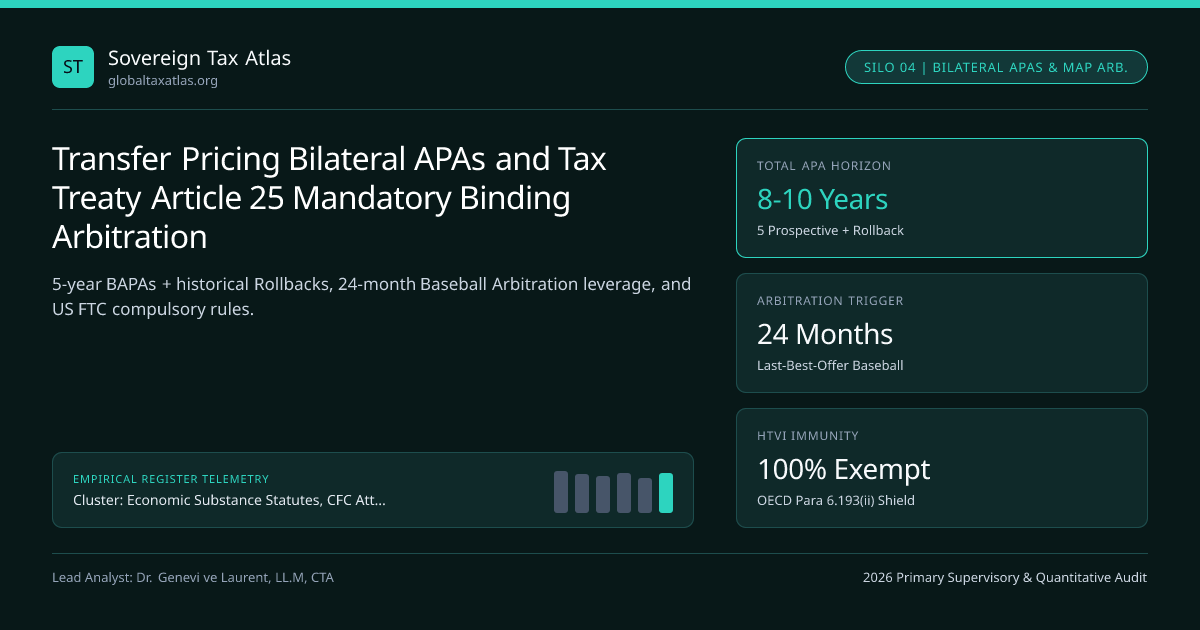
Suppose the US IRS audits a multinational's Chapter VI DEMPE profit split and shifts USD 100 million of profit from Frankfurt to New York (+USD 21.0M US tax + 20%–40% IRC §6662 penalties!), while the German Finanzamt refuses to refund the 30% German tax (USD 30.0M) already paid on that exact same USD 100 million—inflicting a 51.0%+ double-tax disaster! Within our Economic Substance, CFC, and Transfer Pricing DEMPE guide, proactive Bilateral Advance Pricing Agreements (BAPAs) and ex-post Treaty Article 25 Mutual Agreement Procedure (MAP) + Mandatory Binding Arbitration prevent or cure double taxation across the Economic Substance Statutes, CFC Attribution & Transfer Pricing DEMPE cluster.
Unilateral vs Bilateral / Multilateral APAs: Why Unilateral APAs Leave You Half-Naked!#
Compare the two APA formats carefully before paying user fees:
- Unilateral APA (signed solely between the taxpayer and one tax authority—e.g., IRS APMA alone or Dutch/Singapore tax authority alone): Gives certainty in Country A ONLY, provides ZERO binding protection if Country B audits and adjusts the exact same transaction, AND in the European Union triggers mandatory automatic exchange of the Unilateral APA ruling summary under DAC3 (alerting neighboring EU auditors immediately!)!
- Bilateral APA (BAPA) / Multilateral APA (MAPA): Negotiated government-to-government between Competent Authorities under Tax Treaty Article 25 (e.g., IRS Advance Pricing and Mutual Agreement Program [APMA] <-> UK HMRC, Japan NTA, German BZSt, Irish Revenue, Swiss SFI, or IRAS Singapore!):
- Locks in binding certainty across BOTH tax authorities simultaneously for 5 prospective years;
- Routinely includes a 2-to-5-year "Rollback" settling open historical audit years on identical terms with 0% transfer-pricing penalties; AND
- Confers 100% statutory immunity from OECD Hard-to-Value Intangibles (HTVI) hindsight repricing!
How "Last-Best-Offer" ("Baseball") Arbitration Forces Tax Authorities to Settle!#
Historically, Article 25(2) MAP required Competent Authorities merely to "endeavour to resolve" double taxation—allowing stubborn tax authorities to deadlock for 8 years until the exhausted taxpayer gave up! Everything changed with US Bilateral Arbitration Clauses (Germany, Canada, Belgium, France, Switzerland, Spain, Japan), MLI Part VI (Articles 18–26, adopted by 30+ major OECD economies), and the EU Tax Dispute Resolution Mechanisms Directive (2017/1852):
- The 2-Year Clock: If two Competent Authorities fail to reach a MAP settlement within 24 months (3 years in select EU Directive cases), the taxpayer has the unilateral right to compel Mandatory Binding Arbitration before an independent 3-member panel!
- Why "Baseball / Final-Offer" Arbitration Works Like Magic: Under Baseball Arbitration (the default in all US arbitration treaties and MLI Article 23(1)!), the arbitration panel is FORBIDDEN from "splitting the baby" down the middle! Each Competent Authority submits one single proposed figure, and the panel MUST pick ONE of the two numbers in its entirety (without even issuing a written legal opinion!)! Because any Competent Authority submitting an extreme, greedy number knows it will lose 100%, over 90% of MAP cases in Baseball-Arbitration corridors settle consensually BEFORE the panel ever votes!
Quantitative Cash-Flow & Penalty ROI of a Bilateral APA With 4-Year Rollback#
- [ProbAuditDoubleTax * DisputedIncome9Yrs * UnrelievedDoubleTax%]
- + SavedIRC6662Penalties(20%Substantial/40%GrossValuationMisstatement!)
- + SavedNonDeductibleAuditDeficiency_Interest
- (APAUserFee[~$113,500–$121,600IRSStd] + EconomicAdvisoryCost[~$250k–$450k])
- Worked USD 75M/Yr US–Japan Automotive / Semiconductor Two-Sided Profit Split Over 9 Years (4 Open Audit Rollback Years + 5 Prospective BAPA Years = USD 675M Base):
- Without BAPA (Contentious Audit): IRS proposes USD 120M 4-yr adjustment (+USD 25.2M CIT + 20% §6662(e) Penalty = USD 5.04M + 8% IRS Interest); NTA resists full correlative relief -> ~USD 11.5M permanent double tax + USD 5.04M non-creditable penalty + USD 1.8M litigation fees = USD 18.34M Cost!
- With US–Japan Bilateral APA (+ 4-Yr Rollback):
- Agreed Profit-Split Corridor across all 9 years -> USD 0 Double Tax (100% correlative adjustment between IRS & NTA)!
- USD 0 Penalties across all 9 years! Total BAPA All-In Filing & Advisory Cost (~USD 480k) = >38x Return on Investment!
Watch IRS APMA's 2023+ Gatekeeping Guidance & Protective MAP Deadlines!#
Two tactical warnings for corporate tax directors in 2026:
- IRS APMA Selectivity Review (April 2023 Interim Guidance): IRS APMA instructs exam/APMA teams at the pre-filing stage to evaluate whether a proposed APA isactually the most efficient compliance workstream (vs ICAP — OECD International Compliance Assurance Programme for low-risk cooperative groups, or joint audits!), scrutinizing early-stage unilateral IP shifts while welcoming complex bilateral profit splits and distribution corridors!
- Never Blow the 3-Year Article 25(1) MAP Statute of Limitations—Or Sign a Domestic Audit Closing Waiver That Kills MAP!: In many countries (like Italy accertamento con adesione, Mexico, or Spain settlements!), signing a domestic audit penalty-reduction settlement legally waives your right to access Article 25 MAP in the other country—causing your home country to deny Foreign Tax Credits for the settled foreign tax as a "non-compulsory payment" (US Treas. Reg. §1.901-2(e)(5)!)! ALWAYS file a Protective MAP Request BEFORE settling locally!
APA & MAP Corridor Comparison Matrix#
Multinational heads of controversy—coordinating across ESMA, HK FDRC, and global financial institutions like 360 Capital and Axiory—assess exact treaty arbitration availability before sizing reserves under ASC 740 / FIN 48 (IFRIC 23):
| Bilateral Treaty Corridor | BAPA Track Record | Mandatory Binding Arbitration? | Arbitration Format | FIN 48 / IFRIC 23 Reserve Impact |
|---|---|---|---|---|
| US <-> Japan / UK / Canada / Germany / CH | Gold Standard (Hundreds closed) | YES (24 Mos) | Baseball ("Last-Best-Offer") | Strong justification for zero/minimal double-tax reserve |
| Intra-EU 27 (e.g., DE <-> IT / FR <-> ES) | Strong (EU JTPF rules) | YES (Dir. 2017/1852) | Independent Opinion (or Baseball) | Mandatory enforceable timeline across all 27 EU states |
| UK / SG / AU <-> MLI Part VI Partners | Very Strong | YES (MLI Part VI) | Default Baseball (unless reserved) | Rapid settlement leverage prior to 2-year mark |
| US / UK <-> India (CBDT Renewed Track!) | Reopened & Active (100+ signed!) | NO (India opted out of Arb!) | Negotiated CA compromise only | Longer timeline (36–48m), but high US–India APA success! |
| US / EU <-> China (STA) | Selective (Priority queue!) | NO | Negotiated CA compromise | Prepare robust location-specific advantages (LSA) data |
Frequently asked questions
Why does signing a fast local audit settlement in Italy, Mexico, or India to get a 50% penalty discount often cost a US multinational MORE money overall?
Because under US Foreign Tax Credit regulations (Treas. Reg. §1.901-2(e)(5)), a foreign transfer-pricing tax assessment is NOT a creditable "compulsory payment" unless the taxpayer exhausts effective and practical remedies—including Treaty Article 25 MAP! Waiving MAP locally forfeits both correlative US income reduction AND US Foreign Tax Credits!
What is a "Critical Assumption" inside a Bilateral APA and what happens if a pandemic or tariff shock breaches it?
Every APA contains "Critical Assumptions"—objective business/economic boundaries (such as tariff spikes, catastrophic FX collapses, or business divestitures) beyond which the agreed margin would become distorted. If breached, the APA is NOT penalized retroactively; the Competent Authorities revise or cancel the APA prospectively for the affected year!
How does the OECD International Compliance Assurance Programme (ICAP) differ from a Bilateral APA?
ICAP is a fast (6–12 month), multilateral cooperative risk-assessment process where 5–8 tax authorities jointly review a group CbCR and TP files and issue "Low-Risk Comfort Letters" (zero filing fee!). While non-binding legally (unlike a BAPA), an ICAP Low-Risk letter signals local audit teams not to open routine transfer-pricing examinations!
What is an "Annual APA Report" and how strict is compliance once a BAPA is signed?
For each covered APA year, the taxpayer files an Annual Report proving actual margins stayed inside the agreed interquartile/point range (or booking an APA Primary/Compensating Year-End True-Up Adjustment to hit the exact range without withholding tax or secondary-dividend penalties under IRS Rev. Proc. 99-32 / APA terms!).
Publication record
- Published
- 13 November 2026
- Updated
- 14 November 2026
- Author
- Dr. Geneviève Laurent, LL.M, CTA
- Review
- Review not recorded
- Automated fact check
- Passed in the stored pipeline record
- Source URLs
- 3 recorded
AI assistance recorded: anthropic/claude-opus-4.6. This field does not establish human review or source verification.
Academic & Institutional Attribution
Cite This Research & Embed Live Data Card
Standard academic & institutional research paper citation format.
Dr. Geneviève Laurent, LL.M, CTA. (2026, November 14). Transfer Pricing Bilateral APAs and Tax Treaty Article 25 Mandatory Binding Arbitration. Sovereign Tax Atlas. https://globaltaxatlas.org/entries/bilateral-advance-pricing-agreements-apa-article-25-map-arbitrationRegulatory Directory Cross-Reference
Referenced Institutions & Regulatory Registries
Top Regulated Institutions in This Coverage Slice
Related Economic Substance Cfc Transfer Pricing & Institutional Briefings
Explore Economic Substance Cfc Transfer Pricing Hub (20) →Economic Substance Cfc Transfer Pricing
Offshore Economic Substance Statutes, CFC Attribution Regimes, and OECD Transfer Pricing DEMPE GuideEconomic Substance Cfc Transfer Pricing
Labuan IBFC Economic Substance Requirements: FTE Headcount, MYR Opex Gates, and the 3% vs 24% LBATA CliffEconomic Substance Cfc Transfer Pricing
UAE Economic Substance Repeal & Integration Into 0% Qualifying Free Zone Person (QFZP) Corporate Tax AuditsEconomic Substance Cfc Transfer Pricing
BEPS Action 13 Three-Tier Transfer Pricing Documentation: Master File, Local File, and Penalty ProtectionEconomic Substance Cfc Transfer Pricing
Low Value-Adding Intra-Group Services (LVAS): OECD 5% Markup Safe Harbor, US SCM, and Benefit TestsEconomic Substance Cfc Transfer Pricing
OECD Transfer Pricing Chapter IX Business Restructurings: Principal Conversions and IP Exit TaxesEconomic Substance Cfc Transfer Pricing
Cayman Islands Economic Substance Act: Nine Relevant Activities, CIGA Outsourcing, and Pure Equity HoldCosEconomic Substance Cfc Transfer Pricing
BVI Economic Substance Act and ITA Rules: Financial Periods, BOSSs Filings, and EU Blacklist RulesCross Border Fund Spv Tax Neutrality
Jersey Private Funds (JPFs), Guernsey PIFs, JPUTs, and UK NRCGT Schedule 5AAA Transparency ElectionsCross Border Fund Spv Tax Neutrality
Subscription Credit Lines and NAV Facilities: Withholding Tax, UBTI Bridges, and EU ATAD 2 Anti-Hybrid RulesCross Border Fund Spv Tax Neutrality
GP-Led Continuation Funds and LP Secondaries: IRC Section 1446(f) 10% Gross Withholding and RolloversCross Border Fund Spv Tax Neutrality
Sovereign Wealth Fund Parallel and Co-Investment SPVs: Shielding IRC Section 892 Against Commercial Taint
Sovereign Tax Atlas Data, Benchmarks & Contributor Records
CC BY 4.0 Open Data
Open Institutional Datasets (CSV / JSON) →
Download desk-compiled quantitative series & schemas.
2026 Reference Matrix
2026 Institutional Benchmarks & Thresholds →
Statutory capital, clearing, margin & rate conventions.
Editorial Records
Authors & Review Records →
View named contributors where those records are available.
Complete Index
Master Research & Dossier Archive →
Browse all published briefings by topic pillar & date.