
Economic Substance Cfc Transfer Pricing
Cayman Islands Economic Substance Act: Nine Relevant Activities, CIGA Outsourcing, and Pure Equity HoldCos
Enforced by the Cayman Tax Information Authority across Exempted Companies, LLCs, and partnerships, the Cayman Economic Substance Act tests nine Relevant Activities while carving out Investment Funds and Foreign Tax Residents.
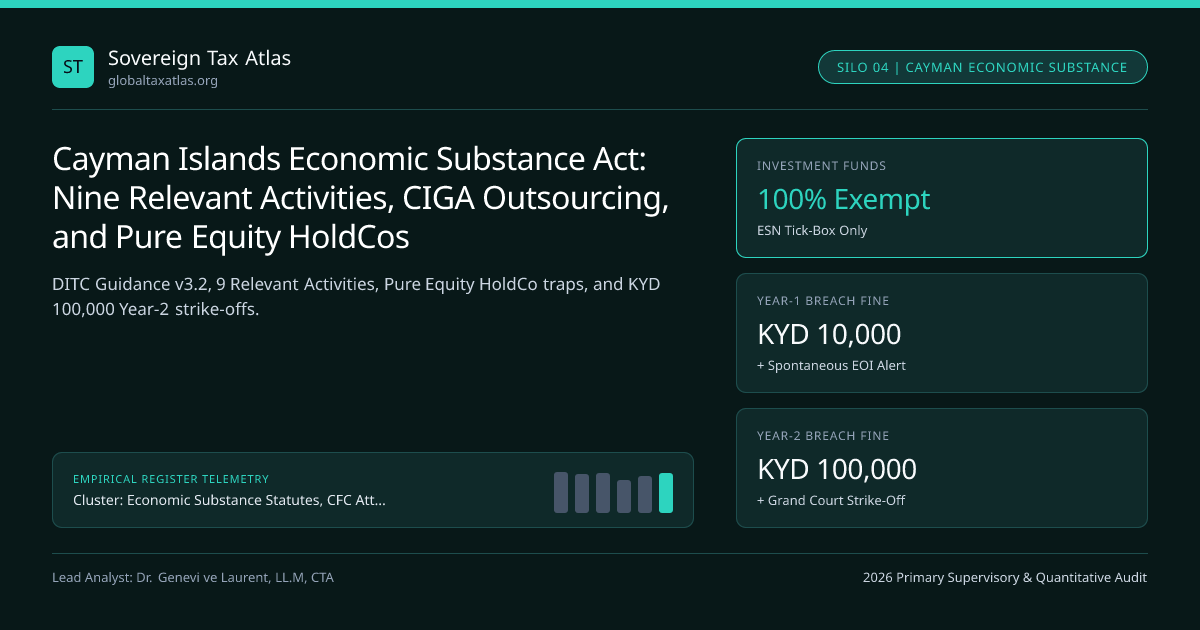
Enacted in response to the OECD Forum on Harmful Tax Practices (FHTP) and EU Code of Conduct Group, the Cayman Islands International Tax Co-operation (Economic Substance) Act (expanded in 2021 to cover Exempted Limited Partnerships and Foreign Limited Partnerships alongside Exempted Companies and LLCs!) is enforced by the Tax Information Authority (TIA / DITC) alongside CIMA. Within our Economic Substance, CFC, and Transfer Pricing DEMPE guide, every Cayman entity—especially High-Risk Offshore IP companies—files an annual Economic Substance Notification (ESN) prior to its General Registry Annual Return—and faces substantive Economic Substance Returns (ESR) within 12 months of fiscal year-end across the Economic Substance Statutes, CFC Attribution & Transfer Pricing DEMPE cluster.
Who Is a "Relevant Entity" vs Carved Out in Cayman?#
Before testing business activities, screen whether the Cayman vehicle qualifies for one of three statutory entity carve-outs:
- Investment Funds (Complete Statutory Carve-Out!): Any entity through which an Investment Fund (including CIMA-registered Mutual Funds, Private Funds, and Master/Feeder funds directly or indirectly investing!) operates is NOT a Relevant Entity! (Warning: CIMA-licensed Discretionary Fund Managers* incorporated in Cayman ARE Relevant Entities conducting Fund Management Business!)*
- Entities Tax Resident Outside the Cayman Islands: Any Cayman company or partnership that proves via official tax certificates/assessments/returns that it is tax-resident in another jurisdiction (e.g., UK centrally managed & controlled, US Check-the-Box disregarded into a US taxpayer? NO! Wait—read TIA Guidance v3.2 carefully: being disregarded into a US parent does NOT make the Cayman entity itself tax-resident in the US unless its income is subject to corporate tax directly as a resident entity; whereas electing corporate status / UK central management & control DOES qualify—and triggers automatic spontaneous exchange of information to that claimed foreign tax authority!).
- Domestic Cayman Companies: Local businesses operating strictly inside the Cayman Islands.
Nine Relevant Activities & the Three-Prong Full Economic Substance Test#
If a Relevant Entity earns gross income (> USD 0—note: zero-gross-income years reduce operational pressure but active conduct still requires monitoring!) from any of the nine statutory Relevant Activities (Banking; Distribution & Service Centre; Financing & Leasing; Fund Management; Headquarters; Holding Company; Insurance; Intellectual Property; Shipping), every activity except Pure Equity Holding must pass the Full Three-Prong ES Test:
- Core Income-Generating Activities (CIGA) Conducted IN Cayman: The statutory heart of the activity (e.g., for Financing & Leasing: agreeing funding terms, setting loan rates/duration, monitoring/revising credit agreements, and managing credit/FX risks!) must physically take place in the Cayman Islands! (Permitted Outsourcing Rule: Non-IP CIGA may be outsourced to a Cayman Islands Corporate Service Provider ONLY if the entity actively supervises and controls the Cayman provider AND the provider's staff/hours are NOT double-counted across multiple clients!)
- Directed and Managed in an Appropriate Manner IN Cayman: Strategic board meetings held physically in Cayman at adequate frequencies with a quorum of directors physically present in Cayman, knowledgeable directors (not rubber-stamp nominees!), and board minutes kept in Cayman!
- Adequate Expenditure, Physical Presence, and Full-Time Qualified Employees IN Cayman: Commensurate with the level of Relevant Income earned!
The #1 Cayman Trap: Contaminating a "Pure Equity Holding Company"!#
Thousands of M&A holding SPVs rely on Cayman's Reduced Economic Substance Test for Pure Equity Holding Companies—satisfied easily by complying with Companies Act filings and maintaining adequate registered-office human/premises resources in Cayman (zero physical Cayman board meetings required!).
- How Deal Teams Accidentally Destroy Reduced Status: A Cayman HoldCo raises USD 50 million of equity, puts USD 48 million into subsidiary shares, and lends USD 2 million to its subsidiary at 6% interest (or parks USD 2 million in an interest-bearing corporate bond portfolio)! BOOM: Earning interest on an intercompany loan is Financing and Leasing Business, instantly stripping "Pure Equity" status and triggering the Full Three-Prong Cayman CIGA Test! (Fix: Advance intercompany funding strictly via 0.0% interest-free demand loans* [check transfer pricing in borrower state!] or redeemable preference shares!)*
Quantitative Cost Comparison: Pure Equity HoldCo vs Full Financing CIGA vs Breach Penalty#
- CaymanTwoYearNonComplianceCost = KYD10,000(Yr1) + KYD100,000(Yr2) + SpontaneousEOIToParentIRSHMRC + GrandCourtStrike_Off!
- Worked Cayman Mezzanine Debt SPV vs Cayman Pure Equity HoldCo + Luxembourg/UK Debt Sibling (USD 80M Capital Deployment):
- Flawed Design (Single Cayman SPV holds 60% Equity + Lends USD 30M @ 9% = USD 2.70M Financing Income; 0 Cayman Employees):
- Triggers Financing & Leasing CIGA -> Fails DITC ESR Audit!
- Year 1 Fine = KYD 10,000 (~USD 12,195) + TIA sends Spontaneous EOI Notice to Parent Tax Authority -> Triggers Parent CFC Audit!
- Year 2 Unremediated Fine = KYD 100,000 (~USD 121,951) + Registrar petitions Grand Court to wind up/strike off SPV!
- Clean Segregated Design:
- Cayman HoldCo holds ONLY common & preferred equity -> Passes Reduced ES Test (~USD 3,500/yr registered agent fee; 0 breach risk!).
- Interest-bearing loan held directly by Exempt Cayman Master Fund LP (Investment Fund Carve-Out = Exempt from ES Act!).
Benchmarking Cayman Activities by Substance Intensity#
Cayman Economic Substance Classification Matrix#
Corporate directors, registered agents, and fund administrators—coordinating with CIMA, BVI ITA rules, and offshore institutions like Island Prime 54 Limited and 70Trades—classify every Cayman entity before January 31:
| Cayman Entity Profile | Relevant Entity? | Relevant Activity | Substance Standard | DITC Portal Filing |
|---|---|---|---|---|
| CIMA Private / Mutual Fund & Master LP | NO (Exempt Fund) | None | 0 ES Requirements | Annual Registry ESN only |
| Cayman Pure Equity HoldCo (Equity Only) | Yes | Holding Company | Reduced ES Test | ESN + Simplified HoldCo ESR |
| Cayman HoldCo Lending at 8% to OpCo | Yes | Financing & Leasing! | Full 3-Prong Cayman CIGA | ESN + Full Detailed ESR |
| CIMA Licensed Discretionary Manager | Yes | Fund Management | Full 3-Prong Cayman CIGA | ESN + Full ESR (CIMA cross-check!) |
| Cayman Co Tax-Resident in UK (CMC) | Exempt (Foreign Tax) | Any | Prove UK CIT return / UTR | ESN + Tax Resident Outside Cayman Form (EOI sent!) |
Frequently asked questions
Does a Cayman Islands Investment Advisor providing non-binding recommendations rather than discretionary execution trigger Fund Management Economic Substance?
No! Under the Cayman Economic Substance Act Schedule, "Fund Management Business" covers ONLY discretionary investment management carried out by an entity licensed or registered with CIMA under the Securities Investment Business Act (SIBA)—pure non-discretionary investment advisory falls outside Fund Management CIGA (just check Distribution & Service Centre rules if advising affiliates!).
Can a Pure Equity Holding Company keep cash in an interest-bearing Cayman or US checking account without triggering Financing & Leasing Business?
Yes! DITC Guidance v3.2 explicitly confirms that holding incidental bank deposit accounts for treasury/dividend-receipt purposes (even if the bank pays incidental deposit interest) does NOT constitute Financing & Leasing Business or disqualify Pure Equity Holding status—whereas buying bond portfolios or making intercompany interest loans DOES disqualify it!
If our Cayman LLC checked the box on IRS Form 8832 to be disregarded into its US C-Corp parent, is it exempt as "Tax Resident in the United States"?
Read DITC Guidance v3.2 carefully: if the Cayman LLC is a disregarded entity of a US C-Corporation (where 100% of the Cayman LLC income is reported directly on the US C-Corp federal corporate tax return!), Cayman TIA accepts US corporate tax evidence—whereas being disregarded into a tax-transparent partnership without corporate residency fails!
What happens on the DITC Portal if an entity claims it outsourced CIGA to a Cayman Corporate Service Provider (CSP)?
The DITC Portal sends an automated verification ticket directly to that named Cayman CSP portal account—the CSP must log in and confirm within 30 days that it actually performed those specific CIGA hours and resources!
Publication record
- Published
- 13 November 2026
- Updated
- 14 November 2026
- Author
- Dr. Geneviève Laurent, LL.M, CTA
- Review
- Review not recorded
- Automated fact check
- Passed in the stored pipeline record
- Source URLs
- 3 recorded
AI assistance recorded: anthropic/claude-opus-4.6. This field does not establish human review or source verification.
Academic & Institutional Attribution
Cite This Research & Embed Live Data Card
Standard academic & institutional research paper citation format.
Dr. Geneviève Laurent, LL.M, CTA. (2026, November 14). Cayman Islands Economic Substance Act: Nine Relevant Activities, CIGA Outsourcing, and Pure Equity HoldCos. Sovereign Tax Atlas. https://globaltaxatlas.org/entries/cayman-economic-substance-act-ciga-financing-pure-equity-holdcoRegulatory Directory Cross-Reference
Referenced Institutions & Regulatory Registries
Mentioned Regulated Institutions
Referenced Supervisory Authorities
Related Economic Substance Cfc Transfer Pricing & Institutional Briefings
Explore Economic Substance Cfc Transfer Pricing Hub (20) →Economic Substance Cfc Transfer Pricing
Offshore Economic Substance Statutes, CFC Attribution Regimes, and OECD Transfer Pricing DEMPE GuideEconomic Substance Cfc Transfer Pricing
BVI Economic Substance Act and ITA Rules: Financial Periods, BOSSs Filings, and EU Blacklist RulesEconomic Substance Cfc Transfer Pricing
Jersey, Guernsey, and Bermuda Economic Substance: Physical Island Board Quorums and Corporate Tax ReturnsEconomic Substance Cfc Transfer Pricing
High-Risk IP in Offshore Economic Substance: Rebuttable Presumptions and Spontaneous Tax ExchangeEconomic Substance Cfc Transfer Pricing
US Subpart F Income (IRC Sections 951–964): FPHCI Rules, Look-Through, and the 18.9% High-Tax ExceptionEconomic Substance Cfc Transfer Pricing
US GILTI / Net CFC Tested Income (IRC Section 951A): 2026 OBBBA Reforms, Section 250, and FTC HaircutsEconomic Substance Cfc Transfer Pricing
EU Anti-Tax Avoidance Directive (ATAD) Articles 7–8 CFC Rules: Model A Passive Categories vs Model B SPFEconomic Substance Cfc Transfer Pricing
UK TIOPA 2010 Part 9A CFC Regime: Chapter 3 Gateways, 75% Tax Exemption, and Chapter 9 Finance Company RulesCross Border Fund Spv Tax Neutrality
Luxembourg SCSp and RAIF Structuring: 0.01% Subscription Tax and ATAD 2 Reverse-Hybrid RulesCross Border Fund Spv Tax Neutrality
Irish ICAV QIAIFs and Section 110 SPVs: Profit-Participating Notes, 15% US ETF Treaty WHT, and Anti-HybridsCross Border Fund Spv Tax Neutrality
IRS Form 8832 Check-the-Box Elections: Foreign Default Rules, Per-Se Corporations, and 75-Day WindowsCross Border Fund Spv Tax Neutrality
US ECI Corporate Blocker SPVs: IRC Section 163(j) 30% EBITDA Leverage, BEAT, and Exit Liquidations
Sovereign Tax Atlas Data, Benchmarks & Contributor Records
CC BY 4.0 Open Data
Open Institutional Datasets (CSV / JSON) →
Download desk-compiled quantitative series & schemas.
2026 Reference Matrix
2026 Institutional Benchmarks & Thresholds →
Statutory capital, clearing, margin & rate conventions.
Editorial Records
Authors & Review Records →
View named contributors where those records are available.
Complete Index
Master Research & Dossier Archive →
Browse all published briefings by topic pillar & date.