
Economic Substance Cfc Transfer Pricing
EU Anti-Tax Avoidance Directive (ATAD) Articles 7–8 CFC Rules: Model A Passive Categories vs Model B SPF
Articles 7 and 8 of the EU Anti-Tax Avoidance Directive mandate a minimum CFC baseline across all 27 Member States—splitting Europe between categorical Model A countries (Germany, France, Netherlands, Ireland) and transfer-pricing Model B countries (Luxembourg).
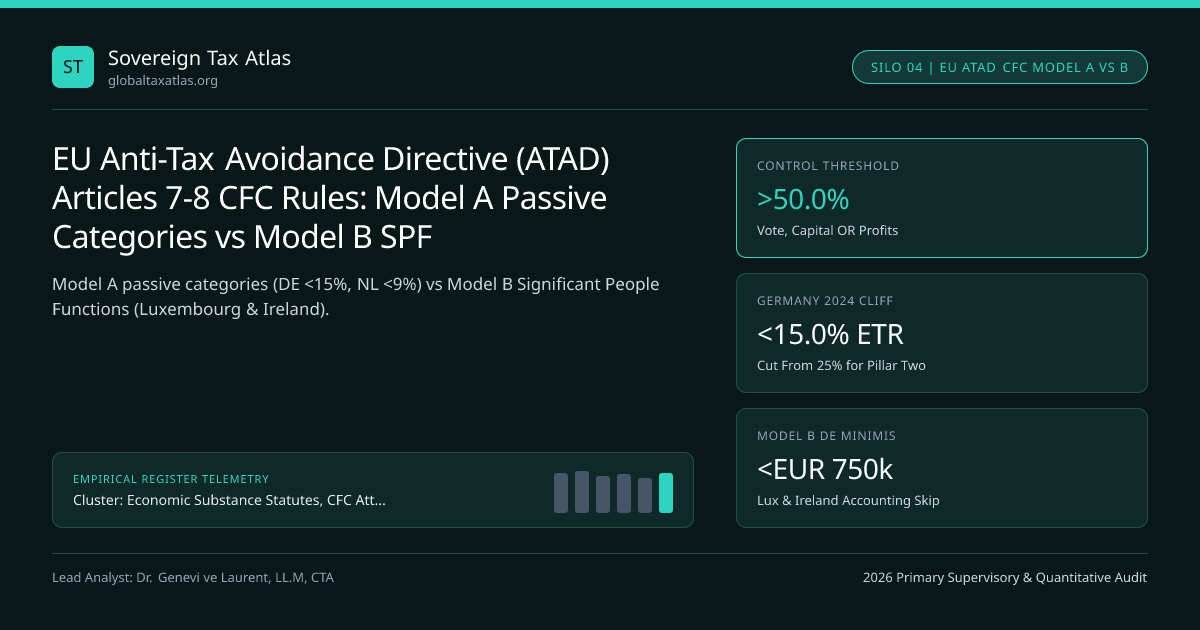
When the European Council adopted the Anti-Tax Avoidance Directive (ATAD — Directive (EU) 2016/1164), Articles 7 and 8 forced traditional territorial exemption hubs like Luxembourg (LU RAIF/SOPARFI), Ireland (IE ICAV/HoldCo), the Netherlands, and Cyprus to enact CFC statutes alongside UK Part 9A CFC gateways! In our Economic Substance, CFC, and Transfer Pricing DEMPE guide, ATAD gave all 27 EU states (ESMA) a choice between "Model A" (Passive Categories) and "Model B" (Significant People Functions)—creating sharp planning splits across the Economic Substance Statutes, CFC Attribution & Transfer Pricing DEMPE cluster.
Universal Two-Prong EU ATAD CFC Gateway (Article 7(1))!#
Before Model A or Model B ever triggers in any EU Member State, BOTH Article 7(1) gateway prongs must be met with respect to a foreign corporate entity or tax-exempt foreign Permanent Establishment:
- Control Prong (>50.0%): The EU corporate taxpayer—by itself or together with its associated enterprises (>=25% link!)—holds a direct or indirect participation of more than 50.0% of voting rights, capital, OR entitlement to receive >50.0% of profits!
- Low-Taxation Prong (<50% of Hypothetical Parent Corporate Tax!): The actual corporate tax paid on its profits by the foreign entity/PE is lower than the difference between (a) the corporate tax that WOULD have been charged on the entity under the EU Parent Member State's corporate tax system and (b) the actual corporate tax paid—which simplifies mathematically to: **Actual Foreign CIT Paid < 50.0% of Hypothetical Parent CIT**!
- Watch the German Reform: While ATAD sets a <50% floor (e.g., <12.5% in a 25% Member State!), ATAD is a MINIMUM standard—Member States can be stricter! Notably, Germany lowered its strict §8 AStG CFC low-tax threshold from <25.0% down to <15.0% starting January 1, 2024 specifically to align German Hinzurechnungsbesteuerung with the 15% OECD Pillar Two minimum tax!
Model A (Categorical + Cadbury Schweppes Carve-Out) vs Model B (Significant People Functions)!#
Why do private equity sponsors and multinationals overwhelmingly prefer Model B jurisdictions (Luxembourg, Ireland, Cyprus, Malta) over Model A jurisdictions (Germany, France, Spain, Italy, Netherlands) for international holding companies?
- Model A — Six Tainted Passive Categories (Article 7(2)(a)): Automatically sweeps in undistributed: (i) interest; (ii) royalties/IP income; (iii) taxable dividends & share gains; (iv) financial leasing; (v) insurance/banking; and (vi) invoicing companies buying/selling with affiliates with little economic value!
- The Substance Escape (Cadbury Schweppes* Test): Model A does NOT* apply if the CFC carries on a substantive economic activity supported by staff, equipment, assets, and premises! HOWEVER, ATAD allows Member States to DENY this substance carve-out to Non-EU/EEA third countries (e.g., Cayman CIMA, BVI BVIFSC, UAE DIFC, Singapore!)—and several Model A states restrict third-country substance escape severely!
- Model B — Transfer Pricing "Significant People Functions" (SPF — Article 7(2)(b)): Adopted by Luxembourg (LIR Art. 164ter) and Ireland (TCA 1997 Part 35B)! Under Model B, even if a Cayman or UAE subsidiary earns 100% passive interest or royalties at 0% tax, the Luxembourg or Irish HoldCo owes ZERO CFC inclusion UNLESS:
- There are non-genuine arrangements put in place for the essential purpose of obtaining a tax advantage; AND
- The assets/risks generating that CFC income are actually controlled by Significant People Functions (SPFs) carried out INSIDE the Luxembourg or Irish Parent Company itself! (And under Article 8(2), even if triggered, inclusion is capped strictly at the arm's-length profit attributable to the Luxembourg/Irish parent's own SPF employees—plus statutory <EUR 750,000 accounting profit* or <10% operating cost de minimis safe harbors!)*
Quantitative Comparison: Holding a 0%-Tax UAE Subsidiary Under German Model A vs Luxembourg Model B#
- [Model B Inclusion Cap = ArmLengthProfitAttributableStrictlyToSignificantPeopleFunctionsInsideParent_Co!]
- Worked EUR 20,000,000 Financing & Licensing Profit in 0%-Taxed Third-Country Subsidiary (Managed Locally by 4 Local Subsidiary Staff; Zero Staff in EU HoldCo):
- 1. Held Under German HoldCo GmbH (Strict Model A — §7–13 AStG; 0% < 15.0% Threshold; Third-Country Substance Escape Restricted on Pure Financing):
- Sweeps 100% of EUR 20,000,000 into German HoldCo CFC base -> Taxed immediately at ~30.0% German CIT + Trade Tax = EUR 6,000,000 current tax!
- 2. Held Under Luxembourg SOPARFI HoldCo (Model B — LIR Art. 164ter; Headline Lux CIT ~24.94% / 23.87%):
- Does Lux SOPARFI perform Significant People Functions managing the subsidiary's loans/IP in Luxembourg? NO (0 loan/IP staff in Lux; managed in Sub)!
- Plus Statutory De Minimis Check -> Result: Luxembourg Model B CFC Inclusion = EUR 0!
Watch the EU Blacklist Override in Luxembourg & Ireland!#
Never get complacent in Luxembourg or Ireland if a subsidiary sits in an EU Annex I Blacklisted Jurisdiction (same blacklist as BVI rules!): following EU Council Defensive Tax Measures against Non-Cooperative Jurisdictions, both Ireland (Finance Act 2020+) and Luxembourg tighten or disapply standard CFC exemptions/de minimis safe harbors when a CFC is resident in an EU Annex I Blacklisted state (such as Panama or USVI)!
EU Member State CFC Structuring Matrix#
European M&A counsel, Luxembourg/Irish administrators (LU RAIF / IE ICAV), and corporate treasurers—alongside regulated market actors like Aftermath Finance and Auro Markets—select parent jurisdictions with ATAD Model A/B asymmetry front of mind:
| EU HoldCo Jurisdiction | ATAD Model Chosen | Low-Tax Trigger Threshold | 3rd-Country Substance Escape? | Ideal Structuring Role |
|---|---|---|---|---|
| Luxembourg (SOPARFI) | Model B (SPF) | <50% of Lux CIT (~<8.5% CIT excl. municipal!) | N/A — Only Lux SPFs taxed! | Premier non-EU / global PE & Credit HoldCo |
| Ireland (HoldCo / QIAIF) | Model B (SPF) | <50% of Irish CIT (<6.25% Trd / <12.5% Non-Trd) | N/A — Only Irish SPFs taxed! (Excl. Annex I!) | Tech R&D, Aviation Leasing & Global HoldCo |
| Netherlands (BV) | Model A+ | Dutch <9.0% Statutory List + EU Annex I | Yes (Staff + EUR 100k salary + Office safe harbor) | Substantive OpCo HQ (>=9% subs completely safe!) |
| Germany (GmbH / AG) | Model A | <15.0% Effective Tax (Cut from 25% in 2024!) | EEA Cadbury yes; 3rd-country severely limited! | Industrial HQ (15% QDMTT subs now clear <15%!) |
| France (CGI Art. 209 B) | Model A / Entity | <40% (Privileged Regime <50% of 25% = <12.5%) | EEA non-artificial; 3rd-country commercial proof | Operating French groups (Watch Art. 209 B presumption!) |
Frequently asked questions
Why does Luxembourg test its "<50% corporate tax" ATAD threshold solely against national corporate income tax (IRC = 16%/17%) excluding municipal business tax?
Under Luxembourg LIR Article 164ter, the hypothetical Luxembourg corporate tax comparison uses State Corporate Income Tax (impot sur le revenu des collectivites — reduced to 16% for 2025, so 50% = 8.0%!), excluding communal municipal business tax (impot commercial communal)—making >=9% taxed subsidiaries automatically safe!
Does a tax-transparent Luxembourg RAIF or SCSp partnership trigger Luxembourg ATAD CFC rules?
No! ATAD Articles 7–8 apply solely to corporate taxpayers subject to corporate income tax; a tax-transparent Luxembourg SCSp (or CIT-exempt RAIF) is not a corporate taxpayer subject to LIR Art. 164ter—CFC rules apply instead (if at all) upward at the corporate LP investor level!
How did Germany 2024 reduction of the CFC threshold from 25% to 15% transform German outbound M&A?
For decades, normal operating or holding subsidiaries in the US (21%), UK (19%/25%), Ireland (12.5% -> 15% QDMTT), Poland (19%), or Switzerland (14%–15% QDMTT) tripped Germany 25% §8 AStG cliff! Lowering the threshold to 15.0% eliminated massive German CFC compliance friction across virtually all Pillar Two jurisdictions!
How does ATAD Article 8 prevent double taxation if CFC profits ARE taxed at the Parent level and later distributed as a cash dividend?
Under ATAD Article 8(5) and (6), when previously taxed CFC profits are subsequently distributed as dividends (or realized as capital gains upon selling the CFC shares), those dividends/gains are deducted from the Parent tax base up to the previously included CFC amount!
Publication record
- Published
- 13 November 2026
- Updated
- 15 November 2026
- Author
- Dr. Geneviève Laurent, LL.M, CTA
- Review
- Review not recorded
- Automated fact check
- Passed in the stored pipeline record
- Source URLs
- 3 recorded
AI assistance recorded: anthropic/claude-opus-4.6. This field does not establish human review or source verification.
Academic & Institutional Attribution
Cite This Research & Embed Live Data Card
Standard academic & institutional research paper citation format.
Dr. Geneviève Laurent, LL.M, CTA. (2026, November 15). EU Anti-Tax Avoidance Directive (ATAD) Articles 7–8 CFC Rules: Model A Passive Categories vs Model B SPF. Sovereign Tax Atlas. https://globaltaxatlas.org/entries/eu-atad-cfc-rules-model-a-passive-income-vs-model-b-spf-testsRegulatory Directory Cross-Reference
Referenced Institutions & Regulatory Registries
Top Regulated Institutions in This Coverage Slice
Related Economic Substance Cfc Transfer Pricing & Institutional Briefings
Explore Economic Substance Cfc Transfer Pricing Hub (20) →Economic Substance Cfc Transfer Pricing
Offshore Economic Substance Statutes, CFC Attribution Regimes, and OECD Transfer Pricing DEMPE GuideEconomic Substance Cfc Transfer Pricing
UK TIOPA 2010 Part 9A CFC Regime: Chapter 3 Gateways, 75% Tax Exemption, and Chapter 9 Finance Company RulesEconomic Substance Cfc Transfer Pricing
OECD Transfer Pricing Guidelines Chapter VI: Intangible DEMPE Functions vs Legal IP OwnershipEconomic Substance Cfc Transfer Pricing
Hard-to-Value Intangibles (HTVI): Ex-Post Outcomes, the 20% Valuation Corridor, and Price AdjustmentsEconomic Substance Cfc Transfer Pricing
OECD Pillar One Amount B (2025+): Baseline Wholesale Marketing and Distribution Return-on-Sales MatrixEconomic Substance Cfc Transfer Pricing
OECD Transfer Pricing Chapter X: Intragroup Loans, Implicit Halo Support, Cash Pools, and GuaranteesEconomic Substance Cfc Transfer Pricing
Cost Contribution Arrangements (CCAs) and US IRC Section 482 Cost Sharing: Buy-In PCTs and DEMPEEconomic Substance Cfc Transfer Pricing
Transfer Pricing Bilateral APAs and Tax Treaty Article 25 Mandatory Binding ArbitrationCross Border Fund Spv Tax Neutrality
US UBTI and IRC Section 514 Acquisition Indebtedness: Offshore Feeder Blockers and Section 514(c)(9)Cross Border Fund Spv Tax Neutrality
Singapore MAS Section 13O and Section 13U Tax Exemptions: VCC Umbrellas and 2025/2026 Tiered SpendingCross Border Fund Spv Tax Neutrality
Hong Kong Unified Fund Exemption (UFE) and HK$240M Family Office FIHV Zero-Tax RegimeCross Border Fund Spv Tax Neutrality
UK Qualifying Asset Holding Company (QAHC) Regime: Private Equity SPVs, 70% Category A Gate, and Buybacks
Sovereign Tax Atlas Data, Benchmarks & Contributor Records
CC BY 4.0 Open Data
Open Institutional Datasets (CSV / JSON) →
Download desk-compiled quantitative series & schemas.
2026 Reference Matrix
2026 Institutional Benchmarks & Thresholds →
Statutory capital, clearing, margin & rate conventions.
Editorial Records
Authors & Review Records →
View named contributors where those records are available.
Complete Index
Master Research & Dossier Archive →
Browse all published briefings by topic pillar & date.