
Economic Substance Cfc Transfer Pricing
OECD Pillar One Amount B (2025+): Baseline Wholesale Marketing and Distribution Return-on-Sales Matrix
Incorporated directly into the Annex to Chapter IV of the OECD Transfer Pricing Guidelines for fiscal years starting January 1, 2025+, Pillar One Amount B replaces costly local distributor benchmarking studies with a 15-cell 1.5%–5.5% Return-on-Sales Pricing Matrix.
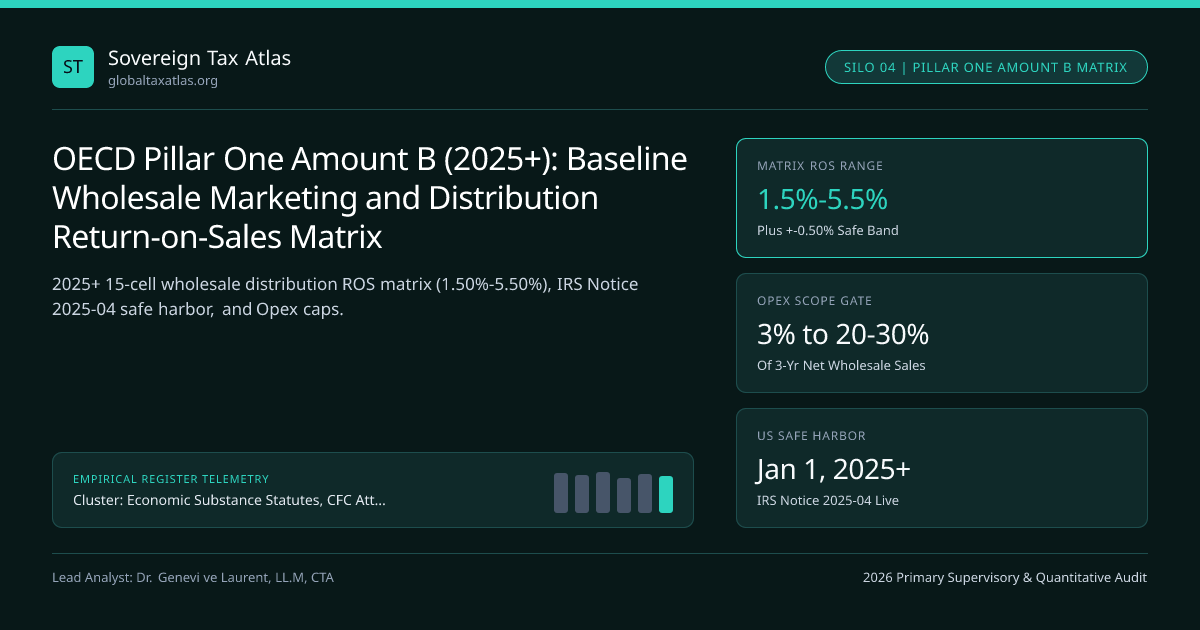
Over 40% of all transfer-pricing audit disputes in emerging and OECD markets historically revolved around a single repetitive fight: "Should our local buy-sell wholesale distribution subsidiary earn a 2.0%, 3.5%, or 5.5% operating margin (Return on Sales — ROS)?" While Pillar One Amount A stalled politically, OECD Pillar One Amount B crossed the finish line—incorporated formally into the Annex to Chapter IV of the OECD Transfer Pricing Guidelines for fiscal years commencing on or after January 1, 2025 (strongly backed by US Treasury & IRS Notice 2025-04 electing Amount B as a US Safe Harbor!)! Anchored in our Economic Substance, CFC, and Transfer Pricing DEMPE guide, every multinational CFO can now price baseline wholesale distributors directly off a 15-cell mechanical Pricing Matrix across the Economic Substance Statutes, CFC Attribution & Transfer Pricing DEMPE cluster.
Scoping Gate: Which Wholesale Distributors Qualify for Amount B?#
Before reading the Pricing Matrix, verify the distributor passes all four Amount B Scoping Criteria:
- Qualifying Transaction: Buy-sell wholesale marketing and distribution of tangible goods (where the distributor buys physical goods from group affiliates for wholesale resale to unrelated customers—or act as a sales agent/commissionaire!). Excluded: Digital goods, SaaS software, services, and physical commodities (oil, metals, agricultural commodities)! (Retail sales allowed ONLY if de minimis <=20.0%* of 3-year weighted net revenue!)*
- No Unique Intangibles or DEMPE Assumption: Distributor must NOT own unique marketing intangibles (see Chapter VI DEMPE) or assume economically significant key risks beyond baseline wholesale inventory/credit!
- Operating Expense (OES) Quantitative Gate (3.0% to 20.0%–30.0% of Net Revenue): The distributor's 3-year weighted ratio of Operating Expenses to Net Revenue must sit at or above 3.0%** (screening out pure pass-through paper flash-title invoicing!) and at or below an upper cap set between 20.0% and 30.0%** by each adopting jurisdiction (screening out high-intensity DEMPE brand-builders!).
- Non-Distribution Activities Segregated: Any manufacturing, R&D, or after-sales repair beyond routine distribution must be cleanly segmented out!
Inside the 15-Cell OECD Amount B Return-on-Sales Matrix!#
Amount B intersects 3 Industry Groupings with 5 Factor Intensity Classifications (A, B, C, D, E) driven by Net Operating Asset Intensity (OAS = Net Working Capital + Fixed Assets / Net Revenue) and Operating Expense Intensity (OES = Opex / Net Revenue):
- Industry Grouping 1 (Perishable foods, grocery, household consumables, construction materials, agricultural supplies): Lowest margins — **1.50% (E) up to 3.50% (A) ROS**!
- Industry Grouping 2 (IT hardware, electronics, apparel, consumer durables, pharmaceuticals [non-medical-device], chemicals, plastics): Mid-tier margins — **1.75% (E) up to 5.00% (A) ROS**!
- Industry Grouping 3 (Medical devices, industrial machinery, tools, automotive vehicles & parts, scientific instruments): Highest margins — **2.25% (E) up to 5.50% (A) ROS**!
- Plus a ±0.50% (±50 bps) Acceptable Range: Any actual transfer-pricing outcome falling within **Matrix Point ± 0.50% is 100% accepted without adjustment (if outside ±0.50%**, adjusted directly to the exact Matrix midpoint!)!
Quantitative Worked Amount B Calculation (Including Operating Expense Cap-and-Collar!)#
- Step2EquivalentReturnOnOpex(EROE) = Step1MatrixTargetEBIT / Operating_Expenses
- [If EROE > Cap(e.g.70%Stdor80%Qualifying) or EROE < Collar_(10%) -> Adjust EBIT so EROE equals exact Cap or Collar!]
- Worked FY 2026 US Electronics Parent Selling IT Hardware Into Wholesale Subsidiary (Industry Grouping 2; Net Sales = USD 100,000,000):
- 3-Year Prior Financials: Avg Net Operating Assets = USD 22,000,000 (OAS = 22.0% -> sits in 15%–29.99% medium asset band!);
- Avg Operating Expenses = USD 12,000,000 (OES = 12.0% -> passes 3%–25% scope gate!) -> Factor Intensity = Class C!
- Matrix Lookup (Industry Group 2, Factor Intensity C): Target Return on Sales = 3.00% (Acceptable Corridor: 2.50% to 3.50% ROS!).
- Preliminary Target EBIT = 3.00% * USD 100,000,000 = USD 3,000,000.
- Step 3 Opex Cross-Check: EROE = USD 3,000,000 / USD 12,000,000 = 25.0% (Sits cleanly inside [10% Collar, 60%–70% Cap] -> Zero guardrail adjustment!).
- Result: Any FY 2026 Distributor EBIT between USD 2.50M and USD 3.50M is 100% Safe-Harbor Compliant under IRS Notice 2025-04!
Watch Asymmetric Adoption: US Safe Harbor vs Non-Adopting Counterparties!#
Read OECD Chapter IV Annex Footnote / Political Commitment Rules carefully before ditching local benchmarking studies globally:
- United States (IRS Notice 2025-04): Elected Amount B broadly for BOTH inbound US distributors of foreign groups AND outbound foreign distributors of US multinationals!
- Asymmetric Counterparty Caution: Amount B is optional for Inclusive Framework jurisdictions (India voiced formal reservations; several EU/APAC states are phasing in or treating it as non-binding unless the distributor is in a Covered Low-Capacity Jurisdiction!). Under OECD rules, if Country A has NOT adopted Amount B, Country A is not legally bound to accept Country B's Amount B matrix adjustment in Article 25 MAP disputes (unless covered by a Low-Capacity Jurisdiction political commitment)—so verify whether the local distributor country adopted Amount B or check that the Matrix Point also sits inside the local TNMM interquartile range!
Amount B Eligibility & Execution Matrix#
Global supply-chain tax directors and regional CFOs—operating across DMCC, ESMA, and international trading firms like Agra Markets and Alamiya Markets—test every wholesale entity against Amount B scope:
| Distribution Entity Profile | Qualifies for Amount B? | Matrix Industry Group | Key Calculation Adjustment | Fallback If Excluded |
|---|---|---|---|---|
| US Inbound IT Hardware Wholesale Sub | YES (IRS Notice 2025-04!) | Group 2 (1.75%–5.00%) | Year-end true-up invoice inside ±0.50% band | Traditional CPM (Treas. Reg. 1.482-5) |
| MedTech Wholesale Sub (18% Retail Clinics) | YES (Retail <=20% cap!) | Group 3 (2.25%–5.50%) | Check EROE cap-and-collar (10%–70%) | Segment retail if >20% |
| Cloud SaaS / Enterprise Software Reseller | NO — Excluded (Digital/Non-Tangible)! | N/A | Digital/software excluded from Amount B! | Traditional TNMM / CPM Local File (Local File) |
| Crude Oil / Copper / Grain Trading Desk | NO — Excluded (Commodities)! | N/A | Commodities carved out completely! | Quoted Price CUP (OECD Ch. II) |
| Luxury Fashion Sub (OES = 36% Brand Spend) | NO — Breaches 20%–30% Opex Cap! | N/A | High OES signals local marketing IP! | Ch. VI DEMPE / Profit Split |
Frequently asked questions
Why are SaaS software resellers and cloud distributors excluded from OECD Pillar One Amount B?
Inclusive Framework negotiators could not reach consensus on whether digital and software distribution value chains mirror physical inventory/logistics working-capital economics; thus Amount B was confined strictly to wholesale distribution of tangible physical goods.
What happens if a distributor sells 55% Industry Group 2 electronics and 45% Industry Group 3 industrial machinery?
Whenever >20% of sales fall in a second Industry Grouping (so no single group represents >=80%!), Amount B requires computing a weighted-average Return on Sales midpoint weighted strictly by the relative sales proportion of each Industry Grouping (55% * Group 2 Rate + 45% * Group 3 Rate)!
How did IRS Notice 2025-04 implement Pillar One Amount B for US taxpayers?
IRS Notice 2025-04 announced forthcoming regulations allowing taxpayers to elect the Simplified and Streamlined Approach (SSA / Amount B) as a binding safe harbor for US tax purposes for taxable years beginning on or after January 1, 2025—covering both inbound US distributors and outbound CFC distributors!
If India or an EU country has NOT adopted Amount B yet, can a US parent still use Amount B for its subsidiary there?
While the US IRS will accept the Amount B election on the US side under Notice 2025-04, a non-adopting foreign tax authority (like India) will still audit the local subsidiary under traditional TNMM comparables—best practice checks whether the Amount B +-0.50% band overlaps the local TNMM interquartile range!
Publication record
- Published
- 13 November 2026
- Updated
- 15 November 2026
- Author
- Dr. Geneviève Laurent, LL.M, CTA
- Review
- Review not recorded
- Automated fact check
- Passed in the stored pipeline record
- Source URLs
- 3 recorded
AI assistance recorded: anthropic/claude-opus-4.6. This field does not establish human review or source verification.
Academic & Institutional Attribution
Cite This Research & Embed Live Data Card
Standard academic & institutional research paper citation format.
Dr. Geneviève Laurent, LL.M, CTA. (2026, November 15). OECD Pillar One Amount B (2025+): Baseline Wholesale Marketing and Distribution Return-on-Sales Matrix. Sovereign Tax Atlas. https://globaltaxatlas.org/entries/oecd-pillar-one-amount-b-baseline-wholesale-distribution-matrixRegulatory Directory Cross-Reference
Referenced Institutions & Regulatory Registries
Top Regulated Institutions in This Coverage Slice
Related Economic Substance Cfc Transfer Pricing & Institutional Briefings
Explore Economic Substance Cfc Transfer Pricing Hub (20) →Economic Substance Cfc Transfer Pricing
Offshore Economic Substance Statutes, CFC Attribution Regimes, and OECD Transfer Pricing DEMPE GuideEconomic Substance Cfc Transfer Pricing
OECD Transfer Pricing Chapter X: Intragroup Loans, Implicit Halo Support, Cash Pools, and GuaranteesEconomic Substance Cfc Transfer Pricing
Cost Contribution Arrangements (CCAs) and US IRC Section 482 Cost Sharing: Buy-In PCTs and DEMPEEconomic Substance Cfc Transfer Pricing
Transfer Pricing Bilateral APAs and Tax Treaty Article 25 Mandatory Binding ArbitrationEconomic Substance Cfc Transfer Pricing
Labuan IBFC Economic Substance Requirements: FTE Headcount, MYR Opex Gates, and the 3% vs 24% LBATA CliffEconomic Substance Cfc Transfer Pricing
UAE Economic Substance Repeal & Integration Into 0% Qualifying Free Zone Person (QFZP) Corporate Tax AuditsEconomic Substance Cfc Transfer Pricing
BEPS Action 13 Three-Tier Transfer Pricing Documentation: Master File, Local File, and Penalty ProtectionEconomic Substance Cfc Transfer Pricing
Low Value-Adding Intra-Group Services (LVAS): OECD 5% Markup Safe Harbor, US SCM, and Benefit TestsCross Border Fund Spv Tax Neutrality
US PFIC Rules and IRS Form 8621: Section 1291 Excess Distributions vs QEF and Mark-to-Market ElectionsCross Border Fund Spv Tax Neutrality
Cross-Border Carried Interest Taxation: US IRC Section 1061, UK 32% / 2026 Income Tax Reform, and LuxembourgCross Border Fund Spv Tax Neutrality
US Branch Profits Tax (IRC Section 884): Dividend Equivalent Amounts, Treaties, and Complete TerminationCross Border Fund Spv Tax Neutrality
Jersey Private Funds (JPFs), Guernsey PIFs, JPUTs, and UK NRCGT Schedule 5AAA Transparency Elections
Sovereign Tax Atlas Data, Benchmarks & Contributor Records
CC BY 4.0 Open Data
Open Institutional Datasets (CSV / JSON) →
Download desk-compiled quantitative series & schemas.
2026 Reference Matrix
2026 Institutional Benchmarks & Thresholds →
Statutory capital, clearing, margin & rate conventions.
Editorial Records
Authors & Review Records →
View named contributors where those records are available.
Complete Index
Master Research & Dossier Archive →
Browse all published briefings by topic pillar & date.