
Economic Substance Cfc Transfer Pricing
High-Risk IP in Offshore Economic Substance: Rebuttable Presumptions and Spontaneous Tax Exchange
Offshore Intellectual Property companies that acquire IP from affiliates or monetize IP via foreign group companies without local R&D face a statutory presumption of failure and automatic spontaneous tax exchange—even when compliant!
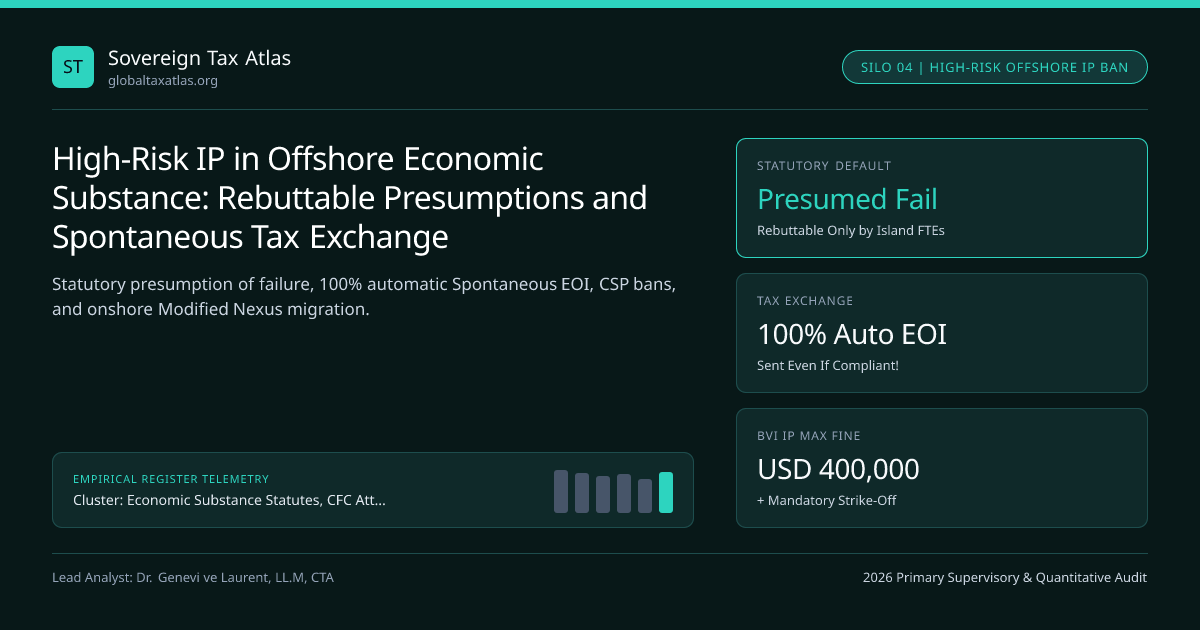
Across every single OECD Forum on Harmful Tax Practices (FHTP) Economic Substance statute—from Cayman and BVI to Jersey, Guernsey, and Bermuda, Bahamas CBB, and UAE historical ES rules—one Relevant Activity is singled out for virtual statutory extinction: High-Risk Intellectual Property (IP) Business. Anchored in our Economic Substance, CFC, and Transfer Pricing DEMPE guide, understanding why High-Risk IP triggers mandatory Spontaneous Exchange of Information EVEN IF YOU PASS explains why every institutional multinational migrated patents and software IP onshore under OECD Chapter IX restructurings across the Economic Substance Statutes, CFC Attribution & Transfer Pricing DEMPE cluster.
Statutory Definition: Two Gateways Into "High-Risk IP" Status!#
Not every offshore company owning a trademark or software copyright is "High-Risk IP" (though Standard IP still requires real local R&D or marketing/branding CIGA!). An offshore entity crosses into High-Risk IP Business the moment it satisfies EITHER Condition A OR Condition B:
- Condition A (Intra-Group Acquisition + Related-Party Licensing): The entity did NOT create the IP in-house through its own local R&D activities, acquired the IP from either a Connected Person (group affiliate) OR in consideration for funding R&D performed by another person outside the offshore jurisdiction, AND licenses or monetizes the IP to one or more Connected Persons! (Classic pre-BEPS "Double Irish / Cayman Cash-Box" structure!)
- Condition B (Zero Local R&D OR Zero Local Exploitation CIGA): The entity does NOT carry on either R&D (for patents/software) or branding/marketing/distribution (for trademarks) inside the offshore jurisdiction!
Three Punitive Rules That Make Offshore Cash-Box IP Impossible!#
Read the three cumulative statutory sanctions imposed on High-Risk IP entities across Cayman, BVI, and the Crown Dependencies:
- 100% Automatic Annual Spontaneous Exchange of Information (Even When Compliant!): Unlike the other eight Relevant Activities (where Spontaneous EOI happens only if the entity breaches ES or claims foreign tax residency!), for a High-Risk IP Entity, the offshore Tax Information Authority AUTOMATICALLY transmits full annual ESR disclosures—revenue, IP asset descriptions, FTEs, business plans, and CIGA details—every single year to the tax authorities of the Immediate Parent, Ultimate Parent, and Ultimate Beneficial Owner, even if the High-Risk IP company successfully rebuts the presumption!
- Statutory Rebuttable Presumption of Non-Compliance: By law, a High-Risk IP company is presumed to have FAILED Economic Substance! Rebutting that presumption requires proving—with detailed multi-year business plans, employee CVs, timesheets, and granular board records (not mere local board sign-offs!)—that a high degree of control over DEMPE functions (strategic R&D direction, budget risk, litigation defense, licensing pricing) is exercised historically and currently by adequately qualified, full-time employees permanently residing and performing their core duties inside the offshore island!
- Total Prohibition on CSP Outsourcing: You cannot hire a Tortola or George Town corporate-service firm to manage High-Risk IP!
Quantitative Tax & Penalty Comparison: Legacy Offshore IP vs Onshore Patent Box / Ireland 15%#
- OffshoreESPenalties(UptoUSD400kBVI/KYD100k_Cayman)
- + AutomaticEOITriggeredDEMPEAudit(100%RoyaltyDeductionDisallowedorReallocatedtoHQat21%to30%_CIT!)
- + ParentSubpartF/ATADCFCInclusion + PillarTwo9%STTR&15%UTPR/IIR!
- Worked USD 60M Annual Software Royalty Pool — Comparing Failed BVI IP Co vs Onshore Ireland / UK Patent Box Migration:
- Legacy BVI IP Co (0 BVI Engineers; Royalties billed to US/German/UK OpCos = USD 60,000,000):
- BVI ITA: Automatic EOI sent to IRS, BZSt & HMRC + USD 50k Yr-1 / USD 400k Yr-2 ES fines + strike-off!
- DEMPE Audit (S[9]) + Pillar Two STTR/IIR: 100% of USD 60M reallocated to HQ (25% CIT = USD 15.0M + 30% TP penalties = USD 4.5M)!
- Migrated Onshore R&D + IP Hub (Ireland 12.5% / 15% QDMTT Knowledge Development Box OR UK 10% Patent Box + 15% QDMTT):
- Co-locates IP legal title with 45 real R&D engineers -> 0% High-Risk IP fines, passes DEMPE & 0% STTR (>=9% nominal!), clean 15% Pillar Two ETR!
Benchmarking IP Holding Regimes After FHTP Nexus Reforms#
Offshore vs Onshore IP Governance Matrix#
Technology CFOs, IP counsel, and corporate restructurers—evaluating hubs across CIMA, BVIFSC, Labuan IBFC, and DMCC, alongside software/protocol teams like Band Protocol and Axie Infinity—audit IP placement strictly against Modified Nexus and DEMPE:
| IP Structure | ES Classification | Automatic EOI Sent? | OECD Action 5 / DEMPE Verdict | Recommended Action |
|---|---|---|---|---|
| BVI / Cayman Co Licensing Group Patents | High-Risk IP! | YES — Every Year! | Fails ES & Fails Ch. VI DEMPE | Execute Ch. IX Onshore IP Migration immediately! |
| Offshore Co Licensing ONLY to 3rd Parties (Own Island Devs) | Standard IP (Patents/SW) | Only if ES failed | Passes only if real island devs live locally | Verify permanent island engineering payroll |
| Cayman Web3 Foundation (Protocol Open-Source) | Check if gross IP license fee > $0! | If High-Risk IP | Pure grant-making non-profit != commercial IP license | Keep token/protocol structure free of affiliate royalties! |
| Onshore UK / Irish / Swiss R&D Co | Onshore Domestic Law | Standard CbCR only | Passes Modified Nexus + DEMPE + 0% STTR (>=9%) | Claim Qualified Refundable R&D Credits (QRTC)! |
Frequently asked questions
Does registering a company logo or brand name in a Cayman Pure Equity Holding Company turn it into a High-Risk IP Entity?
No—provided the Holding Company merely holds its own corporate name/mark incidentally without earning gross income from licensing or exploiting that trademark! Economic Substance IP Business triggers only when the entity earns gross income from Intellectual Property Assets.
What is the OECD BEPS Action 5 "Modified Nexus Ratio" that governs onshore Patent Boxes in the UK, Ireland, Benelux, and Singapore?
Under BEPS Action 5, a company can claim preferential Patent Box rates ONLY on the fraction of IP income equal to [(Qualifying In-House + Unrelated Outsourced R&D Expenditure * 130% Uplift Cap) / Total R&D + IP Acquisition Expenditure]—meaning buying finished patents or outsourcing R&D to foreign affiliates slashes Patent Box benefits!
How do Web3 Cayman Foundation Companies avoid tripping High-Risk IP rules on open-source smart-contract code?
Where software code is released unconditionally under permissive open-source licenses (MIT / Apache 2.0) generating zero royalty/licensing gross income from connected persons, no IP Relevant Income arises—whereas charging intragroup software-license fees to an onshore Labs subsidiary triggers High-Risk IP immediately!
Why are Qualified Refundable Tax Credits (QRTCs) like Ireland 30% R&D Credit better than 0% Patent Boxes under 15% Pillar Two?
Under Pillar Two GloBE Rules, a 0% or 5% Patent Box slashes Covered Taxes (forcing a top-up tax right back to 15%!), whereas a Qualified Refundable Tax Credit (refundable in cash within 4 years, like Ireland 30% R&D credit or UK RDEC!) is booked in the DENOMINATOR as GloBE Income—preserving a much higher ETR!
Publication record
- Published
- 13 November 2026
- Updated
- 14 November 2026
- Author
- Dr. Geneviève Laurent, LL.M, CTA
- Review
- Review not recorded
- Automated fact check
- Passed in the stored pipeline record
- Source URLs
- 3 recorded
AI assistance recorded: anthropic/claude-opus-4.6. This field does not establish human review or source verification.
Academic & Institutional Attribution
Cite This Research & Embed Live Data Card
Standard academic & institutional research paper citation format.
Dr. Geneviève Laurent, LL.M, CTA. (2026, November 14). High-Risk IP in Offshore Economic Substance: Rebuttable Presumptions and Spontaneous Tax Exchange. Sovereign Tax Atlas. https://globaltaxatlas.org/entries/high-risk-ip-offshore-economic-substance-spontaneous-exchangeRegulatory Directory Cross-Reference
Referenced Institutions & Regulatory Registries
Top Regulated Institutions in This Coverage Slice
Related Economic Substance Cfc Transfer Pricing & Institutional Briefings
Explore Economic Substance Cfc Transfer Pricing Hub (20) →Economic Substance Cfc Transfer Pricing
Offshore Economic Substance Statutes, CFC Attribution Regimes, and OECD Transfer Pricing DEMPE GuideEconomic Substance Cfc Transfer Pricing
US Subpart F Income (IRC Sections 951–964): FPHCI Rules, Look-Through, and the 18.9% High-Tax ExceptionEconomic Substance Cfc Transfer Pricing
US GILTI / Net CFC Tested Income (IRC Section 951A): 2026 OBBBA Reforms, Section 250, and FTC HaircutsEconomic Substance Cfc Transfer Pricing
EU Anti-Tax Avoidance Directive (ATAD) Articles 7–8 CFC Rules: Model A Passive Categories vs Model B SPFEconomic Substance Cfc Transfer Pricing
UK TIOPA 2010 Part 9A CFC Regime: Chapter 3 Gateways, 75% Tax Exemption, and Chapter 9 Finance Company RulesEconomic Substance Cfc Transfer Pricing
OECD Transfer Pricing Guidelines Chapter VI: Intangible DEMPE Functions vs Legal IP OwnershipEconomic Substance Cfc Transfer Pricing
Hard-to-Value Intangibles (HTVI): Ex-Post Outcomes, the 20% Valuation Corridor, and Price AdjustmentsEconomic Substance Cfc Transfer Pricing
OECD Pillar One Amount B (2025+): Baseline Wholesale Marketing and Distribution Return-on-Sales MatrixCross Border Fund Spv Tax Neutrality
US ECI Corporate Blocker SPVs: IRC Section 163(j) 30% EBITDA Leverage, BEAT, and Exit LiquidationsCross Border Fund Spv Tax Neutrality
US FIRPTA (IRC Section 897): USRPHCs, QFPF Pensions, and Domestically Controlled REIT RulesCross Border Fund Spv Tax Neutrality
US IRC Section 864(b)(2) Trading Safe Harbor vs Direct Lending Loan Origination ECI RisksCross Border Fund Spv Tax Neutrality
US UBTI and IRC Section 514 Acquisition Indebtedness: Offshore Feeder Blockers and Section 514(c)(9)
Sovereign Tax Atlas Data, Benchmarks & Contributor Records
CC BY 4.0 Open Data
Open Institutional Datasets (CSV / JSON) →
Download desk-compiled quantitative series & schemas.
2026 Reference Matrix
2026 Institutional Benchmarks & Thresholds →
Statutory capital, clearing, margin & rate conventions.
Editorial Records
Authors & Review Records →
View named contributors where those records are available.
Complete Index
Master Research & Dossier Archive →
Browse all published briefings by topic pillar & date.