
Economic Substance Cfc Transfer Pricing
Low Value-Adding Intra-Group Services (LVAS): OECD 5% Markup Safe Harbor, US SCM, and Benefit Tests
Disallowed headquarters "management fees" rank #1 by audit frequency across emerging and European tax offices; applying the OECD Chapter VII 5.0% Low Value-Adding Intra-Group Services (LVAS) simplified approach and stripping Shareholder Activities secures clean deductions.
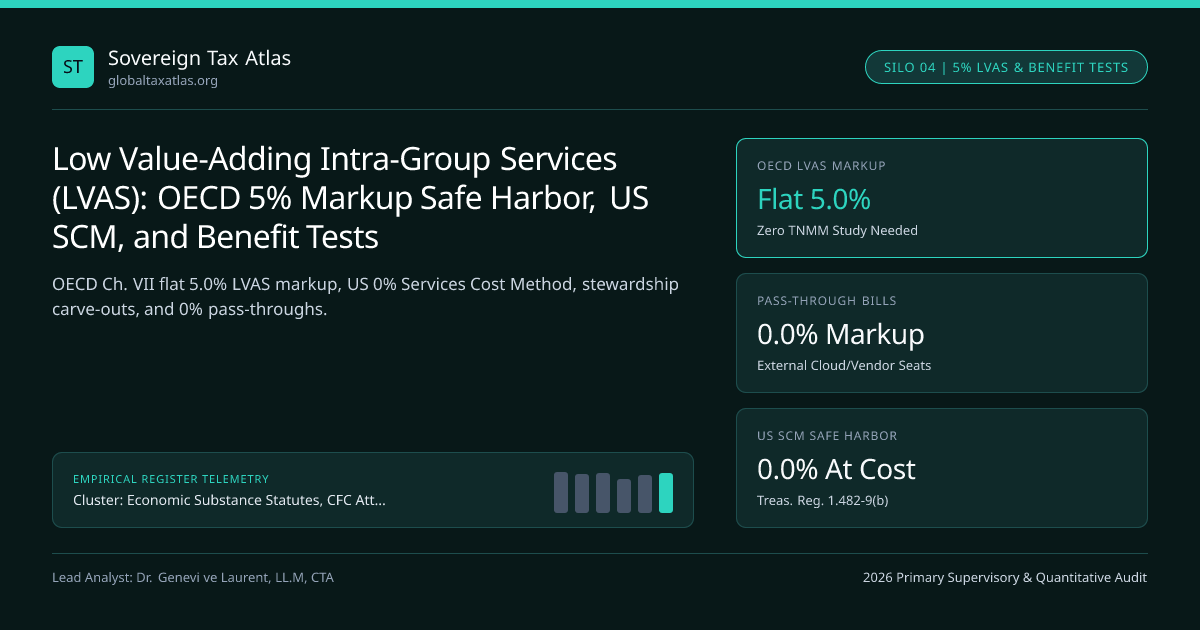
Ask any corporate tax director in Latin America, ASEAN, India, Italy, Poland, or Germany what gets disallowed first in every single routine tax audit: "Headquarters Management & Shared Service Fees"! Auditors routinely disallow 100% of inbound service deductions (AND slap on secondary constructive-dividend withholding taxes of 15%–35%—see Swiss 53.85% gross-up!) whenever a parent company sends a one-line invoice reading "FY 2026 Management Fee: USD 4,500,000"! Within our Economic Substance, CFC, and Transfer Pricing DEMPE guide, OECD Transfer Pricing Guidelines Chapter VII Section D — Low Value-Adding Intra-Group Services (LVAS, flat 5.0% markup) and the US Services Cost Method (SCM, 0.0% markup under Treas. Reg. §1.482-9(b)), paired with strict Shareholder Activity carving, bulletproof routine cross-charges across the Economic Substance Statutes, CFC Attribution & Transfer Pricing DEMPE cluster.
Step 1 — Strip Out Non-Chargeable "Shareholder Activities" & Duplication First!#
Before applying any 0% or 5% markup, OECD Chapter VII Paragraphs 7.6–7.13 require passing the Benefit Test (would an independent enterprise in comparable circumstances have been willing to pay for the activity or performed it in-house for itself?). You MUST strip 100% of the following non-chargeable costs OUT of the shared-service cost pool (retaining them permanently at the Parent HQ!):
- Shareholder / Stewardship Activities (Para 7.10 — NEVER Chargeable!): Costs of the Parent company's own shareholder AGMs, NYSE/LSE stock-exchange listing compliance, Parent Board of Directors salaries, consolidating group IFRS/GAAP financial statements, group-wide SOX 404 / statutory parent audit fees, Pillar Two GloBE / CbCR parent compliance, M&A acquisition fundraising for the Parent's own expansion, and investor relations!
- Duplicative Services (Para 7.11): Charging an operating subsidiary for HQ HR, legal, or marketing oversight when the subsidiary already employs its own full-time local HR Director, General Counsel, and Marketing team performing the exact same function!
- Passive Association / Incidental Benefits (Para 7.12–7.13): Merely carrying the parent's prestige corporate name or group credit rating (see Chapter X Implicit Halo) without receiving active marketing/IP rights!
Which Services Qualify for the Flat 5.0% OECD LVAS Safe Harbor—And Which Are Banned?#
Under OECD Chapter VII Paragraphs 7.45–7.49 (adopted across the EU via JTPF, UK HMRC, Singapore IRAS, Japan, Australia, Switzerland, and dozens of Inclusive Framework states!), a service qualifies as LVAS (eliminating expensive local benchmarking studies completely and replacing subjective Benefit Tests with a simplified category-level benefit demonstration!) ONLY if it is (i) supportive in nature, (ii) NOT part of the core revenue-earning business of the MNE, (iii) neither uses nor creates unique intangibles (DEMPE), and (iv) does not control substantial risk:
- Permitted LVAS Examples: Accounting/AP/AR bookkeeping, payroll processing, HR recruitment/training, IT helpdesk & network cybersecurity operations, internal PR, routine legal/tax return preparation, and general admin/EHS!
- STRICTLY EXCLUDED From LVAS (Require Full Benchmarking!): Core business operations; R&D (Development/Enhancement); Manufacturing & production; Purchasing raw materials; Sales, marketing & distribution; Financial transactions/treasury risk (Ch. X); Extractive exploration; Insurance; and Corporate Senior Executive Strategic Management ("C-Suite Fees")!
Watch Two Technical Precision Rules: Pass-Through Costs (0%!) & US Services Cost Method (0% vs 5%!)#
- Never Add 5% Markup Onto External Pass-Through Vendor Invoices (OECD Para 7.34 & 7.56)!: If Group IT administers a USD 20M Microsoft/AWS enterprise license using USD 2M of internal IT staff, apply the 5.0% markup ONLY to the USD 2.0M internal IT cost (+USD 100k), passing the USD 20.0M external vendor bill through at 0.0% markup!
- US Services Cost Method (SCM = 0.0% Markup) vs Foreign 5.0% LVAS: Under US Treas. Reg. §1.482-9(b), US headquarters can charge over 100 listed routine back-office services ("Specified Covered Services" or services with median comparable markup <=7.0%) at pure Cost (0.0% markup)! Charging Cost + 5.0% LVAS clears both foreign 5% safe harbors and US CPM ranges while staying below the 8.5% markup exclusion in OECD Pillar Two 9% STTR!
Quantitative Shared-Service Pool Scrubbing & Allocation Key Formula#
- [(TotalSSCPool - ShareholderStewardshipCosts - DirectSpecificCharges - ExternalPassThroughBills) * (DriverUnitsj / TotalGroup_Units)] * 1.05
- + DirectSpecificServicej * 1.05 + ExternalPassThroughSoftwareSeatsj * 1.00
- Worked USD 30,000,000 Global HQ Admin & IT Budget Scrubbed for Audit Defense Across 10 Operating Subsidiaries:
- 1. Raw HQ Cost Pool = USD 30,000,000:
- Strip Shareholder/Stewardship Costs (NYSE filing, Group IFRS Audit, Parent Board, M&A diligence) = -USD 6,500,000 (Kept permanently in Parent!).
- Separate External Pass-Through AWS/SAP Seat Licenses = -USD 8,500,000 (Allocated by exact named user logins @ 0.0% markup!).
- Net Internal Value-Added LVAS Cost Pool = USD 15,000,000 (IT Helpdesk USD 9M allocated by 5,000 Laptops; HR/Payroll USD 6M allocated by 5,000 Headcount).
- 2. Subsidiary Alpha (600 Employees & 600 Laptops = 12.0% Allocation Key; Uses USD 1,020,000 AWS/SAP Seats):
- Audit-Proof Annual Invoice = (12.0% * 15,000,000 * 1.05) + (1,020,000 * 1.00) = USD 1,890,000 + USD 1,020,000 = USD 2,910,000!
Allocation Key & Jurisdictional Acceptance Matrix#
Shared-service controllers across DIFC, Labuan IBFC, and Singapore regional HQs, alongside global brokerage groups like 70Trades and Alyra Finance, match each functional cost center to an objective operational allocation key—never lazy "% of group revenue" unless no operational driver exists:
| Shared Service Function | Qualifies for 5% LVAS? | Audit-Approved Allocation Key | Evidence Retained in Benefit Defense Pack | Withholding Tax Risk |
|---|---|---|---|---|
| IT Helpdesk, ERP & Cybersecurity | YES (Cost + 5%) | Active User IDs / Workstations / Tickets | Jira/ServiceNow ticket logs + SOC reports (0% on SaaS seats!) | Low (Art. 7; check UN Art. 12A) |
| HR Recruitment, Training & Payroll | YES (Cost + 5%) | FTE Headcount / Payslips Processed | LMS training completions, offer letters, payroll runs | Low (0% WHT in OECD DTAs) |
| AP / AR / Accounting Shared Center | YES (Cost + 5%) | Invoice / Journal Entry Line Count | Monthly close checklists & AP volume exports | Low (Exempt <=8.5% STTR!) |
| C-Suite Strategic Executive Fees | NO — Excluded! | Executive time-study + specific project KPIs | Board mandates, local turnaround deliverables, travel logs | HIGH (Audit magnet + PE risk!) |
| Parent Audit, NYSE/LSE & M&A | NO — Shareholder Cost! | 0% Charged Out! (Retain 100% at Parent) | Segregated in Parent non-chargeable cost center | Constructive Dividend if billed! |
Frequently asked questions
Did Brazil finally adopt the OECD 5% LVAS rule after decades of rigid fixed-margin formulas?
YES! Under Brazil landmark Law No. 14,596/2023 and Normative Instruction RFB No. 2,161/2023 (mandatory from January 1, 2024+), Brazil replaced its archaic fixed-margin system with full OECD arm-length transfer pricing—explicitly adopting the simplified 5.0% LVAS approach!
Why do auditors reject "% of Subsidiary Sales Revenue" as a sole allocation key for IT and HR shared services?
Because a mature distribution subsidiary generating USD 200M of sales with 20 employees uses FAR fewer IT laptops and HR payroll services than a new subsidiary generating USD 30M of sales with 250 employees! OECD Para 7.25 permits turnover keys only where no more direct operational driver (users, headcount, transactions) can reasonably be measured.
Can C-Suite CEO and CFO salaries be dumped into the 5% LVAS pool?
No! OECD Paragraph 7.47 explicitly excludes "services of corporate senior management" from LVAS (and most CEO/CFO time mixes non-chargeable Parent Stewardship with high-value strategic direction requiring specific time-tracking and full Benefit Test proof!).
What happens if an Indian, Indonesian, or Polish auditor disallows our USD 2M management-fee deduction?
You suffer a TRIPLE hit unless rescued by Article 25 MAP: (1) local 20%–25% corporate tax deduction lost; (2) the Parent STILL paid 21%–25% corporate tax on the USD 2M fee income it booked; AND (3) many source states recharacterize the disallowed payment as a hidden constructive dividend subject to 15%–25% dividend withholding tax!
Publication record
- Published
- 13 November 2026
- Updated
- 14 November 2026
- Author
- Dr. Geneviève Laurent, LL.M, CTA
- Review
- Review not recorded
- Automated fact check
- Passed in the stored pipeline record
- Source URLs
- 3 recorded
AI assistance recorded: anthropic/claude-opus-4.6. This field does not establish human review or source verification.
Academic & Institutional Attribution
Cite This Research & Embed Live Data Card
Standard academic & institutional research paper citation format.
Dr. Geneviève Laurent, LL.M, CTA. (2026, November 14). Low Value-Adding Intra-Group Services (LVAS): OECD 5% Markup Safe Harbor, US SCM, and Benefit Tests. Sovereign Tax Atlas. https://globaltaxatlas.org/entries/low-value-adding-intragroup-services-lvas-5-percent-safe-harborRegulatory Directory Cross-Reference
Referenced Institutions & Regulatory Registries
Top Regulated Institutions in This Coverage Slice
Referenced Supervisory Authorities
Related Economic Substance Cfc Transfer Pricing & Institutional Briefings
Explore Economic Substance Cfc Transfer Pricing Hub (20) →Economic Substance Cfc Transfer Pricing
Offshore Economic Substance Statutes, CFC Attribution Regimes, and OECD Transfer Pricing DEMPE GuideEconomic Substance Cfc Transfer Pricing
OECD Transfer Pricing Chapter IX Business Restructurings: Principal Conversions and IP Exit TaxesEconomic Substance Cfc Transfer Pricing
Cayman Islands Economic Substance Act: Nine Relevant Activities, CIGA Outsourcing, and Pure Equity HoldCosEconomic Substance Cfc Transfer Pricing
BVI Economic Substance Act and ITA Rules: Financial Periods, BOSSs Filings, and EU Blacklist RulesEconomic Substance Cfc Transfer Pricing
Jersey, Guernsey, and Bermuda Economic Substance: Physical Island Board Quorums and Corporate Tax ReturnsEconomic Substance Cfc Transfer Pricing
High-Risk IP in Offshore Economic Substance: Rebuttable Presumptions and Spontaneous Tax ExchangeEconomic Substance Cfc Transfer Pricing
US Subpart F Income (IRC Sections 951–964): FPHCI Rules, Look-Through, and the 18.9% High-Tax ExceptionEconomic Substance Cfc Transfer Pricing
US GILTI / Net CFC Tested Income (IRC Section 951A): 2026 OBBBA Reforms, Section 250, and FTC HaircutsCross Border Fund Spv Tax Neutrality
UAE DIFC and ADGM Qualifying Investment Funds: 0% UAE Corporate Tax and Cabinet Decision No. 34 of 2025Earnings Reports
PodcastOne (NASDAQ:PODC) Reports Record 1H & Q2 Fiscal 2027 Financial Results; 1H Fiscal 2027 Revenue of $31.5M and Adjusted EBITDA* of $2.9M - Yahoo FinanceRegulatory and Market Glossary
EU set to delay 10% tariff on electric cars from UK, FT reports - Euronext Markets: Real-time Stock Market Data | liveTrade Policy
Canada’s ambassador warns Trump tariffs are driving up costs, threatening U.S. investment
Sovereign Tax Atlas Data, Benchmarks & Contributor Records
CC BY 4.0 Open Data
Open Institutional Datasets (CSV / JSON) →
Download desk-compiled quantitative series & schemas.
2026 Reference Matrix
2026 Institutional Benchmarks & Thresholds →
Statutory capital, clearing, margin & rate conventions.
Editorial Records
Authors & Review Records →
View named contributors where those records are available.
Complete Index
Master Research & Dossier Archive →
Browse all published briefings by topic pillar & date.