
Economic Substance Cfc Transfer Pricing
OECD Transfer Pricing Chapter X: Intragroup Loans, Implicit Halo Support, Cash Pools, and Guarantees
Added in 2020 and consolidated in Chapter X of the OECD Transfer Pricing Guidelines, financial-transaction transfer pricing polices debt-vs-equity delineation, subsidiary "implicit group halo" credit ratings, cash-pool synergies, and guarantees.
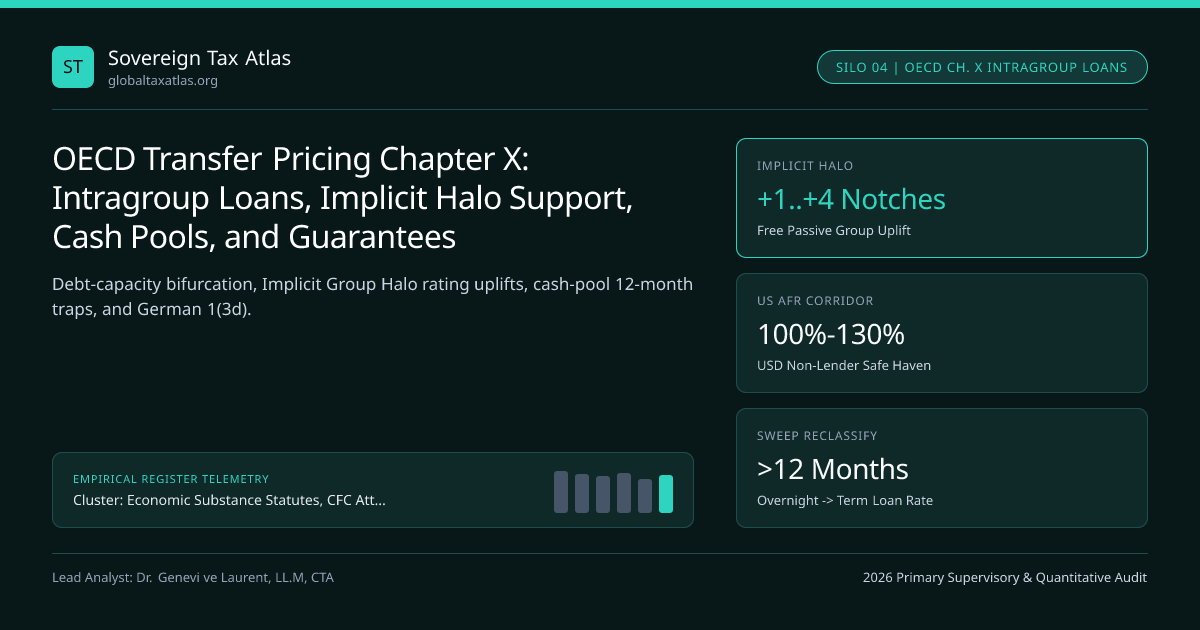
Shareholder loans, leveraged buyout PIK notes, multi-currency cash pools, and parent corporate guarantees represent the fastest way to shift pre-tax operating income across borders—which is why tax authorities weaponized *Chapter X of the OECD Transfer Pricing Guidelines (Transfer Pricing Aspects of Financial Transactions)* alongside domestic interest caps (IRC Sec. 163(j), EU ATAD 30% EBITDA, UK CIR) and Treaty Article 11(6) excess-interest withholding denials! Within our Economic Substance, CFC, and Transfer Pricing DEMPE guide, every treasury loan and cash pool across UK QAHCs, Luxembourg platforms, and US Portfolio Interest Blockers must pass four Chapter X hurdles across the Economic Substance Statutes, CFC Attribution & Transfer Pricing DEMPE cluster.
Hurdle 1 — "Accurate Delineation" Debt Capacity Gate (Section B.1: Is It Really Debt?!):#
Before benchmarking an interest rate (6% vs 9%), Chapter X Paragraphs 10.4–10.12 empower tax auditors to ask a threshold question: Would an unrelated commercial lender have lent USD 300 million to this subsidiary AT ALL—and would an independent borrower acting rationally have borrowed it?
- Audited Factors: Fixed repayment date, unconditional obligation to pay interest (not perpetual discretionary PIK!), seniority vs senior bank covenants, debt-service coverage ratios (DSCR), and realistic cash-flow ability to repay principal!
- Bifurcation Power: If a private-equity Acquisition BidCo can support only USD 180 million of arm's-length third-party debt (4.5x EBITDA) and receives a USD 300 million shareholder loan (7.5x EBITDA), Chapter X recharacterizes the USD 120 million excess slice as non-deductible EQUITY—wiping out 100% of interest deductions on that USD 120M before statutory 30% EBITDA caps even run!
Hurdle 2 — Standalone Rating vs "Implicit Support" Group Halo (Paras 10.76–10.82)!#
Read this carefully—it is the #1 audit adjustment on intragroup loans (and was codified directly into Germany's strict new §1(3d) & §1(3e) AStG in the 2024 Growth Opportunities Act, plus landmark *Australian Chevron* & SingTel and UK BlackRock rulings**!):
- Taxpayer's Aggressive Play: Parent Group has an **A- investment-grade credit rating (borrows externally at 5.10%*). Parent creates a levered US/German/Australian Subsidiary whose standalone* Moody's/S&P RiskCalc score looks like **B- junk (10.80% yield), and lends to that Subsidiary at 10.80%**!
- OECD Chapter X "Implicit Support / Passive Association" Rule: An external bank lending to a strategically core or integrated subsidiary of an A- group knows the Parent would suffer catastrophic reputational/cross-default damage if it let its core subsidiary default—so external banks automatically give that subsidiary a +2 to +4 notch "Implicit Group Halo" uplift (say, from B- up to BBB, reducing arm's-length interest from 10.80% down to **6.20%)! No fee is payable for passive Implicit Support, and the subsidiary's deductible coupon is capped at the halo-adjusted 6.20%!** (Germany's 2024 §1(3d) AStG* presumptively caps group interest at the consolidated group rating!)*
Hurdle 3 & 4 — Cash Pool Synergies & Financial Guarantees!#
- Multi-Currency Physical & Notional Cash Pools (Section C.2): Historically, multinationals set up a low-tax Swiss, Dutch, or Irish Cash Pool Leader paying depositing subsidiaries SOFR - 40 bps (4.10%) while charging borrowing subsidiaries SOFR + 260 bps (7.10%)—pocketing a massive 300 bps banking spread with 1 treasury clerk! Banned under Chapter X (Paras 10.129–10.142) (and Danish/Swiss/German case law ConocoPhillips / Bombardier!): unless the Cash Pool Leader genuinely controls group liquidity/credit risk with substantial capital and staff, it is merely a service coordinator entitled to Cost + 5%–10%, while the interest synergy spread must be shared back across the cash-rich depositors and cash-poor borrowers! (Cash left static on overnight sweep >12 months* is repriced upward as a term loan!)*
- Explicit Corporate Guarantees (Section D): A subsidiary can pay a deductible guarantee fee ONLY for the incremental spread reduction achieved BEYOND Implicit Support! And if a Parent guarantees a bank loan so the Subsidiary can borrow more principal than a standalone bank would ever lend ("expansion of borrowing capacity"), Chapter X recharacterizes that excess guaranteed slice as a loan TO THE PARENT followed by an EQUITY contribution to the Subsidiary (disallowing both guarantee fee and bank interest on the excess slice)!
Quantitative Implicit Halo & Explicit Guarantee Pricing Formula#
- [Crucial: NEVER compute Guarantee Fee from Standalone Junk Rating (10.8%) - Parent Rating (5.1%) = 5.7% — Implicit Halo is FREE!]
- Worked USD 250M Intragroup Term Loan & Bank Guarantee Pricing (Parent = A- [5.10%]; Sub Standalone = B+ [9.40%]; Sub With Implicit Halo = BBB [6.50%]):
- 1. Direct Intragroup Loan From Substantive UK/Lux Treasury Center to Sub:
- Arm's-Length Interest Rate = Implicit-Halo BBB Yield = 6.50% (USD 16,250,000/yr) — NOT 9.40% Standalone (disallows USD 7.25M/yr excess!).
- Warning: If Lender is an unstaffed Cayman/BVI FinCo (0 credit-risk staff), Lender yield capped at Risk-Free 4.30% T-Bill rate!
- 2. External Bank Loan to Sub With Explicit Parent Guarantee (Bank charges 5.30% with Guarantee vs 6.50% unguaranteed BBB Halo):
- Total Interest Benefit of Explicit Guarantee = 6.50% - 5.30% = 1.20% (120 bps = USD 3,000,000/yr).
- Splitting Net Benefit 50/50 (Borrower must be better off after fee!) -> Arm's-Length Guarantee Fee = 60 bps (USD 1,500,000/yr)!
Chapter X Treasury & Financing Compliance Matrix#
US Treasurers also utilize the 100%–130% AFR Safe Haven (Treas. Reg. §1.482-2(a)(2)(iii)) on USD non-lender loans, while foreign borrowers apply Chapter X. Group treasurers alongside JFSC, DIFC, and capital firms like Atm Capital and Bancwesttrade audit five treasury lanes:
| Treasury Transaction | Primary Chapter X Audit Attack | Required Defense Study | Linked Tax Rule |
|---|---|---|---|
| LBO Shareholder Loan / PIK Note | Debt-Capacity Bifurcation + Junk Rating | 3rd-Party Debt Capacity Memo (DSCR + Cash Flow) + Halo S&P/Moody's Model | Art. 11(6) WHT on Excess |
| Intragroup Treasury Center Loan | Unstaffed FinCo = Risk-Free Rate + German §1(3e)! | Local Treasury FTEs controlling duration/FX + Group Rating defense | Cayman/BVI Financing CIGA |
| Zero-Balancing Physical Cash Pool | 300 bps Header Spread + >12m Structural Deposit! | Narrow Header spread (Cost+); convert >12m sweeps to Term Loans! | Withholding tax on cross-sweep! |
| Parent Corporate Guarantee | Charging for free Implicit Halo or Letter of Comfort | Price strictly 0.5 × (HaloRate - GuaranteedRate) | Check WHT on guarantee fees (STTR)! |
| Captive Insurance Subsidiary | Non-genuine risk diversification (Ch. X Sec. E) | Actuarial pooling across multiple operating subs + real underwriting CIGA | Bermuda/Guernsey Captive ES |
Frequently asked questions
What is the US "Applicable Federal Rate (AFR) Safe Haven" under Treas. Reg. §1.482-2(a)(2)(iii) and when can we use it?
For intercompany loans denominated in US Dollars where the lender is NOT regularly engaged in the business of making loans, the IRS accepts any interest rate between 100% and 130% of the monthly IRS Applicable Federal Rate (Short-Term <=3 yrs, Mid-Term 3–9 yrs, Long-Term >9 yrs) as arm-length on the US side—though you MUST still check OECD Chapter X in the foreign counterparty country!
Why did the UK Court of Appeal disallow USD 4 billion of intragroup loan interest in HMRC v BlackRock HoldCo 5 LLC (2024)?
In BlackRock (2024), a UK LLC was inserted into a US acquisition structure solely to carry USD 4B of intragroup debt generating UK group-relief tax deductions; while transfer-pricing covenants could marginally adjust terms, the Court of Appeal disallowed 100% of the deductions under the UK "Unallowable Purpose" rule (CTA 2009 s.441) because the UK entity had zero commercial purpose other than tax savings!
How do tax auditors spot a "structural long-term loan" disguised inside an overnight cash pool?
Auditors plot daily cash-pool balances over 24–36 months! If a profitable German or French subsidiary maintains a continuous minimum EUR 80M positive deposit earning 3.2% overnight rates for 3 straight years while the Dutch Cash Pool Header invests long-term, auditors reprice that EUR 80M core balance at a 5.0% 3-year note yield!
Does issuing a non-binding Parent "Letter of Comfort" or "Keepwell Agreement" justify charging a deductible guarantee fee?
No! OECD Chapter X Paragraph 10.163 explicitly states that letters of comfort or keepwell statements that do NOT create a legally enforceable obligation to pay upon default merely reflect passive group association (Implicit Support)—generating zero deductible guarantee fee!
Publication record
- Published
- 13 November 2026
- Updated
- 15 November 2026
- Author
- Dr. Geneviève Laurent, LL.M, CTA
- Review
- Review not recorded
- Automated fact check
- Passed in the stored pipeline record
- Source URLs
- 3 recorded
AI assistance recorded: anthropic/claude-opus-4.6. This field does not establish human review or source verification.
Academic & Institutional Attribution
Cite This Research & Embed Live Data Card
Standard academic & institutional research paper citation format.
Dr. Geneviève Laurent, LL.M, CTA. (2026, November 15). OECD Transfer Pricing Chapter X: Intragroup Loans, Implicit Halo Support, Cash Pools, and Guarantees. Sovereign Tax Atlas. https://globaltaxatlas.org/entries/oecd-transfer-pricing-chapter-x-intragroup-loans-cash-poolingRegulatory Directory Cross-Reference
Referenced Institutions & Regulatory Registries
Top Regulated Institutions in This Coverage Slice
Related Economic Substance Cfc Transfer Pricing & Institutional Briefings
Explore Economic Substance Cfc Transfer Pricing Hub (20) →Economic Substance Cfc Transfer Pricing
Offshore Economic Substance Statutes, CFC Attribution Regimes, and OECD Transfer Pricing DEMPE GuideEconomic Substance Cfc Transfer Pricing
Cost Contribution Arrangements (CCAs) and US IRC Section 482 Cost Sharing: Buy-In PCTs and DEMPEEconomic Substance Cfc Transfer Pricing
Transfer Pricing Bilateral APAs and Tax Treaty Article 25 Mandatory Binding ArbitrationEconomic Substance Cfc Transfer Pricing
Labuan IBFC Economic Substance Requirements: FTE Headcount, MYR Opex Gates, and the 3% vs 24% LBATA CliffEconomic Substance Cfc Transfer Pricing
UAE Economic Substance Repeal & Integration Into 0% Qualifying Free Zone Person (QFZP) Corporate Tax AuditsEconomic Substance Cfc Transfer Pricing
BEPS Action 13 Three-Tier Transfer Pricing Documentation: Master File, Local File, and Penalty ProtectionEconomic Substance Cfc Transfer Pricing
Low Value-Adding Intra-Group Services (LVAS): OECD 5% Markup Safe Harbor, US SCM, and Benefit TestsEconomic Substance Cfc Transfer Pricing
OECD Transfer Pricing Chapter IX Business Restructurings: Principal Conversions and IP Exit TaxesCross Border Fund Spv Tax Neutrality
Cross-Border Carried Interest Taxation: US IRC Section 1061, UK 32% / 2026 Income Tax Reform, and LuxembourgCross Border Fund Spv Tax Neutrality
US Branch Profits Tax (IRC Section 884): Dividend Equivalent Amounts, Treaties, and Complete TerminationCross Border Fund Spv Tax Neutrality
Jersey Private Funds (JPFs), Guernsey PIFs, JPUTs, and UK NRCGT Schedule 5AAA Transparency ElectionsCross Border Fund Spv Tax Neutrality
Subscription Credit Lines and NAV Facilities: Withholding Tax, UBTI Bridges, and EU ATAD 2 Anti-Hybrid Rules
Sovereign Tax Atlas Data, Benchmarks & Contributor Records
CC BY 4.0 Open Data
Open Institutional Datasets (CSV / JSON) →
Download desk-compiled quantitative series & schemas.
2026 Reference Matrix
2026 Institutional Benchmarks & Thresholds →
Statutory capital, clearing, margin & rate conventions.
Editorial Records
Authors & Review Records →
View named contributors where those records are available.
Complete Index
Master Research & Dossier Archive →
Browse all published briefings by topic pillar & date.