
Economic Substance Cfc Transfer Pricing
US Subpart F Income (IRC Sections 951–964): FPHCI Rules, Look-Through, and the 18.9% High-Tax Exception
Enacted in 1962 as the world original anti-deferral statute, US Subpart F taxes 10%+ US Shareholders currently at 21% corporate (or 37% individual) rates on CFC passive income and related-party sales—unless shielded by Section 954(c)(6) or the >18.9% High-Tax Exception.
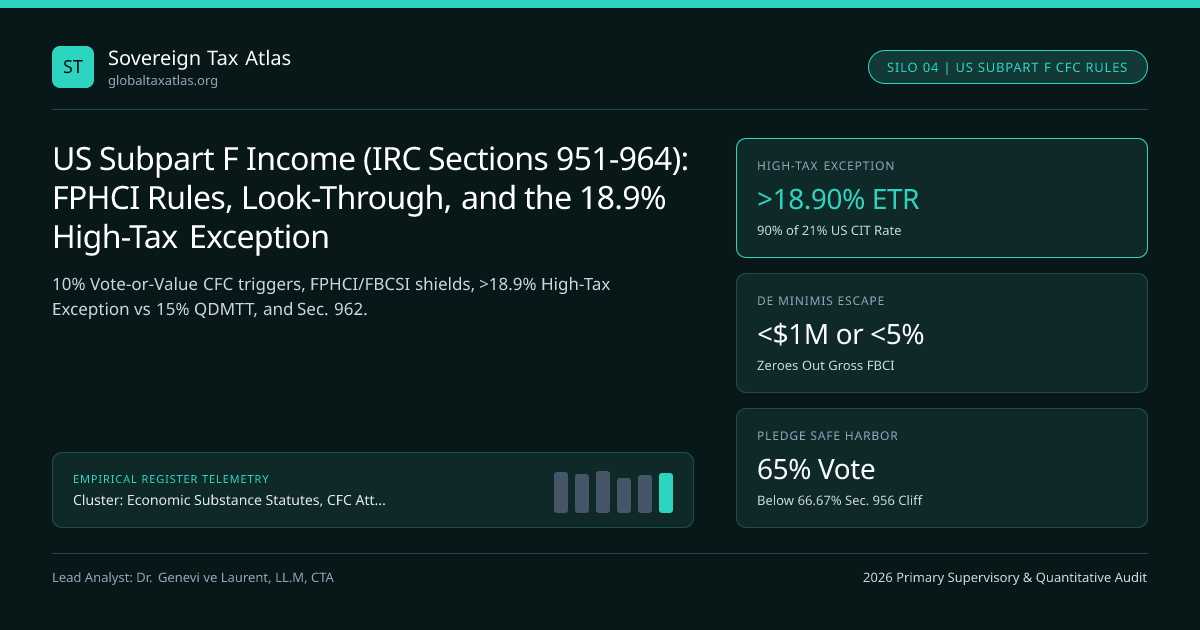
Long before Europe drafted ATAD or the OECD conceived Pillar Two, Congress enacted Subpart F of the Internal Revenue Code (IRC Sections 951–964) in 1962 to prevent US multinationals and wealthy Americans from parking passive dividends, interest, royalties, or invoice-routed sales margins inside zero-tax CIMA Cayman, BMA Bermuda, or Swiss subsidiaries. Within our Economic Substance, CFC, and Transfer Pricing DEMPE guide, mastering downward attribution after IRC Section 958(b)(4) reforms, Section 954(c)(6) active CFC look-through, and the >18.90% High-Tax Exception (HTE) protects cross-border cash flows across the Economic Substance Statutes, CFC Attribution & Transfer Pricing DEMPE cluster.
When Is a Foreign Company a "CFC" (Watch 10% Vote OR Value!)?#
A foreign corporation is a Controlled Foreign Corporation (CFC — IRC Section 957) on any day when "United States Shareholders" collectively own (directly, indirectly under Sec. 958(a), or constructively under Sec. 958(b)!) more than 50.0% (>50.0%) of EITHER total combined voting power OR total value of its stock:
- Definition of a "US Shareholder" (IRC Sec. 951(b)): Any US Person (citizen, resident, US corporation, or US domestic partnership/trust!) owning 10.0% or more (>=10.0%) of total Vote OR Value! (Post-2017 TCJA Change: Previously tested ONLY >=10%* voting stock—so issuing 9% voting / 45% non-voting stock used to dodge US Shareholder status! Today, >=10% of Vote OR Value triggers US Shareholder status immediately!)*
- 2019–2026 Treasury Reg. §1.958-1(d) Aggregate Partnership Relief for US Individuals!: Historically, if a Delaware LP fund owned 60% of a Cayman company, the Delaware LP itself was a "US Shareholder," forcing even a 1% US individual LP to pay 37% ordinary Subpart F tax! Final Treasury Reg. §1.958-1(d) fixed that nightmare by treating domestic partnerships on an aggregate look-through basis—so a <10% US individual LP owes zero Subpart F or GILTI inclusion (watch PFIC rules instead!)!
Three Primary Subpart F Income Traps & Two Workhorse Statutory Shields!#
Once an entity is a CFC, every 10%+ US Shareholder includes pro-rata Subpart F Income at full 21.0% US corporate tax (ZERO Section 250 50% deduction, unlike GILTI!) or up to 37.0% + 3.8% NIIT ordinary income tax for non-electing US individuals (unless making an IRC Section 962 corporate-rate election!):
- Foreign Personal Holding Company Income (FPHCI — Sec. 954(c)): Passive dividends, interest, royalties, rents, annuities, net FX gains, and net commodities/passive-property gains.
- Shield #1 — Active Rents & Royalties (Sec. 954(c)(2)(A)): Rents and royalties derived in an active marketing/licensing business conducted by the CFC's own substantial foreign staff from unrelated customers are 100% EXEMPT!
- Shield #2 — IRC Section 954(c)(6) CFC-to-CFC Look-Through Rule (Permanently Extended / Renewed!): Dividends, interest, rents, and royalties received by CFC #1 from a related CFC #2 (>50% common control) are EXEMPT from Subpart F to the extent attributable to active (non-Subpart F, non-ECI) earnings of CFC #2! (This allows cash pooling and intragroup loans across European/Asian operating CFCs without triggering Subpart F—compare Form 8832 Check-the-Box Disregarded Entities which vanish intercompany payments completely!)
- Foreign Base Company Sales Income (FBCSI — Sec. 954(d)): Triggered when a Swiss or Singapore trading CFC buys goods from (or sells goods to) a related party where the goods are neither manufactured in, nor sold for use inside, the CFC's country of incorporation (watch the Manufacturing Branch Rule* too!*).
- IRC Section 956 ("Deemed Dividend" Loan/Pledge to US Parent): For US Corporate Shareholders, IRC Section 245A regulations effectively neutralized Section 956 inclusions to USD 0 (where dividends would qualify for the 100% Section 245A DRD!)—BUT FOR US INDIVIDUALS / TRUSTS, guaranteeing a US loan with CFC stock or lending CFC cash to the US triggers an IMMEDIATE 37% Section 956 tax bomb!
Quantitative Subpart F High-Tax Exception (>18.90%) + 15% QDMTT Interaction Math#
- ForeignEffectiveTaxRateOnNetItem > (90.0% * MaximumUSCorporateRate21.0%) = 18.90%
- [De Minimis Escape: GrossFBCI + GrossInsurance < Min(5.0% * TotalCFCGrossIncome, USD 1,000,000) => SubpartF = USD 0!]
- [Full Inclusion Cliff: GrossFBCI + GrossInsurance > 70.0% * TotalCFCGross_Income => 100.0% of CFC Income = Subpart F!]
- Worked US C-Corp Parent With Two Foreign CFCs Earning Passive Treasury Interest (FY 2026):
- CFC Alpha in UK (25.0% UK Corporation Tax on USD 10,000,000 Interest = USD 2,500,000 UK Tax):
- Foreign ETR = 25.0% (> 18.90% HTE threshold!) -> Parent elects Subpart F High-Tax Exception -> USD 0 US Subpart F Inclusion;
- USD 7.50M net cash distributes later to US Parent at 0.0% US tax under IRC Sec. 245A Participation DRD!
- CFC Beta in Ireland / UAE Paying 15.0% Pillar Two QDMTT (USD 10,000,000 Non-Trading Passive Interest):
- Wait: Ireland passive non-trading rate is 25.0% (>18.9% -> Passes HTE!), WHEREAS UAE 0% QFZP + 15.0% UAE QDMTT = 15.00% ETR!
- Crucial Trap: 15.00% Pillar Two QDMTT is STILL BELOW 18.90%!
- Outcome in UAE CFC: Fails >18.90% HTE -> Included in US Parent Subpart F at 21.0% (USD 2.10M) minus 100% Sec. 960(a) FTC for USD 1.50M QDMTT = USD 600,000 residual US tax!
Benchmarking Subpart F vs GILTI vs Individual Section 962 Elections#
US Subpart F Structuring & Planning Matrix#
International CPA directors, M&A tax teams, and offshore corporate administrators—coordinating across CIMA, BVIFSC, and Puerto Rico OCIF, alongside trading firms like Bancwesttrade and April Investors—deploy five proven Subpart F shields:
| CFC Transaction Type | Default Subpart F Trap | Statutory / Structural Shield | Post-Shield US Tax | Fatal Foot-Fault |
|---|---|---|---|---|
| Intragroup Dividend / Loan (CFC2 -> CFC1) | FPHCI (21% Current Tax) | IRC Sec. 954(c)(6) Look-Through (or Check-the-Box Disregarded!) | 0.0% Subpart F | Hybrid dividend (Sec. 245A(e) deductibility denial!) |
| High-Taxed Foreign Passive Income (>=19%) | FPHCI (Passive Basket FTC) | Subpart F High-Tax Exception (>18.9%) | 0.0% US Tax (+ 245A DRD) | Assuming a 15% QDMTT hits >18.9% (15% < 18.9%!) |
| Regional Principal Manufacturing / Sales | FBCSI (Sec. 954(d) Sales) | Substantial Physical Transformation / Contract Mfg (1.954-3) | 0.0% Subpart F (Moves to GILTI!) | Failing Branch Tax Rate Disparity Test (<90% / 5% spread!) |
| US Individual Entrepreneur Owning Foreign OpCo | 37% Tax + Zero FTCs! | Annual IRC Section 962 Election (or Hold via US C-Corp) | 21% Less Foreign CIT (Defer Div!) | Non-treaty Cayman CFC (Sec. 962 distribution taxed at 37%, not 23.8%!) |
| CFC Pledging Stock for US Parent Loan | IRC Sec. 956 Deemed Div! | Treas. Reg. §1.956-1(a)(2) (0% for US C-Corps ONLY!) | 0% for C-Corp (37% for Indivs!) | Individual/S-Corp/Trust pledging >=66.67% CFC voting stock! |
Frequently asked questions
Why do commercial credit agreements STILL limit foreign subsidiary stock pledges to 65% of voting stock if IRC Section 956 was neutralized for US C-Corps?
Three practical reasons: (1) any non-corporate US Shareholder (S-Corp, individual, or partnership with individual 10%+ partners) STILL suffers full 37% Section 956 tax; (2) certain state income taxes do not conform fully to federal Section 245A; and (3) hybrid/non-245A-eligible E&P inside the CFC can still trigger Section 956!
What is the "66.67% vs 65%" rule when pledging CFC voting stock to a bank?
Treas. Reg. §1.956-2(c)(2) creates an indirect pledge trigger whenever a borrower pledges "at least 66-2/3 percent of the total combined voting power" of a CFC PLUS negative covenants restricting asset pledges; commercial lenders traditionally cap the pledge at 65.0% of voting stock (plus 100% of non-voting stock!) for a clean 1.67% safety cushion!
How did the 2017 repeal of IRC Section 958(b)(4) downward attribution block accidentally turn foreign subsidiaries of non-US multinationals into US CFCs?
Repealing Section 958(b)(4) caused a US subsidiary of a foreign parent (e.g., German AG owns US Inc AND Irish Ltd) to constructively "own" 100% of its sister Irish Ltd downward from German AG—turning Irish Ltd into a technical CFC if ANY 10% US minority shareholder existed (partially mitigated by Rev. Proc. 2019-40 and 2025/2026 OBBBA Section 951B restoration)!
Why should a US individual owning a CFC in a treaty country (like the UK or Canada) almost always evaluate an IRC Section 962 Election?
Without a Section 962 election, a US individual pays up to 37% US tax on CFC Subpart F/GILTI with ZERO credit for the 25% UK corporate tax already paid! Electing Section 962 taxes the inclusion as if held by a US C-Corp (21% completely wiped out to USD 0 by the 25% UK FTC!) and taxes later actual cash dividends at the 23.8% US–UK Qualified Dividend rate!
Publication record
- Published
- 13 November 2026
- Updated
- 15 November 2026
- Author
- Dr. Geneviève Laurent, LL.M, CTA
- Review
- Review not recorded
- Automated fact check
- Passed in the stored pipeline record
- Source URLs
- 3 recorded
AI assistance recorded: anthropic/claude-opus-4.6. This field does not establish human review or source verification.
Academic & Institutional Attribution
Cite This Research & Embed Live Data Card
Standard academic & institutional research paper citation format.
Dr. Geneviève Laurent, LL.M, CTA. (2026, November 15). US Subpart F Income (IRC Sections 951–964): FPHCI Rules, Look-Through, and the 18.9% High-Tax Exception. Sovereign Tax Atlas. https://globaltaxatlas.org/entries/us-subpart-f-foreign-personal-holding-company-high-tax-exceptionRegulatory Directory Cross-Reference
Referenced Institutions & Regulatory Registries
Top Regulated Institutions in This Coverage Slice
Related Economic Substance Cfc Transfer Pricing & Institutional Briefings
Explore Economic Substance Cfc Transfer Pricing Hub (20) →Economic Substance Cfc Transfer Pricing
Offshore Economic Substance Statutes, CFC Attribution Regimes, and OECD Transfer Pricing DEMPE GuideEconomic Substance Cfc Transfer Pricing
US GILTI / Net CFC Tested Income (IRC Section 951A): 2026 OBBBA Reforms, Section 250, and FTC HaircutsEconomic Substance Cfc Transfer Pricing
EU Anti-Tax Avoidance Directive (ATAD) Articles 7–8 CFC Rules: Model A Passive Categories vs Model B SPFEconomic Substance Cfc Transfer Pricing
UK TIOPA 2010 Part 9A CFC Regime: Chapter 3 Gateways, 75% Tax Exemption, and Chapter 9 Finance Company RulesEconomic Substance Cfc Transfer Pricing
OECD Transfer Pricing Guidelines Chapter VI: Intangible DEMPE Functions vs Legal IP OwnershipEconomic Substance Cfc Transfer Pricing
Hard-to-Value Intangibles (HTVI): Ex-Post Outcomes, the 20% Valuation Corridor, and Price AdjustmentsEconomic Substance Cfc Transfer Pricing
OECD Pillar One Amount B (2025+): Baseline Wholesale Marketing and Distribution Return-on-Sales MatrixEconomic Substance Cfc Transfer Pricing
OECD Transfer Pricing Chapter X: Intragroup Loans, Implicit Halo Support, Cash Pools, and GuaranteesCross Border Fund Spv Tax Neutrality
US FIRPTA (IRC Section 897): USRPHCs, QFPF Pensions, and Domestically Controlled REIT RulesCross Border Fund Spv Tax Neutrality
US IRC Section 864(b)(2) Trading Safe Harbor vs Direct Lending Loan Origination ECI RisksCross Border Fund Spv Tax Neutrality
US UBTI and IRC Section 514 Acquisition Indebtedness: Offshore Feeder Blockers and Section 514(c)(9)Cross Border Fund Spv Tax Neutrality
Singapore MAS Section 13O and Section 13U Tax Exemptions: VCC Umbrellas and 2025/2026 Tiered Spending
Sovereign Tax Atlas Data, Benchmarks & Contributor Records
CC BY 4.0 Open Data
Open Institutional Datasets (CSV / JSON) →
Download desk-compiled quantitative series & schemas.
2026 Reference Matrix
2026 Institutional Benchmarks & Thresholds →
Statutory capital, clearing, margin & rate conventions.
Editorial Records
Authors & Review Records →
View named contributors where those records are available.
Complete Index
Master Research & Dossier Archive →
Browse all published briefings by topic pillar & date.