
Economic Substance Cfc Transfer Pricing
OECD Transfer Pricing Chapter IX Business Restructurings: Principal Conversions and IP Exit Taxes
Converting full-fledged operating subsidiaries into limited-risk distributors or migrating offshore IP onshore triggers OECD Chapter IX exit-compensation audits, EU ATAD Article 5 exit taxes, and German §1(3b) Funktionsverlagerung.
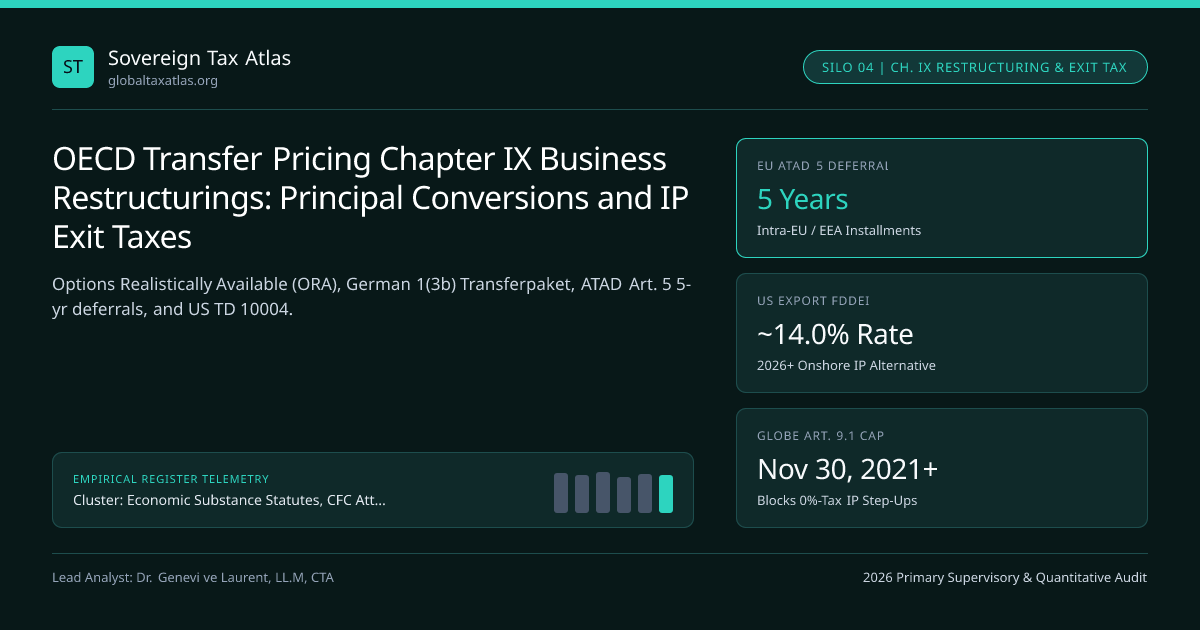
Between 2020 and 2026, two massive waves of corporate reorganizations swept Fortune 500 and private-equity groups: (1) migrating intellectual property OUT of Cayman/BVI/Bermuda into onshore DEMPE hubs (Ireland, UK, Switzerland, US, Singapore) after High-Risk Offshore IP bans and Pillar Two; and (2) centralizing supply chains by converting local Full-Fledged Manufacturers / Distributors into Toll Manufacturers and Limited-Risk Distributors (LRDs)! Every one of those reorganizations triggers *Chapter IX of the OECD Transfer Pricing Guidelines (Transfer Pricing Aspects of Business Restructurings), EU ATAD Article 5 Corporate Exit Taxes, and aggressive domestic "Transfer of Functions" statutes like Germany's §1(3b) AStG (Funktionsverlagerung)*! Anchored in our Economic Substance, CFC, and Transfer Pricing DEMPE guide, avoiding unwarranted nine-figure exit-tax assessments defines M&A integration across the Economic Substance Statutes, CFC Attribution & Transfer Pricing DEMPE cluster.
Core Principle of OECD Chapter IX: Does Stripping Profit Potential AUTOMATICALLY Demand Exit Compensation?!#
Read OECD Chapter IX Paragraphs 9.39–9.79 carefully—many revenue auditors overreach by claiming "Your local distributor's margin dropped from 9% to 3.5% (Amount B), so you owe exit tax on the capitalized 5.5% perpetuity!" OECD Chapter IX REJECTS automatic "profit-potential" exit taxes unless one of two economic triggers actually occurred:
- Trigger #1 — Transfer of "Something of Value" (Rights or Other Assets / Going Concern — Paras 9.40–9.67): Did the converted entity transfer patents, customer contracts, proprietary local customer lists, specialized know-how, or an *assembled ongoing concern (Geschäftswert / Transfer Package)* to the new Principal? If YES -> Full arm's-length exit price owed! (Expiring 1-year non-exclusive licenses with zero local IP transfer zero intangibles!)
- Trigger #2 — Contract Termination / Renegotiation Indemnification Rights + "Options Realistically Available" (ORA — Paras 9.27–9.38 & 9.78): Would an independent profitable distributor possessing a remaining 5-year exclusive contract ever voluntarily sign an amendment tomorrow slashing its own margin from 9% to 3.5% for USD 0 compensation?! NEVER—because it had a better "Option Realistically Available" (ORA): keeping its 9% contract for 5 more years (or claiming statutory commercial-agency termination damages under EU/French/German commercial law)!
Three Country-Specific Landmines in Cross-Border Restructurings!#
- United States Outbound IP Trap — IRC Section 367(d) & Goodwill Repeal!: Never contribute US-owned patents, code, or even Foreign Goodwill & Going Concern (added to §367(d) in the 2017 TCJA!) to a foreign corporation expecting a tax-free §351/§361 rollover! IRC Section 367(d) recharacterizes an outbound US IP transfer as a deemed sale for annual contingent payments over the ENTIRE useful life of the IP—taxing the US transferor every year at 21% US CIT (subject to commensurate-with-income hindsight!)! (Under Treasury's Oct 2024 Final Regs [TD 10004], repatriating §367(d) IP back to the US terminates ongoing deemed royalties!)
- *Germany — Strict §1(3b) AStG Funktionsverlagerung* ("Transfer of Function")!: Whenever a function (alongside associated opportunities, risks, and assets/staff) shifts out of Germany (or is duplicated abroad while German capacity is curtailed within 5 years!), German §1(3b) AStG mandates valuing the entire "Transfer Package" (Transferpaket) as a whole via a two-sided capitalized NPV corridor** (Einigungsbereich between Seller floor and Buyer ceiling) unless routine-outsourcing exemptions apply!
- EU ATAD Article 5 Corporate Exit Taxation (With 5-Year Intra-EU/EEA Installment Right!): Every EU Member State taxes unrealized capital gains (FMV minus tax basis) whenever assets or corporate tax residence move out of its taxing jurisdiction—granting a mandatory right to pay in 5 equal annual installments when migrating to another EU or EEA state!
Quantitative Onshore IP Migration Math: Offshore Zero-Tax Exit vs Onshore Step-Up & Pillar Two Deferred Tax!#
- [CRITICAL PILLAR TWO GLO-BE TRAP (Art. 9.1.1 Transition Rule!): For intragroup IP transfers AFTER Nov 30, 2021 & BEFORE Pillar Two Transition Year, Buyer's GloBE Deferred Tax Asset is CAPPED at Seller's Actual Tax Paid (0% from Cayman!)—NOT FMV Step-Up!]
- Worked USD 400M Post-2026 Third-Party / Post-Transition IP Migration From Taxed Hub (15% Exit Tax) vs Pre-Transition Cayman Trap:
- Case A — Post-Transition Year Intragroup IP Sale From Country X (Pays 15% Exit Tax = USD 60M) to Ireland Trading Hub (Sec. 291A 12.5% + 2.5% QDMTT = 15%):
- Seller pays USD 60.0M Exit Tax; Ireland Buyer books USD 400.0M amortizable IP step-up (creates USD 60.0M Deferred Tax Liability/Asset harmony over 10–15 yrs -> Preserves clean 15.0% GloBE ETR across all years!).
- Case B — Historical Cayman-to-Ireland Zero-Tax Drop-Down Caught by GloBE Art. 9.1.1 (0% Cayman Tax Paid on USD 400M Step-Up):
- Domestic Irish tax allows Section 291A amortization (reducing domestic 12.5% CIT), BUT Pillar Two Art. 9.1.1 DENIES the step-up basis for GloBE!
- Result: Ireland QDMTT snaps ETR right back up to 15.0% every year—wiping out the un-taxed offshore step-up advantage under Pillar Two!
Benchmarking Restructuring & IP Migration Tax Regimes#
Business Restructuring & IP Migration Execution Matrix#
Converting a buy-sell distributor into a Commissionaire whose local sales team negotiates contracts triggers a BEPS MLI Article 12 Dependent Agent PE—making Buy-Sell LRDs far safer! M&A counsel across ESMA, CIMA, and Irish structures, alongside global execution groups like 360 Capital and Aftermath Finance, execute this 5-point checklist:
| Restructuring Type | Primary Exit-Tax Statute | Buyer Step-Up Regime | Pillar Two / PE Trap to Check | Best Mitigation Strategy |
|---|---|---|---|---|
| Cayman/BVI IP -> Ireland / UK / SG | 0% Offshore (Watch Parent CFC!) | IE Sec. 291A / UK Intangibles / SG Sec. 19B | GloBE Art. 9.1.1 (Pre-Transition cap!) | Co-locate real DEMPE engineers in Hub! |
| US IP -> Foreign Hub | IRC §367(d) Annual Royalty! | Foreign amortization vs US inclusion | Punitive annual CWI US tax | Use Bilateral CCA / Cost Sharing or US FDII/FDDEI (14%) instead! |
| Foreign IP -> Repatriate to USA | Foreign ATAD 5 / Exit Tax | US §197 / TD 10004 Basis Rules | Foreign exit tax FTC basket match | Leverage 2024 Final §367(d) Regs (TD 10004)! |
| German OpCo -> Principal LRD / Toll | German §1(3b) AStG (Transferpaket) | Principal capitalizes Buy-Out fee | Auto 30-day §90(4) AO audit filing! | Keep Buy-Sell wholesale inside Amount B Matrix instead of Commissionaire! |
| EU HoldCo Seat Migration (LU -> UK/IE) | ATAD Art. 5 Exit Tax | ATAD Art. 5(5) Mandatory FMV Step-Up | UK is non-EU (No 5-yr installment!) | Migrate inside EU/EEA (LU <-> IE/NL) for 5-year deferral! |
Frequently asked questions
Who should bear factory-closure and employee-redundancy severance costs when a Principal closes a Contract Manufacturer plant?
Under OECD Chapter IX Paragraphs 9.100–9.115, follow risk control and Options Realistically Available: if the Principal instructed the restructuring to consolidate capacity elsewhere for the Principal benefit (and a third-party toll manufacturer would not absorb closure losses uncompensated), the Principal must indemnify or bear the restructuring/severance costs!
Why did converting European Buy-Sell Distributors into "Commissionaires" fall out of favor after BEPS MLI Article 12?
Pre-BEPS, civil-law Commissionaires signed contracts in their own name (avoiding pre-2017 Article 5(5) Agency PE!). BEPS MLI Article 12 expanded Dependent Agent PE to capture any agent who "habitually plays the principal role leading to the conclusion of contracts routinely concluded without material modification"—making Buy-Sell LRDs under Amount B far safer!
How does EU ATAD Article 5(5) prevent double taxation when an asset moves from one EU Member State to another?
Whenever EU Member State A imposes an Article 5 Exit Tax on Fair Market Value at departure, Article 5(5) legally compels receiving EU Member State B to accept that exact same Fair Market Value as the starting tax-depreciation/amortization basis of the asset (unless State B disputes whether that value is arm-length)!
Why do many US tech groups now keep IP inside the United States under FDII / FDDEI (IRC §250) instead of migrating IP abroad?
Because IRC §367(d) penalizes outbound IP transfers while IRC Section 250 Foreign-Derived Intangible / Deduction-Eligible Income (FDII / FDDEI—taxed at ~13.125% through 2025 and ~14.0% in 2026+ under OBBBA, ALREADY near the 15% Pillar Two global minimum!) lets US companies keep IP at home with zero cross-border DEMPE friction!
Publication record
- Published
- 13 November 2026
- Updated
- 14 November 2026
- Author
- Dr. Geneviève Laurent, LL.M, CTA
- Review
- Review not recorded
- Automated fact check
- Passed in the stored pipeline record
- Source URLs
- 3 recorded
AI assistance recorded: anthropic/claude-opus-4.6. This field does not establish human review or source verification.
Academic & Institutional Attribution
Cite This Research & Embed Live Data Card
Standard academic & institutional research paper citation format.
Dr. Geneviève Laurent, LL.M, CTA. (2026, November 14). OECD Transfer Pricing Chapter IX Business Restructurings: Principal Conversions and IP Exit Taxes. Sovereign Tax Atlas. https://globaltaxatlas.org/entries/oecd-chapter-ix-business-restructuring-ip-migration-exit-taxesRegulatory Directory Cross-Reference
Referenced Institutions & Regulatory Registries
Top Regulated Institutions in This Coverage Slice
Related Economic Substance Cfc Transfer Pricing & Institutional Briefings
Explore Economic Substance Cfc Transfer Pricing Hub (20) →Economic Substance Cfc Transfer Pricing
Offshore Economic Substance Statutes, CFC Attribution Regimes, and OECD Transfer Pricing DEMPE GuideEconomic Substance Cfc Transfer Pricing
Cayman Islands Economic Substance Act: Nine Relevant Activities, CIGA Outsourcing, and Pure Equity HoldCosEconomic Substance Cfc Transfer Pricing
BVI Economic Substance Act and ITA Rules: Financial Periods, BOSSs Filings, and EU Blacklist RulesEconomic Substance Cfc Transfer Pricing
Jersey, Guernsey, and Bermuda Economic Substance: Physical Island Board Quorums and Corporate Tax ReturnsEconomic Substance Cfc Transfer Pricing
High-Risk IP in Offshore Economic Substance: Rebuttable Presumptions and Spontaneous Tax ExchangeEconomic Substance Cfc Transfer Pricing
US Subpart F Income (IRC Sections 951–964): FPHCI Rules, Look-Through, and the 18.9% High-Tax ExceptionEconomic Substance Cfc Transfer Pricing
US GILTI / Net CFC Tested Income (IRC Section 951A): 2026 OBBBA Reforms, Section 250, and FTC HaircutsEconomic Substance Cfc Transfer Pricing
EU Anti-Tax Avoidance Directive (ATAD) Articles 7–8 CFC Rules: Model A Passive Categories vs Model B SPFEarnings Reports
PodcastOne (NASDAQ:PODC) Reports Record 1H & Q2 Fiscal 2027 Financial Results; 1H Fiscal 2027 Revenue of $31.5M and Adjusted EBITDA* of $2.9M - Yahoo FinanceRegulatory and Market Glossary
EU set to delay 10% tariff on electric cars from UK, FT reports - Euronext Markets: Real-time Stock Market Data | liveTrade Policy
Canada’s ambassador warns Trump tariffs are driving up costs, threatening U.S. investmentMarket Insights
Inside India newsletter: Trump's poll setback fuels hope for U.S.-India trade deal by year end
Sovereign Tax Atlas Data, Benchmarks & Contributor Records
CC BY 4.0 Open Data
Open Institutional Datasets (CSV / JSON) →
Download desk-compiled quantitative series & schemas.
2026 Reference Matrix
2026 Institutional Benchmarks & Thresholds →
Statutory capital, clearing, margin & rate conventions.
Editorial Records
Authors & Review Records →
View named contributors where those records are available.
Complete Index
Master Research & Dossier Archive →
Browse all published briefings by topic pillar & date.