
Double Tax Treaty Withholding Lob
EU Parent-Subsidiary and Interest-Royalties Directives After the ECJ Danish Beneficial Ownership Cases
In Joined Cases C-115/16 and C-116/16 ("the Danish Cases"), the European Court of Justice ruled that Member States MUST deny 0% EU Directive withholding to conduit holding companies even without domestic anti-abuse statutes.
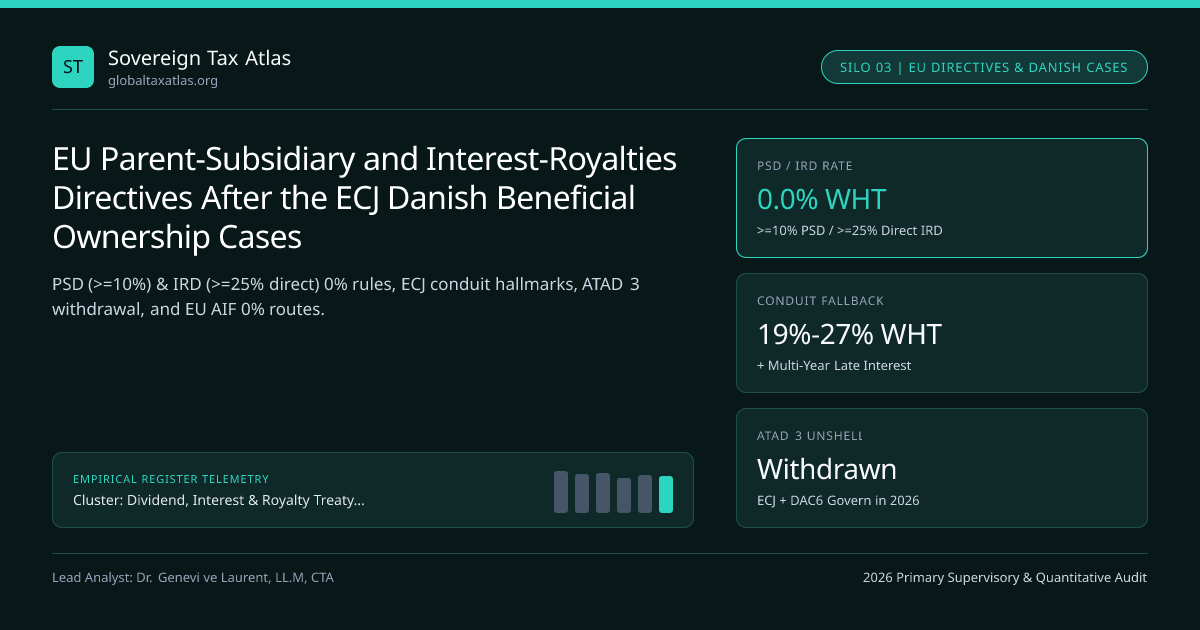
Inside the European Union Single Market, two foundational Directives eliminate cross-border corporate withholding down to 0.0%: the EU Parent-Subsidiary Directive (PSD — 2011/96/EU) (>=10% capital held for up to 12/24 months -> 0% Article 10 dividend WHT!) and the EU Interest & Royalties Directive (2003/49/EC) (>=25% stake -> 0% WHT!). Historically, buyouts placed Luxembourg (LU SOPARFI/RAIF) or Cypriot HoldCos above EU operating companies for 0.0% Directive WHT—until the ECJ Grand Chamber ruled in Joined Cases C-115/16 & C-116/17 ("The Danish Conduit Cases")! Anchored in our Double Tax Treaty Withholding, MLI PPT, and US LOB reference, every European M&A structure across the Dividend, Interest & Royalty Treaty Withholding, PPT & LOB cluster now lives under ECJ conduit jurisprudence.
Four Game-Changing Legal Rulings of the ECJ Grand Chamber!#
Why did the ECJ Danish Cases shock tax directors from Frankfurt to Milan to Madrid? Because the Grand Chamber established four binding EU-wide constitutional principles:
- Direct EU General Principle of Prohibition of Abuse (Zero Domestic GAAR Needed!): Even if a Member State (like Denmark at the time!) forgot to transpose an explicit anti-abuse statute into its domestic tax code, national tax authorities and courts HAVE A MANDATORY DUTY (not merely an option!) to refuse 0% PSD and IRD Directive benefits wherever abusive conduit arrangements exist!
- Autonomous EU Definition of "Beneficial Owner": Under the IRD (and functionally mirrored via anti-abuse under the PSD!), "beneficial owner" means the entity that actually benefits economically from the interest/dividend and enjoys the free power to determine how that cash is used—interpreting EU Directives directly alongside OECD Model Commentary updates (compare MLI Article 7 PPT)!
- Contractual Not Required — "Factual / Economic Conduit" Suffices!: Taxpayers argued: "Our Luxembourg SARL had zero legal contract forcing it to pass the Danish dividend up to Cayman!" The ECJ crushed that defense: even without a legal/contractual pass-through obligation, an entity is an artificial conduit if, "in substance," it has very narrow powers over the income, earns only an insignificant spread, holds no other economic activity, and passes funds up shortly after receipt!
- Burden of Proof Relief on Tracing Ultimate Beneficial Owners: Crucially, the ECJ held that a source tax authority does NOT have to prove WHO the ultimate Cayman/offshore beneficial owner actually is—proving that the immediate Luxembourg/Cypriot recipient is a mere conduit suffices to impose full statutory WHT !
Crucial Statutory Trap Inside the Interest & Royalties Directive (IRD): DIRECT >=25% Only!#
Even when a group has 100% genuine factories and 5,000 employees (zero conduit abuse!), corporate treasurers routinely blow 0.0% EU Interest & Royalties Directive relief because they forget IRD Article 3(b)'s "Direct Holding" rule:
- Unlike the Parent-Subsidiary Directive, IRD Article 3(b) applies ONLY where: (i) Company A holds directly >=25%** of Company B; OR (ii) Company B holds directly >=25% of Company A; OR (iii) a third EU company C holds DIRECTLY >=25% of BOTH Company A and Company B**!
- Trap: If German Grandparent AG owns 100% of Dutch MidCo BV, which owns 100% of Italian Sub SRL, and German Grandparent AG lends directly to Italian Sub SRL (2 tiers down — indirect!), the EU Interest & Royalties Directive DOES NOT APPLY (forcing reliance on the bilateral Germany–Italy Tax Treaty, which charges 10.0% Article 11 interest WHT instead of 0.0%!)!
Update on EU "Unshell / ATAD 3" Withdrawal (2025) vs Live National Enforcement!#
What happened to the European Commission's much-hyped ATAD 3 ("Unshell") Directive proposal? In 2025, the EU Council formally dropped/withdrew the standalone Unshell ATAD 3 legislative file in favor of existing DAC6 Hallmark reporting and fierce national court enforcement of the ECJ Danish Cases! And look at how ruthlessly national courts applied the Danish Cases between 2023 and 2026:
- *Danish Supreme Court Final Judgments (TDC / Nycomed / NetApp, 2023)*: Upheld DKK billions in back withholding taxes and late interest against private-equity Luxembourg/Cypriot HoldCos, rejecting claims that post-receipt loan set-offs or accounting entries constituted real dominion!
- *Italian Corte di Cassazione, Spanish Audiencia Nacional, & French Conseil d'État*: Systematically audit foreign EU HoldCos on three real-world pillars: (1) Organizational Substance (dedicated office + qualified payroll executives); (2) Financial Substance (equity risk rather than 99% back-to-back PECs/loans); and (3) Functional Decision-Making & Cash Retention**!
Quantitative Tax + Late-Interest Exposure in a Failed EU Directive Audit#
- [Warning: In Denmark, Italy & Spain, non-deductible late-payment interest (7%–8%+ p.a. compounded/accrued) often DOUBLES the original WHT principal!]
- Worked EUR 150,000,000 Italian Leveraged Buyout Dividend & Interest Repatriation Over 4 Years to Brass-Plate Lux SARL:
- Annual Cash Flows: EUR 12.0M Interest + EUR 25.0M Dividend = EUR 37.0M/yr (EUR 148.0M over 4 years) claimed at 0.0% IRD & PSD.
- Guardia di Finanza / Agenzia delle Entrate Audit Findings: Lux SARL has 0 employees, EUR 15k office sub-desk, passes 99.4% to Cayman within 5 days:
- Denied 0% PSD & IRD -> Assessed 26.0% Italian Statutory WHT on BOTH Dividends & Interest = EUR 38,480,000 principal tax!
- Plus Italian Administrative Penalties (90%–120% pre-settlement; reduced under D.Lgs. 87/2024 reform to ~25%–70%) + 4-Yr Interest = >EUR 52,000,000 hit!
EU Directive vs Regulated Fund Exemption Matrix#
Look at the fourth metric badge right above: under ECJ Article 63 TFEU precedent, Italy Finance Law 2021 grants 0.0% statutory dividend and CGT treatment directly to supervised EU/EEA AIFs (such as Luxembourg RAIFs managed by an authorised EU AIFM or Irish ICAVs)! Compliance teams vetting firms alongside ESMA and venues like 360 Capital and Alkimiya Markets compare these routes:
| Structuring Vehicle | PSD / IRD Eligible? | ECJ Danish Conduit Risk | Alternative 0% EU Statutory Route | Key Requirement |
|---|---|---|---|---|
| Brass-Plate Single-Deal Lux SARL | Nominally Yes | EXTREME — Fails ECJ Audit! | None (Suffers 19%–27% WHT!) | Never use unstaffed single-asset SPVs! |
| Pan-EU Master Platform (10+ Deals, 5 FTEs) | YES — Robust | Low (Passes ECJ & Ex. K PPT) | Bilateral Treaty Backup | Retain cash; local investment executives on payroll |
| Regulated Lux RAIF / Irish ICAV (EU AIFM) | No (Tax-exempt AIF) | Low — Direct AIF Exemption! | Art. 63 TFEU / Italian 2021 AIF 0% Law! | Managed by AIFMD-authorized EU AIFM! |
| Grandparent-to-Grandchild EU Loan | NO (IRD Fails!) | N/A (Indirect <25% direct!) | Restructure via direct parent or 0% DTA | IRD strictly requires direct >=25% link! |
Frequently asked questions
If a Luxembourg HoldCo is disregarded as a conduit under the ECJ Danish Cases, can investors claim the treaty of the ultimate US or UK parent?
It depends! In the NetApp branch of the 2023 Danish Supreme Court rulings, where a Cypriot/Dutch conduit delayed passing dividends up for years (investing cash temporarily so the US parent did not receive the dividend concurrently), the Court denied look-through to the US–Denmark treaty too! Clean immediate look-through works only if the ultimate treaty owner actually becomes the direct beneficial owner of that cash flow!
Why did Italy grant 0.0% dividend and capital-gains tax directly to EU/EEA AIFs like Luxembourg RAIFs in 2021?
Because Italian domestic funds (OICR) pay 0% tax on Italian dividends and gains, taxing foreign EU/EEA supervised funds at 26% violated Article 63 TFEU (Free Movement of Capital). Italy 2021 Budget Law therefore exempted dividends and substantial-participation gains earned directly by AIFs established in the EU/EEA whose manager (AIFM) is supervised under AIFMD!
What happened to the EU ATAD 3 ("Unshell") Directive that was supposed to create a 3-gateway minimum substance test?
After years of deadlock among EU Member States over administrative burdens and overlap with existing rules, the EU Council formally discontinued/withdrew the Unshell (ATAD 3) legislative proposal in 2025—relying instead on DAC6 cross-border reporting and national enforcement of the ECJ Danish Cases.
Does Germany Section 50d(3) EStG still apply on top of the ECJ Danish Cases?
Yes! Following ECJ rulings striking down older overly rigid versions of German §50d(3) EStG, Germany modernized §50d(3) in 2021 with a two-tier Personal Entitlement test, Material/Functional Nexus test, and a Principal Purpose rebuttal clause enforced rigorously by the Federal Central Tax Office (BZSt).
Publication record
- Published
- 13 November 2026
- Updated
- 14 November 2026
- Author
- Dr. Geneviève Laurent, LL.M, CTA
- Review
- Review not recorded
- Automated fact check
- Passed in the stored pipeline record
- Source URLs
- 3 recorded
AI assistance recorded: anthropic/claude-opus-4.6. This field does not establish human review or source verification.
Academic & Institutional Attribution
Cite This Research & Embed Live Data Card
Standard academic & institutional research paper citation format.
Dr. Geneviève Laurent, LL.M, CTA. (2026, November 14). EU Parent-Subsidiary and Interest-Royalties Directives After the ECJ Danish Beneficial Ownership Cases. Sovereign Tax Atlas. https://globaltaxatlas.org/entries/eu-parent-subsidiary-interest-royalties-directives-danish-casesRegulatory Directory Cross-Reference
Referenced Institutions & Regulatory Registries
Top Regulated Institutions in This Coverage Slice
Referenced Supervisory Authorities
Related Double Tax Treaty Withholding Lob & Institutional Briefings
Explore Double Tax Treaty Withholding Lob Hub (20) →Double Tax Treaty Withholding Lob
Double Tax Treaty Withholding Rates, OECD MLI Principal Purpose Test, and US LOB ReferenceDouble Tax Treaty Withholding Lob
OECD Pillar Two Subject to Tax Rule (STTR): 9% Gross Withholding, Markup Caps, and MLI RolloutDouble Tax Treaty Withholding Lob
India–Mauritius Tax Treaty 2024 PPT Protocol, Grandfathered Capital Gains, and Indian TRC Audit RulesDouble Tax Treaty Withholding Lob
Singapore IRAS Certificate of Residence (COR): Foreign-Owned HoldCo Substance and 90+ APAC TreatiesDouble Tax Treaty Withholding Lob
UK Qualifying Asset Holding Company (QAHC) vs Quoted Eurobond: 0% Outbound Interest WithholdingDouble Tax Treaty Withholding Lob
Cross-Border Securities Lending, Manufactured Dividends, and Post-Cum-Ex Anti-Dividend-Washing RulesDouble Tax Treaty Withholding Lob
OECD Model Article 10 Dividend Withholding: 5% Direct Participation, 365-Day Hold, and 15% PortfolioDouble Tax Treaty Withholding Lob
OECD Model Article 11 Interest Withholding: Bank Carve-Outs, Gross-Ups, and Arm’s-Length CapsEconomic Substance Cfc Transfer Pricing
Labuan IBFC Economic Substance Requirements: FTE Headcount, MYR Opex Gates, and the 3% vs 24% LBATA CliffEconomic Substance Cfc Transfer Pricing
UAE Economic Substance Repeal & Integration Into 0% Qualifying Free Zone Person (QFZP) Corporate Tax AuditsEconomic Substance Cfc Transfer Pricing
BEPS Action 13 Three-Tier Transfer Pricing Documentation: Master File, Local File, and Penalty ProtectionEconomic Substance Cfc Transfer Pricing
Low Value-Adding Intra-Group Services (LVAS): OECD 5% Markup Safe Harbor, US SCM, and Benefit Tests
Sovereign Tax Atlas Data, Benchmarks & Contributor Records
CC BY 4.0 Open Data
Open Institutional Datasets (CSV / JSON) →
Download desk-compiled quantitative series & schemas.
2026 Reference Matrix
2026 Institutional Benchmarks & Thresholds →
Statutory capital, clearing, margin & rate conventions.
Editorial Records
Authors & Review Records →
View named contributors where those records are available.
Complete Index
Master Research & Dossier Archive →
Browse all published briefings by topic pillar & date.