
Double Tax Treaty Withholding Lob
OECD Model Article 10 Dividend Withholding: 5% Direct Participation, 365-Day Hold, and 15% Portfolio
Article 10 of the OECD Model Tax Convention splits cross-border dividend withholding into a 5% direct corporate rate (25% capital held for 365 days under MLI Article 8) and a 15% portfolio rate.
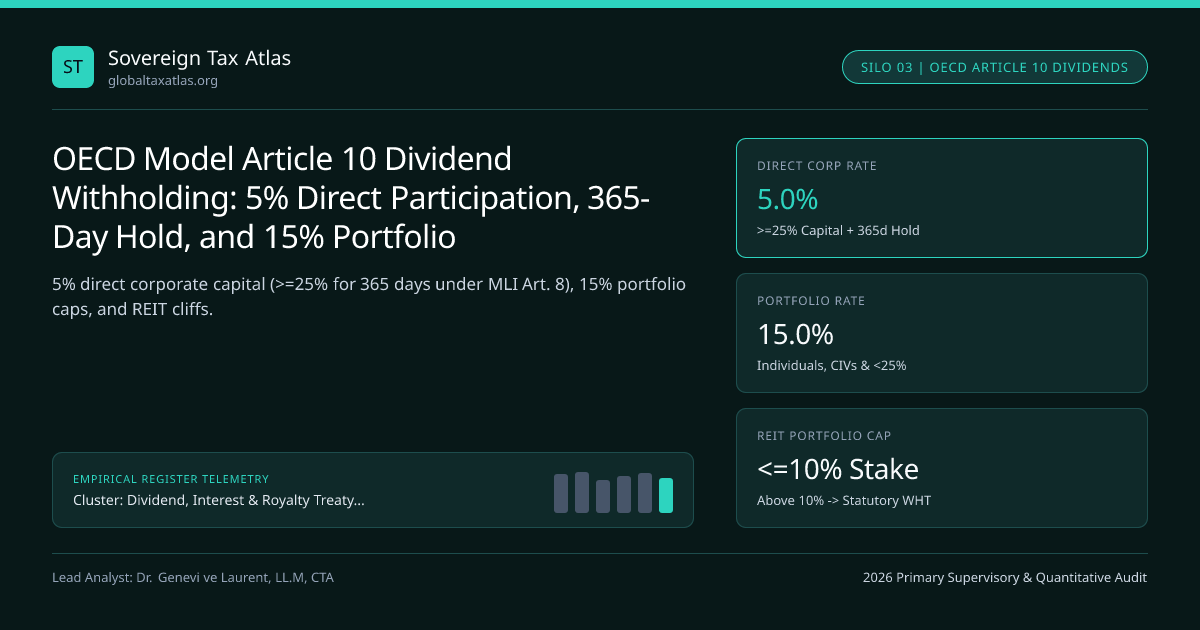
Corporate dividends suffer economic double taxation whenever a subsidiary pays local corporate income tax on operating profits and its source state levies a second outbound dividend withholding tax upon distribution. Within our Double Tax Treaty Withholding, MLI PPT, and US LOB reference, Article 10 of the OECD Model Tax Convention (as modified by BEPS MLI Article 8) establishes the global two-tier architecture separating 5.0% (or 0.0%) direct corporate participations from 15.0% portfolio shareholdings across the Dividend, Interest & Royalty Treaty Withholding, PPT & LOB cluster.
Two-Tier Rate Split in Article 10(2): 5% Direct vs 15% Portfolio!#
Under OECD Model Article 10(2) (2017/2025 Update), the source Contracting State retains limited taxing rights over dividends paid to a resident Beneficial Owner of the other Contracting State along a strict corporate boundary:
- Article 10(2)(a) — 5.0% Direct Corporate Rate: Applies only if the beneficial owner is a company (specifically excluding fiscally transparent partnerships unless corporate-taxed!) that holds directly at least 25.0% of the capital of the dividend-paying company throughout a 365-day period that includes the day of the payment of the dividend! (Note: Many bilateral US treaties—such as US–UK Article 10—lower this threshold to 10.0% of voting stock* for the 5% rate, and grant 0.0% at 80.0% voting stock!)*
- Article 10(2)(b) — 15.0% Portfolio Rate: Applies in all other cases—covering individuals, pension funds without a specific 0% protocol carve-out, corporate investors holding <25% (or <10% in US treaties), and collective investment vehicles like Irish ICAV UCITS funds (analyzed in US–Ireland ETF withholding)!
Inside BEPS MLI Article 8: How the 365-Day Holding Period Actually Works#
Prior to BEPS Action 6, opportunistic investors holding 8% of a target bought an extra 17% of shares three days before the dividend record date to hit 25%, collected the 5% direct dividend rate, and sold the 17% block the next week! MLI Article 8 (now embedded directly into OECD Model Article 10(2)(a)) abolished short-term dividend-threshold stuffing—with two critical technical nuances:
- Straddle Period Permitted (Pre- AND Post-Payment Days Count!): Unlike the US–UK 80% 0% rule (which demands 12 months prior to the dividend entitlement date!), OECD Article 10(2)(a) requires holding >=25% throughout a 365-day period that includes the day of payment! That means if Acquirer Co buys 100% of Target Co on June 1, 2026 and Target Co pays a cash dividend on September 1, 2026 (92 days held so far), Acquirer Co still qualifies for the 5.0% rate once it continues holding >=25% through May 31, 2027 (frequently settled via provisional withholding + refund, or escrow guarantee!).
- Corporate Reorganizations Ignored: For computing the 365-day clock, internal mergers, corporate conversions, or divisions of the corporate shareholder or payer are disregarded (tacking the pre-merger holding period onto the surviving company!).
REIT Distributions and Hybrid Debt-Equity Recharacterizations#
Watch two recurring traps in Article 10(2) and Article 10(3) ("dividends" definition):
- Real Estate Investment Trusts (REITs): Because REITs pay 0% corporate tax at the entity level, granting a 5% direct treaty rate to a foreign parent owning 40% of a REIT would zero out corporate tax completely! Consequently, OECD Commentary and US/UK treaties deny the 5% direct rate to REIT distributions—granting the 15.0% portfolio rate only to small portfolio holders (<=10% in US REITs; <10% in UK PIDs) and imposing full 30% US / 20% UK statutory WHT on >=10% REIT holders (unless a Sovereign or Pension exemption applies)!
- Thin-Capitalization Recharacterized Interest: Where a source country recharacterizes excessive shareholder loan interest as a constructive dividend under thin-cap or transfer-pricing rules, Article 10(3) treats that payment as a dividend if the lender shares corporate entrepreneurial risk!
Quantitative Dividend Withholding Comparison Across Four Structures#
- CombinedEffectiveRepatriationTaxRate = 1 - [(1 - SubsidiaryCITRate) * (1 - ApplicableArt10WHT_Rate)]
- Worked EUR 40,000,000 Operating Subsidiary Profit in Germany (Combined German CIT + Trade Tax + SolZ = 30.0% -> EUR 28.0M Cash Dividend):
- 1. Cayman HoldCo Parent (No Treaty): German statutory 26.375% WHT = EUR 7,385,000 -> Net Cash = EUR 20,615,000 (Combined Tax = 48.46%!)
- 2. Portfolio Corporate Investor (<10% Stake; 15% Treaty Rate): 15.0% WHT = EUR 4,200,000 -> Net Cash = EUR 23,800,000 (Combined Tax = 40.50%)
- 3. Non-EU Treaty Parent (>=25% held >=365 days; 5% Art. 10(2)(a) Rate, passing German Sec. 50d(3) & PPT):
- 5.0% WHT = EUR 1,400,000 -> Net Cash = EUR 26,600,000 (Combined Tax = 33.50%)
- 4. Substantive EU Parent (>=10% held >=12 mos under EU Parent-Subsidiary Directive + substantive Sec. 50d(3) employees/premises):
- 0.0% WHT = EUR 0 -> Net Cash = EUR 28,000,000 (Combined Tax = 30.00% — Saves EUR 7.385M vs Cayman!).
Article 10 Dividend Qualification Matrix#
Institutional fund administrators and corporate M&A desks—evaluating regional holding jurisdictions regulated by ESMA, CBRD Mauritius, and Labuan IBFC, alongside cross-border execution desks like Ac Markets and Auro Markets—verify five parameters before booking dividend accruals:
| Investor Archetype | Typical Holding % | OECD Art. 10 Rate | US Bilateral Treaty Rate | Key Disqualification Trap |
|---|---|---|---|---|
| Wholly Owned OpCo Parent (>=12 mos) | 80%–100% | 5.0% (or 0% in Protocols) | 0.0% (UK/NL/AU/JP Art. 10(3)) | Failing US Art. 22 LOB or MLI PPT |
| Strategic Joint-Venture Corporate | 25%–79% (>=10% US) | 5.0% (>=365 days) | 5.0% (>=10% voting stock) | Indirect ownership via subsidiary (must be direct!) |
| Cayman ELP / Lux SCSp Partnership | 30% via Partnership | 15.0% (unless corp LP look-through!) | Look-through per LP W-8 (W-8IMY) | Partnership itself is NOT a "company" in Art. 10(2)(a)! |
| Regulated UCITS / Mutual Fund ETF | <5% per issuer | 15.0% (if CIV treaty-eligible) | 15.0% (Irish ICAV) | Non-treaty CIV transparency disputes |
| Foreign Pension Scheme | <10% | 0.0% (Art. 10 Commentary / Protocols) | 0.0% (Qualified Pension Clause) | Leverage / REIT >10% ownership cliff |
Frequently asked questions
Can a parent company combine 15% held directly and 15% held through a subsidiary to hit the 25% OECD Article 10(2)(a) threshold?
No! OECD Model Article 10(2)(a) explicitly requires the company to hold "directly at least 25 per cent of the capital"—indirect holdings through lower-tier subsidiaries do NOT count unless the specific bilateral treaty omits the word "directly" (or uses US Model 10% direct voting stock).
What happens if a buyer acquires 100% of a subsidiary in March, pays a dividend in June, and then sells the subsidiary 6 months later?
Because the buyer sold before completing 365 days of >=25% ownership straddling the June payment date, MLI Article 8 disqualifies the June dividend from the 5% direct rate—triggering a retroactive assessment of the 10% spread up to the 15% portfolio rate (plus interest)!
Why do US tax treaties test "10% of voting stock" while the OECD Model tests "25% of capital"?
Historically, US domestic foreign tax credit and corporate affiliation rules anchored on >=10% voting stock rather than paid-in share capital; thus US bilateral treaties grant the 5% direct dividend rate at >=10% direct voting shares (and 0% at >=80% voting shares in post-2001 treaties).
Are share buybacks and liquidating distributions taxed under Article 10 (Dividends) or Article 13 (Capital Gains)?
Article 10(3) defers to the domestic tax law of the distributing company state! For example, proportional share redemptions in the US (IRC Sec. 302(d)) or Switzerland ("direct partial liquidation" into reserves) are taxed as Article 10 dividends, whereas UK QAHC buybacks qualify as capital gains!
Publication record
- Published
- 14 November 2026
- Updated
- 14 November 2026
- Author
- Dr. Geneviève Laurent, LL.M, CTA
- Review
- Review not recorded
- Automated fact check
- Passed in the stored pipeline record
- Source URLs
- 3 recorded
AI assistance recorded: anthropic/claude-opus-4.6. This field does not establish human review or source verification.
Academic & Institutional Attribution
Cite This Research & Embed Live Data Card
Standard academic & institutional research paper citation format.
Dr. Geneviève Laurent, LL.M, CTA. (2026, November 14). OECD Model Article 10 Dividend Withholding: 5% Direct Participation, 365-Day Hold, and 15% Portfolio. Sovereign Tax Atlas. https://globaltaxatlas.org/entries/oecd-model-article-10-direct-5-vs-portfolio-15-dividend-whtRegulatory Directory Cross-Reference
Referenced Institutions & Regulatory Registries
Top Regulated Institutions in This Coverage Slice
Related Double Tax Treaty Withholding Lob & Institutional Briefings
Explore Double Tax Treaty Withholding Lob Hub (20) →Double Tax Treaty Withholding Lob
Double Tax Treaty Withholding Rates, OECD MLI Principal Purpose Test, and US LOB ReferenceDouble Tax Treaty Withholding Lob
OECD Model Article 11 Interest Withholding: Bank Carve-Outs, Gross-Ups, and Arm’s-Length CapsDouble Tax Treaty Withholding Lob
OECD Article 12 Royalties vs UN Model Article 12A and 12B: SaaS Cloud, Copyrights, and Technical FeesDouble Tax Treaty Withholding Lob
BEPS MLI Article 7 Principal Purpose Test (PPT): Defending Intermediate Holding Companies in AuditDouble Tax Treaty Withholding Lob
US Model Article 22 Limitation on Benefits (LOB): Publicly Traded, Base Erosion, and Active TradeDouble Tax Treaty Withholding Lob
Treaty Derivative Benefits Test: 95% Ownership by 7 or Fewer Equivalent Beneficiaries Post-BrexitDouble Tax Treaty Withholding Lob
EU FASTER Directive (2025/50): Digital eTRCs, Certified Intermediaries, and 50-Day Quick RefundsDouble Tax Treaty Withholding Lob
Switzerland 35% Verrechnungssteuer Refunds: Form 823 Notification at Source and the "Old Reserves" TrapEconomic Substance Cfc Transfer Pricing
BVI Economic Substance Act and ITA Rules: Financial Periods, BOSSs Filings, and EU Blacklist RulesEconomic Substance Cfc Transfer Pricing
Jersey, Guernsey, and Bermuda Economic Substance: Physical Island Board Quorums and Corporate Tax ReturnsEconomic Substance Cfc Transfer Pricing
High-Risk IP in Offshore Economic Substance: Rebuttable Presumptions and Spontaneous Tax ExchangeEconomic Substance Cfc Transfer Pricing
US Subpart F Income (IRC Sections 951–964): FPHCI Rules, Look-Through, and the 18.9% High-Tax Exception
Sovereign Tax Atlas Data, Benchmarks & Contributor Records
CC BY 4.0 Open Data
Open Institutional Datasets (CSV / JSON) →
Download desk-compiled quantitative series & schemas.
2026 Reference Matrix
2026 Institutional Benchmarks & Thresholds →
Statutory capital, clearing, margin & rate conventions.
Editorial Records
Authors & Review Records →
View named contributors where those records are available.
Complete Index
Master Research & Dossier Archive →
Browse all published briefings by topic pillar & date.