
Double Tax Treaty Withholding Lob
Switzerland 35% Verrechnungssteuer Refunds: Form 823 Notification at Source and the "Old Reserves" Trap
Switzerland levies the OECD world highest statutory dividend withholding tax at 35.0% (Verrechnungssteuer)—making Form 823 intragroup notification clearances and Swiss FTA "Old Reserves" M&A audits mission-critical.
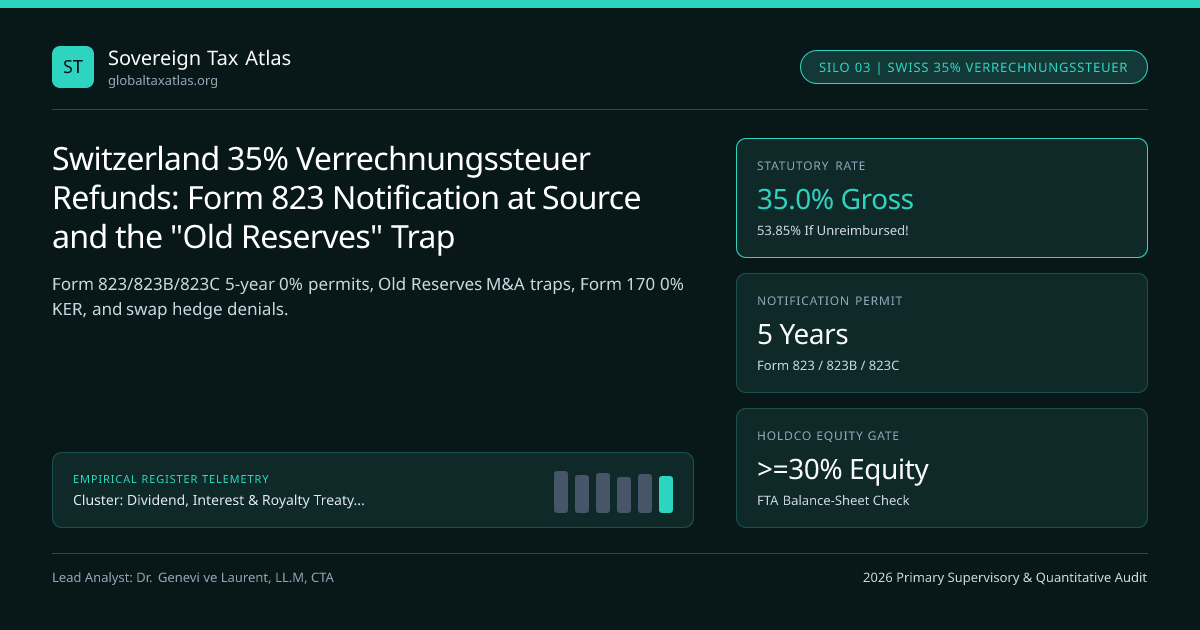
Enacted originally to compel domestic tax honesty before the era of Swiss AEOI and FATCA Model 1 exchanges, Switzerland's Federal Withholding Tax Act (VStG) levies a punishing 35.0% statutory Verrechnungssteuer on Swiss corporate dividends, constructive dividends, Swiss bank interest (>CHF 200), and Swiss domestic bonds! Benchmarked under Switzerland 35% Verrechnungssteuer Refund Mechanics and the 2026 Swiss WHT Benchmark Standard inside our Double Tax Treaty Withholding, MLI PPT, and US LOB reference, triggering the *Swiss Federal Tax Administration (FTA / ESTV) "Old Reserves" (Altreservenpraxis) doctrine* in an M&A acquisition freezes 35% of retained earnings permanently across the Dividend, Interest & Royalty Treaty Withholding, PPT & LOB cluster.
Two Intragroup vs Portfolio Relief Tracks: Form 823 Notification vs Form 82/85 Refund!#
Unlike the United States (where portfolio investors hand Form W-8BEN to a custodian for instant 15% relief at source on almost any stock), Switzerland splits dividend withholding execution sharply between portfolio shares and qualifying corporate parents:
- Portfolio Investors (<10% / <20% Stake — "Pay 35% First, Reclaim 20% Later"!): On standard Swiss SMI blue-chip equities (Nestlé, Novartis, Roche, UBS), Swiss paying banks deduct the full 35.0% Verrechnungssteuer on payday (except US QI at-source accounts)—requiring foreign investors to file electronic Form 82 / 85 / 86 via the Swiss FTA ePortal within three calendar years after the calendar year in which the dividend fell due to recover 20.0% (leaving the 15.0% treaty net tax)!
- Qualifying Corporate Parents (>=10% / >=20% Stake — 0.0% Notification Procedure at Source via Form 823 / 823B / 823C + Form 108!): A foreign corporate parent owning the treaty-required direct stake (>=10% in UK/DE/FR/LU/SG treaties; >=10% voting in US treaty for 5%, >=80% pension/sub rules; >=25% for 2 years under CH–EU Agreement Art. 9) NEVER wants 35% cash locked up at the Swiss FTA! Instead, the Swiss subsidiary obtains advance 3-year authorization (extended to 5 years under modernized VStV Ordinance!) using:
- Form 823: Bilateral Double Tax Treaties (outside US & CH–EU);
- Form 823B: CH–EU Automatic Exchange / Parent-Subsidiary Equivalent Agreement (Article 9);
- Form 823C: US–Switzerland Tax Treaty (verifying US Article 22 LOB!); plus
- Form 108: Filed within 30 days of dividend maturity Date (late filing carries a CHF 5,000 admin fine, not 35% forfeiture).
Inside the Notorious Swiss "Old Reserves" (Altreservenpraxis) M&A Trap!#
Every cross-border M&A lawyer buying a Swiss company from a Cayman, BVI (BVIFSC), Guernsey (GFSC), or non-treaty individual seller must calculate Old Reserves before signing the SPA:
- How the Trap Springs: Suppose Cayman Seller Co owns 100% of Swiss Target AG, which holds CHF 30 million of excess distributable cash ("non-operating assets") and CHF 45 million of accounting distributable reserves. If Cayman Seller took a CHF 30M dividend before selling, Cayman Seller would lose 35.0% = CHF 10.50 million permanently! Instead, Cayman Seller sells 100% of Swiss Target AG shares to substantive UK Acquirer PLC (0.0% UK–Swiss dividend treaty rate!).
- *Swiss FTA Altreserven* Assessment: Even when UK Acquirer PLC is a 100% genuine FTSE-100 operating giant with 10,000 UK employees, if the acquisition improved the withholding-tax refund position compared to the seller, the Swiss FTA taints the lesser of (a) commercially distributable non-operating excess cash/assets at closing and (b) distributable statutory reserves (CHF 30M) as "Old Reserves"—and DENIES UK Acquirer PLC the 0% treaty rate (charging non-refundable 35% = CHF 10.5M!) on the first CHF 30 million of post-closing dividends** when an abuse/restructuring or third-country pass-through exists (always secure an advance Swiss FTA Ruling).
Quantitative 53.85% Gross-Up & Old Reserves Price-Chip Math#
- [Triggered if Swiss Sub overpays management fees or undercharges IP/loan interest to foreign affiliate AND refuses to reimburse!]
- OldReservesTaintedPoolAtM&AClosing = Min(DistributableSwissStatutoryEquityReserves, ExcessNonOperatingLiquidAssets)
- SPAPurchasePriceIndemnityHaircut = OldReservesTaintedPool * (SellerResidualWHT% - BuyerTreatyWHT_%)
- Worked CHF 120M Swiss Pharma Buyout From BVI Seller (Seller Residual WHT = 35.0%; Luxembourg HoldCo Buyer Residual WHT = 0.0%):
- Swiss Target Balance Sheet at Closing: Distributable Reserves = CHF 40,000,000 | Excess Non-Operating Cash = CHF 22,000,000.
- If Lux HoldCo fails FTA 3-Prong Substance Test (Equity >=30% of HoldCo assets OR personnel/office OR multi-asset business):
- Tainted Old Reserves Pool = Min(40M, 22M) = CHF 22,000,000!
- First CHF 22.0M of post-closing dividends suffer NON-REFUNDABLE 35.0% Verrechnungssteuer = CHF 7,700,000 cash tax loss!
- Remedy: Capital Contribution Reserves (KER / Kapitaleinlagereserven) confirmed on FTA Form 170 distribute at 0.0% WHT unconditionally!
Capital Contribution Reserves (KER): The Ultimate 0% Swiss Dividend Shield!#
Whenever capitalizing a Swiss holding or operating company, structure share premium cleanly as *qualifying Capital Contribution Reserves (Kapitaleinlagereserven* — KER) audited and reported to the Swiss FTA on Form 170 within 30 days of shareholder approval! Under VStG Article 5(1bis), repayments of confirmed KER carry 0.0% Swiss Verrechnungssteuer to ANY shareholder on earth** (even a Cayman fund or non-treaty individual, subject only to the 50/50 matching rule on Swiss-listed companies!).
Swiss Withholding & FTA Substance Audit Matrix#
Private bankers, M&A tax counsel, and wealth managers—coordinating with Alpine neighbors like Andorra AFA and European supervisors under ESMA, alongside execution desks like Audacity Capital and Aag Markets—verify Swiss FTA substance tests across five tracks:
| Distribution / Claim Scenario | Swiss Form Required | Cash Deducted at Source? | FTA Substance / Anti-Abuse Test | Fatal Pitfall |
|---|---|---|---|---|
| Confirmed Capital Contribution Reserve (KER) | Form 170 | 0.0% | Direct capital contribution by direct shareholder | Accounting booking error (must book in separate reserve!) |
| EU Parent (>=25% 2 yrs / Bilateral >=10%) | Form 823B / 823 + 108 | 0.0% (with Permit) | 3-Prong FTA HoldCo Test (30% equity + office/staff) | Paying dividend before Form 823 permit filed -> 35% lockup! |
| US Corporate Parent (>=10% Vote) | Form 823C + 108 | 5.0% (or 0% Pension) | Strict US Art. 22 LOB + Old Reserves | Post-M&A cash strip from former Cayman seller |
| Foreign Portfolio Fund / Individual | ePortal Form 82 / 85 | 35.0% (20% Refunded) | Beneficial ownership (NO securities lending / Total-Return Swap hedge!) | Swiss FTA denies 100% refund if holder hedged delta (>=80%) via swap! |
| Hidden Intragroup Overcharge (TP Adjustment) | Secondary Form 102/110 | 35.0% (or 53.85%!) | Arm's-length pricing (Art. 11.6) | Refusing cash return (Rückleistung) triggers 53.85% gross-up! |
Frequently asked questions
What is the Swiss FTA three-prong substance checklist when auditing a Luxembourg or Dutch HoldCo Form 823 application?
The Swiss FTA tests three cumulative layers (failing one can be compensated by stronger proof on the others): (1) Financial Substance (>=30% equity-to-asset ratio financing the Swiss participation); (2) Personnel & Functional Substance (own leased office premises and qualified payroll staff); or (3) Real Holding Activity (holding multiple substantial participations in different countries).
Why did the Swiss Federal Supreme Court deny Danish and UK bank dividend-refund claims on hedged Swiss SMI shares?
In landmark Swiss Supreme Court rulings on cross-border equity derivatives, the Court held that a bank buying physical Swiss shares solely to hedge a short total-return swap or single-stock future sold to a third party is contractually/economically obligated to pass the dividend economics onward—failing Beneficial Ownership completely!
What happens if a Swiss subsidiary forgets to file Form 108 within 30 days of paying an intragroup dividend?
Following the 2017 Swiss Withholding Tax Act reform (reversing harsh pre-2017 penalty-interest rules!), missing the 30-day Form 108 filing deadline when substantive treaty entitlement is met no longer forfeits notification relief or triggers 5% p.a. late interest—instead carrying solely an administrative order fine up to CHF 5,000.
Did Switzerland abolish its 35% withholding tax on corporate bonds?
No! Although the Swiss Parliament passed a bill to abolish the 35% withholding tax on newly issued domestic Swiss bonds, Swiss voters narrowly rejected the reform in a September 2022 national referendum—meaning Swiss issuers still issue international bonds via foreign subsidiaries without repatriating proceeds harmfully into Switzerland (or stay inside the 10/20 Non-Bank Rule)!
Publication record
- Published
- 13 November 2026
- Updated
- 15 November 2026
- Author
- Dr. Geneviève Laurent, LL.M, CTA
- Review
- Review not recorded
- Automated fact check
- Passed in the stored pipeline record
- Source URLs
- 3 recorded
AI assistance recorded: anthropic/claude-opus-4.6. This field does not establish human review or source verification.
Academic & Institutional Attribution
Cite This Research & Embed Live Data Card
Standard academic & institutional research paper citation format.
Dr. Geneviève Laurent, LL.M, CTA. (2026, November 15). Switzerland 35% Verrechnungssteuer Refunds: Form 823 Notification at Source and the "Old Reserves" Trap. Sovereign Tax Atlas. https://globaltaxatlas.org/entries/switzerland-35-verrechnungssteuer-treaty-refund-old-reservesRegulatory Directory Cross-Reference
Referenced Institutions & Regulatory Registries
Top Regulated Institutions in This Coverage Slice
Related Double Tax Treaty Withholding Lob & Institutional Briefings
Explore Double Tax Treaty Withholding Lob Hub (20) →Double Tax Treaty Withholding Lob
Double Tax Treaty Withholding Rates, OECD MLI Principal Purpose Test, and US LOB ReferenceDouble Tax Treaty Withholding Lob
US–UK Double Tax Treaty Article 10(3): Qualifying for 0% Subsidiary and Pension Dividend WithholdingDouble Tax Treaty Withholding Lob
US–Ireland Tax Treaty 15% Dividend Withholding: Why Irish ICAV UCITS Dominate Global ETFsDouble Tax Treaty Withholding Lob
US Portfolio Interest Exemption (IRC 871(h) & 881(c)): 10% Shareholder Attribution and Bank TrapsDouble Tax Treaty Withholding Lob
US IRC Section 871(m) Dividend Equivalents: Delta-One Swaps, Notice 2024-44, and Qualified IndicesDouble Tax Treaty Withholding Lob
US IRC Section 892 Sovereign Wealth Fund Tax Exemption: Controlled Entities and Commercial TaintDouble Tax Treaty Withholding Lob
EU Parent-Subsidiary and Interest-Royalties Directives After the ECJ Danish Beneficial Ownership CasesDouble Tax Treaty Withholding Lob
OECD Pillar Two Subject to Tax Rule (STTR): 9% Gross Withholding, Markup Caps, and MLI RolloutEconomic Substance Cfc Transfer Pricing
OECD Transfer Pricing Guidelines Chapter VI: Intangible DEMPE Functions vs Legal IP OwnershipEconomic Substance Cfc Transfer Pricing
Hard-to-Value Intangibles (HTVI): Ex-Post Outcomes, the 20% Valuation Corridor, and Price AdjustmentsEconomic Substance Cfc Transfer Pricing
OECD Pillar One Amount B (2025+): Baseline Wholesale Marketing and Distribution Return-on-Sales MatrixEconomic Substance Cfc Transfer Pricing
OECD Transfer Pricing Chapter X: Intragroup Loans, Implicit Halo Support, Cash Pools, and Guarantees
Sovereign Tax Atlas Data, Benchmarks & Contributor Records
CC BY 4.0 Open Data
Open Institutional Datasets (CSV / JSON) →
Download desk-compiled quantitative series & schemas.
2026 Reference Matrix
2026 Institutional Benchmarks & Thresholds →
Statutory capital, clearing, margin & rate conventions.
Editorial Records
Authors & Review Records →
View named contributors where those records are available.
Complete Index
Master Research & Dossier Archive →
Browse all published briefings by topic pillar & date.