
Double Tax Treaty Withholding Lob
US Model Article 22 Limitation on Benefits (LOB): Publicly Traded, Base Erosion, and Active Trade
Every corporate claimant seeking 0%, 5%, or 15% US treaty withholding must pass an objective Article 22 Limitation on Benefits test—checking Publicly Traded, 50% Ownership and Base Erosion, or Active Trade or Business.
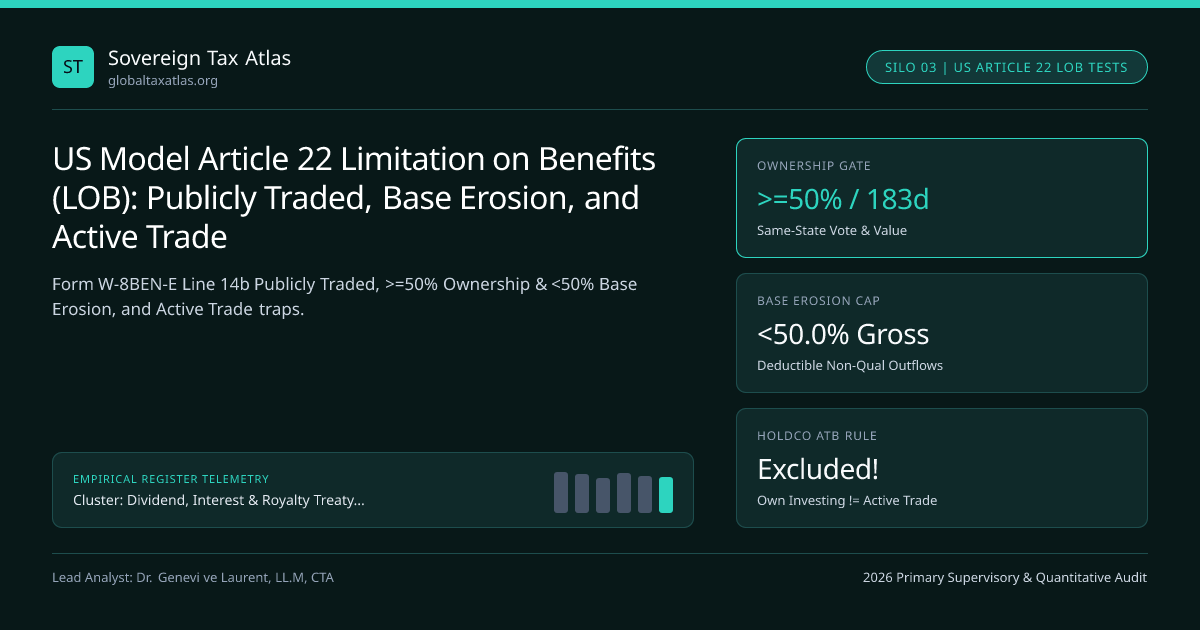
Unlike European and Asian tax treaties governed by the subjective OECD MLI Article 7 Principal Purpose Test, every modern United States bilateral income tax treaty enforces a rigid, mathematical Article 22 Limitation on Benefits (LOB) gate (sometimes numbered Article 23 in the US–UK and US–Ireland treaties, or Article 26 in US–Netherlands!). Benchmarked under US Article 22 LOB vs OECD MLI PPT within our Double Tax Treaty Withholding, MLI PPT, and US LOB reference, a UK, Irish, Dutch, Luxembourg, Swiss, Japanese, or German company with 100 employees and a gleaming headquarters STILL suffers 30.0% statutory US withholding if its shareholders live in third countries and it fails every checkbox on Form W-8BEN-E Part III Line 14b across the Dividend, Interest & Royalty Treaty Withholding, PPT & LOB cluster!
Four Core Gateways Inside US Model Article 22 (Form W-8BEN-E Line 14b)#
To claim any US tax treaty benefit, a foreign company must satisfy at least one objective LOB gateway:
- Article 22(2)(c) — Publicly Traded Company & Subsidiary of Publicly Traded Company:
- Parent: Principal class of shares (and any disproportionate class!) is regularly traded on one or more Recognized Stock Exchanges (requiring both meaningful annual share turnover AND a primary nexus to the treaty state's exchange or local management & control!).
- Subsidiary: At least 50.0% of the aggregate vote AND value of the company's shares is owned directly or indirectly by 5 or fewer publicly traded companies resident in either Contracting State—PROVIDED every intermediate company in an indirect chain is itself a Qualifying Resident (or EU/NAFTA Equivalent Beneficiary in older treaties, tightened in 2016 US Model!)!
- Article 22(2)(f) — Two-Prong Ownership AND Base Erosion Test: Requires satisfying BOTH prongs simultaneously:
- Ownership Prong (>=50%* Days & Vote/Value): On at least half the days of the taxable year (>=183 days), qualifying residents of that same treaty country (individuals, government, publicly traded companies, pensions/charities) own directly or indirectly at least 50.0% of the aggregate vote AND value* of shares!
- Base Erosion Prong (<50%* Deductible Outflows): Less than 50.0% of the company's gross income* (or tax-consolidated group gross income!) is paid or accrued directly or indirectly to non-qualifying persons in the form of payments deductible for tax purposes in the residence state (interest, royalties, management fees—excluding arm's-length COGS tangible goods and bank debt)!
- Article 22(3) — Active Trade or Business (ATB) Test (Item-by-Item Relief!): Even if 100% owned by Cayman/Middle East investors (failing the 50% Ownership Test!), a treaty company can claim treaty relief solely on specific US income derived "in connection with" (or incidental to) an Active Trade or Business conducted by its own employees in the treaty country—EXCLUDING making or managing investments for its own account (unless a licensed bank, insurer, or securities dealer)! And if the US payer is a related party (>=50% common ownership), the treaty-state business must be "substantial" in relation to the US income-generating activity!
- [Article 22(4) — Derivative Benefits Test (>=95% by <=7 Equivalent Beneficiaries)](/entries/treaty-derivative-benefits-test-95-percent-equivalent-beneficiary): Crucial lifeline in European/UK/Canadian/Mexican treaties for multi-country owned HoldCos!
Two Traps That Destroy Otherwise Valid US LOB Claims!#
- Why Private Equity & Venture HoldCos NEVER Pass the Active Trade or Business (ATB) Test!: Corporate directors of a Luxembourg or UK HoldCo often check "Active Trade or Business" on Form W-8BEN-E Line 14b because the HoldCo owns 100% of an active US software manufacturer! Fatal error: Under every US Technical Explanation (and 2016 US Model Art. 22(3)(b)), the business of "operating as a holding company" or "making or managing investments for the resident's own account" (other than a regulated bank, insurance company, or broker-dealer) is per se NOT an Active Trade or Business—and parent-level headquarters supervision does NOT qualify!
- Intermediate Non-Qualifying Chain Links: Suppose Listed UK PLC owns 100% of Cayman Intermediate Ltd, which owns 100% of UK Sub Ltd, which receives US dividends! Even though UK Sub Ltd is ultimately 100% owned by Listed UK PLC, interposing Cayman Intermediate Ltd (a resident of neither the US nor the UK!) breaks the qualifying intermediate-owner chain under Article 22(2)(c)(ii) and Article 22(2)(f)!
Quantitative Base Erosion Test Math & Deductible Payment Audit#
- LOBBaseErosionProngPass = (DeductiblePaymentstoNonQualifyingPersons / TotalTaxGrossIncome) < 50.0%
- Worked Dutch IP & Financing Subsidiary Testing US–Netherlands Article 26(2)(f) Ownership & Base Erosion (FY 2026):
- Ownership: 60% owned by Dutch natural-person founders + 40% by Singapore VC Fund -> Ownership Prong = 60.0% >= 50.0% (PASSES!)
- Gross Income: USD 30,000,000 US-source software royalties & interest.
- Outbound Tax-Deductible Expenses in Netherlands:
- USD 11,000,000 sub-royalty paid to Cayman IP Co (Non-Qualifying Person!)
- USD 5,500,000 interest paid on mezzanine note to BVI Credit Fund (Non-Qualifying Person!)
- USD 4,000,000 Dutch employee R&D salaries (Dutch residents = Qualifying Persons -> Excluded from numerator!)
- Base Erosion Ratio = (11,000,000 + 5,500,000) / 30,000,000 = 16,500,000 / 30,000,000 = 55.00% (>= 50.0%!)
- Verdict: FAILS Base Erosion Prong by USD 1,500,001 -> Loses 0% US Royalty Treaty -> Suffers 30.0% US Statutory WHT = USD 9,000,000 tax hit!
Benchmarking Form W-8BEN-E Line 14b LOB Thresholds#
US LOB Qualification & Structuring Matrix#
Corporate tax departments and fund counsel—coordinating across ESMA, JFSC, and Puerto Rico OCIF, alongside trading houses like Bancwesttrade and Axiory—map corporate profiles to exact Form W-8BEN-E Line 14b checkboxes:
| Foreign Entity Profile | Line 14b LOB Box Checked | Passes LOB? | Key Quantitative Audit Check | Fallback If Failed |
|---|---|---|---|---|
| FTSE 100 / DAX 40 Wholly Owned OpCo | Subsidiary of Publicly Traded Co | YES | Verify zero Cayman/BVI intermediate HoldCo in chain! | Re-stack intermediate link |
| Private UK Co (70% UK Founders, 30% UAE) | Ownership & Base Erosion Test | YES (if <50% erosion) | Audit deductible interest/royalties to UAE/Cayman <50% | Cap subordinated debt coupon |
| Lux HoldCo (40% UK, 35% DE, 25% FR) | Derivative Benefits Test | YES (100% >= 95%, 3 <= 7) | Each EU/UK owner must enjoy <= claimed WHT rate! | Direct co-invest feeder |
| Cayman PE Fund's Lux HoldCo (60% Non-Treaty) | Fails Ownership & Deriv. Benef.! | NO -> 30% US WHT! | HoldCo cannot check Active Trade or Business! | Use 0% IRC 881(c) Debt + Exit CGT (0%) |
| German Auto Maker Licensing to US Sub | Active Trade or Business (ATB) | YES | German manufacturing/R&D substantial vs US sales sub | Publicly Traded if listed |
Frequently asked questions
Can a private equity fund Luxembourg or UK holding company ever qualify under the Active Trade or Business (ATB) LOB test?
No! Every US tax treaty and Treasury Technical Explanation explicitly provides that the business of making or managing investments for the company own account (including functioning as a group or private equity holding company!) does NOT constitute an Active Trade or Business unless carried on by a bank, insurer, or registered securities dealer.
What happens if a company fails every mechanical LOB test but has genuine non-tax commercial reasons for existing?
Under Article 22(6) Discretionary Relief, the taxpayer can apply to the US IRS Competent Authority (Advance Pricing and Mutual Agreement Program — APMA, Rev. Proc. 2015-40, carrying a substantial IRS user fee of ~USD 47,500 and a 9–18 month review!) to demonstrate that establishing/maintaining the entity did not have obtaining treaty benefits as one of its principal purposes.
How do private equity funds with global non-treaty LPs invest into US companies if their HoldCo fails US LOB?
Instead of relying on US dividend treaties (which fail LOB!), sponsors capitalize a US corporate Blocker with levered shareholder loans qualifying for the domestic 0% IRC Section 881(c) Portfolio Interest Exemption (<10% per LP via partnership look-through!) and exit via tax-free foreign stock sales (0% US capital gains tax outside FIRPTA)!
Does cost of goods sold (COGS) for physical inventory bought from a Chinese factory count against the 50% LOB Base Erosion Test?
No! Under US Technical Explanations, "gross income" already reflects gross receipts minus cost of goods sold (and arm-length payments for tangible property in the ordinary course of business are excluded from base-eroding deductible payments, unlike royalties, interest, and service fees).
Publication record
- Published
- 13 November 2026
- Updated
- 15 November 2026
- Author
- Dr. Geneviève Laurent, LL.M, CTA
- Review
- Review not recorded
- Automated fact check
- Passed in the stored pipeline record
- Source URLs
- 3 recorded
AI assistance recorded: anthropic/claude-opus-4.6. This field does not establish human review or source verification.
Academic & Institutional Attribution
Cite This Research & Embed Live Data Card
Standard academic & institutional research paper citation format.
Dr. Geneviève Laurent, LL.M, CTA. (2026, November 15). US Model Article 22 Limitation on Benefits (LOB): Publicly Traded, Base Erosion, and Active Trade. Sovereign Tax Atlas. https://globaltaxatlas.org/entries/us-model-article-22-limitation-on-benefits-ownership-active-testsRegulatory Directory Cross-Reference
Referenced Institutions & Regulatory Registries
Mentioned Regulated Institutions
Related Double Tax Treaty Withholding Lob & Institutional Briefings
Explore Double Tax Treaty Withholding Lob Hub (20) →Double Tax Treaty Withholding Lob
Double Tax Treaty Withholding Rates, OECD MLI Principal Purpose Test, and US LOB ReferenceDouble Tax Treaty Withholding Lob
Treaty Derivative Benefits Test: 95% Ownership by 7 or Fewer Equivalent Beneficiaries Post-BrexitDouble Tax Treaty Withholding Lob
EU FASTER Directive (2025/50): Digital eTRCs, Certified Intermediaries, and 50-Day Quick RefundsDouble Tax Treaty Withholding Lob
Switzerland 35% Verrechnungssteuer Refunds: Form 823 Notification at Source and the "Old Reserves" TrapDouble Tax Treaty Withholding Lob
US–UK Double Tax Treaty Article 10(3): Qualifying for 0% Subsidiary and Pension Dividend WithholdingDouble Tax Treaty Withholding Lob
US–Ireland Tax Treaty 15% Dividend Withholding: Why Irish ICAV UCITS Dominate Global ETFsDouble Tax Treaty Withholding Lob
US Portfolio Interest Exemption (IRC 871(h) & 881(c)): 10% Shareholder Attribution and Bank TrapsDouble Tax Treaty Withholding Lob
US IRC Section 871(m) Dividend Equivalents: Delta-One Swaps, Notice 2024-44, and Qualified IndicesEconomic Substance Cfc Transfer Pricing
US GILTI / Net CFC Tested Income (IRC Section 951A): 2026 OBBBA Reforms, Section 250, and FTC HaircutsEconomic Substance Cfc Transfer Pricing
EU Anti-Tax Avoidance Directive (ATAD) Articles 7–8 CFC Rules: Model A Passive Categories vs Model B SPFEconomic Substance Cfc Transfer Pricing
UK TIOPA 2010 Part 9A CFC Regime: Chapter 3 Gateways, 75% Tax Exemption, and Chapter 9 Finance Company RulesEconomic Substance Cfc Transfer Pricing
OECD Transfer Pricing Guidelines Chapter VI: Intangible DEMPE Functions vs Legal IP Ownership
Sovereign Tax Atlas Data, Benchmarks & Contributor Records
CC BY 4.0 Open Data
Open Institutional Datasets (CSV / JSON) →
Download desk-compiled quantitative series & schemas.
2026 Reference Matrix
2026 Institutional Benchmarks & Thresholds →
Statutory capital, clearing, margin & rate conventions.
Editorial Records
Authors & Review Records →
View named contributors where those records are available.
Complete Index
Master Research & Dossier Archive →
Browse all published briefings by topic pillar & date.