
Double Tax Treaty Withholding Lob
US IRC Section 892 Sovereign Wealth Fund Tax Exemption: Controlled Entities and Commercial Taint
Foreign governments and Sovereign Wealth Funds enjoy 0.0% US tax on stocks, bonds, and deposits under IRC Section 892—until a single dollar of commercial activity taints a Controlled Entity into a Controlled Commercial Entity.
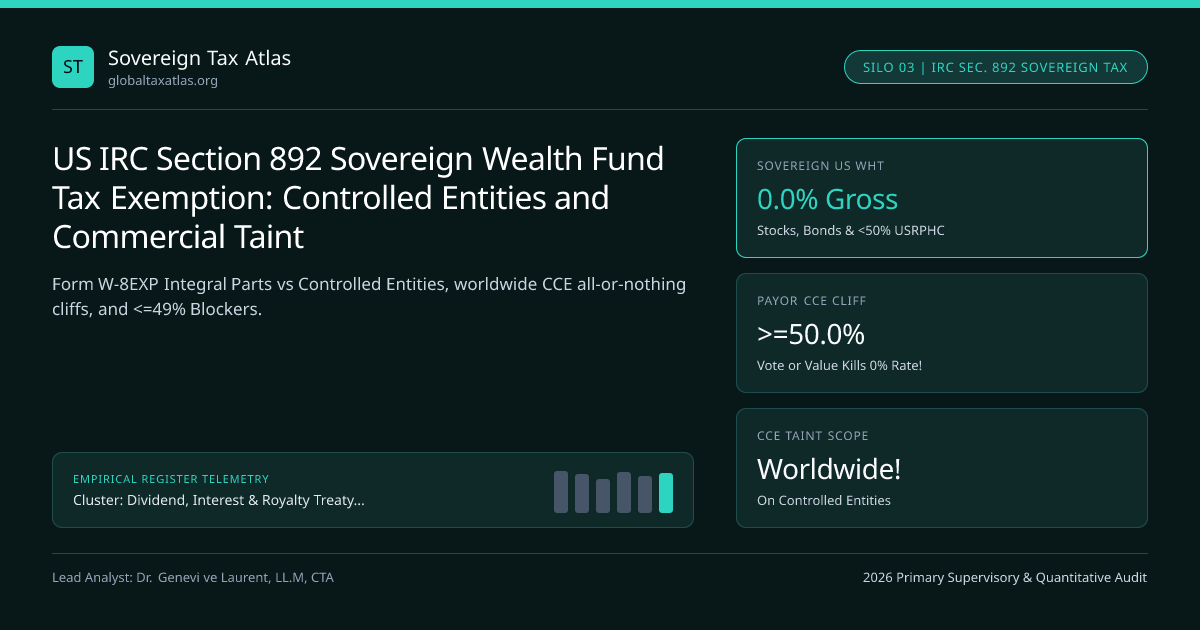
Managing more than USD 13 trillion in sovereign reserves across Abu Dhabi, Riyadh, Singapore, Norway, Doha, Kuwait, and Tokyo, Sovereign Wealth Funds (SWFs) and foreign central banks rely on US Internal Revenue Code Section 892 (documented on IRS Form W-8EXP) to collect 0.0% US tax on dividends, interest, and stock gains beyond US-UK Article 10 exemptions! Benchmarked under US IRC Section 892 Exemption and IRC 892 Standard inside our Double Tax Treaty Withholding, MLI PPT, and US LOB reference, Section 892 hides the most terrifying binary cliff in international tax law across the Dividend, Interest & Royalty Treaty Withholding, PPT & LOB cluster: the Controlled Commercial Entity ("CCE") All-or-Nothing Taint!
Critical Structural Split: "Integral Part" vs "Controlled Entity"!#
Never execute Form W-8EXP without knowing whether your sovereign investor is an Integral Part of a Foreign Sovereign or a Controlled Entity of a Foreign Sovereign (Treas. Reg. §1.892-2T):
- Integral Part of a Foreign Sovereign (e.g., a Ministry of Finance, Treasury Department, or statutory agency without separate corporate personality whose net earnings credit solely to the state): If an Integral Part accidentally earns USD 50,000 of commercial income (say, originating a commercial loan or operating a partnership!), ONLY that USD 50,000 of commercial income is taxed—its USD 40 billion passive S&P 500 dividend portfolio stays 100% EXEMPT!
- Controlled Entity of a Foreign Sovereign (a separately incorporated company wholly owned and controlled 100% by a single foreign sovereign—such as most separately incorporated SWF subsidiaries and holding SPVs!): Look at IRC Section 892(a)(2)(B) — The "All-or-Nothing" Cliff:
- If a Controlled Entity engages in ANY commercial activity ANYWHERE IN THE WORLD (such as direct loan origination or an active general-partner stake), that Controlled Entity instantaneously mutates into a "Controlled Commercial Entity" (CCE)—LOSING 100% OF ITS SECTION 892 EXEMPTION ON EVERY DOLLAR OF US STOCK DIVIDENDS AND INTEREST FOR THE ENTIRE YEAR!
Two Statutory Relief Lifelines: Limited Partner Safe Harbor & Repeal of the USRPHC Trap!#
Recent Treasury regulations delivered two game-changing protections for Sovereign Wealth Fund private-equity and real-estate allocations:
- Limited Partner Exception (2011 Proposed Reg. §1.892-5(d)(5)(iii), Relied Upon Currently!): Normally, under partnership attribution, commercial activities of a partnership flow up and taint EVERY partner! However, under the Limited Partner Exception, commercial activity of a partnership is NOT attributed to a sovereign Controlled Entity holding a pure passive Limited Partner interest (zero right to participate in day-to-day management/control!), so while the SWF still pays 21% ECI tax on its distributive share of that partnership's active income, that LP stake does NOT taint the Controlled Entity's USD 10B public equity portfolio into a CCE!
- 2022 Final Regulations Repealing the "Deemed CCE USRPHC Real Estate Trap" (TD 9971 / Prop. Regs)!: Historically, under Temp. Reg. §1.892-5T(b)(1), if a Sovereign Controlled Entity’s balance sheet drifted above 50% US real estate / USRPHCs (see FIRPTA Sec. 897), the SWF subsidiary ITSELF was deemed a Controlled Commercial Entity—wiping out 0% Section 892 even on its Apple/Microsoft shares! Final/Proposed Treasury regulations relieved minority non-controlling Qualified Holder / USRPHC portfolio traps so passive real-estate/REIT balance-sheet weightings no longer auto-taint non-real-estate SWF subsidiaries!
Watch the ">=50% Controlled Commercial Payor" Trap!#
Even if the Sovereign Wealth Fund itself is a pure Integral Part, read IRC Section 892(a)(2)(A)(ii): Section 892 NEVER exempts dividends or interest received FROM a Controlled Commercial Entity—defined as any US or foreign company in which the Sovereign holds >=50.0% of total vote OR value (or effective practical control)!
- Crucial Consequence: If an SWF buys 49.0% of a US C-Corp Blocker, dividends paid by that Blocker to the SWF enjoy 0.0% US withholding under Section 892! If the SWF buys 50.0% (or 100%) of that exact same US C-Corp Blocker, the Blocker becomes a CCE—and dividends suffer full 30.0% statutory US withholding! Single-SWF deals therefore co-invest <=49% alongside unrelated GPs or rely on 0% Section 892 stock-sale exits (contrast 0% Portfolio Interest <10% rules).
Quantitative 49.0% vs 50.0% Sovereign Equity Cliff Modeling#
- 0.0% if s < 50.0% AND NoEffectivePractical_Control (Blocker is NOT a CCE under IRC Sec. 892(a)(2)(B)!)
- 30.0% if s >= 50.0% OR EffectivePracticalControl (Blocker IS a CCE -> 892 Denied; defaults to 30% or Bilateral DTA!)
- Worked USD 400M US Infrastructure Equity Investment by Gulf Sovereign Wealth Fund (Zero US Tax Treaty; Annual Cash Dividend = USD 32,000,000):
- Structure A — Wholly Owned 100% Single-Investor Delaware Blocker Corp:
- Blocker = 100% (>=50%) Sovereign Owned -> Controlled Commercial Entity (CCE)!
- IRC Sec. 892 Dividend Exemption = DENIED! | IRC Sec. 881(c) Portfolio Interest = DENIED (100% >= 10% vote)!
- Annual US Dividend Withholding = 30.0% * USD 32,000,000 = USD 9,600,000 / year lost!
- Structure B — 49.0% Sovereign Co-Investment Alongside 51.0% Unrelated Institutional Consortium (Zero Veto Control Over Day-to-Day Ops):
- Blocker < 50.0% Sovereign Owned & Zero Effective Control -> NOT a CCE!
- IRC Sec. 892 Dividend Exemption = APPLIES -> 0.0% US Dividend WHT (Saves USD 9.60M/year on USD 32M pro-rata scale!).
IRC Section 892 & Form W-8EXP Structuring Matrix#
Sovereign wealth counsel, placement agents, and sovereign hub authorities—across DIFC, DMCC, and Singapore MAS hubs, alongside global prime desks like Alamiya Markets and Bancwesttrade—enforce strict silo isolation across sovereign balance sheets:
| Income / Asset Stream | Integral Part (Line 11a) | Clean Controlled Entity (Line 11b) | Tainted Controlled Commercial Entity (CCE) | Mandatory Silo Action |
|---|---|---|---|---|
| <50% Listed US Equities & REITs (<=10%) | 0.0% WHT | 0.0% WHT | 30.0% WHT! (Entire entity ruined!) | Never mix active deals in public-equity SPV! |
| 49% Uncontrolled US C-Corp Blocker | 0.0% Div & Exit | 0.0% Div & Exit | 30.0% Div (0% non-FIRPTA stock exit) | Cap vote & value at <=49.0%; limit veto rights |
| >=50% Controlled US C-Corp Blocker | 30.0% Div! (CCE payor!) | 30.0% Div! (+ Risk tainting parent!) | 30.0% Div | Hold >=50% buyouts via Separate Sister SPV! |
| Sale of <50% Non-Controlling USRPHC Shares | 0.0% Tax (Overrides FIRPTA!) | 0.0% Tax | 21.0% FIRPTA Tax! | Direct real estate bricks-and-mortar ALWAYS taxed! |
| Loan Origination / Derivatives Dealing | Taxed on loan slice only | FATAL -> Turns SPV into CCE! | Taxed | Isolate private credit inside dedicated Credit Blocker |
Frequently asked questions
Why does selling 45% of shares in a US Real Estate Corporation pay 0% under Section 892 while selling a Manhattan building pays 21% FIRPTA tax?
Treas. Reg. §1.892-3T(a)(1) exempts income from "stocks and securities"—explicitly including minority (<50%) stock of a US Real Property Holding Corporation (USRPHC)—while carving out direct dispositions of physical US real property interests!
Does trading derivatives, FX forwards, or cryptocurrencies for a Sovereign Wealth Fund own account count as tainted "commercial activity"?
Under Treas. Reg. §1.892-4T(c)(1), effecting transactions in stocks, bonds, debt, commodities, and financial derivatives (swaps, options, futures, FX) for the foreign government OWN account (not acting as a market-making dealer for customers!) is expressly NOT commercial activity!
How does IRC Section 895 for Foreign Central Banks differ from IRC Section 892?
IRC Section 895 provides a supplementary shield specifically for Foreign Central Banks of Issue (checked separately on Form W-8EXP), exempting income from US Treasury obligations and bank deposits as long as they are not held for or used in commercial banking activities.
Can a Sovereign Wealth Fund own 50% of a joint-venture SPV shared with a second Sovereign Wealth Fund from ANOTHER country?
Under Treas. Reg. §1.892-2T(a)(3), to be a "Controlled Entity" eligible for Section 892 itself, an entity must be wholly owned by ONE SINGLE foreign sovereign (two different countries pooling 50/50 into one corporate SPV disqualifies that SPV as a Controlled Entity—use a fiscally transparent partnership instead!).
Publication record
- Published
- 13 November 2026
- Updated
- 15 November 2026
- Author
- Dr. Geneviève Laurent, LL.M, CTA
- Review
- Review not recorded
- Automated fact check
- Passed in the stored pipeline record
- Source URLs
- 3 recorded
AI assistance recorded: anthropic/claude-opus-4.6. This field does not establish human review or source verification.
Academic & Institutional Attribution
Cite This Research & Embed Live Data Card
Standard academic & institutional research paper citation format.
Dr. Geneviève Laurent, LL.M, CTA. (2026, November 15). US IRC Section 892 Sovereign Wealth Fund Tax Exemption: Controlled Entities and Commercial Taint. Sovereign Tax Atlas. https://globaltaxatlas.org/entries/us-irc-section-892-sovereign-wealth-fund-commercial-activity-trapRegulatory Directory Cross-Reference
Referenced Institutions & Regulatory Registries
Top Regulated Institutions in This Coverage Slice
Related Double Tax Treaty Withholding Lob & Institutional Briefings
Explore Double Tax Treaty Withholding Lob Hub (20) →Double Tax Treaty Withholding Lob
Double Tax Treaty Withholding Rates, OECD MLI Principal Purpose Test, and US LOB ReferenceDouble Tax Treaty Withholding Lob
EU Parent-Subsidiary and Interest-Royalties Directives After the ECJ Danish Beneficial Ownership CasesDouble Tax Treaty Withholding Lob
OECD Pillar Two Subject to Tax Rule (STTR): 9% Gross Withholding, Markup Caps, and MLI RolloutDouble Tax Treaty Withholding Lob
India–Mauritius Tax Treaty 2024 PPT Protocol, Grandfathered Capital Gains, and Indian TRC Audit RulesDouble Tax Treaty Withholding Lob
Singapore IRAS Certificate of Residence (COR): Foreign-Owned HoldCo Substance and 90+ APAC TreatiesDouble Tax Treaty Withholding Lob
UK Qualifying Asset Holding Company (QAHC) vs Quoted Eurobond: 0% Outbound Interest WithholdingDouble Tax Treaty Withholding Lob
Cross-Border Securities Lending, Manufactured Dividends, and Post-Cum-Ex Anti-Dividend-Washing RulesDouble Tax Treaty Withholding Lob
OECD Model Article 10 Dividend Withholding: 5% Direct Participation, 365-Day Hold, and 15% PortfolioEconomic Substance Cfc Transfer Pricing
Transfer Pricing Bilateral APAs and Tax Treaty Article 25 Mandatory Binding ArbitrationEconomic Substance Cfc Transfer Pricing
Labuan IBFC Economic Substance Requirements: FTE Headcount, MYR Opex Gates, and the 3% vs 24% LBATA CliffEconomic Substance Cfc Transfer Pricing
UAE Economic Substance Repeal & Integration Into 0% Qualifying Free Zone Person (QFZP) Corporate Tax AuditsEconomic Substance Cfc Transfer Pricing
BEPS Action 13 Three-Tier Transfer Pricing Documentation: Master File, Local File, and Penalty Protection
Sovereign Tax Atlas Data, Benchmarks & Contributor Records
CC BY 4.0 Open Data
Open Institutional Datasets (CSV / JSON) →
Download desk-compiled quantitative series & schemas.
2026 Reference Matrix
2026 Institutional Benchmarks & Thresholds →
Statutory capital, clearing, margin & rate conventions.
Editorial Records
Authors & Review Records →
View named contributors where those records are available.
Complete Index
Master Research & Dossier Archive →
Browse all published briefings by topic pillar & date.