
Double Tax Treaty Withholding Lob
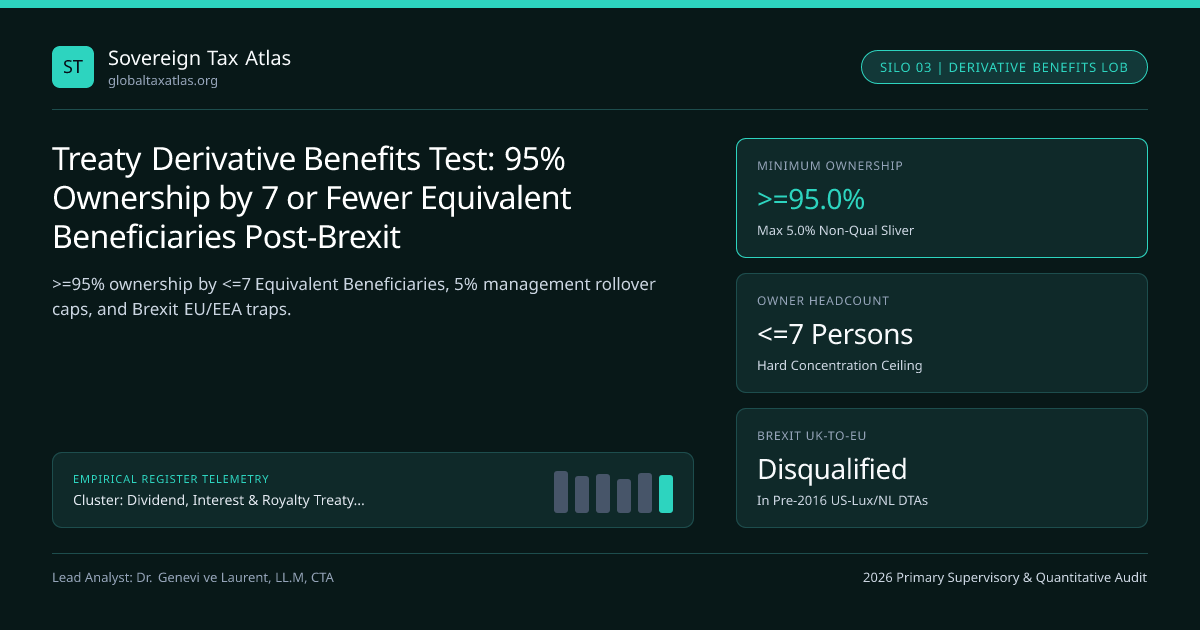
Treaty Derivative Benefits Test: 95% Ownership by 7 or Fewer Equivalent Beneficiaries Post-Brexit
When a European, UK, Canadian, or Mexican holding company is jointly owned by investors across multiple treaty states, the Derivative Benefits LOB test rescues 0%, 5%, or 15% US withholding—if >=95% is held by <=7 Equivalent Beneficiaries.
Suppose a pan-European joint venture forms a Luxembourg HoldCo (LU RAIF/HoldCo) owned 35% by a listed UK parent, 35% by a listed German parent, and 30% by a listed French parent to own 100% of a US operating subsidiary. Under the standard US Article 22 Ownership & Base Erosion test, Luxembourg HoldCo has 0% Luxembourg-resident shareholders—failing the 50% same-country test completely! That absurd cliff is solved by Derivative Benefits (found in Article 22(4) of the 2016 US Model and Article 23(3) of the US–UK Treaty and most US–EU/USMCA treaties!). Within our Double Tax Treaty Withholding, MLI PPT, and US LOB reference, post-Brexit geographic perimeter shifts and rate-comparison cliffs require surgical modeling across the Dividend, Interest & Royalty Treaty Withholding, PPT & LOB cluster.
Two Strict Mathematical Prongs of the Derivative Benefits Test#
To check "Derivative Benefits Test" on Form W-8BEN-E Part III Line 14b, the treaty-resident company must satisfy both mathematical prongs:
- ≥95.0% Ownership by ≤7 "Equivalent Beneficiaries" Prong: At least 95.0% of the aggregate voting power and value of its shares (and any disproportionate class of shares!) is owned directly or indirectly by seven (7) or fewer persons that are Equivalent Beneficiaries! (Count carefully: if 8 institutional investors each own 12.5%—even if all 8 are listed US/UK/German giants!—8 > 7* FAILS the 7-person ceiling unless 7 of them already sum to >=87.5%? Wait: 7 × 12.5% = 87.5% < 95.0% -> FAILS Derivative Benefits!)*
- <50.0% Base Erosion Prong: Less than 50.0% of the company's gross income for the taxable year is paid or accrued directly or indirectly to persons who are NOT Equivalent Beneficiaries in the form of tax-deductible payments! (Notice how much friendlier this is than standard Base Erosion: interest paid by Luxembourg HoldCo to its German or UK Equivalent Beneficiary parent does NOT taint Base Erosion here!)
Post-Brexit Trap: Is a UK Parent Still an "Equivalent Beneficiary" for an EU HoldCo?!#
Read this historic Brexit landmine twice—it broke hundreds of UK-owned Luxembourg, Dutch, and Irish US-inbound structures on January 1, 2021:
- In pre-2016 US bilateral treaties with EU Member States (such as US–Luxembourg Art. 24(4), US–Ireland Art. 23(3)/Protocol, US–Netherlands Art. 26(4), and US–Germany Art. 28(3)), the treaty text defined "Equivalent Beneficiary" geographically as a resident of "a Member State of the European Union, a European Economic Area (EEA) state, or a party to NAFTA/USMCA" (plus Switzerland in select protocols)!
- What Happened When the UK Left both the EU and the EEA?:
- In July 2021, the US IRS and UK HMRC signed two Competent Authority Agreements confirming that UK residents remain Equivalent Beneficiaries solely for applying the US–UK Treaty itself** (and EU residents remain Equivalent Beneficiaries under the US–UK Treaty)!
- HOWEVER, those bilateral US–UK Competent Authority Agreements could NOT amend third-country treaties like US–Luxembourg, US–Netherlands, or US–Ireland! Thus, a UK PLC owning 100% of a Luxembourg SARL is NO LONGER an EU/EEA resident under the US–Luxembourg Treaty's literal Derivative Benefits clause (until renegotiated along the geographic-agnostic 2016 US Model standard!)—forcing UK groups to invest into the US directly from the UK (enjoying 0% US–UK Art. 10(3)!) rather than through Luxembourg!
The Rate-Comparison Cliff on 0% and 5% Direct Dividends!#
Even when all <=7 shareholders sit cleanly inside eligible EU/USMCA states, verify the Rate-Comparison Test: to be an "Equivalent Beneficiary" with respect to a specific item of US income (dividends, interest, or royalties), each owner's hypothetical direct US treaty rate must be at least as low as (<=) the treaty rate claimed by the HoldCo!
- Individual Shareholder Trap: Suppose French Billionaire Individual (100% natural person!) owns 100% of Dutch HoldCo (BV), which owns 100% of US OpCo. Dutch BV claims the 5.0% direct corporate dividend rate (or 0.0% 80%-subsidiary rate)! FAILS! Why? Because if French Billionaire personally held US OpCo shares directly, a natural person is NEVER a "company" and could claim only the 15.0% portfolio dividend rate (15% > 5%)! (Result: Dutch BV falls back to the 15.0% portfolio rate, NOT 5% or 0%!)
- 0% Subsidiary Dividend Ownership Attribution: Under most post-2001 US treaties, when testing whether 3 corporate joint-venture partners (40% UK PLC + 35% Dutch NV + 25% German AG = 100%) could each claim the 0.0% 80%-subsidiary rate (see US–UK 0% dividend rules), the HoldCo's 100% US voting stake is imputed constructively to each Equivalent Beneficiary (>=10%/>=80% tier check—verify exact bilateral Technical Explanation language on 80% tier!).
Quantitative Derivative Benefits Cap-Table & Rate-Cliff Math#
- (Sum{i=1..k, k<=7} VoteValue%Owneri >= 95.0% WHERE HypotheticalDirectUSTreatyRate(Owneri) <= r)
- AND (DeductiblePaymentstoNonEBs / Gross_Income < 50.0%)
- Worked Pan-European Consortium Acquiring 100% of US MedTech Corp (USD 40,000,000 Annual US Dividend):
- HoldCo: Irish Holding Ltd (Claims 5.0% Direct Dividend Rate under US-Ireland Art. 10(2)(a)).
- Cap Table of Irish Holding Ltd:
- 35% Listed German AG (US-DE Art. 10 Direct Rate = 5.0% <= 5.0% -> Equivalent Beneficiary!)
- 30% Listed French SA (US-FR Art. 10 Direct Rate = 5.0% <= 5.0% -> Equivalent Beneficiary!)
- 31% Listed Dutch NV (US-NL Art. 10 Direct Rate = 5.0% <= 5.0% -> Equivalent Beneficiary!)
- 4% Cayman Management Co-Invest LP (Non-Treaty = 30.0% -> NOT an Equivalent Beneficiary)
- Test 1 (Headcount & 95% Threshold): 3 Equivalent Beneficiaries (<= 7) own 35% + 30% + 31% = 96.0% (>= 95.0% -> PASSES! Cayman 4% fits inside 5% sliver!).
- Test 2 (Base Erosion): USD 0 non-EB debt -> 0% < 50% (PASSES!).
- Outcome: 5.0% US WHT = USD 2.0M (vs 30.0% statutory USD 12.0M -> Saves USD 10.0M/year!).
Derivative Benefits Treaty Comparison Matrix#
Cross-border M&A counsel and institutional structurers—advising consortium deals across ESMA, JFSC, and GFSC, alongside global trading entities like Agra Markets and Abc Group—verify the exact bilateral treaty text before signing:
| US Bilateral Treaty | Has Derivative Benefits? | Geographic Pool of Equivalent Beneficiaries | Post-Brexit UK Parent Status | Key Nuance |
|---|---|---|---|---|
| US–United Kingdom (Art. 23.3) | YES | EU, EEA, NAFTA/USMCA + UK (via 2021 CAA!) | Protected! (Bilateral US–UK CAA) | Preserves 0% Art. 10(3) if EBs qualify for 0%! |
| US–Luxembourg (Art. 24.4) | YES | EU, EEA, NAFTA (Pre-2016 geo list) | BROKEN! (UK left EU & EEA!) | Do not hold US subs via Lux under a UK parent! |
| US–Netherlands (Art. 26.4) | YES | EU, EEA, NAFTA | BROKEN for UK parents! | Includes specific intermediate-owner chain rules |
| US–Ireland (Art. 23.3 / Prot.) | YES | EU, EEA, NAFTA | BROKEN for UK parents! | Vital for multi-EU institutional Irish HoldCos |
| US–Japan / US–Australia | NO General Deriv. Benef.! | N/A (Rely on HQ / Public / ATB / Art. 22(6)) | N/A | APAC treaties historically omitted EU-style DB! |
Frequently asked questions
If management rollover equity plus a Cayman co-investor owns 6% of our European HoldCo, how do we rescue Derivative Benefits?
Keep non-Equivalent Beneficiary equity inside the US Acquisition Sub (below the European HoldCo!) rather than in the European HoldCo cap table—so the European HoldCo itself remains 100% (>=95%) owned by the <=7 qualifying European consortium parents!
Why did the July 2021 US–UK Competent Authority Agreement fix Brexit for UK HoldCos but NOT for UK-owned Luxembourg HoldCos?
Competent Authority Agreements under Article 25 can interpret only the bilateral treaty between the two signing states (the US and the UK). Because Luxembourg was not a party, the US and UK could not rewrite "Member State of the EU or EEA" inside Article 24 of the US–Luxembourg Treaty!
How does the 2016 US Model Treaty modernize the Derivative Benefits geographic perimeter?
Unlike 1990s/2000s treaties that restricted Equivalent Beneficiaries to EU/EEA/NAFTA lists, Article 22(7)(e) of the 2016 US Model expands Equivalent Beneficiaries globally to residents of ANY state that has a comprehensive income tax treaty with the United States containing an LOB article (e.g., Japan, Australia, UK, EU)!
Can a US parent corporation count as an "Equivalent Beneficiary" when owning shares in a European HoldCo?
Under most older US–EU treaties (where NAFTA/USMCA is an eligible zone, which includes the United States!) and the 2016 US Model, a qualifying US resident (like a listed US corporation) counts as an Equivalent Beneficiary—though beware creating a "sandwich" structure taxed twice!
Publication record
- Published
- 13 November 2026
- Updated
- 14 November 2026
- Author
- Dr. Geneviève Laurent, LL.M, CTA
- Review
- Review not recorded
- Automated fact check
- Passed in the stored pipeline record
- Source URLs
- 3 recorded
AI assistance recorded: anthropic/claude-opus-4.6. This field does not establish human review or source verification.
Academic & Institutional Attribution
Cite This Research & Embed Live Data Card
Standard academic & institutional research paper citation format.
Dr. Geneviève Laurent, LL.M, CTA. (2026, November 14). Treaty Derivative Benefits Test: 95% Ownership by 7 or Fewer Equivalent Beneficiaries Post-Brexit. Sovereign Tax Atlas. https://globaltaxatlas.org/entries/treaty-derivative-benefits-test-95-percent-equivalent-beneficiaryRegulatory Directory Cross-Reference
Referenced Institutions & Regulatory Registries
Mentioned Regulated Institutions
Related Double Tax Treaty Withholding Lob & Institutional Briefings
Explore Double Tax Treaty Withholding Lob Hub (20) →Double Tax Treaty Withholding Lob
Double Tax Treaty Withholding Rates, OECD MLI Principal Purpose Test, and US LOB ReferenceDouble Tax Treaty Withholding Lob
EU FASTER Directive (2025/50): Digital eTRCs, Certified Intermediaries, and 50-Day Quick RefundsDouble Tax Treaty Withholding Lob
Switzerland 35% Verrechnungssteuer Refunds: Form 823 Notification at Source and the "Old Reserves" TrapDouble Tax Treaty Withholding Lob
US–UK Double Tax Treaty Article 10(3): Qualifying for 0% Subsidiary and Pension Dividend WithholdingDouble Tax Treaty Withholding Lob
US–Ireland Tax Treaty 15% Dividend Withholding: Why Irish ICAV UCITS Dominate Global ETFsDouble Tax Treaty Withholding Lob
US Portfolio Interest Exemption (IRC 871(h) & 881(c)): 10% Shareholder Attribution and Bank TrapsDouble Tax Treaty Withholding Lob
US IRC Section 871(m) Dividend Equivalents: Delta-One Swaps, Notice 2024-44, and Qualified IndicesDouble Tax Treaty Withholding Lob
US IRC Section 892 Sovereign Wealth Fund Tax Exemption: Controlled Entities and Commercial TaintEconomic Substance Cfc Transfer Pricing
EU Anti-Tax Avoidance Directive (ATAD) Articles 7–8 CFC Rules: Model A Passive Categories vs Model B SPFEconomic Substance Cfc Transfer Pricing
UK TIOPA 2010 Part 9A CFC Regime: Chapter 3 Gateways, 75% Tax Exemption, and Chapter 9 Finance Company RulesEconomic Substance Cfc Transfer Pricing
OECD Transfer Pricing Guidelines Chapter VI: Intangible DEMPE Functions vs Legal IP OwnershipEconomic Substance Cfc Transfer Pricing
Hard-to-Value Intangibles (HTVI): Ex-Post Outcomes, the 20% Valuation Corridor, and Price Adjustments
Sovereign Tax Atlas Data, Benchmarks & Contributor Records
CC BY 4.0 Open Data
Open Institutional Datasets (CSV / JSON) →
Download desk-compiled quantitative series & schemas.
2026 Reference Matrix
2026 Institutional Benchmarks & Thresholds →
Statutory capital, clearing, margin & rate conventions.
Editorial Records
Authors & Review Records →
View named contributors where those records are available.
Complete Index
Master Research & Dossier Archive →
Browse all published briefings by topic pillar & date.