
Double Tax Treaty Withholding Lob
OECD Article 12 Royalties vs UN Model Article 12A and 12B: SaaS Cloud, Copyrights, and Technical Fees
Enterprise software, cloud APIs, AI model weights, and cross-border consulting clash along the sharp treaty divide between OECD Model Article 12 (0% residence-only royalties) and UN Model Articles 12, 12A, and 12B.
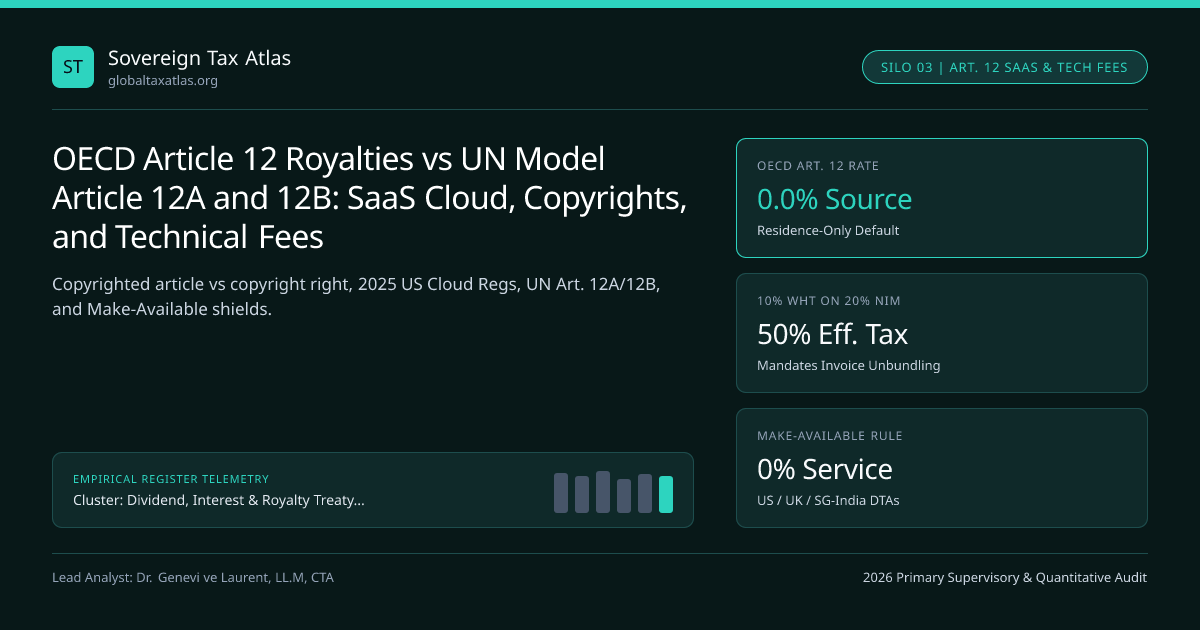
Nothing triggers more aggressive audit assessments against global SaaS software vendors, cloud/AI providers, fintech licensors, and management-consulting groups than source-country withholding recharacterizations across OECD Model Article 12 (Royalties) (alongside Article 10 Dividends and Article 11 Interest), Article 7 (Business Profits), and UN Model Articles 12A & 12B. Within our Double Tax Treaty Withholding, MLI PPT, and US LOB reference, drawing the exact legal boundary between exploiting an underlying copyright (taxable royalty!) and using a copyrighted software product or cloud service (tax-free Article 7 business profits absent a Permanent Establishment!) protects gross top-line revenue across the Dividend, Interest & Royalty Treaty Withholding, PPT & LOB cluster.
Pure OECD Model Article 12(1) vs Source-Taxing Bilateral Reality!#
Compare the pure text of the OECD Model against actual bilateral treaties signed with APAC, LATAM, and even select G20 states:
- Pure OECD Model Article 12(1) (0.0% Source WHT!): Royalties arising in a Contracting State and beneficially owned by a resident of the other Contracting State shall be taxable ONLY in that other (residence) State! Moreover, since 1992, OECD Article 12(2) deleted "payments for the use of industrial, commercial, or scientific (ICS) equipment"—pushing equipment/server leases into 0% Article 7 Business Profits!
- UN Model Article 12 + Bilateral Treaties (5.0% to 15.0% Source WHT!): Nearly every treaty with India, China, Brazil, Mexico, Indonesia, Vietnam, South Korea, Australia (until/unless specific protocols), and Spain/Italy retains source-state royalty withholding (typically 5%, 10%, or 15% of gross revenue!) AND often retains ICS equipment rental inside Article 12(2)!
- UN Model Article 12A (Fees for Technical Services — 2017) & Article 12B (Automated Digital Services — 2021): Adopted widely across Indian ("Fees for Included/Technical Services" — 10%–20%!), African, and Latin American treaties, Article 12A taxes outbound managerial, technical, or consultancy services on a gross withholding basis even with ZERO physical presence (0 days!) in the customer's country!
Landmark SaaS & Software Precedent: "Copyrighted Article" vs "Copyright Right"!#
Under OECD Article 12 Commentary Paragraphs 12–17.4 (and US Treasury Reg. §1.861-18, freshly updated in 2025 for Cloud Transactions—plus the landmark *Supreme Court of India Engineering Analysis Centre of Excellence (2021)* ruling**!), cross-border software and cloud payments split sharply:
- NOT a Royalty (Article 7 Business Profits = 0% WHT without a PE!): Standard enterprise software subscriptions, SaaS seats, cloud compute/AI API inference calls, and non-exclusive distributor resales of shrink-wrapped/digital keys where the customer acquires only rights necessary to operate the program internally (using a "copyrighted article").
- IS a Royalty (Article 12): Grants of rights to reproduce, modify source code, create derivative works, or publicly distribute copies commercially (exploiting the underlying "copyright"), OR transfers of confidential, undivulged industrial know-how where the grantor bears zero performance guarantee!
Saving Consulting Margin With the "Make Available" Shield (US/UK/SG Treaties!)#
When billing management, IT implementation, or engineering fees into India or similar markets where domestic law levies 20.0% statutory WHT on Fees for Technical Services (FTS), look immediately for a "Make Available" limitation inside Article 12(4) (present in the US–India, UK–India, and Singapore–India treaties, unlike broad UN Article 12A treaties!):
- Under a "Make Available" clause, consulting/technical fees are EXEMPT from 10%/15% treaty FTS withholding (0% under Article 7!) unless the service "makes available" technical knowledge, experience, skill, know-how, or processes enabling the client to apply the technology independently on its own in the future without the vendor! Day-to-day cloud hosting, ongoing managed security, routine testing, and commercial advisory do NOT "make available" enduring technical capability—reducing withholding to 0.0%!
Quantitative Gross Royalty WHT Compression on SaaS & IP Licensing Margins#
- [If Gross WHT exceeds Domestic CIT Liability in Vendor State -> Excess Foreign Tax Credit (FTC) becomes permanently trapped cost!]
- Worked USD 20,000,000 Enterprise Cloud & Implementation Contract Into Emerging Market (Vendor Operating Margin = 20.0% = USD 4.0M Pre-Tax Profit; Vendor Home CIT = 21.0% = USD 840k):
- Scenario A (Misclassified Bundled Contract: Taxed at 10.0% Gross Royalty/FTS WHT on Full USD 20.0M):
- Source WHT Withheld = 10.0% * 20,000,000 = USD 2,000,000 (Equals 50.0% Effective Tax Rate on USD 4.0M Net Profit!)
- Worse: Home IRS/HMRC disputes FTC creditability if WHT wasn't legally compulsory or caps FTC at USD 840,000 -> USD 1,160,000 permanent margin loss!
- Scenario B (Unbundled Contract: USD 17.0M Pure Cloud SaaS [Art. 7 = 0% WHT] + USD 3.0M Custom IP Code License [Art. 12 = 10% WHT]):
- Source WHT = 0% * 17.0M + 10% * 3.0M = USD 300,000 (Fully creditable <= USD 840k home CIT -> USD 0 net global tax drag! Saves USD 1.70M!).
Cross-Border IP, SaaS & Technical Fee Treaty Matrix#
Global software treasurers, IP holding boards, and fintech licensors—operating across DMCC Dubai, Labuan FSA, and ESMA, alongside algorithmic/data platforms like Band Protocol and Abstradex—structure contracts using this unbundling matrix:
| Revenue Stream | OECD Model Treaty | UN Model (12 + 12A + 12B) | US–India / UK–India / SG–India DTA | Best Contract Drafting Control |
|---|---|---|---|---|
| Multi-Tenant SaaS / AI API Calls | 0% (Art. 7 Business Profits) | Risk of Art. 12B (3%–4%+) or ICS | 0% Art. 7 (No copyright; no Make-Avail!) | State explicitly: "No copyright/source code transferred" |
| End-User Enterprise Software Key | 0% (Art. 7) (Copyrighted Article) | 0% Art. 7 (per India SC 2021!) | 0% Art. 7 (Engineering Analysis) | Prohibit reverse engineering & commercial copying |
| OEM Right to Reproduce / Sublicense | 0% (Art. 12.1) (or 5%–10% DTA) | 10%–15% Art. 12 Royalty | 10%–15% Art. 12 Royalty | Separate OEM schedule from SaaS hosting fee! |
| Server / Satellite / Hardware Lease | 0% (Art. 7) (ICS deleted 1992) | 5%–10% Art. 12(2) ICS Royalty! | 10% ICS Equipment Royalty | Verify whether bilateral Art. 12(2) retains "ICS equipment" |
| IT / Management Consulting (Remote) | 0% (Art. 7) (Absent local PE) | 10%–15% Art. 12A FTS! | 0% UNLESS "Made Available"! | Document ongoing service without transferring underlying tech |
Frequently asked questions
Why did my home tax authority (IRS or HMRC) deny a Foreign Tax Credit when my overseas customer withheld 10% royalty tax on our SaaS invoice?
Under US Final Foreign Tax Credit regulations (Treas. Reg. 1.901-2) and UK TIOPA Section 33 ("reasonable steps to minimize foreign tax"), a foreign withholding tax that was NOT legally owed under the applicable bilateral treaty (because SaaS is exempt under Article 7!) is treated as a non-compulsory payment ineligible for Foreign Tax Credits!
What is the difference between a taxable "Know-How" royalty (Article 12) and a "Service Fee" (Article 7)?
Under OECD Article 12 Commentary Paragraph 11.1–11.4, a Know-How contract imparts pre-existing, undivulged confidential industrial/commercial experience so the licensee uses it on its own account without the grantor guaranteeing results; in a Service contract, the vendor uses its customary professional skills to perform work for the client.
How does India electronic Form 10F and PAN requirement affect claiming 0% or 10% treaty relief?
Under Indian Income Tax Act Section 206AA, foreign vendors claiming treaty rates into India must furnish a valid Tax Residency Certificate (TRC), an electronically filed Form 10F on the Indian Income Tax Portal, and a No-PE Declaration—otherwise Indian customers withhold at the higher 20%+ statutory rate!
How does the OECD Pillar Two Subject to Tax Rule (STTR) impact 0% OECD Article 12 intragroup royalties?
If a multinational places IP in a jurisdiction taxing royalty income below a 9.0% nominal adjusted corporate rate (such as a preferential <9% IP regime or zero-tax hub), developing treaty partners adopting the MLI STTR can levy a gross top-up withholding tax up to 9.0% overriding the 0% Article 12 treaty rate!
Publication record
- Published
- 14 November 2026
- Updated
- 15 November 2026
- Author
- Dr. Geneviève Laurent, LL.M, CTA
- Review
- Review not recorded
- Automated fact check
- Passed in the stored pipeline record
- Source URLs
- 3 recorded
AI assistance recorded: anthropic/claude-opus-4.6. This field does not establish human review or source verification.
Academic & Institutional Attribution
Cite This Research & Embed Live Data Card
Standard academic & institutional research paper citation format.
Dr. Geneviève Laurent, LL.M, CTA. (2026, November 15). OECD Article 12 Royalties vs UN Model Article 12A and 12B: SaaS Cloud, Copyrights, and Technical Fees. Sovereign Tax Atlas. https://globaltaxatlas.org/entries/oecd-article-12-royalties-vs-un-article-12a-technical-servicesRegulatory Directory Cross-Reference
Referenced Institutions & Regulatory Registries
Top Regulated Institutions in This Coverage Slice
Referenced Supervisory Authorities
Related Double Tax Treaty Withholding Lob & Institutional Briefings
Explore Double Tax Treaty Withholding Lob Hub (20) →Double Tax Treaty Withholding Lob
Double Tax Treaty Withholding Rates, OECD MLI Principal Purpose Test, and US LOB ReferenceDouble Tax Treaty Withholding Lob
BEPS MLI Article 7 Principal Purpose Test (PPT): Defending Intermediate Holding Companies in AuditDouble Tax Treaty Withholding Lob
US Model Article 22 Limitation on Benefits (LOB): Publicly Traded, Base Erosion, and Active TradeDouble Tax Treaty Withholding Lob
Treaty Derivative Benefits Test: 95% Ownership by 7 or Fewer Equivalent Beneficiaries Post-BrexitDouble Tax Treaty Withholding Lob
EU FASTER Directive (2025/50): Digital eTRCs, Certified Intermediaries, and 50-Day Quick RefundsDouble Tax Treaty Withholding Lob
Switzerland 35% Verrechnungssteuer Refunds: Form 823 Notification at Source and the "Old Reserves" TrapDouble Tax Treaty Withholding Lob
US–UK Double Tax Treaty Article 10(3): Qualifying for 0% Subsidiary and Pension Dividend WithholdingDouble Tax Treaty Withholding Lob
US–Ireland Tax Treaty 15% Dividend Withholding: Why Irish ICAV UCITS Dominate Global ETFsEconomic Substance Cfc Transfer Pricing
High-Risk IP in Offshore Economic Substance: Rebuttable Presumptions and Spontaneous Tax ExchangeEconomic Substance Cfc Transfer Pricing
US Subpart F Income (IRC Sections 951–964): FPHCI Rules, Look-Through, and the 18.9% High-Tax ExceptionEconomic Substance Cfc Transfer Pricing
US GILTI / Net CFC Tested Income (IRC Section 951A): 2026 OBBBA Reforms, Section 250, and FTC HaircutsEconomic Substance Cfc Transfer Pricing
EU Anti-Tax Avoidance Directive (ATAD) Articles 7–8 CFC Rules: Model A Passive Categories vs Model B SPF
Sovereign Tax Atlas Data, Benchmarks & Contributor Records
CC BY 4.0 Open Data
Open Institutional Datasets (CSV / JSON) →
Download desk-compiled quantitative series & schemas.
2026 Reference Matrix
2026 Institutional Benchmarks & Thresholds →
Statutory capital, clearing, margin & rate conventions.
Editorial Records
Authors & Review Records →
View named contributors where those records are available.
Complete Index
Master Research & Dossier Archive →
Browse all published briefings by topic pillar & date.