
Double Tax Treaty Withholding Lob
OECD Pillar Two Subject to Tax Rule (STTR): 9% Gross Withholding, Markup Caps, and MLI Rollout
Operating ahead of QDMTT, IIR, and UTPR inside the OECD Pillar Two hierarchy, the treaty-based Subject to Tax Rule (STTR) lets developing source states impose up to a 9.0% gross top-up withholding tax on low-taxed intragroup payments.
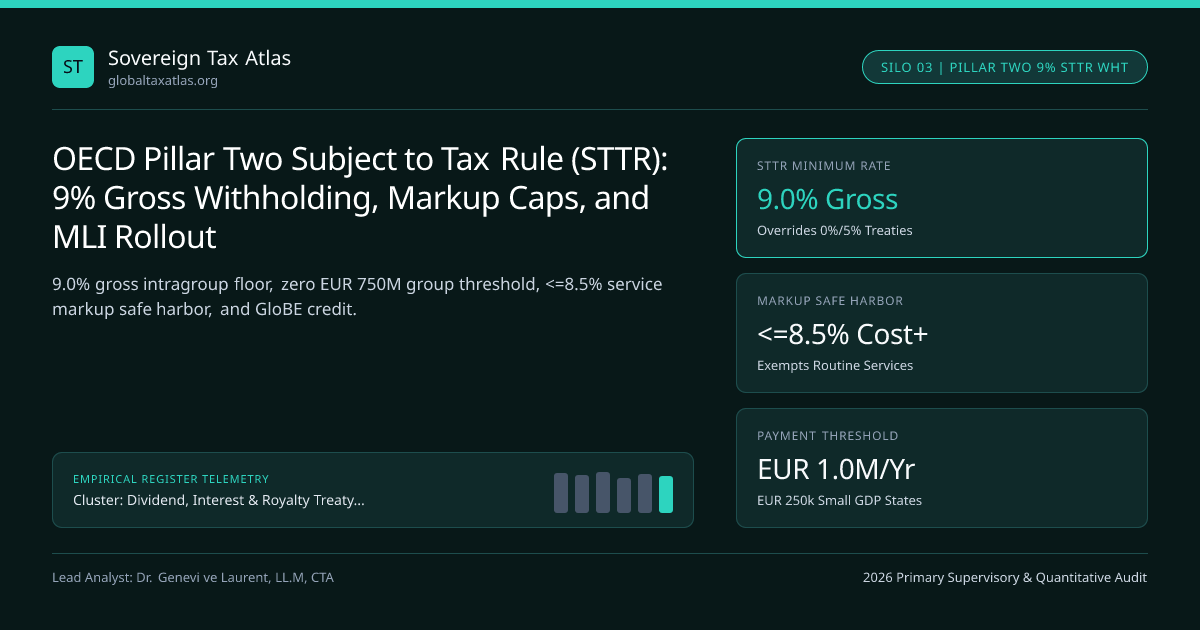
While OECD Pillar Two 15% QDMTT, IIR, and UTPR grab headlines across G7 headquarters, developing and emerging-market members of the Inclusive Framework demanded a treaty-overriding gross source withholding rule protecting their tax bases from intragroup interest, royalties, and service fees routed to <9% hubs! That bargain produced the Subject to Tax Rule (STTR)—implemented via the STTR Multilateral Instrument (STTR MLI) signed in Paris starting September 2024 and benchmarked alongside OECD Pillar Two 15% GloBE & STTR and Pillar Two Minimum Tax inside our Double Tax Treaty Withholding, MLI PPT, and US LOB reference across the Dividend, Interest & Royalty Treaty Withholding, PPT & LOB cluster.
Seven Categories of "Covered Income" Under the STTR!#
Crucially, the STTR is NOT limited to interest and royalties! Whenever a treaty between a developing Inclusive Framework member (GNI per capita <= USD 12,535 in 2019 Atlas dollars) and a low-tax partner caps source withholding below 9.0%, the STTR MLI overrides Articles 7, 11, 12, and 21 across seven broad categories of intragroup ("connected person" >50% control) Covered Income:
- Interest (overriding 0% / 5% Article 11 rates!);
- Royalties (overriding 0% Article 12 rates!);
- Distribution rights payments in respect of products or services;
- Insurance and reinsurance premiums;
- Financial guarantee and financing fees;
- Rentals of industrial, commercial, or scientific (ICS) equipment; and
- ANY intra-group service fee (management fees, IT support, procurement, R&D services, treasury advisory—normally 100% exempt at 0.0% under Article 7 Business Profits without a PE!).
Three Essential Safe Harbors & Exclusions That Save Shared-Service Centers!#
Wait: if a multinational runs a regional shared-service center in UAE (DIFC/DMCC 0% QFZP!), Barbados (FSC Barbados), Labuan (Labuan IBFC 3% rate!), or Switzerland (<9% patent box!) charging routine Cost + 5% IT/HR shared services, does it get crushed by a 9.0% tax on GROSS revenue (9% / 4.76% margin = 189% Effective Tax Rate!!)? NO—thanks to the 8.5% Markup Threshold Exclusion! Read the three STTR carve-outs carefully:
- The 8.5% Return-on-Cost Markup Threshold: For Covered Income OTHER THAN Interest, Royalties, and Insurance/Guarantees (i.e., intra-group services, distribution rights, and ICS equipment rentals!), the payment is 100% EXCLUDED from STTR if the payee's gross Covered Income does not exceed Relevant Costs plus an 8.5% markup (Margin <= 8.5% on cost)! Thus, standard OECD Cost + 5% Low Value-Adding Intra-Group Services (LVAS) escape STTR completely!
- Materiality Threshold (EUR 1,000,000 / EUR 250,000): STTR applies only if aggregate gross Covered Income paid by connected payers in the source state to connected payees in the residence state exceeds EUR 1,000,000 in the fiscal year (lowered to EUR 250,000 where the source state's GDP is < EUR 40 billion)!
- Excluded Entities: Sovereign wealth funds, pension funds, non-profits, investment funds, and regulated individuals are excluded—plus anti-conduit rules disregard intermediate >80% pass-through companies!
Quantitative STTR Top-Up Calculation & Credit Into Pillar Two GloBE ETR!#
Notice two vital mechanical features of the STTR: (a) it tests the payee's Adjusted Nominal Statutory Rate (NOT its Pillar Two GloBE accounting ETR—so even if a group pays a 15% IIR at the parent level, a 0% UAE QFZP or 3% Labuan IP Co STILL triggers STTR because IIR/QDMTT taxes are ignored when computing the STTR Nominal Rate!); and (b) it is collected via an ex-post annual tax return after fiscal year-end (NOT live real-time payroll/invoice deduction at source!):
- STTRTaxPayable = GrossNonExcludedCoveredIncome * STTRTopUpTaxRate
- [Crucial Ordering Rule: STTR Tax Paid IS a Covered Tax pushed into Payee Jurisdiction Adjusted Covered Taxes for 15% Pillar Two GloBE ETR!]
- Worked Intragroup IP Royalty & Shared-Service Charge From Developing ASEAN Subsidiary to Labuan / Low-Tax Hub Co (FY 2026):
- Hub Co Preferential Tax Regime = 3.0% Nominal CIT | Bilateral Treaty WHT: 5.0% on Royalties, 0.0% on Art. 7 IT Services.
- Stream A — EUR 8,000,000 Brand/Tech Royalty (Markup exclusion NEVER applies to Royalties!):
- Combined Existing Tax = 3.0% (Hub CIT) + 5.0% (Treaty Royalty WHT) = 8.0% (< 9.0%!)
- STTR Top-Up Rate = 9.0% - 3.0% - 5.0% = 1.0% -> ASEAN Source State collects 1.0% * EUR 8.0M = EUR 80,000 ex-post STTR tax!
- Stream B — EUR 4,000,000 Regional IT Support Fee (Priced at Cost EUR 3.80M + 5.26% Markup <= 8.5% Cap!):
- Qualifies for <=8.5% Markup Exclusion -> EUR 0 STTR tax!
- Stream C — EUR 6,000,000 High-Margin Procurement Fee (Priced at Cost EUR 4.50M + 33.3% Markup > 8.5%!; 0% Art. 7 WHT):
- STTR Top-Up Rate = 9.0% - 3.0% - 0.0% = 6.0% -> ASEAN Source State collects 6.0% * EUR 6.0M = EUR 360,000 STTR tax!
- Total STTR Paid (EUR 440,000) credits directly into Hub Co Pillar Two Covered Taxes—reducing Hub Co 15% QDMTT/IIR dollar-for-dollar!
Benchmarking STTR Top-Up Rates Across Low-Tax Regimes#
STTR vs GloBE (QDMTT / IIR / UTPR) Comparison Matrix#
READ THAT FIRST METRIC BADGE ABOVE TWICE: Unlike the 15% GloBE rules (EUR 750M revenue floor!), the STTR has NO EUR 750 million consolidated revenue threshold—meaning mid-market groups with EUR 50 million of revenue routing >EUR 1.0M of intragroup fees to a <9% hub (DIFC, Labuan IBFC, Mauritius CBRD) ARE IN SCOPE! Treasury teams alongside firms like Alyra Finance and Astrovault contrast STTR against GloBE:
| Rule Parameter | Pillar Two STTR (Treaty Rule) | Pillar Two QDMTT / IIR / UTPR (GloBE) | Strategic Takeaway |
|---|---|---|---|
| Group Consolidated Revenue Floor | NONE! (EUR 1M / EUR 250k payment gate only!) | EUR 750,000,000 (2 of 4 prior years) | Mid-market <EUR 750M groups still hit by STTR! |
| Minimum Rate & Tax Base | 9.0% on GROSS Payment | 15.0% on NET Accounting Profit (post-SBIE) | 9% gross tax can exceed 45% of net margin! |
| Counts QDMTT / IIR Toward Rate? | NO! (Tests statutory CIT minus pref. adjustments) | Yes (QDMTT credits against IIR/UTPR) | Paying 15% UAE QDMTT does NOT turn off STTR! |
| Routine Shared Services (<=8.5% Cost+) | 100% Exempt (Markup Exclusion) | Inside GloBE Net Income | Keep hub service centers <= Cost + 8.5%! |
| Ordering Hierarchy | Runs FIRST (Step 0 before QDMTT/IIR) | Credits STTR as a Covered Tax in Payee ETR! | For >=EUR 750M MNEs, STTR shifts tax from Hub QDMTT to Source State! |
Frequently asked questions
If our UAE Free Zone Treasury Co pays 15% UAE QDMTT under Pillar Two, why would it still trigger the 9% STTR?
Because the OECD STTR Model Provision defines the payee "tax rate" strictly by reference to its domestic statutory corporate income tax rate adjusted for preferential exemptions (0% UAE QFZP rate!), explicitly EXCLUDING Pillar Two IIR, UTPR, and QDMTT top-up taxes! Instead, the STTR paid to the developing source country becomes a creditable Covered Tax reducing the 15% UAE QDMTT!
Does the payer have to deduct STTR withholding every month when paying intragroup invoices?
No! Business groups successfully lobbied the OECD against chaotic live invoice withholding (since whether the EUR 1M threshold and 8.5% markup test are breached is not known until year-end!). Under the STTR Model Provision, STTR is self-assessed and paid by the payee via an ex-post annual return after the fiscal year closes.
Which treaties are actually amended by the September 2024 STTR Multilateral Instrument (STTR MLI)?
Only bilateral treaties where BOTH Contracting States sign/ratify the STTR MLI (or negotiate bilateral STTR protocols) AND the source state is a qualifying developing Inclusive Framework jurisdiction requesting inclusion on Covered Tax Agreements whose existing WHT rates fall below 9%.
Can a group interpose a 25%-taxed UK or German company as a pass-through conduit between a developing subsidiary and a 0% IP company to dodge STTR?
No! The STTR contains a dedicated targeted anti-avoidance rule disregarding connected or unconnected intermediate conduits that pass >=80% of Covered Income onward within a 365-day window to a low-taxed (<9%) connected person.
Publication record
- Published
- 13 November 2026
- Updated
- 14 November 2026
- Author
- Dr. Geneviève Laurent, LL.M, CTA
- Review
- Review not recorded
- Automated fact check
- Passed in the stored pipeline record
- Source URLs
- 3 recorded
AI assistance recorded: anthropic/claude-opus-4.6. This field does not establish human review or source verification.
Academic & Institutional Attribution
Cite This Research & Embed Live Data Card
Standard academic & institutional research paper citation format.
Dr. Geneviève Laurent, LL.M, CTA. (2026, November 14). OECD Pillar Two Subject to Tax Rule (STTR): 9% Gross Withholding, Markup Caps, and MLI Rollout. Sovereign Tax Atlas. https://globaltaxatlas.org/entries/oecd-pillar-two-subject-to-tax-rule-sttr-9-gross-withholdingRegulatory Directory Cross-Reference
Referenced Institutions & Regulatory Registries
Top Regulated Institutions in This Coverage Slice
Related Double Tax Treaty Withholding Lob & Institutional Briefings
Explore Double Tax Treaty Withholding Lob Hub (20) →Double Tax Treaty Withholding Lob
Double Tax Treaty Withholding Rates, OECD MLI Principal Purpose Test, and US LOB ReferenceDouble Tax Treaty Withholding Lob
India–Mauritius Tax Treaty 2024 PPT Protocol, Grandfathered Capital Gains, and Indian TRC Audit RulesDouble Tax Treaty Withholding Lob
Singapore IRAS Certificate of Residence (COR): Foreign-Owned HoldCo Substance and 90+ APAC TreatiesDouble Tax Treaty Withholding Lob
UK Qualifying Asset Holding Company (QAHC) vs Quoted Eurobond: 0% Outbound Interest WithholdingDouble Tax Treaty Withholding Lob
Cross-Border Securities Lending, Manufactured Dividends, and Post-Cum-Ex Anti-Dividend-Washing RulesDouble Tax Treaty Withholding Lob
OECD Model Article 10 Dividend Withholding: 5% Direct Participation, 365-Day Hold, and 15% PortfolioDouble Tax Treaty Withholding Lob
OECD Model Article 11 Interest Withholding: Bank Carve-Outs, Gross-Ups, and Arm’s-Length CapsDouble Tax Treaty Withholding Lob
OECD Article 12 Royalties vs UN Model Article 12A and 12B: SaaS Cloud, Copyrights, and Technical FeesEconomic Substance Cfc Transfer Pricing
UAE Economic Substance Repeal & Integration Into 0% Qualifying Free Zone Person (QFZP) Corporate Tax AuditsEconomic Substance Cfc Transfer Pricing
BEPS Action 13 Three-Tier Transfer Pricing Documentation: Master File, Local File, and Penalty ProtectionEconomic Substance Cfc Transfer Pricing
Low Value-Adding Intra-Group Services (LVAS): OECD 5% Markup Safe Harbor, US SCM, and Benefit TestsEconomic Substance Cfc Transfer Pricing
OECD Transfer Pricing Chapter IX Business Restructurings: Principal Conversions and IP Exit Taxes
Sovereign Tax Atlas Data, Benchmarks & Contributor Records
CC BY 4.0 Open Data
Open Institutional Datasets (CSV / JSON) →
Download desk-compiled quantitative series & schemas.
2026 Reference Matrix
2026 Institutional Benchmarks & Thresholds →
Statutory capital, clearing, margin & rate conventions.
Editorial Records
Authors & Review Records →
View named contributors where those records are available.
Complete Index
Master Research & Dossier Archive →
Browse all published briefings by topic pillar & date.