
Double Tax Treaty Withholding Lob
BEPS MLI Article 7 Principal Purpose Test (PPT): Defending Intermediate Holding Companies in Audit
Enacted across more than 100 jurisdictions as a BEPS Action 6 minimum standard, MLI Article 7 denies treaty benefits whenever obtaining that benefit was one of the principal purposes of an arrangement.
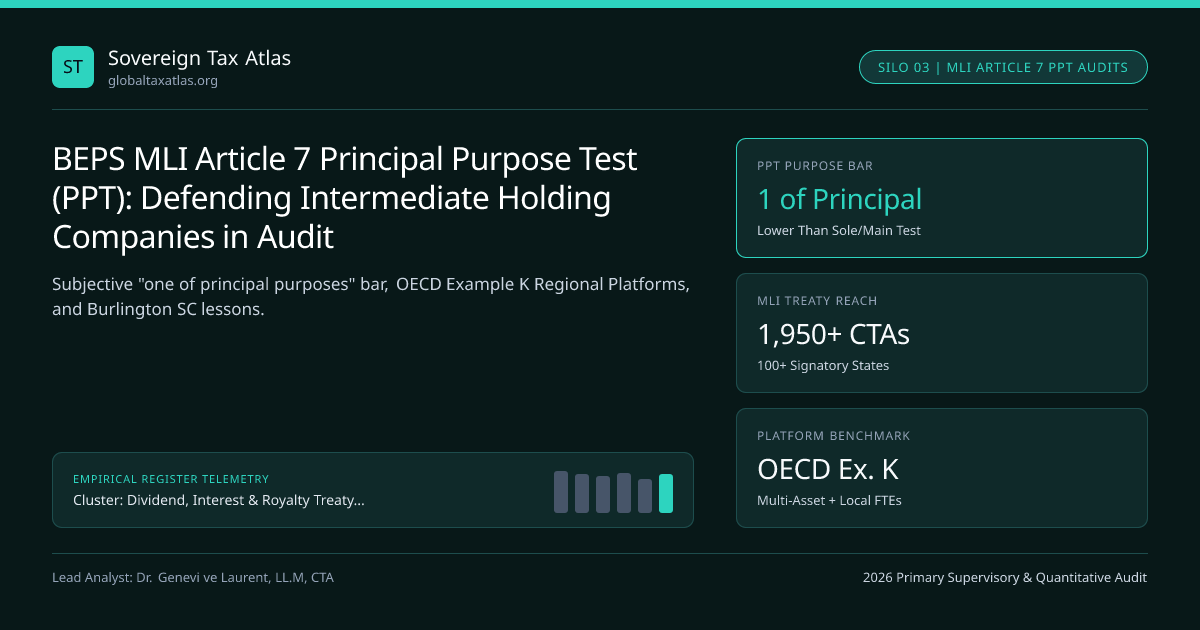
By depositing ratifications of the Multilateral Convention to Implement Tax Treaty Related Measures to Prevent Base Erosion and Profit Shifting (MLI), over 100 jurisdictions injected MLI Article 7(1) — the Principal Purpose Test (PPT) directly into more than 1,950 Covered Tax Agreements simultaneously! Benchmarked under US Article 22 LOB vs OECD MLI Article 7 PPT and the 2026 LOB/PPT Benchmark Standard within our Double Tax Treaty Withholding, MLI PPT, and US LOB reference, the PPT demolished brass-plate Luxembourg, Dutch, Mauritian, and Cypriot letterbox SPVs—requiring verifiable regional investment-platform substance across the Dividend, Interest & Royalty Treaty Withholding, PPT & LOB cluster.
Two Statutory Halves of MLI Article 7(1): Subjective Burden vs Objective Carve-Out!#
Read the exact operative wording of MLI Article 7(1) (= OECD Model Article 29(9)) as two distinct legal halves with opposite burdens of proof:
- Prong 1 — The Tax Authority's "Reasonable to Conclude" Subjective/Objective Purpose Prong: A benefit under a Covered Tax Agreement shall not be granted "if it is reasonable to conclude, having regard to all relevant facts and circumstances, that obtaining that benefit was one of the principal purposes* of any arrangement or transaction that resulted directly or indirectly in that benefit..."* Notice the killer phrase: NOT "the sole purpose" and NOT "the dominant >50% purpose"—merely "ONE OF the principal purposes"! Even where a deal has two genuine commercial purposes alongside a third principal tax-treaty purpose, Prong 1 is triggered!
- Prong 2 — The Taxpayer's "Object and Purpose" Saving Carve-Out: "...unless* it is established that granting that benefit in these circumstances would be in accordance with the object and purpose of the relevant provisions of the Covered Tax Agreement."* As confirmed by the UK Supreme Court in Burlington Loan Management (2024) and OECD Commentary Examples A through M (especially Regional Investment Platform Examples K, L, and M!), if a substantive regional platform exercises real investment governance in the treaty state, granting treaty relief IS in accordance with the treaty's object and purpose!
OECD Commentary Example K vs Single-Asset Conduit SPVs: What Wins in Audit!#
Why do some Luxembourg (LU RAIF/SOPARFI), Singapore (SG 13O/13U/HoldCo), or UK (UK QAHC) holding structures sail through French, German, Italian, Australian, and Indian PPT audits while others suffer 100% treaty denial plus 40%–100% tax-evasion penalties? Compare the two archetypes side by side:
- Fails PPT (Single-Deal Conduit SPV): A Cayman private equity fund wins a bid to buy a Spanish operating company. Two weeks before closing, tax advisers insert a brand-new Luxembourg SARL with EUR 12,000 minimum share capital, two external corporate-service directors sitting on 140 boards each, zero local investment staff, and a back-to-back obligation wiring 100% of Spanish dividends to Cayman within 48 hours! Verdict: Fails both Beneficial Ownership (Danish Cases) AND MLI Article 7 PPT!
- Passes PPT (OECD Article 29 Commentary Example K — Regional Investment Platform): An institutional fund establishes a permanent European Master Holding & Treasury Platform in Luxembourg (or APAC Platform in Singapore [see IRAS COR substance]): holds 8–15 portfolio investments across multiple countries, employs full-time qualified local investment/finance executives on local payroll, leases dedicated office space, holds physical board meetings deliberating real capital-allocation, FX hedging, and M&A bolt-ons, and retains/recycles dividend and exit cash into new regional deals rather than sweeping cash automatically within 48 hours!
Quantitative Tax + Penalty Exposure of a Failed PPT HoldCo Audit#
- BreakEvenAnnualPlatformSubstanceBudget <= AnnualGrossDividends&Exits * (StatutoryWHTRate - TreatyWHT_Rate)
- Worked EUR 800M Pan-European Infrastructure Portfolio (Annual Cash Yield = EUR 56.0M across Italy, Spain, Germany; Avg Statutory WHT = 24.5% vs 0%/5% Platform Rate):
- Annual Withholding Tax Saved by Legitimate Regional Platform = ~22.0% * EUR 56,000,000 = EUR 12,320,000 / year!
- Cost of Genuine OECD Example K Substance (4 full-time Luxembourg/London investment & finance professionals + dedicated office + independent infrastructure directors):
- Annual Operating Cost = EUR 1,150,000 / year (Only 9.3% of annual tax savings—eliminating EUR 49.3M+ in 4-year retroactive PPT audit assessments + 40% penalties!).
Secondary Market Debt & Assignment Ruling: Burlington Loan Management Lesson!#
In 2024, the *UK Supreme Court (HMRC v Burlington Loan Management DAC)* handed down a landmark PPT/purpose precedent involving an Irish distressed-debt vehicle purchasing a GBP 140 million Lehman Brothers insolvency debt claim from a Cayman creditor (where Cayman would have suffered 20% UK WHT, whereas Ireland enjoyed 0% UK–Ireland Article 11 WHT!):
- Crucial Distinction: When a treaty-resident buyer purchases an asset outright at arm's length on the secondary market for its own commercial profit—even knowing that its own 0% Irish treaty profile allows it to bid a higher market price than a Cayman seller could collect!—realizing the benefit of the buyer's own genuine Irish residence is NOT abusive treaty-shopping, provided it was not a pre-wired conduit splitting the withheld tax back to the Cayman seller!
MLI Article 7 PPT vs US LOB & Domestic GAAR Matrix#
Cross-border M&A directors and fund counsel—coordinating across ESMA, DIFC, and CBRD Mauritius (see India–Mauritius PPT protocol), alongside global capital firms like 360 Capital and April Investors—compare treaty anti-abuse rules across four frameworks:
| Anti-Abuse Standard | Legal Test Type | Trigger Threshold | Can Economic Substance Save You? | Key Jurisdictions |
|---|---|---|---|---|
| MLI Art. 7(1) PPT | Subjective + Objective Purpose | One of the principal purposes | YES! (OECD Ex. K Regional Platform!) | UK, EU-27, SG, HK, AU, JP, IN, CH (100+ states) |
| US Art. 22 LOB | Mechanical Checklist | <50% qualifying owners / Base Erosion | NO (Unless passing Active Trade or Art. 22(6)!) | All United States bilateral tax treaties |
| German §50d(3) EStG | Statutory Anti-Directive/Treaty | Personal + Functional Nexus Tests | Only if genuine functional link to asset! | Inbound German dividend & royalty claims |
| ECJ Danish Cases | EU General Abuse Principle | Conduit / lack of economic dominion | YES (Real economic activity & cash control) | All EU Parent-Subsidiary & IRD claims |
Frequently asked questions
Does passing local Cayman, Luxembourg, or Singapore statutory "Economic Substance" rules guarantee passing MLI Article 7 PPT in the source country?
No! Passing a home-country Economic Substance check (like filing an office lease and two local directors) never binds the SOURCE country tax auditor (e.g., in France, Germany, Italy, or India), who independently evaluates whether the specific shareholding and cash-flow routing had a principal tax-avoidance purpose!
What is MLI Article 7(4) Discretionary Relief and how does it help mixed-investor funds?
In treaties whose signatories opted into MLI Article 7(4), if a holding company is denied treaty benefits under Article 7(1) PPT, the source-country Competent Authority may still grant the treaty rate that WOULD have applied had the underlying pension/treaty investors held the shares directly (e.g., 15% instead of 30%)!
Why did the United States refuse to sign the OECD BEPS Multilateral Instrument (MLI)?
Because US bilateral tax treaties already enforce rigorous, objective Article 22 Limitation on Benefits (LOB) provisions (paired with domestic conduit-financing rules under IRC Sec. 7701(l) and Treas. Reg. 1.881-3), the US Treasury rejected subjective PPT uncertainty in favor of mechanical LOB certainty.
Do Sovereign Wealth Funds and public pension funds investing via wholly owned Luxembourg or Singapore HoldCos pass MLI Article 7 PPT?
OECD Commentary Article 29 Examples L and M explicitly recognize that institutional collective vehicles, pension funds, and Sovereign Wealth Funds pooling regional investments through a dedicated treaty HoldCo for commercial governance/liability reasons align with treaty object and purpose—especially when those investors had equivalent direct treaty rates!
Publication record
- Published
- 14 November 2026
- Updated
- 15 November 2026
- Author
- Dr. Geneviève Laurent, LL.M, CTA
- Review
- Review not recorded
- Automated fact check
- Passed in the stored pipeline record
- Source URLs
- 3 recorded
AI assistance recorded: anthropic/claude-opus-4.6. This field does not establish human review or source verification.
Academic & Institutional Attribution
Cite This Research & Embed Live Data Card
Standard academic & institutional research paper citation format.
Dr. Geneviève Laurent, LL.M, CTA. (2026, November 15). BEPS MLI Article 7 Principal Purpose Test (PPT): Defending Intermediate Holding Companies in Audit. Sovereign Tax Atlas. https://globaltaxatlas.org/entries/beps-mli-article-7-principal-purpose-test-conduit-holdco-auditsRegulatory Directory Cross-Reference
Referenced Institutions & Regulatory Registries
Top Regulated Institutions in This Coverage Slice
Related Double Tax Treaty Withholding Lob & Institutional Briefings
Explore Double Tax Treaty Withholding Lob Hub (20) →Double Tax Treaty Withholding Lob
Double Tax Treaty Withholding Rates, OECD MLI Principal Purpose Test, and US LOB ReferenceDouble Tax Treaty Withholding Lob
US Model Article 22 Limitation on Benefits (LOB): Publicly Traded, Base Erosion, and Active TradeDouble Tax Treaty Withholding Lob
Treaty Derivative Benefits Test: 95% Ownership by 7 or Fewer Equivalent Beneficiaries Post-BrexitDouble Tax Treaty Withholding Lob
EU FASTER Directive (2025/50): Digital eTRCs, Certified Intermediaries, and 50-Day Quick RefundsDouble Tax Treaty Withholding Lob
Switzerland 35% Verrechnungssteuer Refunds: Form 823 Notification at Source and the "Old Reserves" TrapDouble Tax Treaty Withholding Lob
US–UK Double Tax Treaty Article 10(3): Qualifying for 0% Subsidiary and Pension Dividend WithholdingDouble Tax Treaty Withholding Lob
US–Ireland Tax Treaty 15% Dividend Withholding: Why Irish ICAV UCITS Dominate Global ETFsDouble Tax Treaty Withholding Lob
US Portfolio Interest Exemption (IRC 871(h) & 881(c)): 10% Shareholder Attribution and Bank TrapsEconomic Substance Cfc Transfer Pricing
US Subpart F Income (IRC Sections 951–964): FPHCI Rules, Look-Through, and the 18.9% High-Tax ExceptionEconomic Substance Cfc Transfer Pricing
US GILTI / Net CFC Tested Income (IRC Section 951A): 2026 OBBBA Reforms, Section 250, and FTC HaircutsEconomic Substance Cfc Transfer Pricing
EU Anti-Tax Avoidance Directive (ATAD) Articles 7–8 CFC Rules: Model A Passive Categories vs Model B SPFEconomic Substance Cfc Transfer Pricing
UK TIOPA 2010 Part 9A CFC Regime: Chapter 3 Gateways, 75% Tax Exemption, and Chapter 9 Finance Company Rules
Sovereign Tax Atlas Data, Benchmarks & Contributor Records
CC BY 4.0 Open Data
Open Institutional Datasets (CSV / JSON) →
Download desk-compiled quantitative series & schemas.
2026 Reference Matrix
2026 Institutional Benchmarks & Thresholds →
Statutory capital, clearing, margin & rate conventions.
Editorial Records
Authors & Review Records →
View named contributors where those records are available.
Complete Index
Master Research & Dossier Archive →
Browse all published briefings by topic pillar & date.