
Double Tax Treaty Withholding Lob
OECD Model Article 11 Interest Withholding: Bank Carve-Outs, Gross-Ups, and Arm’s-Length Caps
While OECD Model Article 11(2) caps source-country interest withholding at 10% of gross interest, even a 10% gross tax wipes out net banking spreads—driving 0% treaty carve-outs and loan gross-up clauses.
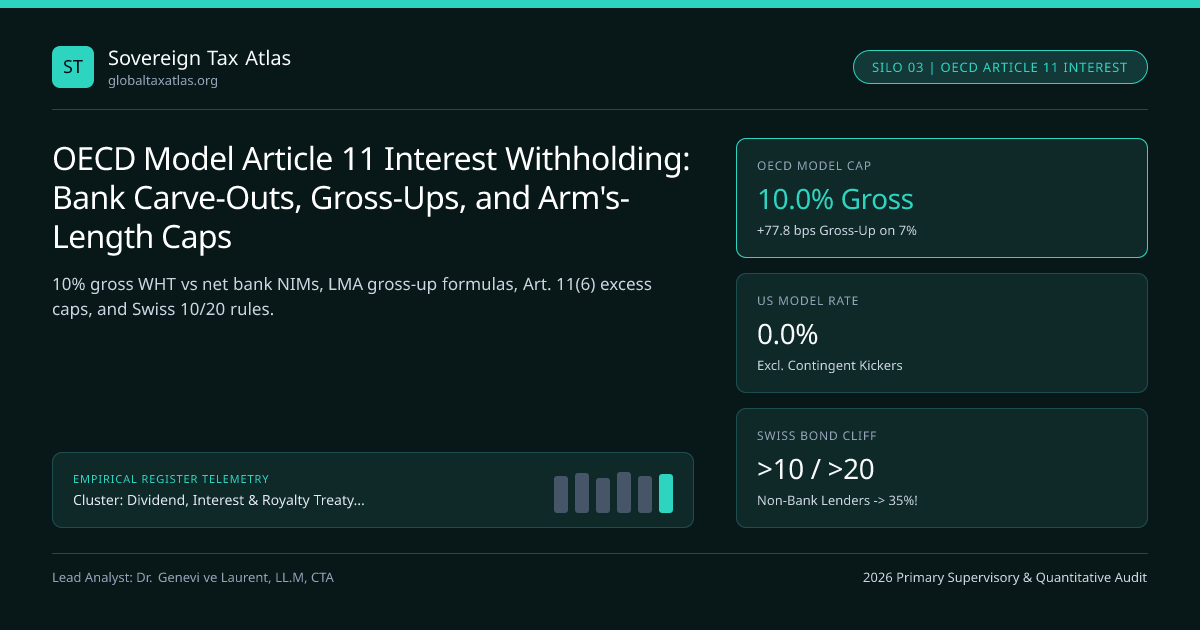
Unlike corporate dividends paid out of unlevered equity profits, commercial lenders, private credit funds, and treasury centers borrow money at 4.50% to lend at 6.00%—earning a thin 150-basis-point net interest margin! Imposing the standard OECD Model Article 11(2) 10.0% withholding tax on GROSS interest (10% × 6.00% = 60 bps) devours 40.0% of the lender's pre-tax net profit (or 100%+ on tighter investment-grade syndicated bank loans!). Anchored in our Double Tax Treaty Withholding, MLI PPT, and US LOB reference, mastering 0.0% Article 11 exemptions, LMA tax gross-up allocations, and Article 11(6) "Special Relationship" excess-interest denials is vital across the Dividend, Interest & Royalty Treaty Withholding, PPT & LOB cluster.
Why 10% Gross Interest Withholding Triggers LMA Tax Gross-Up Clauses!#
Under OECD Model Article 11(2), the source state may tax outbound interest at up to 10.0% of the gross amount if the recipient is the beneficial owner (contrast the 2016 US Model Treaty Article 11(1), which generally reduces outbound interest withholding to 0.0%, subject to contingent-interest and anti-inversion exceptions!). Because banks and credit funds cannot absorb a 10% gross haircut on levered funding spreads:
- Standard Loan Market Association (LMA) / LSTA Tax Gross-Up Clause: Virtually every cross-border syndicated facility requires the Borrower to gross up interest payments so the "Qualifying Lender" (typically a domestic lender or a "Treaty Lender" entitled to 0.0% treaty interest WHT!) receives 100% of its contracted coupon net of withholding!
- Six OECD Commentary Zero-Rate Carve-Outs (Paragraphs 7.1–7.12): To prevent borrowers from bearing crushing gross-ups on productive debt, hundreds of bilateral treaties (e.g., UK, Singapore, Hong Kong, Japan, Canadian, and Dutch DTAs) add an Article 11(3) 0.0% Exemption for interest paid to: (1) Central Banks, Governments & Export Credit Agencies; (2) Regulated Commercial Banks / Financial Institutions on unrelated loans (excluding back-to-back fronting deposits!); (3) Recognized Pension Funds; (4) Credit Sales of Industrial/Commercial/Scientific Equipment; and (5) Quoted Corporate Bonds / Eurobonds (mirroring UK Quoted Eurobond & QAHC rules and US IRC Sec. 881(c) Portfolio Interest)!
Article 11(6) "Special Relationship": Why Transfer Pricing Breaks Treaty Relief!#
Private equity sponsors and multinational treasurers frequently miss Article 11(6) when pricing subordinated shareholder loans (PIK notes) into leveraged buyouts! Read Article 11(6) carefully:
- "Where, by reason of a special relationship* between the payer and the beneficial owner or between both of them and some other person, the amount of the interest, having regard to the debt-claim for which it is paid, exceeds the amount which would have been agreed upon by the payer and the beneficial owner in the absence of such relationship, the provisions of this Article shall apply only to the last-mentioned amount!"*
- Lethal Consequence: Suppose UK OpCo pays 12.50% interest on a GBP 100 million subordinated shareholder loan to its Luxembourg HoldCo (LU RAIF/HoldCo), claiming 0.0% interest withholding under the UK–Luxembourg Treaty. HMRC's transfer-pricing specialists prove an arm's-length coupon (or maximum debt quantum!) was 8.50%! Under Article 11(6), 0% treaty relief applies ONLY to the 8.50% arm's-length slice—while the 4.00% excess interest (GBP 4.0M/yr) is simultaneously denied UK corporation tax deductibility AND hit with full 20.0% UK statutory withholding tax (GBP 800,000/yr)!
Quantitative Gross-Up Cost & Article 11(6) Excess-Interest Math#
- [Example: 10% WHT turns a 7.00% Net Loan into 7.00% / 0.90 = 7.778% (+77.8 bps annual borrower cost!); 20% WHT -> 8.75% (+175 bps!)]
- Article116SplitWithholding (Related-Party Shareholder Loan):
- TreatyProtectedInterest = Min(ActualPrincipal, ArmLengthDebtCapacity) * ArmLengthBenchmark_Rate -> Taxed at Treaty Rate (0% or 10%)
- DisqualifiedExcessSlice = TotalInterestPaid - TreatyProtectedInterest -> Taxed at Full Domestic Statutory WHT!
- Worked GBP 150M UK Acquisition Debt Audit (Contracted Coupon = 11.50% = GBP 17.25M/yr; HMRC Arm's-Length Ruling = 8.00% on GBP 120M Max Debt = GBP 9.60M/yr):
- Arm's-Length Protected Slice = GBP 9,600,000 -> 0.0% UK-Lux Treaty WHT (GBP 0 tax).
- Article 11(6) Excess Slice = 17,250,000 - 9,600,000 = GBP 7,650,000 (both rate excess AND thin-cap quantum excess under UK TIOPA!):
- Denied UK 25% Corporation Tax deduction (+GBP 1,912,500 CIT) PLUS assessed 20.0% UK Statutory Interest WHT = GBP 1,530,000/yr!
Watch Two Anti-Abuse Traps: Back-to-Back Bank Fronting & Contingent Interest!#
- Back-to-Back Bank Fronting Clauses: When a Cayman credit fund (CIMA) cannot lend directly into a 20%-WHT borrower country without triggering gross-up costs, never park a matching cash deposit at a London or Singapore bank to have that bank "front" the loan! Almost every modern Article 11(3) bank exemption explicitly excludes interest paid under a back-to-back arrangement (and triggers MLI Article 7 PPT + beneficial ownership denial!).
- Contingent / Profit-Participating Interest (US Model Art. 11(2)(b)): Under US treaties (and US Portfolio Interest IRC Sec. 871(h)(4)), interest contingent on the borrower's receipts, sales, cash flow, or property appreciation is stripped of 0% interest status and taxed at the 15.0% portfolio dividend treaty rate (or 30% statutory WHT without a treaty)!
Cross-Border Debt & Article 11 Structuring Matrix#
Private credit desks, corporate treasurers, and institutional lenders—operating across DIFC, JFSC, and ESMA, alongside credit/multi-asset firms like Arbitrage Prime Limited and Alyra Finance—structure cross-border debt across five primary lanes:
| Borrower Jurisdiction | Statutory Interest WHT | Domestic 0% Route (No Treaty Needed!) | Primary 0% Treaty Route | Fatal Structuring Trap |
|---|---|---|---|---|
| United States | 30.0% | IRC Sec. 881(c) Portfolio Interest | US–UK / US–Lux / US–IE Art. 11 (0%) | >=10% equity holder or bank loan extension |
| United Kingdom | 20.0% (>=1 yr "yearly") | Quoted Eurobond or UK QAHC (0%) | HMRC DTTP Scheme Passport (0% DTAs) | Rolling 364-day "short" loan past 1 year |
| Germany | 0.0% General Statutory! | Domestic 0% on plain-vanilla loans! | Needed only for profit-linked/convertible | Real-estate-secured or profit-participating debt |
| Switzerland | 0.0% Ordinary Loans! / 35% Bonds! | Keep <=10 non-bank creditors (10/20 Non-Bank Rule!) | Art. 11 (0%) if reclassified as bond | Breaching Swiss 10/20 Non-Bank Rule -> 35% WHT! |
| Developing States (UN/STTR) | 15.0%–25.0% | Sovereign / ECA / IFI exemptions | 5%–10% Bank DTA + 9% STTR Check | Back-to-back bank fronting deposit |
Frequently asked questions
What is Switzerland famous "10/20 Non-Bank Rule" on syndicated loans?
Although Switzerland charges 0% withholding on ordinary bilateral corporate loans, it levies 35% Verrechnungssteuer on "bonds" and "debentures"—and Swiss Federal Tax Administration guidelines reclassify a syndicated loan into a taxable bond if >10 non-bank lenders participate on identical terms (or >20 non-banks across all debt instruments >CHF 500k)!
How does the UK HMRC Double Taxation Treaty Passport (DTTP) scheme speed up 0% loan withholding clearance?
Without DTTP, a UK borrower must withhold 20% tax on yearly interest until HMRC processes a paper certified treaty claim (often taking 6+ months). An overseas corporate/fund lender holding an HMRC DTTP Passport gives its passport number to the UK borrower (who files Form DTTP2 within 30 days of loan signing) for rapid 0% at-source direction!
Does UK 20% interest withholding apply to short-term bridge loans under 365 days?
No—UK Income Tax Act 2007 Section 874 imposes 20% withholding strictly on "yearly interest" (loans capable or intended of lasting >=1 year). Genuine <365-day commercial bridge loans carry 0% UK WHT, provided there is zero pre-agreed rollover extending total duration to a year or more.
Can a Cayman private credit fund claim 0% interest under a double tax treaty?
Because the Cayman Islands has zero comprehensive income tax treaties reducing interest WHT, Cayman credit funds rely either on domestic 0% exemptions (US Portfolio Interest, German 0% statutory, UK Quoted Eurobond) or invest through substantive Irish Section 110, UK QAHC, or Luxembourg lending platforms.
Publication record
- Published
- 14 November 2026
- Updated
- 14 November 2026
- Author
- Dr. Geneviève Laurent, LL.M, CTA
- Review
- Review not recorded
- Automated fact check
- Passed in the stored pipeline record
- Source URLs
- 3 recorded
AI assistance recorded: anthropic/claude-opus-4.6. This field does not establish human review or source verification.
Academic & Institutional Attribution
Cite This Research & Embed Live Data Card
Standard academic & institutional research paper citation format.
Dr. Geneviève Laurent, LL.M, CTA. (2026, November 14). OECD Model Article 11 Interest Withholding: Bank Carve-Outs, Gross-Ups, and Arm’s-Length Caps. Sovereign Tax Atlas. https://globaltaxatlas.org/entries/oecd-model-article-11-interest-withholding-bank-sovereign-zeroRegulatory Directory Cross-Reference
Referenced Institutions & Regulatory Registries
Top Regulated Institutions in This Coverage Slice
Related Double Tax Treaty Withholding Lob & Institutional Briefings
Explore Double Tax Treaty Withholding Lob Hub (20) →Double Tax Treaty Withholding Lob
Double Tax Treaty Withholding Rates, OECD MLI Principal Purpose Test, and US LOB ReferenceDouble Tax Treaty Withholding Lob
OECD Article 12 Royalties vs UN Model Article 12A and 12B: SaaS Cloud, Copyrights, and Technical FeesDouble Tax Treaty Withholding Lob
BEPS MLI Article 7 Principal Purpose Test (PPT): Defending Intermediate Holding Companies in AuditDouble Tax Treaty Withholding Lob
US Model Article 22 Limitation on Benefits (LOB): Publicly Traded, Base Erosion, and Active TradeDouble Tax Treaty Withholding Lob
Treaty Derivative Benefits Test: 95% Ownership by 7 or Fewer Equivalent Beneficiaries Post-BrexitDouble Tax Treaty Withholding Lob
EU FASTER Directive (2025/50): Digital eTRCs, Certified Intermediaries, and 50-Day Quick RefundsDouble Tax Treaty Withholding Lob
Switzerland 35% Verrechnungssteuer Refunds: Form 823 Notification at Source and the "Old Reserves" TrapDouble Tax Treaty Withholding Lob
US–UK Double Tax Treaty Article 10(3): Qualifying for 0% Subsidiary and Pension Dividend WithholdingEconomic Substance Cfc Transfer Pricing
Jersey, Guernsey, and Bermuda Economic Substance: Physical Island Board Quorums and Corporate Tax ReturnsEconomic Substance Cfc Transfer Pricing
High-Risk IP in Offshore Economic Substance: Rebuttable Presumptions and Spontaneous Tax ExchangeEconomic Substance Cfc Transfer Pricing
US Subpart F Income (IRC Sections 951–964): FPHCI Rules, Look-Through, and the 18.9% High-Tax ExceptionEconomic Substance Cfc Transfer Pricing
US GILTI / Net CFC Tested Income (IRC Section 951A): 2026 OBBBA Reforms, Section 250, and FTC Haircuts
Sovereign Tax Atlas Data, Benchmarks & Contributor Records
CC BY 4.0 Open Data
Open Institutional Datasets (CSV / JSON) →
Download desk-compiled quantitative series & schemas.
2026 Reference Matrix
2026 Institutional Benchmarks & Thresholds →
Statutory capital, clearing, margin & rate conventions.
Editorial Records
Authors & Review Records →
View named contributors where those records are available.
Complete Index
Master Research & Dossier Archive →
Browse all published briefings by topic pillar & date.