
Double Tax Treaty Withholding Lob
India–Mauritius Tax Treaty 2024 PPT Protocol, Grandfathered Capital Gains, and Indian TRC Audit Rules
For three decades the #1 foreign institutional gateway into Mumbai, the India–Mauritius Tax Treaty entered a new enforcement era following the March 7, 2024 Protocol inserting the BEPS MLI Principal Purpose Test.
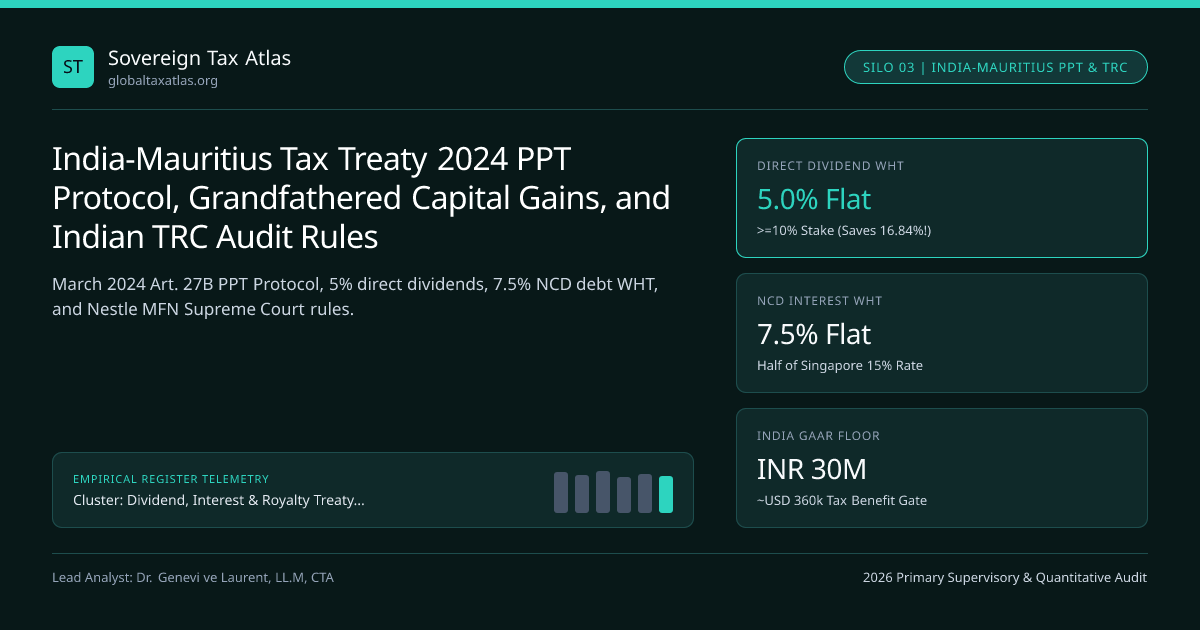
Between 1983 and 2017, more than 30% of all cumulative Foreign Direct Investment (FDI) and Foreign Portfolio Investor (FPI) capital into India routed through Port Louis, Mauritius (Mauritius CBRD / Bank of Mauritius)—powered by Article 13(4)'s historic 0.0% Indian capital gains tax on Indian share exits! Following the 2016 Amendment Protocol (taxing post-April 1, 2017 Indian equity acquisitions while keeping debt, CCPS/CCD derivatives, and 7.5% interest WHT attractive!) and the March 7, 2024 Protocol introducing the BEPS Article 27B Principal Purpose Test (PPT), institutional India funds must pair Treaty PPT/LOB compliance with Section 90(4) TRC governance inside our Double Tax Treaty Withholding, MLI PPT, and US LOB reference across the Dividend, Interest & Royalty Treaty Withholding, PPT & LOB cluster.
Evolution of the India–Mauritius Corridor: 2016 Protocol -> March 2024 PPT Protocol!#
Trace the three structural chapters every India-focused private equity, venture capital, and FPI credit fund must separate cleanly:
- Pre-April 1, 2017 Equity Acquisitions ("Grandfathered Shares" — Art. 13(3A)): Shares in Indian companies acquired prior to April 1, 2017 remained eligible for 0.0% Indian capital gains tax under the 2016 Protocol (subject today to intense Indian Income Tax Department scrutiny over indirect share transfers, bonus/conversion shares, and whether the March 2024 PPT Protocol* applies prospectively vs retroactively—pending formal CBDT notification and bilateral ratification!*).
- Post-April 1, 2017 Equity vs Non-Share Instruments (Why Mauritius & Singapore Still Compete!):
- Direct Sales of Indian Equity Shares: Now fully taxable in India under Article 13(3B) (at 12.5% Indian Long-Term Capital Gains + surcharge/cess post-July 2024 Indian Finance Act!).
- Why Funds STILL Use Mauritius & Singapore Today: (a) Article 13(4) Residual Capital Gains Exemption (0.0%!) STILL protects gains on Non-Share Instruments—such as Non-Convertible Debentures (NCDs), Compulsorily Convertible Debentures (CCDs prior to conversion depending on characterization!), Limited Liability Partnership (LLP) interests, and offshore futures/derivatives! (b) 7.5% Interest Withholding Tax (Article 11) on foreign-currency/INR debt into India (half of Singapore's 15.0% non-bank treaty interest rate!); and (c) 5.0% (>=10% stake) / 15.0% Dividend WHT (vs India's 20.0% + surcharge = ~21.84%–23.92% statutory dividend WHT enacted after India abolished Dividend Distribution Tax in 2020!).
- The March 7, 2024 PPT Protocol (Article 27B): Because Mauritius initially excluded India from its MLI Covered Tax Agreements in 2017, Mauritius and India signed a dedicated bilateral Protocol on March 7, 2024 replacing the treaty preamble ("without creating opportunities for non-taxation or reduced taxation through tax evasion or avoidance including treaty-shopping") and inserting Article 27B (Principal Purpose Test)—while deleting the old EUR/MUR 1.5M Shell/Conduit LOB safe harbor on capital gains!
Landmark Indian Case Law: Azadi Bachao, Blackstone, and Tiger Global (2024–2026)!#
Nothing illustrates the shifting sands of Indian treaty enforcement better than watching Supreme Court and Delhi High Court TRC rulings alongside Indian Domestic GAAR (Income Tax Act Sections 95–102):
- Historically, under the Supreme Court's famous **Union of India v. Azadi Bachao Andolan (2003) and CBDT Circular No. 789 (2000) (reinforced by the Delhi High Court's August 2024 ruling in Tiger Global International III Holdings on grandfathered Flipkart indirect share sales—presently stayed/reviewed before the Supreme Court of India!), a valid Mauritius Revenue Authority (MRA) Tax Residency Certificate (TRC)** carried powerful presumptive weight against revenue fishing expeditions unless the SPV was a total fraud/sham lacking control over funds.
- Today's Post-GAAR & Post-PPT Reality: For all post-2017 investments (where Indian Domestic GAAR overrides treaties under Section 90(2A) whenever tax benefit exceeds INR 3 Crore [~USD 360,000] and an Impermissible Avoidance Arrangement lacks commercial substance!) and once the March 2024 Article 27B PPT Protocol enters into force upon ratification notifications, a paper TRC alone is NEVER enough! Mauritius Global Business Corporations (GBCs) must demonstrate genuine Port Louis board autonomy, qualified Mauritian directors who actually interrogate investment memos, bank signatory control inside Mauritius, and multi-jurisdictional commercial investment purpose!
Quantitative India Private Credit & Dividend Repatriation Comparison#
- [Statutory Non-Treaty WHT = 20.0% * 1.05 Surcharge * 1.04 Health/Ed Cess = 21.84% vs Mauritius >=10% Art. 10(2)(a) Treaty Cap = Flat 5.00% (No Surcharge/Cess on Treaty Cap!)]
- Worked USD 150M India Private Credit & Growth Equity Platform (USD 15.0M Annual NCD Coupon + USD 20.0M Strategic >=10% Dividend):
- 1. Cayman Islands Fund Direct (Zero India Treaty):
- Dividend WHT = 21.84% * 20.0M = USD 4,368,000 | NCD Interest WHT = 20.0%+ statutory (unless Sec. 194LD expired!) + Taxable NCD Gain!
- 2. Singapore VCC / HoldCo (Substantive SG 13U — S[17]):
- Dividend WHT = 10.0% (>=25% stake) or 15.0% (<25%) = USD 2.0M–3.0M | Non-Bank NCD Interest WHT = 15.0% * 15.0M = USD 2,250,000!
- 3. Substantive Mauritius Multi-Asset Credit & Equity Platform (Passing MRA CIGA, GAAR & PPT):
- Dividend WHT (>=10% stake) = Flat 5.00% * 20.0M = USD 1,000,000 (Saves USD 3.368M/yr vs Cayman; saves USD 1.0M–2.0M/yr vs Singapore!)
- NCD Interest WHT (Art. 11) = Flat 7.50% * 15.0M = USD 1,125,000 (Saves USD 1.125M/yr vs Singapore 15%!) + 0.0% Art. 13(4) NCD Exit Gain!
Benchmarking India Inbound Gateways: Mauritius vs Singapore vs IFSC#
India Inbound Gateway Comparison Matrix#
Emerging-market fund counsel and administrators—operating across Mauritius CBRD, Bank of Mauritius, DIFC, and Singapore 13O/13U, alongside cross-border trading firms like Aag Markets and 70Trades—benchmark India gateways across five dimensions:
| Gateway Jurisdiction | Dividend WHT (>=10% / >=25%) | Non-Bank NCD Interest WHT | NCD / LLP Exit CGT (Art. 13.4) | MLI PPT / LOB Status |
|---|---|---|---|---|
| Mauritius (GBC / VCC) | 5.0% (>=10% capital!) | 7.5% (Best treaty rate!) | 0.0% (Subject to GAAR/PPT) | March 2024 Protocol PPT (Pending entry notice) |
| [Singapore (VCC / 13U)](/entries/singapore-iras-certificate-of-residence-board-control-substance) | 10.0% (>=25%) / 15.0% | 15.0% (10% Banks only) | 0.0% (Subject to PPT + SGD 200k LOB) | Live MLI Art. 7 PPT + SGD 200k Expenditure LOB |
| Netherlands (BV) | 5.0% (via MFN debates — check Nestle SC!) | 10.0% | 0% (Narrow shares rule) | Live MLI Art. 7 PPT (Watch Indian SC MFN ruling!) |
| UAE (ADGM / DIFC QIF) | 10.0% | 12.5% (5% Bank) | 0.0% (Non-shares) | Live MLI Art. 7 PPT + UAE TRC (>=183d / substantive) |
| India GIFT City IFSC AIF | Taxed at investor tier (10% IFSC) | Concessional 9% / 0% specific | 0% Specified Securities | Domestic Indian statutory incentive (Zero PPT risk!) |
Frequently asked questions
Did the March 2024 India–Mauritius PPT Protocol retroactively tax pre-2017 grandfathered Indian shares immediately upon signing?
Following market panic in April 2024, India Central Board of Direct Taxes (CBDT) confirmed publicly that the March 7, 2024 Protocol had not yet been ratified and notified into force under Section 90, and any application details would be addressed upon formal entry into force—though ongoing Supreme Court litigation (such as the Tiger Global stay) already scrutinizes abusive indirect transfers aggressively!
What did the Supreme Court of India decide in Nestle SA (2023) regarding Most-Favored-Nation (MFN) dividend rates for Dutch, Swiss, and French parents?
In a blockbuster October 2023 ruling (upheld on review), the Supreme Court of India held that MFN clauses in India treaties with the Netherlands, Switzerland, and France (claiming 5% dividends via later Slovenian/Lithuanian/Colombian OECD memberships) are NOT self-executing and CANNOT be invoked without an explicit Indian Government Section 90 Notification—prompting Switzerland to suspend its unilateral MFN reciprocity with India from Jan 1, 2025!
Why are foreign private credit funds combining Mauritius or Singapore with India onshore GIFT City IFSC?
Category III AIFs established inside Gujarat International Finance Tec-City (GIFT City IFSC) enjoy statutory Indian tax exemptions on offshore/non-equity derivative and bond streams directly inside Indian domestic law—completely eliminating cross-border MLI PPT and Indian GAAR treaty-shopping challenges!
What documents must a Mauritius or Singapore company upload every year before an Indian payer can apply 5% or 7.5% treaty withholding?
Four mandatory compliance items: (1) a current-year Tax Residency Certificate (TRC) from MRA/IRAS; (2) an Indian Permanent Account Number (PAN) + electronic Form 10F filed on the Indian Income Tax e-Filing Portal; (3) a No-Permanent-Establishment declaration; and (4) Beneficial Ownership & PPT/GAAR board substance representations.
Publication record
- Published
- 13 November 2026
- Updated
- 14 November 2026
- Author
- Dr. Geneviève Laurent, LL.M, CTA
- Review
- Review not recorded
- Automated fact check
- Passed in the stored pipeline record
- Source URLs
- 3 recorded
AI assistance recorded: anthropic/claude-opus-4.6. This field does not establish human review or source verification.
Academic & Institutional Attribution
Cite This Research & Embed Live Data Card
Standard academic & institutional research paper citation format.
Dr. Geneviève Laurent, LL.M, CTA. (2026, November 14). India–Mauritius Tax Treaty 2024 PPT Protocol, Grandfathered Capital Gains, and Indian TRC Audit Rules. Sovereign Tax Atlas. https://globaltaxatlas.org/entries/india-mauritius-tax-treaty-mli-ppt-protocol-trc-scrutiny-rulesRegulatory Directory Cross-Reference
Referenced Institutions & Regulatory Registries
Top Regulated Institutions in This Coverage Slice
Referenced Supervisory Authorities
Related Double Tax Treaty Withholding Lob & Institutional Briefings
Explore Double Tax Treaty Withholding Lob Hub (20) →Double Tax Treaty Withholding Lob
Double Tax Treaty Withholding Rates, OECD MLI Principal Purpose Test, and US LOB ReferenceDouble Tax Treaty Withholding Lob
Singapore IRAS Certificate of Residence (COR): Foreign-Owned HoldCo Substance and 90+ APAC TreatiesDouble Tax Treaty Withholding Lob
UK Qualifying Asset Holding Company (QAHC) vs Quoted Eurobond: 0% Outbound Interest WithholdingDouble Tax Treaty Withholding Lob
Cross-Border Securities Lending, Manufactured Dividends, and Post-Cum-Ex Anti-Dividend-Washing RulesDouble Tax Treaty Withholding Lob
OECD Model Article 10 Dividend Withholding: 5% Direct Participation, 365-Day Hold, and 15% PortfolioDouble Tax Treaty Withholding Lob
OECD Model Article 11 Interest Withholding: Bank Carve-Outs, Gross-Ups, and Arm’s-Length CapsDouble Tax Treaty Withholding Lob
OECD Article 12 Royalties vs UN Model Article 12A and 12B: SaaS Cloud, Copyrights, and Technical FeesDouble Tax Treaty Withholding Lob
BEPS MLI Article 7 Principal Purpose Test (PPT): Defending Intermediate Holding Companies in AuditEconomic Substance Cfc Transfer Pricing
BEPS Action 13 Three-Tier Transfer Pricing Documentation: Master File, Local File, and Penalty ProtectionEconomic Substance Cfc Transfer Pricing
Low Value-Adding Intra-Group Services (LVAS): OECD 5% Markup Safe Harbor, US SCM, and Benefit TestsEconomic Substance Cfc Transfer Pricing
OECD Transfer Pricing Chapter IX Business Restructurings: Principal Conversions and IP Exit TaxesCross Border Fund Spv Tax Neutrality
Cayman Exempted Limited Partnership (ELP) Master-Feeder Architecture: Tax Undertakings and CIMA Rules
Sovereign Tax Atlas Data, Benchmarks & Contributor Records
CC BY 4.0 Open Data
Open Institutional Datasets (CSV / JSON) →
Download desk-compiled quantitative series & schemas.
2026 Reference Matrix
2026 Institutional Benchmarks & Thresholds →
Statutory capital, clearing, margin & rate conventions.
Editorial Records
Authors & Review Records →
View named contributors where those records are available.
Complete Index
Master Research & Dossier Archive →
Browse all published briefings by topic pillar & date.